
Health24.com | What is the vertical diet – and is it good for weight loss?

There are two types of people in the world: those who do CrossFit, and those who hear about the commitment, dedication and effort involved with this intense fitness mindset and say, “Yeah… no thanks.”

If you fall into the former camp, then you’ve probably already heard the vertical diet being talked about around your local box. But non-CrossFitters may still be in the dark about this inverted diet trend — whose nutrient profile is often described as an upside-down letter “T” — and wondering if it could help them lose weight.

“The vertical diet was created to help bodybuilders easily put on mass to meet weight-gain goals without digestive issues,” says registered dietician Amy Shapiro, founder of Real Nutrition. “The foods allowed are easy to digest and dense, yet they are clean and minimally processed.”

But before you jump on yet another diet bandwagon with a catchy name, there’s some stuff you should know about it. It’s not for everyone, first of all — and it doesn’t meet all your nutritional goals as is. Here’s the whole scoop.

What exactly is the vertical diet, anyway?

Okay, back to the upside-down “T.” The vertical diet gets its name because it emphasises receiving the majority of your calories from a restricted number of nutrient-dense foods instead of eating more evenly, or horizontally, across several different food groups.

The bottom of the upside-down “T” is your foundation — meant to be filled with small quantities of foods providing necessary micronutrients — while the vertical line represents the bulk of your calories for the day (mainly red meat and white rice, but I’ll get to that later).

READ MORE: What Is Alternate-Day Fasting — And Is It A Safe Weight-Loss Method?

The diet was designed by a bodybuilder, Stan Efferding, and because of its focus on protein and carbs, it’s meant to help people build muscle mass and improve energy, stamina and endurance. According to Efferding, reducing your food intake to a limited number of easily digestible foods allows you to enhance your metabolism and improve your gut health.

Ah. So what can (and can’t) you eat on the vertical diet?

When you’re following the vertical diet, you’re supposed to build a solid foundation of micronutrients by eating things like milk, eggs, fish, vitamin C-rich fruits and some vegetables, like potatoes, spinach and carrots, says Shapiro. These foods are not, however, meant to contribute to your overall calorie intake. Instead, you eat them in small amounts for their vitamins, minerals, and antioxidants.

The bulk of your calories comes from red meat and white rice. Why? Well, red meat is a nutrient-dense protein source that’s rich in iron, zinc and vitamin B12 (more so than other proteins, like chicken). Meanwhile, white rice is easily digestible, so it’s a good carb source for athletes. The vertical diet also encourages you to keep increasing your carb intake, i.e. moving up the vertical line over time.
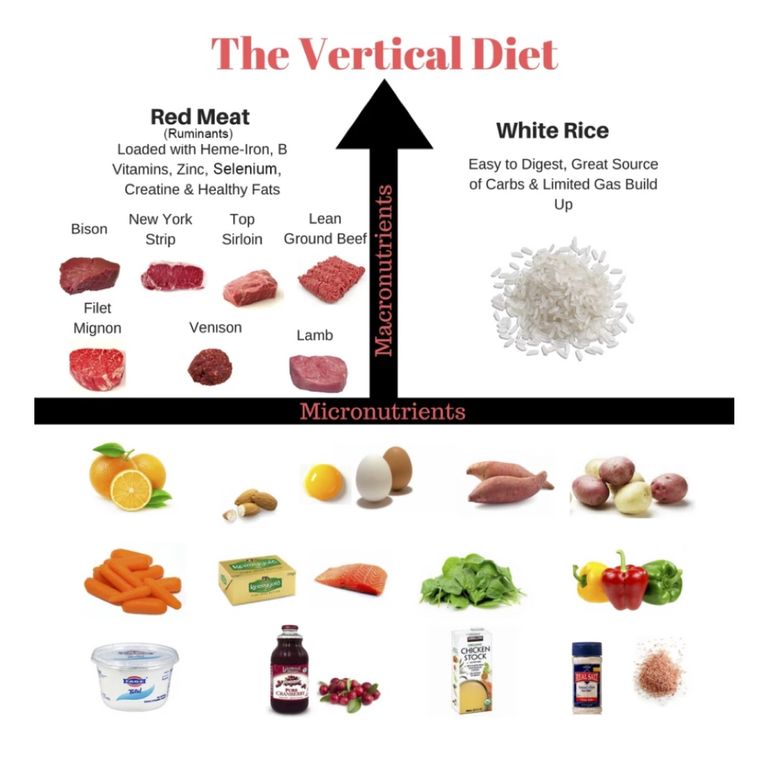
What Is The Vertical Diet—And Is It Good For Weight Loss?

As for what’s off the vertical diet menu: chicken, fish, brown rice, wheat-based and whole-grain foods, beans and legumes, and high-raffinose (a.k.a. gassy) foods, like broccoli and cauliflower. You can’t have added or artificial sugars. There are no onions or garlic allowed, either. Basically, any food that’s not super digestible should be avoided.

Sounds… interesting. So, can the vertical diet help me lose weight?

The only reason people who aren’t extreme athletes or powerlifters might consider doing a diet like this is if it promises weight loss, right? (Otherwise, just… why?)

But here’s the thing: Though the vertical diet could result in weight loss for some (such as those who eat a lot of processed foods or sugars), it’s not really designed for that. Remember, the diet is supposed to help people gain muscle mass, so to lose weight — as in, fat — on the diet, you have to do some strategic tweaking.

READ MORE: Low-Carb Vs. Keto: What’s The Diff And Which Is Better?

“You could lose weight on this diet if you watch portions and eliminate excessive amounts of white rice and simple carbs,” says Shapiro.

Because the programme limits many plant-based foods needed for weight loss, she adds, you would also want to increase the amount of vegetables and reduce the quantity of fatty cuts of meat and cheese you consume. (Hello, keto’s antithesis!)

Got it. Well, are there any other benefits?

Great Q! The vertical diet claims that it will improve your gut health, and that may be true: The diet is based around foods that are mostly low in FODMAPs (a.k.a. fermentable carbs), which can contribute to bloating, gas, diarrhoea and other GI conditions like irritable bowel syndrome (IBS) and Crohn’s disease when eaten in high quantities.

A 2016 review published in Clinical and Experimental Gastroenterology showed that mostly all of the studies done on low FODMAP diets are correlated with improvement of IBS symptoms, with up to 86 percent of patients reporting fewer GI symptoms.

READ MORE: 12 Fasting Tips That’ll Help You Actually Lose Weight (And Not Go Crazy)

So, by sheer virtue of being mostly low in FODMAPs, the vertical diet may ease some of your GI distress. And, certainly, if you’re an athlete looking to put on muscle, the nutrient profile here can help you meet your goals without causing other problems.

“Usually, when you’re trying to put on muscle mass and eating large quantities, you can feel overly full, gassy and bloated,” explains Shapiro. “Vertical-diet foods are streamlined to digest easily and with minimal side effects. But because they are calorically dense, they assist with weight gain” — unless, once again, you customise the plan for your goals.

What about the downsides — are there any?

Though the foods you eat on the vertical diet are relatively clean, whole foods, there’s historically been a lot of concerns about the effects of high red meat consumption on overall health. The American Heart Association warns that eating too much red meat can have negative effects on your cholesterol levels and heart health, but some newer studies — including one done at the Harvard School of Public Health — debate whether red meat is really to blame for heart disease.

READ MORE: 5 Mindful Eating Tips That Will Change Your Relationship With Food

It’s also worth noting that the vertical diet is fairly deficient in fibre, since it emphasises white rice and cuts out whole grains, legumes and some vegetables. Shapiro says that fibre is crucial for maintaining cholesterol levels and heart health (not to mention regular bowel movements). She also notes that the diet is low in probiotics (because it cuts out most fermented foods) and high in animal protein, saturated fat and simple carbs.

So although you’re eating “cleaner,” you’re not necessarily eating more nutritiously — and you could suffer from a lack of fibre and probiotics if you’re not compensating for those losses.

So should I try the vertical diet or not?

Shapiro says if you’re a bodybuilder or extreme athlete looking to put on mass as your number-one goal, the vertical diet can be an effective way to get there. And even if you’re a more moderate gym rat, she says, it can still work for you — but with some important modifications.

“I would recommend including additional sprouted grains, nuts, seeds, vegetables and fruits, and limiting the intake of saturated fat from red meat and full-fat dairy,” Shapiro advises.

Although the diet mostly eliminates added sugars and processed foods (always a good thing), casual dieters just looking to lose weight might struggle to follow the high-protein, high-carb requirements of the vertical diet without accidentally gaining weight. And they might find themselves deficient in many nutrients that contribute to a broader definition of health.

At the end of the day, it’s your call, but only try an eating plan that suits you — not your kinda-obnoxious, CrossFit-obsessed next-door neighbour.

This article was originally published on www.womenshealthsa.co.za

Image credit: iStock

NEXT ON HEALTH24X

Share Button

Coronavirus will be here for some months, says health secretary

The health secretary says global cases of the new virus are “doubling every five days”.

Share Button

Scientists listen to whales, walruses and seals in a changing Arctic seascape

A year-round acoustic study of marine mammals in the northern Bering Sea is providing scientists with a valuable snapshot of an Arctic world already under drastic pressure from climate change, according to WCS (Wildlife Conservation Society), Columbia University, Southall Environmental Associates, and the University of Washington.

Authors of the new study in the journal Marine Mammal Science conducted a 4-year acoustic monitoring project to determine how seasons, sea surface temperature, and sea ice influence the presence, distribution, and movements of five species of endemic Arctic marine mammals. It is the first study to conduct year-round acoustic monitoring for marine mammals off St. Lawrence Island in the Bering Sea.

“The data gathered during the study will serve as an important baseline for future monitoring of the effects of climate change, subsequent sea ice changes, and expected increases in shipping on the distribution of the region’s marine mammals,” said Emily Chou, WCS scientist and lead author of the study.

The scientists conducted the study between 2012 and 2016 with a focus on five species of Arctic marine mammal: bowhead whales (Balaena mysticetus), beluga whales (Delphinapterus leucas), walrus (Odobenus rosmarus), bearded seals (Erignathus barbatus), and ribbon seals (Histriophoca fasciata).

With the support of local indigenous hunters and fishermen, the scientists deployed archival acoustic recorders in three locations in the northern Bering Sea. “Working with local residents to deploy and retrieve equipment was an important part of our effort to keep the work as locally-based as possible,” said co-author Martin Robards.

Two of the recorders (attached to flotation devices and anchored to the seafloor with weights) were deployed off the northern shore of St. Lawrence Island, specifically near the Native villages of Savoonga and Gambell. The third recorder was placed in the Bering Strait, a 36-mile wide gap between the Russian Far East and Alaska that serves as the migratory pathway for thousands of marine mammals moving between the Bering Sea and the Arctic Ocean.

“Acoustic monitoring is the most effective means of determining the seasonal presence of these species in these challenging Arctic areas, given the unpredictable weather conditions and variable daylight and ice conditions,” said Brandon Southall, a co-author on the study. “It can also be used to measure variability in ocean noise from both natural and human sources, such as shipping, and how they may affect the behavior and well-being of marine mammals.”

The recorders logged more than 33,000 individual vocalizations from whales, walruses, and seals over the study period. Overall, the study supported previous scientific and traditional knowledge about the distribution of marine mammals in the northern Bering Sea with a finer-scale resolution than previously available. The data showed consistent seasonal distribution and movement patterns for most species, and analyses showed that time-of-year was the most statistically significant factor in the detection of marine mammal vocalization.

The study findings will help guide future monitoring efforts on the region’s cetacean and pinniped species and will inform conservation management decisions for acoustically sensitive marine mammals in the context of disappearing ice and projected increases in maritime traffic. Specifically, this type of work and continued monitoring at strategic locations in this Arctic area will eventually help identify trends caused by long-term changes in environmental conditions and human-related activities.

“There is no doubt that the Arctic is currently undergoing rapid and significant changes that are alarming,” said Dr. Howard Rosenbaum, Director of WCS’s Ocean Giants Program. “Our work on Arctic marine mammal populations in this region is essential to assess any forthcoming resulting shifts or changes resulting from warming Arctic conditions, and ultimately working partners and authorities to find solution to protect these iconic species and their habitats”

Story Source:

Materials provided by Wildlife Conservation Society. Note: Content may be edited for style and length.

Share Button

‘Parentese’ helps parents, babies make ‘conversation’ and boosts language development

Used in virtually all of the world’s languages, parentese is a speaking style that draws baby’s attention. Parents adopt its simple grammar and words, plus its exaggerated sounds, almost without thinking about it.

But if parents knew the way they speak could help baby learn, would they alter their speech?

A new study from the Institute for Learning & Brain Sciences, or I-LABS, at the University of Washington suggests they would, to baby’s benefit. Researchers examined how parent coaching about the value of parentese affected adults’ use of it with their own infants, and demonstrated that increases in the use of parentese enhanced children’s later language skills.

The study, published online Feb. 3 in the Proceedings of the National Academy of Sciences, finds that parents who participated in individual coaching sessions used parentese more often than control-group parents who were not coached, and that coaching produced more parent-child “conversational turns” and increased the child’s language skills months later.

“We’ve known for some time that the use of parentese is associated with improved language outcomes,” said Patricia Kuhl, I-LABS co-director and professor of speech and hearing sciences at the UW. “But we didn’t know why. We believe parentese makes language learning easier because of its simpler linguistic structure and exaggerated sounds. But this new work suggests a more fundamental reason.

“We now think parentese works because it’s a social hook for the baby brain — its high pitch and slower tempo are socially engaging and invite the baby to respond.”

Parentese is not what is often called “baby talk,” which is generally a mash-up of silly sounds and nonsense words. Instead, it is fully grammatical speech that involves real words, elongated vowels and exaggerated tones of voice. Spoken directly to the child, it sounds happy and engaged, and helps infants tune in socially to their parents and respond, even if only through babbling.

In a 2018 study, I-LABS researchers tracked use of parentese among adults and their 6-month-old infants, and found that babies whose parents participated in parentese coaching sessions babbled more and produced more words by age 14 months than infants whose parents were not directed in the technique.

The new study focuses on the long-term outcomes of parent coaching and how it led to changes in the parents’ language, in parent-child conversation, and eventually, in the child’s speech at 18 months.

“We had no idea that parents would respond so positively to information about how their own speech to the child affects the child’s language development. Parent coaching gave parents a measurement tool, almost like a Fitbit for parentese, and it worked,” said lead author Naja Ferjan Ramírez, a UW assistant professor of linguistics.

To assess child language output, all families in the study were given a lightweight recorder, which the child wore in a specially designed vest during four separate weekends at ages 6, 10, 14 and 18 months. The device recorded both parent and infant speech over the entirety of two consecutive days, so that researchers could measure parents’ use of parentese, parent-child conversational turns, as well as infant language production — either babbling or actual words. Parent coaching sessions occurred at 6, 10 and 14 months.

For the 48 families randomly assigned to receive coaching, the sessions provided guidance and feedback on specific communication strategies, such as using parentese, speaking directly to the child and engaging the child in back-and-forth exchanges known as conversational turns. In reviewing recordings with parents, researchers played back recordings of parents’ language behaviors and measured them against research-based targets for child language development. Parents were encouraged to include language as part of daily routines and were given language-interaction tips in the form of cards with “brain building” tips from Vroom, a program of the Bezos Family Foundation.

All parents in the study already used parentese at the beginning of the project, but their use varied greatly, the researchers said. Those in the coaching group learned more about the cognitive and social benefits of parentese, when and how to use it to promote interaction with their child, and the positive effects that parentese could have on their child’s language development.

The results show that parent coaching resulted in an increased use of parentese and infant vocalizations that continued to grow after the end of the parent coaching sessions. Between 14- and 18-months, coached families showed a drastic jump in conversational turn-taking and child vocalizations. Children of coached parents produced real words — such as “banana” or “milk” — at almost twice the frequency of children whose parents were in the control group. Parent surveys estimated that the children’s 18-month vocabulary averaged around 100 words among children of coached families, compared to 60 words among children in the control group.

“We know that language skills in infancy predict subsequent stages in language development, so enhancements in language behaviors in infancy could therefore have cascading effects on speech development over time,” said Ferjan Ramírez.

Kuhl added, “Language evolved to facilitate the social communication skills that are essential for survival of the species. In this study, we observe firsthand how parents’ language and social engagement can promote baby’s initial responsive coos, which become words, and then sentences — educating infants in the art of human communication.”

The study was funded by the Overdeck Family Foundation and UW I-LABS Ready Mind Project. Sarah Roseberry Lytle, outreach and education director at I-LABS, was a co-author.

Share Button

How ants get angry: Precise ‘lock and key’ process regulates aggression, acceptance

For most social animals, even humans, the ability to distinguish friend versus foe can be a challenge that often can lead to knee-jerk aggression. But when it comes to ants getting aggressive, there’s a more sophisticated method to their madness.

In a new study, published this month in the Journal of Experimental Biology, scientists in the Department of Biological Sciences at Vanderbilt report definitive evidence of a specific mechanism within ants that is responsible for unlocking aggressive behaviors toward other ants. The research — the first to pinpoint this mechanism and its precise role in ant biology — reports a social characteristic which could help account for their evolutionary success.

“Eusocial ants are one of the biggest success stories in evolutionary biology, thanks in no small part to their advanced organizational behaviors and complex social interactions,” said Laurence Zwiebel, senior author of the paper and Cornelius Vanderbilt Chair in Biological Sciences. “For years, researchers have hypothesized that ants have specific chemical markers which play key roles in their interactions. What surprised us is that ants not only have these markers, but require these signals be very precisely decoded by specific receptors to trigger aggression.”

One of the most important aspects of ant identity is the ability to distinguish nestmates from non-nestmates that typically act as bad actors. To do this, they rely on chemical markers made up of specific odorants on their bodies, which Zwiebel refers to as a “coat of many odors,” to emit complex odor blends that act as a sort of personal identifier for other ants.

In this study, the researchers discovered that ants have to smell and correctly decode these specific compounds on intruder ants from other colonies in order to “unlock” their aggressive behavior and defend their nest. This implies that ants default to acceptance and select aggression only if they are specifically triggered.

To study this “lock and key” mechanism, Zwiebel and graduate student Stephen Ferguson, the lead author on the study, gathered Camponotus floridanus ants from nine distinct colonies collected across the Florida Keys.

Before testing, they used a specific chemical agent previously discovered by Zwiebel lab to block or over-excite ant odorant receptors. They set up mini-dueling arenas for two ants (either from the same or different colonies) to interact and, if they decide, fight. During each arena test, they filmed the ants to score the interactions based on their aggressive behaviors — the most common being lunging, biting or dragging.

While ants with normal receptors continued to recognize and fight ants from other colonies, ants with blocked or over-activated receptors displayed dramatically reduced aggressive behavior.

“Accepting friends and rejecting foes is one of the most important decisions an ant worker must make,” said Ferguson. “Our study finds that unless there is a clear and unambiguous threat, ants are more likely to be accepting than they are to be aggressive. This process may have contributed to the evolutionary success of these insects, and there may be important lessons about tempering aggression for other social beings such as humans.”

The research is supported by a grant from the National Institutes of Health and with endowment funding from Vanderbilt University.

Story Source:

Materials provided by Vanderbilt University. Original written by Spencer Turney. Note: Content may be edited for style and length.

Share Button

Health24.com | Experimental HIV vaccine trial stopped after jab found ineffective

South Africa will halt one of the largest and most advanced HIV vaccine trials ever to be undertaken in the country ahead of schedule after the jab was found to be safe but not effective at protecting against HIV infection.

In 2016, South African researchers embarked on the HVTN 702 study – what they thought might just be the best shot at developing a vaccine to protect people from HIV infection. At the centre of the research? The world’s only experimental HIV jab to ever show a modest result – too modest a result, showed the 2009 results of a Thai trial published in the New England Medical Journal, however for the vaccine to make it to market.

But in South Africa, the vaccine had been packed with a new adjuvant which is an ingredient used to stimulate immune system responses. It had a new booster and had been specially formulated for the HIV strains most common to South Africa. 

“The fact remains that the HIV epidemic is still really, in many respects, out of control and South Africa has more infections than essentially any other country,” said Anthony Fauci at the time. Fauci heads the United States government’s National Institutes of Allergy and Infectious Diseases (NIAID), which funded the trial. 

He reasoned: “A safe and effective vaccine could be the final nail in the coffin for HIV.”

Unsuccessful

Late on Monday, researchers announced that almost four years later, they will stop administering the jab to the 5 400 people who enrolled in the trial at 14 sites across South Africa.

The decision comes after a review of data from almost 5 400 participants found the shot had been unsuccessful in preventing new HIV infections.

As part of the trial, HIV-negative people at 14 sites across the country agreed to receive six shots over 18 months – half of whom will get the vaccine while the other 50% receive a placebo as part of a randomised controlled clinical trial. 

This kind of randomisation means that any characteristics such as age or location that could have a bearing on the study’s outcome should be equally present in both groups. Studies designed in this way – also called randomised controlled clinical trials – are better at determining cause and effect than other types of studies and are often called the “gold standard” in research.

But early results in January showed that whether groups of participants got the real shot or the fake, each cluster – or arm – of the study showed roughly the same number of new infections.  

Well-conducted trial

In short, said the NIAID, there was no difference in the risk of contracting HIV between those that got the vaccine and those who didn’t.

“We always hope that efficacy trials will show positive results that lead to new prevention options,” explained Avac executive director Mitchell Warren in a statement. “It is very disappointing that this vaccine candidate does not work, but the trial was well-conducted and got an answer as quickly as possible.”

Scientists will continue to follow up with participants for up to a year, deputy director of the Desmond Tutu HIV Foundation and one of the lead researchers Linda-Gail Bekker told Bhekisisa. She explained that the trial stopped injections at all sites Monday. 

Participants will get letters asking them to urgently come to their nearest research clinic for more information on the results. 

The trial is just one of three different HIV vaccine studies ongoing in South Africa – each taking a slightly different approach at trying to ward off new infections. Tuesday’s announcement about HVTN 702 study does not affect the other two trials.

Valuable contribution

Glenda Gray is the president of South Africa’s Medical Research Council and one of the trial’s lead researchers. In a statement, she said that regardless of the results, the trial – and the people involved – had still made a valuable contribution to science.  

“The people of South Africa have made history by answering an important scientific question,” said Glenda Gray. “We will continue to explore promising avenues for preventing HIV with other vaccines and tools, both in South Africa and the world.”

Vaccine activist organisation, the Vaccine Advocacy Resource Group (Varg) called the news disheartening but it too believed that the trial had provided valuable data to the “ever-increasing pool of knowledge along the road to find a vaccine for HIV.” 

In a statement, Varg said the trial was a reminder of the need “to push for meaningful, and honest engagement and transparency, which is critically lacking in far too many trials.” 

“We centre, we salute and we honour the 5 400 mostly black South Africans who made this trial possible.”

This story was produced by the Bhekisisa Centre for Health Journalism, http://bhekisisa.org. Subscribe to the newsletter http://bit.ly/BhekisisaSubscribe. 

Image credit: iStock

Share Button

Health24.com | WATCH: Beauty sleep is real

Sleep disorders expert

Dr Alison Bentley is a general practitioner who has consulted in sleep medicine and sleep disorders, in both adults and children of all ages, for almost 30 years. She also researches and publishes on a number of sleep-related topics both in formal research journals and lay publications including as editor of Sleep Matters, an educational newsletter on sleep disorders for doctors.

Share Button

Health24.com | What’s the difference between keto and Atkins – and which one is better?

Although eliminating bread is the hardest goodbye of all, low-carb diets have been the rage for quite some time now. There are a few different plans you can follow. Keto is a major one that’s yielding quick, drastic weight-loss results for tons of people, and Paleo is another trendy plan. And then there are the tried-and-true low-carb classics, like the Atkins diet (this might be the first time you’ve heard that one in a while).

Both keto and Atkins are actually pretty similar when it comes to the amount of macronutrients (fat, carbs, protein) you should be consuming day to day, but what are the actual differences between the two — and which would be a better fit, nutritionally?

Of course you could just make your choice based on how much pasta you’re able to eat, but nutrition experts do believe that one is a little bit better than the other for a few reasons. Two dietitians — Natalie Rizzo and Susan Piergeorge — give the lowdown on these high-fat, high-protein, low-carb eating styles. Their verdict, ahead.

The keto diet

“The ketogenic diet is a high-fat, low-protein and low-carbohydrate diet that was originally developed to treat epilepsy,” explains Piergeorge. That’s right, historically, it wasn’t prescribed for extreme weight loss but to reduce blood sugar — you can hardly have any sugar on the diet — which during the 1920s was thought to lower the risk of seizures. Now, the diet is a huge trend for weight loss as well as treating type 2 diabetes, Piergeorge adds.

Here’s the basic formula: Fat accounts for 70 to 95 percent of the keto diet, while protein makes up 5 to 20 percent, and carbohydrates just 5 to 10 percent of what you’re eating. It tends to bring on dramatic weight loss because you’re consuming less than 50 grams of carbs a day on keto, ideally.

At this ratio, the body starts to burn fat. “Once the body’s glucose stores become depleted, ketone bodies are produced (these are products of fatty acid oxidation in the liver) and provide an alternate source of energy,” Piergeorge explains. Basically, fat, instead of sugar from carbs, becomes your body’s main energy source — and when you’re burning fat, you lose weight.

READ MORE: Low-Carb Vs. Keto: What’s The Diff And Which Is Better?

What you can and can’t eat on the keto diet

Once you read this, you may be tempted to devour an entire charcuterie platter. But the focus really is on healthy fats and lean meats, and supplementing those with fruits and vegetables in moderate amounts, since those are technically considered carbs.

Keto-friendly foods:

  • Eggs
  • Seafood
  • Lean meats
  • Healthy fats (including nuts, olive oil, and avocado)
  • Green, leafy veggies
  • Lower sugar, high-antioxidant fruits (like dark berries or pumpkin)

Foods to avoid on keto:

  • Bread
  • Pasta
  • Potatoes
  • Starchy veggies
  • Sugar and other processed foods

Keto pros and cons

There are some potential health benefits you could experience by going keto. At the same time, the diet can have side effects, as explained below.

Health benefits of keto:

  1. You may experience weight loss after starting keto.
  2. It may also lower your blood sugar in the interim.
  3. You’re consuming good fats, which are high in omega-3s (which have proven to be beneficial to heart health, skin and brain health).

Cons of keto:

  1. Carbs, which are also found in foods like fruits and veggies, and whole grains, are what fuel you when you work out, for the most part. Because of that, you may experience sluggishness and less motivation to exercise.
  2. The keto lifestyle may not be sustainable; it’s difficult to stick with this diet because it’s restrictive.
  3. Because you’re consuming less fruits and veggies and whole grains, you may have less fibre in your diet, which can cause constipation.
  4. At the beginning of switching to keto, you may not feel like yourself. The “keto flu” is common when your body is going into ketosis, and symptoms include headaches, nausea and fatigue.
  5. You may be deficient in certain nutrients, like B vitamins, calcium, iron, magnesium and zinc, because you’re eliminating macros and some fruits and veggies, as well as whole grains.

Who keto might be right for

Well, if you’re trying to lose weight and have tried many other avenues to do so, eating keto may be effective. If you’re diabetic or pre-diabetic, it may also help lower your blood sugar since you’re cutting out all that sugar.

And, Rizzo adds, it could be a fit for some athletes, too. “Certain elements of the keto diet, like the emphasis on healthy fats and protein, is a good recommendation for active individuals who put a lot of wear and tear on their muscles and need more calories,” Rizzo says. You have to make sure the fats you choose are healthy, omega-3-rich fats instead of saturated fats, and that you’re choosing lean sources of protein.

Remember that before making a major lifestyle change, though, it’s best to check it out with your medical professional first. You don’t want to end up feeling worse after making this dietary switch instead of better.

READ MORE: Do You Really Need To Give Up Carbs To Lose Weight?

The Atkins diet

Though the Atkins diet basically peaked in the late ‘90s (didn’t we all?), it was actually developed much earlier by Robert C. Atkins, a doctor who published his first book, Dr. Atkins’ Diet Revolution, in 1972, and then his most popular bestseller, Dr. Atkins’ New Diet Revolution, in 1995. Dr. Atkins intended on it being a way to cut carbs, of course, and reduce high blood pressure.

Basically, with Atkins, you generally have two paths you can choose from: Atkins 20 and Atkins 40, based on the grams of carbs you should be eating per day. It’s also low in carbs, higher in fat and higher in protein, which ideally should prompt the body to burn fat.

If you’re trying to shave off more than 20 kilograms, you’d eat about 60 to 70 percent fat, 20 to 30 percent protein, and 5 to 10 percent carbs on Atkins 20 (you’re allowed 20 grams of carbs a day), Rizzo explains.

If you would like to lose less than 20 kilograms, go with Atkins 40. It consists of 55 to 65 percent fat, 20 to 30 percent protein, and 10 to 15 percent carbs. You’re allowed 40 grams of carbs per day, which is a bit easier when you’re tallying up macros. There’s also Atkins 100, which is a slightly simpler plan that allows for 100 grams of carbs per day.

What you can and can’t eat on the Atkins diet

Like keto, Atkins focuses on lean protein, as well as healthy fats. “Depending on the plan individuals follow, the plan emphasizes consuming protein at least three times per day in 120 to 170-gram portions including meat, seafood, poultry and eggs,” Piergeorge explains. “Fats are encouraged, you want at least 3 tablespoons per day in the form of butter, mayonnaise, or olive or other vegetable oils,” she adds.

Atkins-friendly foods:

  • Lean meats
  • Eggs
  • Seafood
  • Nuts
  • Cheese (no more than 85-115g per day)
  • Non-starchy veggies
  • Unsweetened beverages

Foods to avoid or limit on the Atkins diet:

  • Fruits (but you can re-introduce them after a while)
  • Whole grains
  • Legumes
  • Eliminate processed foods, sugar and refined grains like bread and pasta
  • Starchy veggies

Health benefits and side effects of the Atkins diet

Just like keto, there are potential health benefits of the Atkins diet, as well as side effect you should be aware of before you try it.

Health benefits of Atkins:

  1. You may lose weight while following a low-carb diet and eating more protein and fat.
  2. It may help lower your blood sugar as well.
  3. You have some flexibility with the amount of carbs you can consume — you’ll be able to eat fruits, veggies and whole grains, in moderation, so your fibre intake might be higher than it would be with keto.

Cons of Atkins:

  1. It may help you lose weight and lower your blood sugar in the beginning, but might not be sustainable in the long run.
  2. You still may have nutritional deficiencies, like you might with keto, in the form of fibre, B vitamins, antioxidants and even calcium, if you’re not eating much dairy on the diet.
  3. If you’re following along with Atkins strictly and buying their products (protein bars, breads, etc.), it can get expensive.
  4. It’s easy to eat tons of saturated fat when you’re allowed a higher fat diet, which is the opposite of what’s healthy in terms of fat intake.

Who Atkins might be right for

Like keto, it may help an individual drop some serious kilos if it’s done the right way. And it can help lower your blood sugar if you have type 2 diabetes or are pre-diabetic.

Also, counting macros can be a good way to really boost awareness of what you’re putting in your body, especially if you are an athlete and want to make sure you’re fuelling properly for training. But, Piergeorge argues, a highly restrictive diet doesn’t work for everyone, and you should consult a doctor or nutritionist before beginning this strict regimen.

READ MORE: 12 Fasting Tips That’ll Help You Actually Lose Weight (And Not Go Crazy)

Recap: the biggest similarities and differences between keto and Atkins

Keto and Atkins may seem like the same thing when it comes to eating more fat and protein and less carbs and sugar, but there are some nuances you should keep in mind.

Keto and Atkins similarities:

  1. The macro ranges you’ll be including in your diet are pretty similar, between fat, protein and carbs.
  2. The allowed foods on keto and Atkins are similar: lean meats, seafood, some dairy products and some green, leafy vegetables.
  3. Both keto and Atkins cut back majorly on carbs, sugar and processed food in order to send your body into a state of ketosis.
  4. They both encourage fat loss and can potentially lower blood sugar.

Keto and Atkins differences:

  1. Keto allows on average 70 to 90 percent fat, 5 to 20 percent protein and 5 to 10 percent carbohydrates, while Atkins allows for 55 to 75 percent fat, 20 to 30 percent protein, and 5 to 15 percent carbohydrates. Close, but not identical macros.
  2. Atkins allows for more carbs than keto. (Keto tends to eliminate all but 5 percent of carbs and doesn’t allow you to eat much fruit at all.)
  3. Keto is higher in fats, while Atkins emphasises proteins as a major macro to focus on.
  4. Atkins has different levels based on how many carbs you’re looking to consume per day, while with keto, you have to go all in.

Is keto or Atkins better overall? The verdict…

Both keto and Atkins are highly restrictive diets, the experts point out, so it may be difficult to sustain these major lifestyle changes and cut out carbs for a long period of time.

Keto becomes tricky because it can be an unhealthy diet if you don’t do it correctly, and consume too many unhealthy fats (we’re talking cured meats instead of avocado). “I wouldn’t necessarily recommend the keto diet because it has such a high percentage of fat and a low percentage of carbs. It’s unsustainable in the long run, and there is too much of a tendency to eat a lot more saturated fat than you need,” Rizzo says.

If she had to choose between these two highly restrictive eating regimens, she’d choose Atkins because it allows for more carbs (in the form of fruits, veggies and whole grains) and ultimately more leeway in your eating and more balance in your diet.

Atkins also gives you more wiggle room because you can choose the 20, 40 or 100 option for allotment of grams of carbs per day. That way, you can introduce a little more pasta into the mix if that’s how you want to roll.

But it’s ultimately your decision — you’ll be making the dietary changes so they have to fit with your lifestyle and make you feel happy and healthy. Changing your diet (and especially eliminating the majority of carbs from your diet) is not easy, and may take some trial and error, so it’s important to thoroughly research all of your options.

This article was originally published on www.womenshealthsa.co.za

Image credit: iStock

NEXT ON HEALTH24X

Share Button

HIV vaccine hopes dashed by trial results

Experts share “deep disappointment” an experimental jab does not offer protection against HIV.

Share Button

Coronavirus: Could it become pandemic?

How likely is coronavirus to go global and become the next pandemic?

Share Button