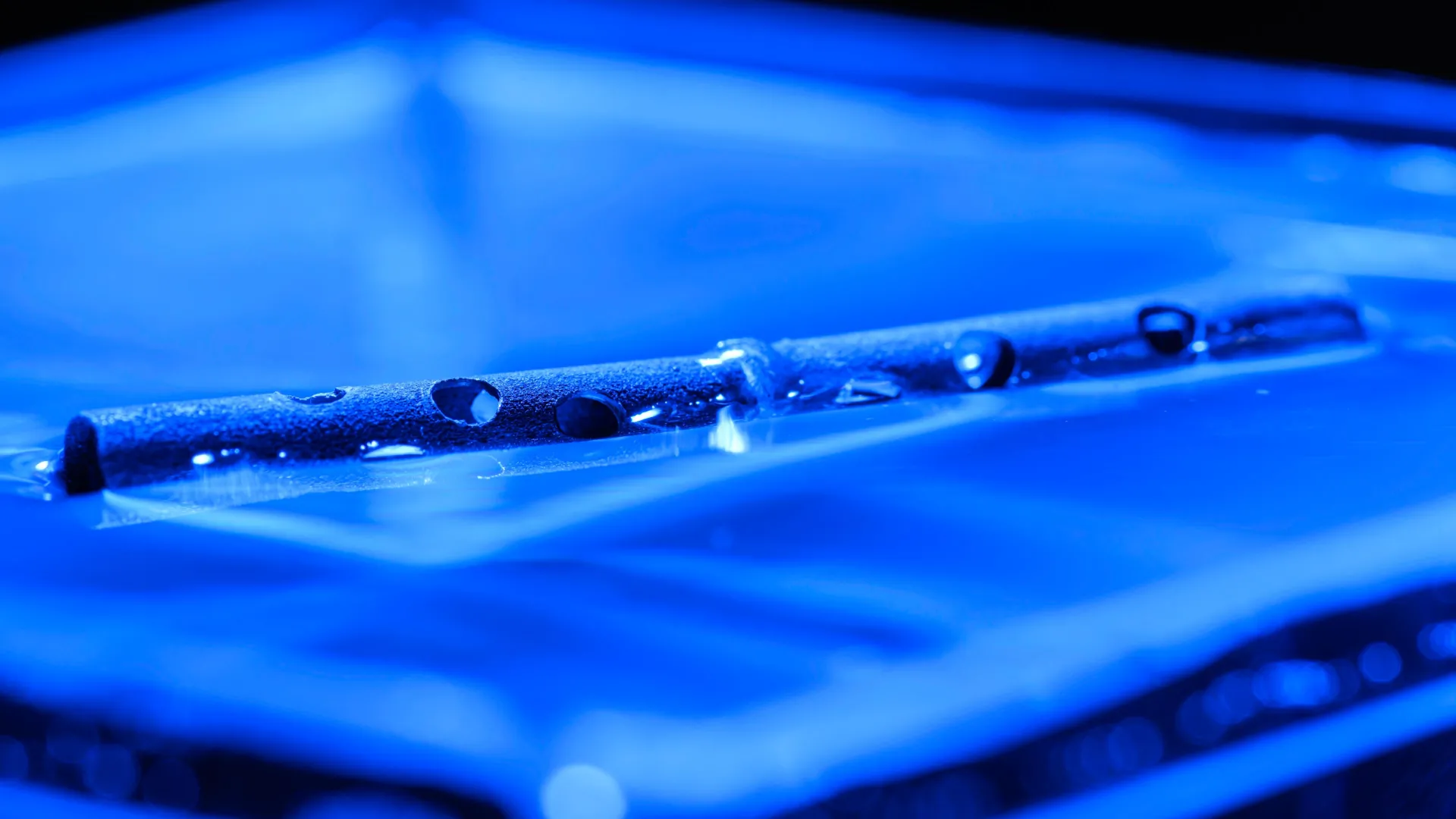
A breakthrough that could make ships nearly unsinkable

More than 100 years after the sinking of the Titanic, the idea of ships that cannot sink continues to motivate engineers. Researchers at the University of Rochester’s Institute of Optics have now taken a significant step toward that long-standing goal. They have developed a technique that makes ordinary metal tubes unsinkable — meaning the tubes stay afloat regardless of how long they remain underwater or how much damage they sustain.

The work was led by Chunlei Guo, a professor of optics and physics and a senior scientist at URochester’s Laboratory for Laser Energetics. Guo and his colleagues detailed the new method in a study published in Advanced Functional Materials. Their approach focuses on modifying the inside surface of aluminum tubes by etching it to create microscopic and nanoscale pits. This textured surface becomes superhydrophobic, allowing it to strongly repel water and remain dry.

How Trapped Air Prevents Sinking

When a treated tube is placed in water, its water-repelling interior captures a stable pocket of air inside. This trapped air keeps water from filling the tube, which prevents it from becoming heavy and sinking. The process resembles natural strategies seen in diving bell spiders, which carry air bubbles underwater, and in fire ants, which form floating rafts using their water-resistant bodies.

“Importantly, we added a divider to the middle of the tube so that even if you push it vertically into the water, the bubble of air remains trapped inside and the tube retains its floating ability,” says Guo.

Improved Stability in Rough Conditions

Guo’s research group first demonstrated superhydrophobic floating devices in 2019. That earlier design relied on two water-repelling disks sealed together to create buoyancy. While effective, the disks could lose their ability to float when tilted at extreme angles. The newer tube-based design simplifies the structure and offers much greater stability, especially in turbulent environments similar to ocean conditions.

“We tested them in some really rough environments for weeks at a time and found no degradation to their buoyancy,” says Guo. “You can poke big holes in them, and we showed that even if you severely damage the tubes with as many holes as you can punch, they still float.”

From Floating Rafts to Renewable Energy

The researchers showed that multiple tubes can be connected to form rafts, which could serve as the foundation for ships, buoys, or floating platforms. In laboratory tests, the team experimented with tubes of different lengths, reaching nearly half a meter. Guo says the design can be scaled up to sizes large enough to support heavy loads.

Beyond transportation and infrastructure, the team also demonstrated that rafts made from superhydrophobic tubes could capture energy from moving water. This capability suggests a potential role for the technology in generating electricity from waves, adding a renewable energy application to its list of possibilities.

This project was supported by the National Science Foundation, the Bill and Melinda Gates Foundation, and URochester’s Goergen Institute for Data Science and Artificial Intelligence.


Share Button

‘I get nightmares of him’: Former patient of surgeon who harmed nearly 100 children tells BBC

12-year-old Vivaan Sharma was one of 94 patients harmed by surgeon Yaser Jabbar

Share Button

Trust’s maternity care ‘exemplary’, say inspectors

Maternity services at Lancaster Royal Infirmary are rated “good”, but improvements must be made in A&E.

Share Button

Could weight-loss jabs be behind rising gallbladder removals?

Last year, there was a 15% annual increase in the operations and surgeons want more research.

Share Button

‘Damning’ evidence of political pressure to open scandal-hit hospital – Sarwar

The Scottish Labour leader says documents prove ministers pushed for the country’s largest hospital to open early.

Share Button

Weight loss jab users warned over rare but serious pancreas issue

Symptoms to look out for include severe pain in the stomach and back which does not go away.

Share Button

A simple blood test could spot Parkinson’s years before symptoms

Researchers led by a team at Chalmers University of Technology in Sweden have identified biological markers that appear in the earliest stages of Parkinson’s disease, before major damage occurs in the brain. These early changes leave detectable traces in the blood, but only for a short time. The findings highlight a critical opportunity to both diagnose the disease earlier and explore treatments while the brain is still largely intact. The researchers believe blood tests based on this work could begin to be tested in healthcare settings within five years.

Parkinson’s disease affects more than 10 million people worldwide and is considered an endemic condition. As populations continue to age, that number is expected to more than double by 2050. Despite its growing impact, there is currently no cure and no widely used screening method that can detect the disease early, before it causes significant and often irreversible brain damage.

New Study Points Toward Earlier Diagnosis

The findings were published in the journal npj Parkinson’s Disease by a research team from Chalmers University of Technology and Oslo University Hospital in Norway. The study describes major progress toward identifying Parkinson’s during its earliest phase, well before classic movement-related symptoms appear.

“By the time the motor symptoms of Parkinson’s disease appear, 50 — 80 per cent of the relevant brain cells are often already damaged or gone. The study is an important step towards facilitating early identification of the disease and counteracting its progression before it has gone this far,” says Danish Anwer, a doctoral student at the Department of Life Sciences at Chalmers and the study’s first author.

A Long and Overlooked Early Phase

Parkinson’s disease develops slowly. In many patients, the early phase can last up to 20 years before noticeable motor symptoms fully emerge. During this time, changes are already occurring inside cells.

The researchers focused on two biological processes believed to play a role at this early stage. One is DNA damage repair, the system cells use to detect and fix genetic damage. The other is the cellular stress response, a protective reaction that helps cells survive by shifting energy away from routine tasks and toward repair and defense.

Machine Learning Reveals a Unique Pattern

Using machine learning and other advanced analytical methods, the team identified a distinct pattern of gene activity related to DNA repair and stress response. This pattern appeared only in people in the early phase of Parkinson’s disease. It was not seen in healthy individuals or in patients who had already developed motor symptoms.

“This means that we have found an important window of opportunity in which the disease can be detected before motor symptoms caused by nerve damage in the brain appear. The fact that these patterns only show at an early stage and are no longer activated when the disease has progressed further also makes it interesting to focus on the mechanisms to find future treatments,” says Annikka Polster, Assistant Professor at the Department of Life Sciences at Chalmers, who led the study.

Why Blood-Based Testing Matters

Scientists around the world have been searching for reliable early indicators of Parkinson’s disease, including markers found through brain imaging and spinal fluid analysis. However, none of these approaches has yet led to a validated screening test suitable for widespread use before symptoms begin.

“In our study, we highlighted biomarkers that likely reflect some of the early biology of the disease and showed they can be measured in blood. This paves the way for broad screening tests via blood samples: a cost-effective, easily accessible method,” says Polster.

Blood Tests Could Reach Healthcare Within Years

The next phase of the research will focus on understanding exactly how these early biological mechanisms work and on developing tools that make them easier to detect.

The researchers estimate that within five years, blood tests designed to identify Parkinson’s disease at an early stage could begin to be tested in healthcare systems. Over the longer term, the findings may also support the development of treatments aimed at slowing or preventing the disease.

“If we can study the mechanisms as they happen, it could provide important keys to understanding how they can be stopped and which drugs might be effective. This may involve new drugs, but also drug repurposing, where we can use drugs developed for diseases other than Parkinson’s because the same gene activities or mechanisms are active,” says Polster.

More About the Scientific Article

The study Longitudinal assessment of DNA repair signature trajectory in prodromal versus established Parkinson’s disease has been published in npj Parkinson’s Disease. The authors are Danish Anwer, Nicola Pietro Montaldo, Elva Maria Novoa-del-Toro, Diana Domanska, Hilde Loge Nilsen and Annikka Polster. The researchers work at Chalmers University of Technology, Sweden, and Oslo University Hospital, Norway.

The research has been funded by Chalmers Health Engineering Area of Advance, Sweden, the Michael J Fox Foundation, the Research Council of Norway, NAISS (National Academic Infrastructure for Supercomputing in Sweden) and the Swedish Research Council.

More About Parkinson’s Disease

Parkinson’s disease is a neurological disorder that interferes with the brain’s ability to control movement. It progresses slowly and most often begins after the age of 55 — 60. Parkinson’s is the second most common neurodegenerative disease worldwide, after Alzheimer’s disease. More than 10 million people have been diagnosed globally, and that number is projected to more than double by 2050.

Sources: The Swedish Parkinson’s Association, The BMJ, global projection study, 2024

Parkinson’s Disease Symptoms and Progression

Early symptoms

  • REM sleep behavior disorder: The person acts out dreams during REM sleep, often with movements or sounds.
  • Reduced sense of smell
  • Constipation
  • Depression
  • Anxiety

Motor symptoms later in the disease

  • Slow movements
  • Rigidity and instability
  • Tremors
  • Involuntary muscle contractions
Share Button

Ancient oceans stayed oxygen rich despite extreme warming

  • The Arabian Sea contained more oxygen about 16 million years ago than it does today, even though Earth’s climate was warmer at the time.
  • Powerful monsoons, shifting ocean currents, and connections between seas strongly influence oxygen levels, showing that ocean health depends on more than temperature alone.
  • Over very long timescales, oxygen levels in the oceans could increase again, although what that would mean for marine life remains uncertain.

Ancient Oceans May Hold Clues to Future Oxygen Recovery

A new study suggests that parts of the world’s oxygen depleted oceans could regain higher oxygen levels in the centuries ahead, even as global temperatures continue to rise.

Scientists from the University of Southampton (UK) and Rutgers University (USA) analyzed fossilized plankton preserved in sediments from the Arabian Sea. Their results show that during a period of intense global warming about 16 million years ago, ocean oxygen levels in this region were actually higher than they are today. Severe oxygen depletion did not emerge until roughly four million years later, after the climate began to cool.

Why the Arabian Sea Behaved Differently

The researchers also found that the Arabian Sea, located off India’s west coast, followed a different path than a comparable low oxygen region in the Pacific Ocean. This contrast points to the importance of regional influences, including strong monsoon winds, ocean circulation patterns, and water exchange from nearby seas. These local factors appear to have slowed the loss of oxygen in the Arabian Sea.

The findings were published in the Nature journal Communications Earth & Environment.

Oxygen Loss Is Already Underway Today

“Oxygen dissolved in our oceans is essential for sustaining marine life, promoting greater biodiversity and stronger ecosystems. However, over the past 50 years, two percent of oxygen in the seas worldwide has been lost each decade as global temperatures rise,” explains co-lead author, Dr. Alexandra Auderset of the University of Southampton and formerly of Max Planck Institute of Chemistry, Mainz.

She adds: “The Miocene Climatic Optimum (MCO), a period approximately 17 to 14 million years ago, had similar temperatures and atmospheric conditions to those we predict will occur after 2100. We have taken a snapshot of sea oxygenation during the MCO to help understand how things might develop a-hundred years or more from now.”

Fossil Plankton Reveal Long Term Oxygen History

To reconstruct ancient ocean conditions, the team studied microscopic fossilized plankton known as foraminifera (forams). These fossils were collected from sediment cores provided by the Ocean Drilling Program (ODP). Chemical signals preserved in the shells of these organisms allow scientists to estimate oxygen levels in seawater across millions of years.

The analysis showed that an Oxygen Minimum Zone (OMZ) was present in the Arabian Sea from the early Miocene, about 19 million years ago, until roughly 12 million years ago. During this time, oxygen concentrations stayed below around 100 micromol per kilogram of water.

Delayed Onset of Severe Oxygen Depletion

Despite these low oxygen levels, conditions were not extreme enough to trigger the release of nitrogen from seawater into the atmosphere, a process that occurs in the Arabian Sea today. That shift did not happen until after 12 million years ago, indicating that the most severe oxygen loss was delayed.

“Today parts of the Arabian sea are ‘suboxic’, supporting only limited marine life due to minimal oxygenation. This same region during the MCO, under similar climatic conditions, was hypoxic — so comparatively moderate oxygen content, supporting a wider range of organisms,” says Dr. Auderset.

Regional Ocean Forces Shape Oxygen Outcomes

Co-lead-author, Dr. Anya Hess of George Mason University, and formerly of Rutgers University and Woods Hole Oceanographic Institution, adds: “The MCO is the closest comparison we have to climate warming beyond 2100 under a high-emissions scenario. One of our previous studies shows the eastern tropical Pacific was actually well oxygenated during this period, in contrast to the deoxygenation trend we see today.

“The Arabian Sea was also better oxygenated during the MCO, but not as much as the Pacific, with moderate oxygenation and an eventual decline that lagged behind the Pacific by about 2 million years.”

Why Future Ocean Predictions Are So Complex

Dr. Auderset concludes: “Our results suggest that ocean oxygen loss, already underway today, is strongly shaped by local oceanography. Global models that focus solely on climate warming, risk not capturing the regional factors that may either amplify or counteract those more general trends.

“Our research shows ocean response to climate warming is complex, and this means that we will need to be ready to adapt to changing ocean conditions.”

Share Button

Scientists found a way to cool quantum computers using noise

Quantum computers only work when they are kept extremely cold. The problem is that today’s cooling systems also create noise, which can interfere with the fragile quantum information they are supposed to protect. Researchers at Chalmers University of Technology in Sweden have now introduced a new type of minimal quantum “refrigerator” that turns this challenge into an advantage. Instead of fighting noise, the device partially relies on it to operate. The result is highly precise control over heat and energy flow, which could help make large scale quantum technology possible.

Quantum technology is widely expected to reshape major areas of society. Potential applications include drug discovery, artificial intelligence, logistics optimization, and secure communications. Despite this promise, serious technical barriers still stand in the way of real world use. One of the most difficult challenges is maintaining and controlling the delicate quantum states that make these systems work.

Why Quantum Computers Must Be Near Absolute Zero

Quantum computers built with superconducting circuits must be cooled to temperatures very close to absolute zero (around — 273 °C). At these temperatures, materials become superconducting, allowing electrons to move without resistance. Only under these extreme conditions can stable quantum states form inside qubits, the basic units of quantum information.

These quantum states are extremely sensitive. Small changes in temperature, electromagnetic interference, or background noise can quickly erase stored information. This sensitivity makes quantum systems difficult to operate and even harder to expand.

As researchers attempt to scale up quantum computers to solve practical problems, heat and noise become harder to control. Larger and more complex systems create more opportunities for unwanted energy to spread and disrupt fragile quantum states.

“Many quantum devices are ultimately limited by how energy is transported and dissipated. Understanding these pathways and being able to measure them allows us to design quantum devices in which heat flows are predictable, controllable and even useful,” says Simon Sundelin, doctoral student of quantum technology at Chalmers University of Technology and the study’s lead author.

Using Noise as a Cooling Tool

In a study published in Nature Communications, the Chalmers team describes a fundamentally different kind of quantum refrigerator. Instead of trying to eliminate noise, the system uses it as the driving force behind cooling.

“Physicists have long speculated about a phenomenon called Brownian refrigeration; the idea that random thermal fluctuations could be harnessed to produce a cooling effect. Our work represents the closest realisation of this concept to date,” says Simone Gasparinetti, associate professor at Chalmers and senior author of the study.

At the core of the refrigerator is a superconducting artificial molecule created in Chalmers’ nanofabrication laboratory. It behaves much like a natural molecule, but instead of atoms, it is built from tiny superconducting electrical circuits.

The artificial molecule is connected to multiple microwave channels. By adding carefully controlled microwave noise in the form of random signal fluctuations within a narrow frequency range, the researchers can guide how heat and energy move through the system with remarkable precision.

“The two microwave channels serve as hot and cold reservoirs, but the key point is that they are only effectively connected when we inject controlled noise through a third port. This injected noise enables and drives heat transport between the reservoirs via the artificial molecule. We were able to measure extremely small heat currents, down to powers in the order of attowatts, or 10-18 watt. If such a small heat flow were used to warm a drop of water, it would take the age of the universe to see its temperature rise one degree Celsius,” explains Sundelin.

New Paths Toward Scalable Quantum Technology

By carefully adjusting reservoir temperatures and tracking minuscule heat flows, the quantum refrigerator can operate in multiple ways. Depending on conditions, it can function as a refrigerator, act as a heat engine, or amplify thermal transport.

This level of control is especially important in larger quantum systems, where heat is produced locally during qubit operation and measurement. Managing that heat directly inside quantum circuits could improve stability and performance in ways conventional cooling systems cannot.

“We see this as an important step towards controlling heat directly inside quantum circuits, at a scale that conventional cooling systems can’t reach. Being able to remove or redirect heat at this tiny scale opens the door to more reliable and robust quantum technologies,” says Aamir Ali, a researcher in quantum technology at Chalmers and co-author of the study.

More Information

The study Quantum refrigeration powered by noise in a superconducting circuit was published in the scientific journal Nature Communications. The authors are Simon Sundelin, Mohammed Ali Aamir, Vyom Manish Kulkarni, Claudia Castillo-Moreno, and Simone Gasparinetti from the Department of Microtechnology and Nanoscience at Chalmers University of Technology.

The quantum refrigerator was fabricated at the Nanofabrication Laboratory, Myfab, at Chalmers University of Technology.

Funding for the research was provided by the Swedish Research Council, the Knut and Alice Wallenberg Foundation through the Wallenberg Centre for Quantum Technology (WACQT), the European Research Council, and the European Union.

Share Button

Hampstead ponds trans access challenge dismissed

The current policy is that trans men and trans women are entitled to use the pond of their choice.

Share Button