
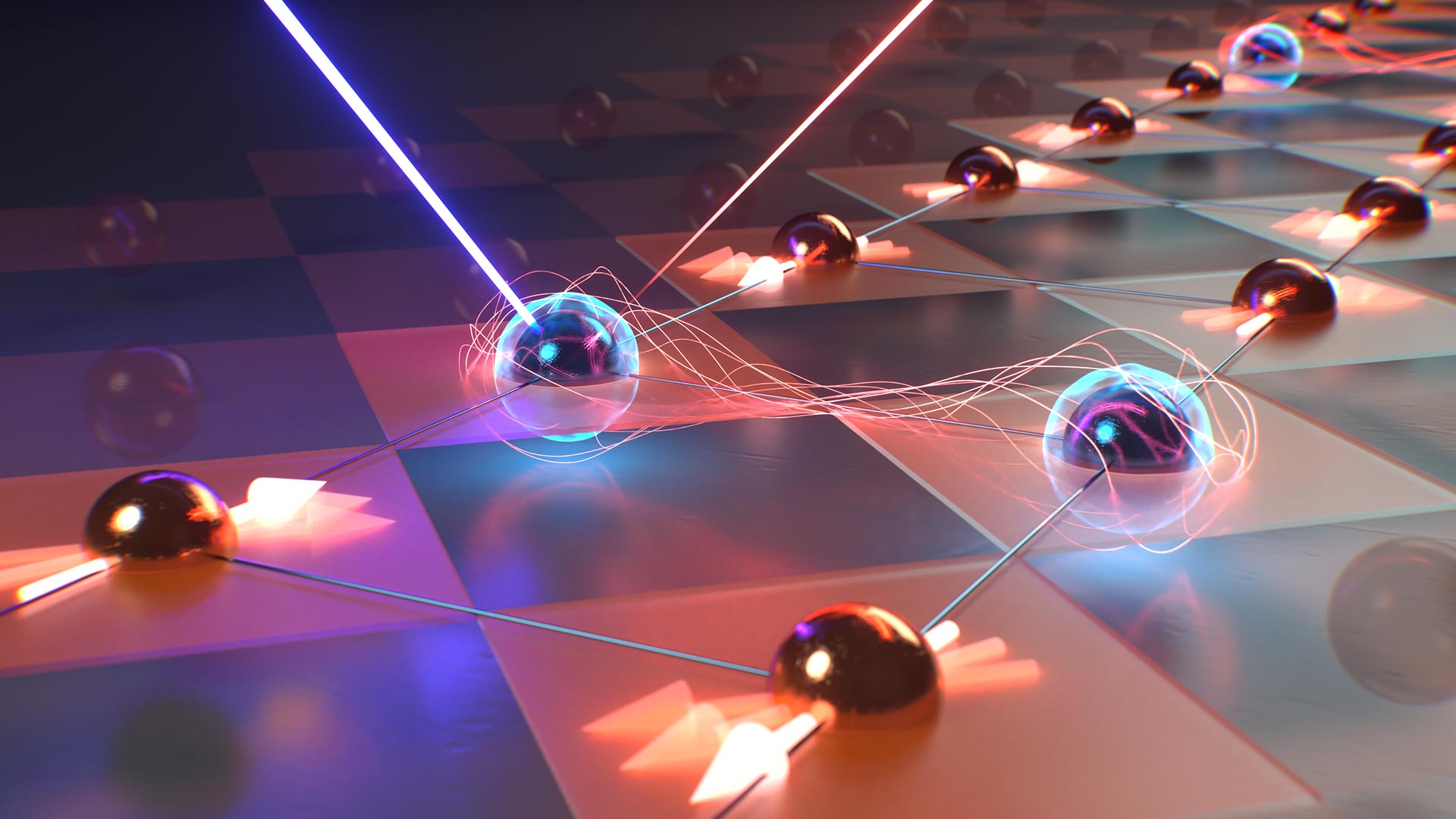
Scientists freeze quantum motion using ultrafast laser trick

Quantum materials exhibit remarkable emergent properties when they are excited by external sources. However, these excited states decay rapidly once the excitation is removed, limiting their practical applications. A team of researchers from Harvard University and the Paul Scherrer Institute PSI have now demonstrated an approach to stabilize these fleeting states and probe their quantum behaviour using bright X-ray flashes from the X-ray free electron laser SwissFEL at PSI. The findings are published in the journal Nature Materials.

Some materials exhibit fascinating quantum properties that can lead to transformative technologies, from lossless electronics to high-capacity batteries. However, when these materials are in their natural state, these properties remain hidden, and scientists need to gently ask for them to pop up. One way they can do this is by using ultrashort pulses of light to alter the microscopic structure and electronic interactions in these materials so that these functional properties emerge. But good things do not last forever – these light-induced states are transient, typically persisting only a few picoseconds, making them difficult to harness in practical applications. In rare cases, light-induced states become long-lived. Yet our understanding of these phenomena remains limited, and no general framework exists for designing excited states that last.

A team of scientists from Harvard University together with PSI colleagues overcame this challenge by manipulating the symmetry of electronic states in a copper oxide compound. Using the X-ray free electron laser SwissFEL at PSI, they demonstrated that tailored optical excitation can induce a ‘metastable’ non-equilibrium electronic state persisting for several nanoseconds – about a thousand times longer than they usually last for.

Steering electrons with light

The compound under study, Sr14Cu24O41 — a so-called cuprate ladder — is nearly one-dimensional. It is composed of two distinct structural units, the so-called ladders and chains, representing the shape in which copper and oxygen atoms organize. This one-dimensional structure offers a simplified platform to understand complex physical phenomena that also show up in higher-dimensional systems. “This material is like our fruit fly. It is the idealized platform that we can use to study general quantum phenomena,” comments experimental condensed matter physicist Matteo Mitrano from Harvard University, who lead the study.

One way to achieve a long-lived (‘metastable’) non-equilibrium state is to trap it in an energy well from which it does not have enough energy to escape. However, this technique risks inducing structural phase transitions that change the material’s molecular arrangement, and that is something Mitrano and his team wanted to avoid. “We wanted to figure out whether there was another way to lock the material in a non-equilibrium state through purely electronic methods,” explains Mitrano. For that reason, an alternative approach was proposed.

In this compound, the chain units hold a high density of electronic charge, while the ladders are relatively empty. At equilibrium, the symmetry of the electronic states prevents any movement of charges between the two units. A precisely engineered laser pulse breaks this symmetry, allowing charges to quantum tunnel from the chains to the ladders. “It’s like switching on and off a valve,” explains Mitrano. Once the laser excitation is turned off, the tunnel connecting ladders and chains shuts down, cutting off the communication between these two units and trapping the system in a new long-lived state for some time that allows scientists to measure its properties.

Cutting-edge fast X-ray probes

The ultra-bright femtosecond X-ray pulses generated at the SwissFEL allowed the ultrafast electronic processes governing the formation and subsequent stabilization of the metastable state to be caught in action. Using a technique known as time-resolved Resonant Inelastic X-ray scattering (tr-RIXS) at the SwissFEL Furka endstation, researchers can gain unique insight into magnetic, electric, and orbital excitations – and their evolution over time – revealing properties that often remain hidden to other probes.

“We can specifically target those atoms that determine the physical properties of the system,” comments Elia Razzoli, group leader of the Furka endstation and responsible for the experimental setup.

This capability was key to dissecting the light-induced electronic motion that gave rise to the metastable state. “With this technique, we could observe how the electrons moved at their intrinsic ultrafast timescale and hence reveal electronic metastability,” adds Hari Padma, postdoctoral scholar at Harvard and lead author of the paper.

The first of many more to come

tr-RIXS gives unique insight into energy and momentum dynamics of excited materials, opening new scientific opportunities for users of SwissFEL in studying quantum materials; indeed, these results come from the first experiment conducted by a user group at the new Furka endstation. It was the interest in the development of tr-RIXS at Furka that motivated the Harvard team to collaborate with scientists at PSI. “It’s a rare opportunity to get time on a machine where you can do these sorts of experiments,” comments Mitrano.

Since this initial pilot experiment, the Furka endstation has undergone upgrades to improve the RIXS energy resolution, and it is ready to study new types of individual and collective excitations, such as lattice excitations. “This experiment was very important to showcase the kind of experiments that we can carry out. The endstation and its instrumentation are already much better now, and we will keep improving it,” concludes Razzoli.

This work represents a major step forward in controlling quantum materials far from equilibrium, with broad implications for future technologies. By stabilising light-induced non-equilibrium states, the study opens new possibilities for designing materials with tuneable functionalities. This could enable ultrafast optoelectronic devices, including transducers that convert electrical signals to light and vice versa — key components for quantum communication and photonic computing. It also offers a pathway toward non-volatile information storage, where data is encoded in quantum states created and controlled by light.

Share Button

Watch: Are weight-loss jabs worth the side effects?

Rebecca ordered the jab online, but now says she is considering not using it after losing some of her hair.

Share Button

Women warned weight-loss jabs may affect the pill

Women should use the most effective contraception to avoid pregnancy while taking ‘skinny jabs’, the drugs regulator says.

Share Button

Greater awareness behind ADHD surge, study suggests

Study found ADHD is not becoming more common, despite a surge in people being diagnosed.

Share Button

First bacteria we ever meet can keep us out of hospital

For the first time, scientists show how our microbiome forms affects the risk of infection.

Share Button

Abortion laws are Victorian era, says grieving mum

Elen Hughes, who lost her son Danial at 37-and-a-half weeks, says police guidance is “terrible”.

Share Button

Science Cafe

Adam Walton delves into three books exploring global health and disease.

Share Button

Police investigate heart deaths at NHS hospital

Patients who died at Castle Hill Hospital near Hull may have suffered avoidable harm, documents suggest.

Share Button

Millions of new solar system objects to be found and ‘filmed in technicolor’ — studies predict

A group of astronomers from across the globe, including a team from the University of Washington and led by Queen’s University Belfast, have revealed new research showing that millions of new solar system objects will be detected by a brand-new facility, which is expected to come online later this year.

The NSF-DOE Vera C. Rubin Observatory is set to revolutionize our knowledge of the solar system’s “small bodies” — asteroids, comets and other minor planets.

The Rubin Observatory, under construction on the Cerro Pachón ridge in northern Chile, features the 8.4-meter Simonyi Survey Telescope with a unique three-mirror design capable of surveying the entire visible sky every few nights. At its heart is the world’s largest digital camera — the 3.2 gigapixel Legacy Survey of Space and Time (LSST) Camera — covering a 9.6 square-degree field of view with six filters, roughly 45 times the area of the full moon. Together, this “wide-fast-deep” system will generate 20 terabytes of data every night — creating an unprecedented time-lapse “movie” of the cosmos over the next 10 years, and an incredibly powerful dataset with which to map the solar system.

The team of astronomers, led by Queen’s University’s Meg Schwamb, created Sorcha, an innovative new open-source software used to predict what discoveries are likely to be made. Sorcha is the first end-to-end simulator that ingests Rubin’s planned observing schedule. It applies assumptions on how Rubin Observatory sees and detects astronomical sources in its images with the best model of what the solar system and its small body reservoirs look like today.

“Accurate simulation software like Sorcha is critical,” said Schwamb, a reader in the School of Mathematics and Physics at Queen’s University. “It tells us what Rubin will discover and lets us know how to interpret it. Our knowledge of what objects fill Earth’s solar system is about to expand exponentially and rapidly.”

In addition to the eight major planets, the solar system is home to a vast population of small bodies that formed alongside the planets more than 4.5 billion years ago. Many of these smaller bodies remain essentially unchanged since the solar system’s birth, acting as a fossil record of its earliest days. By studying their orbits, sizes and compositions, astronomers can reconstruct how planets formed, migrated and evolved.

These objects — numbering in the tens of millions — — provide a powerful window into processes such as the delivery of water and organic material to Earth, the reshaping of planetary orbits by giant planets and the ongoing risk posed by those whose paths bring them near our planet.

In addition to Queen’s University and the UW, the international team includes researchers from the Center for Astrophysics | Harvard & Smithsonian and the University of Illinois Urbana-Champaign.

A series of papers describing the software and the predictions have been accepted for publication by The Astronomical Journal.

Beyond just finding these new small bodies, Rubin Observatory will observe them multiple times using different optical filters, revealing their surface colors. Past solar system surveys typically observed with a single filter.

“With the LSST catalog of solar system objects, our work shows that it will be like going from black-and-white television to brilliant color,” said Joe Murtagh, a doctoral student at Queen’s University. “It’s very exciting — we expect that millions of new solar system objects will be detected and most of these will be picked up in the first few years of sky survey.”

The team’s simulations show that Rubin will map:

  • 127,000 near-Earth objects — asteroids and comets whose orbits cross or approach Earth. That’s more than tripling today’s known objects, about 38,000, and detecting more than 70% of potentially hazardous bodies larger than 140 meters. This will cut the risk of undetected asteroid impact of catastrophic proportions by at least two times, making a tremendous contribution to planetary defense.

  • Over 5 million main-belt asteroids, up from about 1.4 million, with precise color and rotation data on roughly one in three asteroids within the survey’s first years. This will give scientists unprecedented insight into the characteristics and history of the solar system’s building blocks.

  • 109,000 Jupiter Trojans, bodies sharing Jupiter’s orbit at stable “Lagrange” points — more than seven times the number cataloged today. These bodies represent some of the most pristine material dating all the way back to the formation of the planets.

  • 37,000 trans-Neptunian objects, residents of the distant Kuiper Belt — nearly 10 times the current census — shedding light on Neptune’s past migration and the outer solar system’s history.

  • Approximately 1,500-2,000 Centaurs, bodies on short-lived giant planet-crossing orbits in the middle solar system. Most Centaurs will eventually be ejected from the solar system, but a few lucky ones will survive to become short-period comets. The LSST will provide the first detailed view of the Centaurs and the important transition stage from Centaur to comet. 

Rubin Observatory’s LSST is a once-in-a-generation opportunity to fill in the missing pieces of our solar system, said Mario Juric, a member of the Sorcha team and a UW professor of Astronomy. Juric also is a team lead of Rubin’s Solar System Processing Pipelines and a director of UW’s DiRAC Institute.

“Our simulations predict that Rubin will expand known small-body populations by factors of 4-9x, delivering an unprecedented trove of orbits, colors and light curves,” Juric said. “With this data, we’ll be able to update the textbooks of solar system formation and vastly improve our ability to spot — and potentially deflect — the asteroids that could threaten Earth.”

It took 225 years of astronomical observations to detect the first 1.5 million asteroids, and researchers found that Rubin will double that number in less than a year, said Jake Kurlander, a doctoral student at the UW.

“Rubin’s unparalleled combination of breadth and depth make it a uniquely effective discovery machine,” Kurlander said.

Siegfried Eggl, an assistant professor of Aerospace Engineering at the University of Illinois Urbana-Champaign added: “Only by debiasing LSST’s complex observing pattern can we turn raw detections into a true reflection of the solar system’s history — where the planets formed, and how they migrated over billions of years. Sorcha is a game changer in that respect.”

The Sorcha code is open-source and freely available with the simulated catalogs, animations at https://sorcha.space. By making these resources available, the Sorcha team has enabled researchers worldwide to refine their tools and be ready for the flood of LSST data that Rubin will generate, advancing the understanding of the small bodies that illuminate the solar system like never before.

Rubin Observatory is scheduled to unveil its first spectacular imagery at its “First Look” event on June 23, offering the world an early glimpse of the survey’s power. Full science operations are slated to begin later this year.

Share Button

Telehealth can improve care for cats with chronic health issues

Caring for a cat with chronic health conditions can be challenging for all involved, from the process of getting to a veterinary clinic to the stress of being in a strange environment with new smells and animals.

Researchers at the University of California, Davis, worked with pet owners across the United States and Canada to determine whether video telehealth visits could help improve care and the home environment for cats with feline degenerative joint disease, commonly referred to as feline arthritis.

The findings, published in the journal Frontiers in Veterinary Science, show that video calls where pet owners can ask questions and get non-medical advice can be beneficial. More than 95% of those who took part in the research said they would pay for telehealth visits, though most were willing to pay a little less than for in-clinic appointments.

“Teleadvice is meant to provide advice and support for caregivers caring for their cats,” said lead author Grace Boone, an assistant specialist in the UC Davis Animal Welfare Epidemiology Lab. “We found that overall everybody was quite interested in video telehealth for home management of their cats and their mobility issues.”

A common ailment

Routine veterinary care is important to prevent, mitigate and treat health and behavioral problems. And feline arthritis is quite common, present in roughly 6% to 30% of cats under age 10 and from 64% to 92% of those older than 10, Boone said.

“Cats are great at hiding signs of pain,” said Carly Moody, senior author on the paper and an assistant animal science professor. “These conditions are prevalent and pain is a serious health and welfare issue that needs to be addressed. Telehealth is beneficial because it allows you to take out that clinic stressor for some aspects of care.”

The researchers recruited 106 pet owners whose cats had mobility issues. Each one filled out a questionnaire about their cat’s mobility, barriers to getting in-person care and how they felt about telehealth.

Pet owners in the test group took the survey and participated in six video visits — one every three weeks over four months — and then retook the survey. The control group only received the questionnaire at the beginning of the research and four months later. A presentation on caring for cats with mobility issues also was offered to all participants at the end.

In the home video session, Boone asked general questions about the cat’s wellbeing and mobility, and suggested modifications if owners asked for advice. Suggestions included elevated food and water dishes to ease neck strain, larger litter boxes with shorter walls, and additional steps to access favorite places. Pet owners reported that the visits helped them understand their cats’ needs, making them more confident in how they cared for their cats.

“There’s a lot of in-home modifications that can be implemented to increase cat comfort in the home,” Moody said. “Telehealth allows veterinary professionals to see and understand the cat’s home environment and make recommendations which can be helpful for the cat.”

Advice not medicine

Telehealth visits don’t require a veterinarian. A registered veterinary technician or other knowledgeable staff member can conduct the calls, answer questions and give advice. They are not meant to replace in-person veterinary care but rather supplement it, Moody said.

“There’s ways you can incorporate telehealth to make it easier for the owner and the cat and increase the number of visits and support an owner is receiving, particularly when they’re caring for a cat that requires chronic high levels of care at home,” Moody said.

The visits have the potential to foster better veterinarian-client-patient relationships. “Rather than being something that detracts from in-person care, I think you can improve it and help supplement it,” Boone said.

Evaluating changes in the home

Next up is to determine whether recommended changes based on expert advice can improve a cat’s wellbeing in the home.

“I think it would be really interesting to look at these interventions and specifically say, ‘Are they helpful?’ If somebody’s not willing to change a lot of things in their home, you could prioritize the ones that make the most difference for the cat’s welfare,” Moody said.

Moody’s lab may also examine whether telehealth could be beneficial for other health issues like obesity and disease prevention.

Hao-Yu Shih from the Mayo Clinic and Daniel Pang, who is affiliated with the University of Calgary and University of Montreal in Canada, contributed to the research. It was supported by the American Society for the Prevention of Cruelty to Animals and the family foundation Maddie’s Fund.

Share Button