Cannabis users were twice as likely to commit violence, review finds

A large review led by researchers at King’s College London has found that people who use cannabis are more likely both to commit violent acts and to experience violence themselves.

Researchers from the Institute of Psychiatry, Psychology & Neuroscience (IoPPN) combined data from 63 studies involving more than 265,000 people. They analyzed the general population separately from people receiving psychiatric care.

What the Review Examined

The researchers used the World Health Organization’s broad definition of violence, which includes physical, sexual and psychological violence toward another person, both inside and outside intimate relationships.

They also separated self-reported violence from cases that resulted in criminal convictions. When individual studies measured several forms of violence, the researchers focused on the most serious type reported. The findings were published in Psychological Medicine.

Dr. Marta Di Forti, co-author of the study from the Institute of Psychiatry, Psychology & Neuroscience (IoPPN) at King’s College London, and South London and Maudsley NHS Foundation Trust, said:

“As a clinician, I’ve seen how heavy cannabis use can be a factor in violence. We’ve been cautious for a long time about how far we could go in describing this link, but a review of this size lets us speak with more confidence about the risks, while being careful not to stigmatize people who use cannabis more broadly.”

Cannabis Use and Victimization

The review also found that people who used cannabis were about one and a half times as likely to become victims of violence. This association was stronger among women than among men.

Professor Sir Robin Murray, senior author of the study from the Institute of Psychiatry, Psychology & Neuroscience at King’s College London, said:

“In the general population, people who used cannabis were around twice as likely to have committed a violent act as those who didn’t; for those in psychiatric care, cannabis users were around two and a half times as likely to be violent as other psychiatric patients who didn’t use cannabis. The link held in studies that followed people over time, though it was smaller than in studies that looked at a single point in time. For violence that led to a criminal conviction, people who used cannabis were three to four times as likely to have been convicted.

“As cannabis becomes more commercialized and legalized around the world, the conversation about its risks has focused mostly on the person using it. This review shows that violence, both committing it and experiencing it, needs to be part of that conversation too.”

Implications for Mental Health and Public Health

Based on the findings, the researchers say mental health services should routinely ask about cannabis use when evaluating a person’s risk of violence. They also argue that public health information about cannabis should include the possible connection with violence.

However, the researchers emphasize that the review identifies an association and does not prove that cannabis directly causes violence. Cannabis use often occurs alongside other factors that can also increase the risk of violent behavior or victimization, including alcohol use, other drug use and difficult social circumstances.

Important Limitations

Only a small number of the studies measured how much cannabis people used or how often they used it. The findings involving criminal convictions were also based on a relatively limited number of studies.

Most of the research was conducted before high potency cannabis became common. The researchers suggest that daily use of today’s more potent cannabis products could potentially be associated with stronger effects.

The study was supported by the National Institute for Health and Care Research (NIHR) Biomedical Research Centre: Maudsley and the Medical Research Council (MR/T007818/1). The views expressed are those of the authors and not necessarily those of the NIHR or the Department of Health and Social Care.

Share Button

A record-breaking X-ray flash may reveal the birth of a magnetar

Astronomers have long relied on brief bursts of gamma rays to identify collisions between neutron stars. These flashes can vanish in less than two seconds. Now, new research suggests that some neutron star mergers may also produce X-ray flashes that remain visible for several minutes.

A study published in Science Bulletin presents strong evidence for that connection. The findings raise the possibility that some mysterious cosmic flashes, whose sources have been difficult to explain, may actually come from merging neutron stars.

Since the Einstein Probe satellite launched in January 2024, astronomers have detected hundreds of bright X-ray flashes from distant galaxies. These events, called fast X-ray transients, have several possible origins. Some have been connected to the deaths of massive stars, while others remain unexplained.

Determining what causes them can be difficult because astronomers often do not know how far away the events are or how much energy they release.

A Possible Magnetar Birth

Researchers in Professor Eleonora Troja’s group, supported by a European Research Council (ERC) Consolidator grant, obtained observations that helped identify the source of one such X-ray transient.

After receiving an alert from the Einstein Probe satellite, the team rapidly organized follow-up observations with several instruments, including the European Southern Observatory’s Very Large Telescope (VLT) and the Very Large Array. By studying what remained after the explosion, the researchers concluded that they may have witnessed the formation of a magnetar produced by the collision (or merger) of two neutron stars.

Neutron stars are extremely dense stellar remnants left behind after massive stars reach the ends of their lives. When two neutron stars merge, they generate gravitational waves that travel through space. The light produced during these events can help astronomers determine what survives the collision.

Short gamma-ray bursts have traditionally been the main electromagnetic signal associated with neutron star mergers.

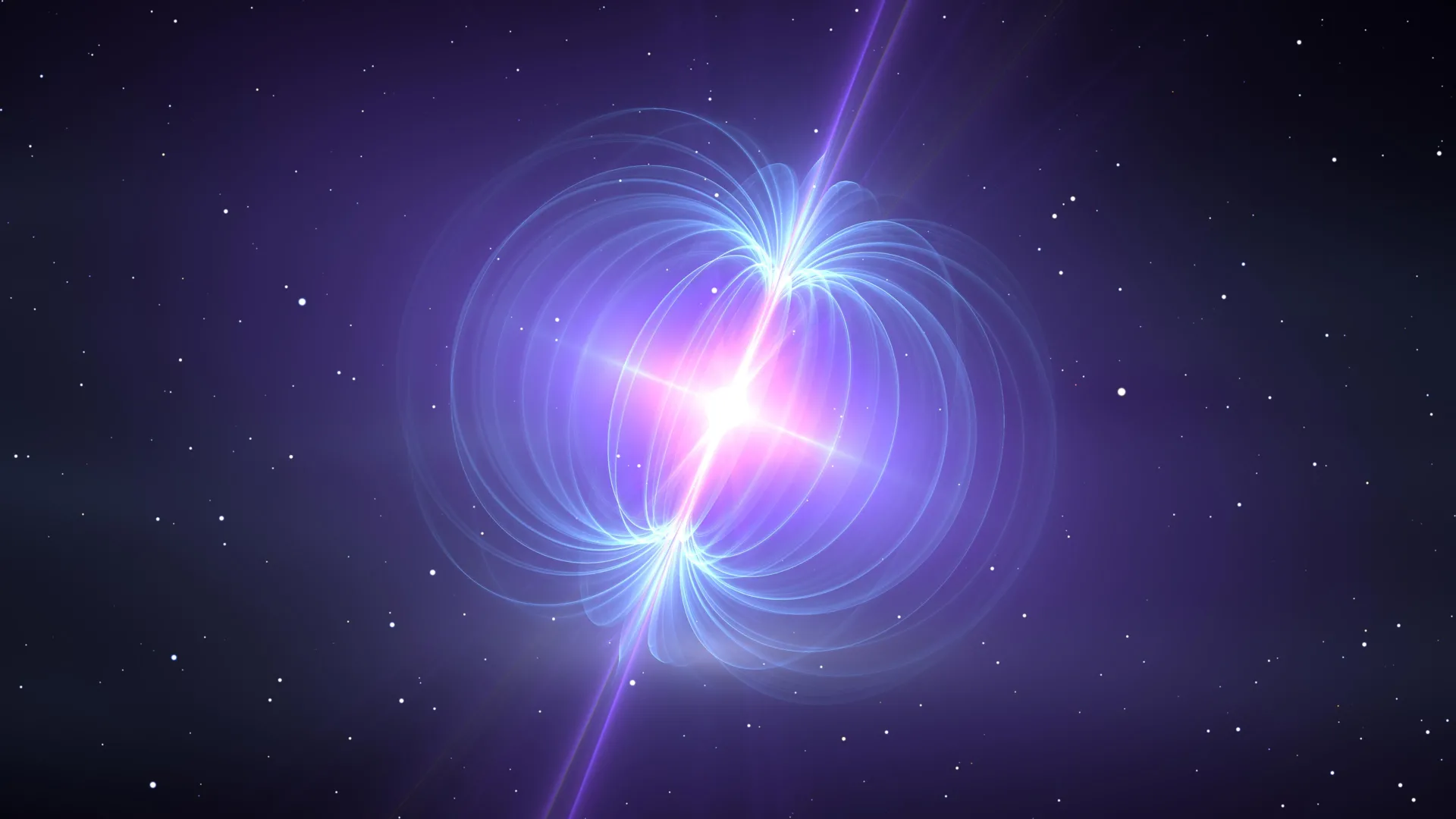
“However, if the remnant of the collision is a magnetar, it could keep bursting for longer,” said Prof. Troja, who is part of the Einstein Probe European collaboration and co-corresponding author of the paper. “Magnetars are rapidly spinning neutron stars with huge magnetic fields. When they damp their magnetic power into the surroundings, they can make any explosion brighter and longer-lasting. When I saw the X-ray data from this new event, I realized something was up.”

A Record X-Ray Flash

The event, designated EP250704a/GRB 250704B, was detected on July 4, 2025, by the SVOM, Insight-HXMT and Einstein Probe satellites.

Its gamma-ray burst lasted only about half a second. In contrast, Einstein Probe recorded bright X-ray emission for nearly ten minutes.

“This is the longest lasting prompt X-ray flash ever observed from a neutron star merger,” said graduate student Niccolò Passaleva, who led the follow-up observations using the VLT in Chile. “It is an opportunity to have a front-row seat to the most extreme forces of the Universe and discover more of its secrets.”

The researchers had spent several years looking for a firm connection between fast X-ray transients and neutron star mergers. Previous candidates faded too quickly to provide enough evidence.

This time, Passaleva responded within minutes, allowing observations to begin while the event was still bright enough to study in detail.

“I was traveling home by train,” recalls Passaleva, “and all of a sudden I was rushing against time to commandeer one of the largest telescopes in the world from my laptop.”

Measuring a Flash From More Than 6 Billion Years Away

Using the VLT’s X-Shooter instrument, Passaleva and his colleagues broke the event’s light into its individual components. They identified distinct absorption patterns that allowed them to measure its redshift, which reveals how far away the source is.

The team measured a redshift of z=0.6610. That showed the explosion happened long before our Sun and its planets formed. Its light traveled for more than six billion years before reaching Earth.

The researchers then searched for another important clue.

Using deep observations from the VLT’s FORS2 instrument, they looked for a bright supernova. A supernova would normally be expected if a long-lasting X-ray flash had been produced by the collapse of a massive star.

No supernova appeared.

Taken together, the measured distance, the absence of a supernova and the properties of the burst provided strong evidence that the event came from a neutron star merger.

A New Way To Find Neutron Star Mergers

If additional events like this one are found, astronomers may be able to determine how frequently neutron star mergers produce magnetars.

“Finding more of these X-ray flashes could help reveal how often neutron star mergers create magnetars,” concludes Passaleva, “I am really excited for the next run of gravitational wave observations, when we could finally pair one of these X-ray flashes with a burst of gravitational waves from the same source.”

Additional Information

The research was carried out by an international collaboration of astronomers.

Lead authors are: An Li (Beijing Normal University), Chen-Wei Wang (Chinese Academy of Sciences), Niccolò Passaleva (University of Rome Tor Vergata), Jie An (Chinese Academy of Sciences)

Corresponding authors are: Binbin Zhang (Nanjing University), Eleonora Troja (University of Rome Tor Vergata), Yi-Han Iris Yin (The University of Hong Kong), Jing-Wei Hu (Chinese Academy of Sciences), Hua-Li Li (Chinese Academy of Sciences)

The VLT observations used in this study were conducted as part of the large program 114.27LW (PI: Eleonora Troja) titled “QUEENB: a QUEst for Elusive Neutron star and Black hole mergers.”

Share Button

How empty chairs are helping people’s mental health

When Dean Perryman’s best friend Rob Clancy took his own life, he wanted to create something positive from an unimaginable loss.
His idea was simple; reserve an empty chair in a pub and invite anyone who needed a conversation to sit down.

Share Button

‘My big breasts lead to lewd comments in the street’

Charlotte Howard has been turned down for breast reduction surgery by the NHS, despite daily pain.

Share Button

Watch Live: NASA’s Crew-13 could make the fastest U.S. trip to the ISS ever

NASA will offer live coverage of preparations, liftoff, and docking for the SpaceX Crew-13 mission to the International Space Station.

The broadcasts will be available across several NASA platforms. Viewers can find streaming options at:

https://www.nasa.gov/live

Crew-13 Launches Oct. 1

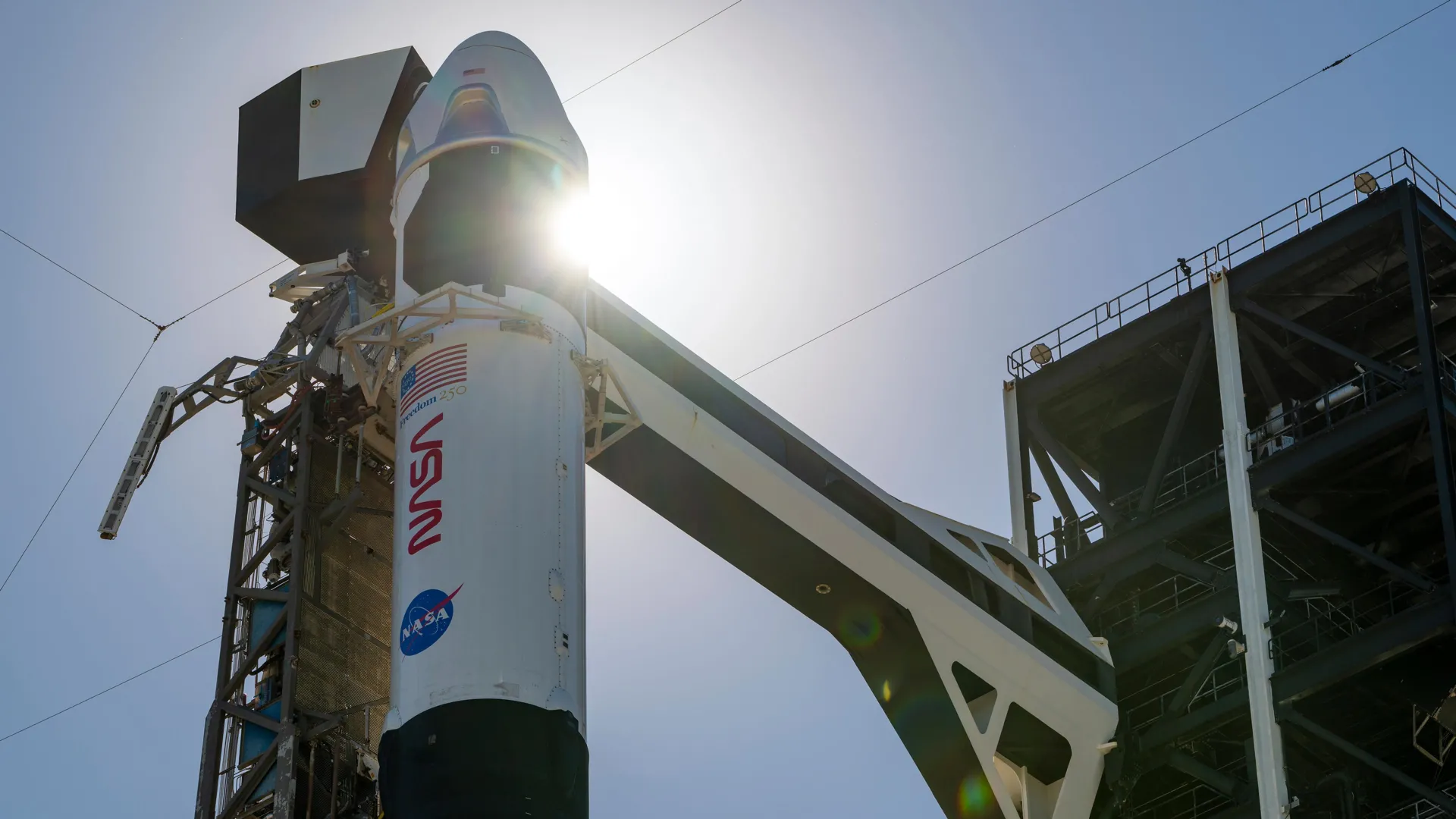
Crew-13 is scheduled to lift off at 11:10 a.m. EDT on Thursday, Oct. 1, from Space Launch Complex 40 at Cape Canaveral Space Force Station in Florida. Docking with the International Space Station is targeted for about 7 p.m.

The SpaceX Dragon spacecraft will transport four crew members: NASA astronauts Jessica Watkins and Luke Delaney, CSA (Canadian Space Agency) astronaut Joshua Kutryk, and Roscosmos cosmonaut Sergey Teteryatnikov. They will spend an extended period aboard the station conducting science and other mission activities.

In person events are limited to media representatives who have already received credentials. Media may request details for participating in calls.

NASA’s Crew-13 mission coverage schedule appears below (all times Eastern and subject to change based on real-time operations):

Wednesday, Sept. 30

5 p.m.: Prelaunch news conference

Participants include:

  • Dr. Lori Glaze, associate administrator, Human Spaceflight Mission Directorate, NASA Headquarters
  • Dana Weigel, manager, Low Earth Orbit Program, NASA’s Johnson Space Center in Houston
  • Mathieu Caron, director, Astronauts, Life Sciences, and Space Medicine, CSA
  • William Gerstenmaier, vice president, Build and Flight Reliability, SpaceX
  • Arlena Moses, launch weather officer, Cape Canaveral Space Force Station’s 45th Weather Squadron

Thursday, Oct. 1

9:20 a.m.: Launch coverage begins

11:10 a.m.: Launch

After the main launch broadcast ends, NASA will provide audio-only communications involving Crew-13, the International Space Station, and flight controllers while Dragon travels toward the orbiting laboratory.

12:45 p.m.: Postlaunch news conference

Participants include:

  • NASA Administrator Jared Isaacman
  • Dr. Lori Glaze, associate administrator, Human Spaceflight Mission Directorate, NASA Headquarters
  • Dana Weigel, manager, Low Earth Orbit Program, NASA Johnson
  • Mathieu Caron, director, Astronauts, Life Sciences, and Space Medicine, CSA
  • Julianna Scheiman, director, NASA Science and Dragon Programs, SpaceX

A Record Fast Trip to the Space Station

NASA’s live coverage will resume as Dragon approaches the station for rendezvous and docking. The planned journey from launch to docking will take 7 hours and 50 minutes on Oct. 1. If completed as scheduled, it will be the fastest trip to the International Space Station by a U.S. spacecraft in the station’s history.

5:20 p.m.: Arrival coverage begins

7 p.m.: Targeted docking to the forward-facing port of the station’s Harmony module

8:45 p.m.: Hatch opening followed by welcome remarks

Crew-13 Begins Its Station Mission

After entering the International Space Station, the Crew-13 astronauts and cosmonaut will complete a brief handover with members of NASA’s SpaceX Crew-12 mission.

Crew-12 is expected to begin its journey back to Earth no earlier than Monday, Oct. 5. NASA plans to release further information about the Crew-12 return after Crew-13 has arrived at the station.

Share Button

The Irish international rugby ‘trailblazer’ and her legacy of cancer awareness

Rosie Stewart played for Ireland and was a founding member of Ulster Women’s Rugby but died after being diagnosed with breast cancer.

Share Button

Family told to call locksmith over mental health fears

A force should have flagged mental health services after a family called about their son, IOPC says.

Share Button

Hidden habits that make your social anxiety worse – and how to break them

Social anxiety is more common than many think. Here’s what you need to know about the condition.

Share Button

Burnham vows to end existing pension triple lock in 2030 to help fund care

The PM was at times emotional during his conference speech in which he outlined his long-term plan for the UK.

Share Button

The ice blasting from Saturn’s moon Enceladus is stranger than scientists realized

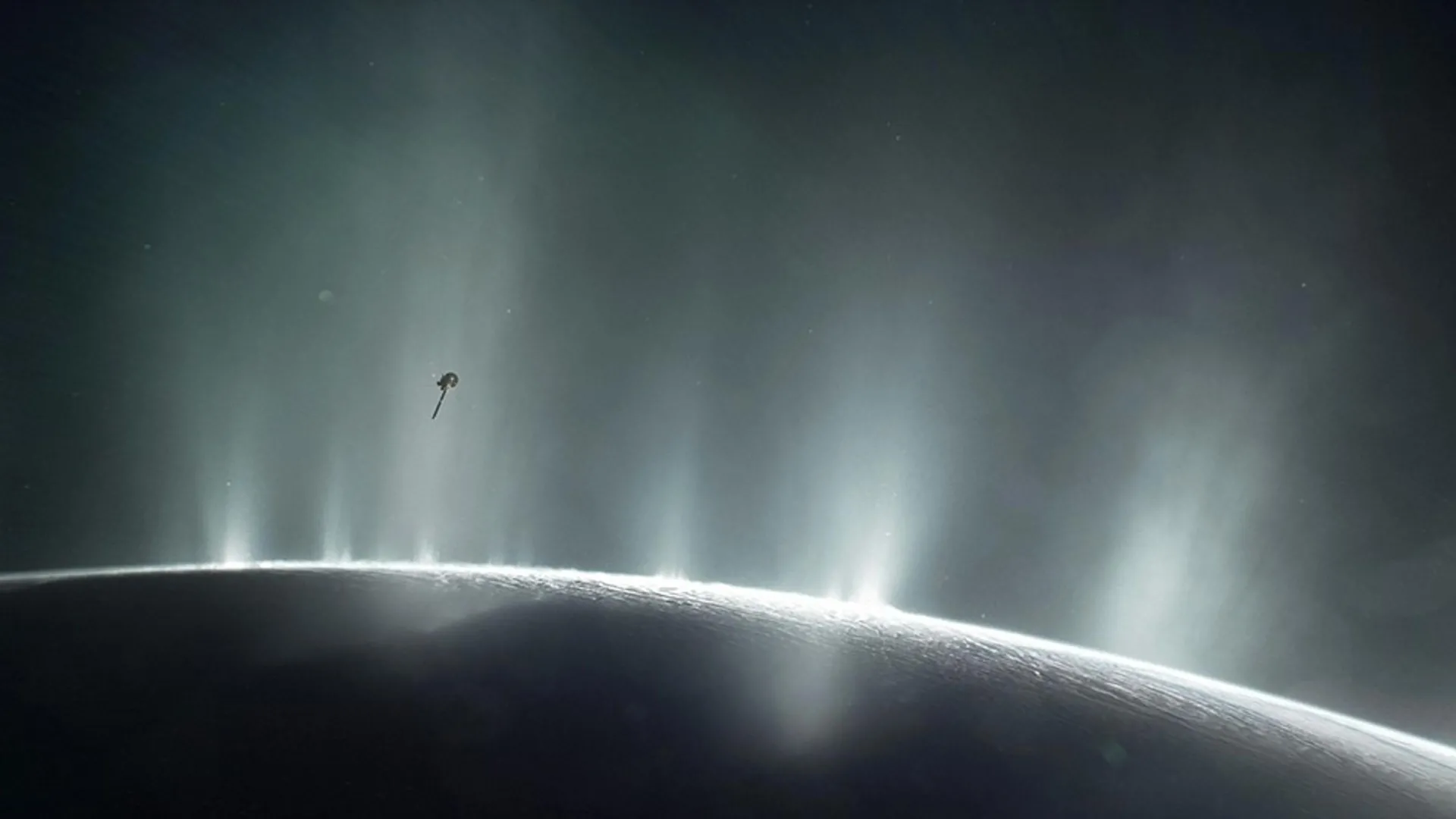
Saturn’s moon Enceladus is covered in ice, but beneath that frozen shell lies a global ocean. Near the moon’s south pole, fractures in the crust release water vapor and ice particles into space. Those particles give scientists an unusual way to study an alien ocean without having to drill through kilometers of ice.

An international team that includes researchers from the Earth-Life Science Institute (ELSI) at the Institute of Science Tokyo has now investigated what happens to that ocean water as it moves from beneath the surface and eventually becomes the tiny ice grains detected in space.

Cassini Found Surprisingly Diverse Ice Grains

Between 2004 and 2017, the Cosmic Dust Analyzer on NASA’s Cassini spacecraft measured the composition of individual ice particles in Saturn’s E-ring. That ring is continually supplied with material erupting from Enceladus.

A team led by Prof Frank Postberg at Freie Universität Berlin examined 961 mass spectra from salt-rich grains known as Type 3 particles. If the grains were simply small samples of the same ocean water, scientists might expect them to contain broadly similar mixtures of salts.

Instead, the grains varied dramatically.

Some were especially rich in sodium chloride, while others contained higher amounts of carbonates, phosphates or potassium chloride. One particularly striking pattern was that chloride and carbonate rarely appeared together in the same sodium-rich particle.

That raised a basic puzzle. If all of these grains came from the same ocean, why did their chemical compositions differ so much?

Recreating Enceladus’ Ocean Droplets in the Lab

To explore that question, Professor Yasuhito Sekine and colleagues at ELSI created laboratory droplets containing the major salts thought to be present in Enceladus’ ocean.

The researchers froze droplets of different sizes under different cooling conditions, then studied how the chemical elements were distributed once the droplets had solidified.

The results showed that the speed of freezing plays a major role.

In droplets about 200 micrometres across, salts became separated into different regions when freezing occurred relatively slowly, at approximately 10 K per minute or less. When the droplets froze more quickly, their chemical ingredients remained much more evenly mixed.

“What surprised us was that the diversity seen by Cassini could emerge from droplets originating from essentially the same ocean water,” said Sekine. “Our experiments show that when relatively large ocean droplets freeze slowly, different salts can separate within them. If those frozen droplets are later broken apart, they can produce much smaller ice grains, each with very different chemical compositions.”

A Slower Journey Through Enceladus’ Ice

The findings may also reveal something about what happens inside the moon’s icy crust.

Earlier studies generally assumed that seawater spray from Enceladus freezes quickly and moves rapidly toward space soon after leaving the ocean. The new experiments point to a different scenario.

The droplets may initially move much more slowly through the underground vent system, following complicated pathways through fractures in the ice before they approach the surface.

The researchers suggest that ocean spray first forms droplets ranging from tens to hundreds of micrometers in size. As those droplets move slowly through deeper sections of the vents, they gradually freeze, giving salts enough time to separate into different regions.

Closer to the surface, conditions change. Gas begins moving faster, and the frozen droplets can slam into the walls of narrower icy channels at high speed. Those collisions may break the droplets into much smaller pieces.

Each fragment can come from a different salt-rich region within the original frozen droplet, creating grains with very different chemical compositions. Those fragments can then escape into space and become part of Saturn’s E-ring.

“The Cassini data showed us that these salt-rich grains are far more chemically diverse than an average ocean composition would suggest,” said Postberg. “Combining those observations with the freezing experiments gives us a physical explanation: Cassini may have sampled fragments of larger frozen ocean droplets, each preserving different components that became separated during their journey towards the surface. The abundance of each individual component in the ocean is then reflected in the number of fragments in which a particular component is found.”

Enceladus May Naturally Concentrate Key Compounds

The discovery could be especially important for future missions to Enceladus.

As droplets freeze and break apart, individual compounds can become concentrated in particular grains. The process does not only separate different salts. Earlier work has also shown that organic substances can become separated from one another and appear at elevated concentrations in certain particles.

That could make future analysis considerably easier.

Compounds that are highly diluted in Enceladus’ ocean and mixed with many other substances may become much easier to detect when concentrated into individual ice grains.

On Earth, laboratories often spend considerable effort separating and concentrating chemicals before analyzing a sample. Enceladus appears to perform both of these “sample preparation” steps naturally: The chemical components become separated, and some end up concentrated within a fraction of the ice particles.

Possible Implications for Prebiotic Chemistry

Slow freezing could have another important consequence.

As ice crystals grow, small pockets of liquid brine may remain trapped between them. Salts and organic compounds can become highly concentrated inside those pockets.

That concentration could matter for prebiotic chemistry, which involves chemical processes that may precede the emergence of life. One major challenge in such chemistry is bringing molecules that are normally very dilute into close contact with one another.

Because much of the material erupted from Enceladus eventually falls back onto the moon, this freezing, concentration and recycling process could potentially happen again and again.

Understanding how Enceladus forms its ice grains therefore does more than explain Cassini’s unusual measurements. It offers new clues about the hidden environment beneath the moon’s surface and may help future spacecraft correctly interpret the particles they collect while searching for evidence of habitability and possible signs of life.

Share Button