Jess’s Rule urges doctors to ‘think again’ if they cannot diagnose a patient’s illness after three appointments.


Jess’s Rule urges doctors to ‘think again’ if they cannot diagnose a patient’s illness after three appointments.

Drinking too little water could increase our vulnerability to stress-related health issues, according to a new study from scientists at LJMU.
People who drink less than the recommended daily fluid intake experience a greater stress hormone response, which is associated with an increased risk of heart disease, diabetes and depression.
A new study, published recently in the Journal of Applied Physiology, found that individuals who drank less than 1.5 liters of fluid – or seven cups of tea – per day had a cortisol response to stress that was over 50% higher than those who met daily water intake recommendations.
Study lead Professor Neil Walsh, a physiologist in LJMU’s School of Sport and Exercise Sciences, said: “Cortisol is the body’s primary stress hormone and exaggerated cortisol reactivity to stress is associated with an increased risk of heart disease, diabetes and depression.”
“If you know you have a looming deadline or a speech to make, keeping a water bottle close could be a good habit with potential benefits for your long-term health.”
Poor long-term health
With the project funded by Danone R&I, Neil and his team divided healthy young adults into two equally sized groups, representing the lowest and highest 25% for daily fluid intake. The ‘low fluid’ group consisted of individuals who typically drank less than 1.5 liters of fluid per day (water, hot drinks etc.). The ‘high fluid’ group included individuals who regularly met the daily water intake recommendations – 2 liters for women and 2.5 liters for men. Both groups were matched for key factors known to influence stress responses such as psychological characteristics and sleep.
Participants maintained their usual drinking habits for one week, during which hydration levels were monitored in blood and urine samples. Then participants underwent the Trier Social Stress Test, widely used to simulate real-world stress through a mock job interview and a mental arithmetic task.
Dr Daniel Kashi, a member of the study team, said: “Both groups felt equally anxious and experienced similar increases in heart rate during the stress test. However, only the ‘low fluid’ group showed a significant increase in saliva cortisol in response to the stress test.”
He added: “Although the low fluid group did not report being thirstier than the high fluid group, they had darker and more concentrated urine, clear signs of poor hydration. An important observation was that poor hydration was associated with greater cortisol reactivity to the stress test. Exaggerated cortisol reactivity to stress has been associated with poor long-term health.”
“If you have a stressful schedule, keeping a bottle of water close could be a good habit.”
Dr Daniel Kashi, physiologist, LJMU
Why is dehydration harmful?
The answer lies in the body’s water-regulation system, which is closely connected to the brain’s stress-response center. When the body senses dehydration, whether due to inadequate fluid intake or excessive fluid loss, it triggers the release of a hormone called vasopressin. Vasopressin acts primarily on the kidneys, promoting water reabsorption to maintain blood volume and electrolyte balance. This conservation mechanism comes at a cost. Sustained vasopressin release places additional strain on the kidneys, which must work harder to concentrate urine and manage electrolyte balance.
Vasopressin also acts on the brain’s stress-response center, the hypothalamus, where it can influence the release of cortisol. This dual role for vasopressin helps maintain blood volume and electrolyte balance but also increases cortisol.
The researchers say that while further long-term studies are needed, the findings reinforce current water intake recommendations – approximately 2 liters of fluid each day for women and 2.5 liters for men.
Hydration helps us manage stress
“Being hydrated may help your body manage stress more effectively,” added Dr Kashi. A practical way to check your hydration status is to monitor your urine colour — light yellow typically indicates good hydration.
“If you know, for example, that you have a stressful schedule, maybe a looming deadline or a speech to make, keeping a water bottle close could be a good habit with potential benefits for your long-term health.”
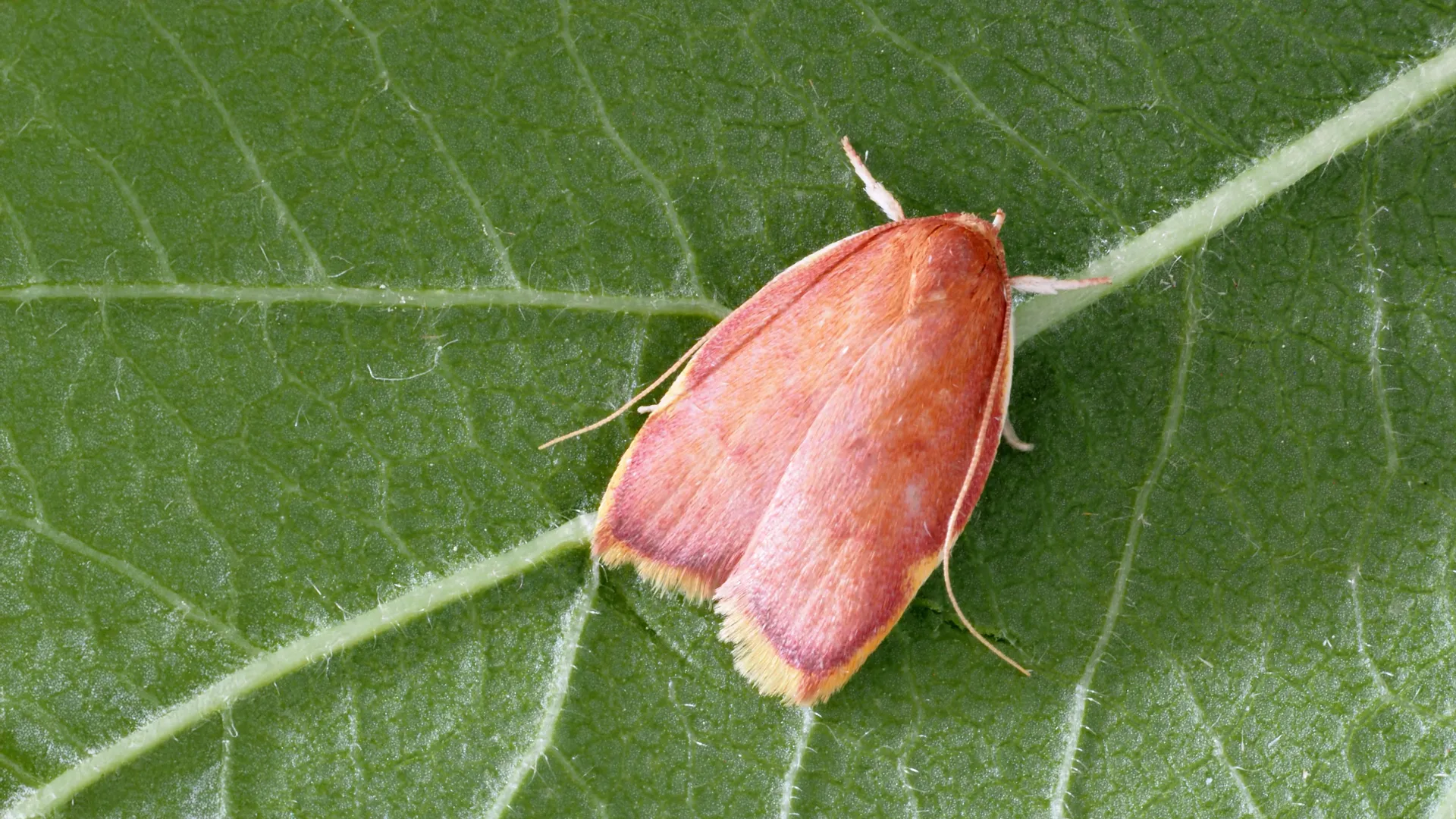
A beautiful, colorful moth, previously mistaken for over a century, has been revealed as a new species by entomologist Dr Peter Huemer of the Tyrolean State Museum Ferdinandeum in Innsbruck, Austria.
Described in the open-access journal Alpine Entomology, the new species, now officially named Carcina ingridmariae, had long been overlooked due to its close resemblance to the widespread oak carcina (Carcina quercana), a moth familiar across Europe and first described in 1775.
Despite its vibrant pink and yellow hues, Carcina ingridmariae escaped detection until advances in DNA barcoding revealed significant genetic differences of more than 6% from its lookalike relative. Subsequent analysis of the insects’ sexual organs confirmed the molecular findings, leading to the revelation that two distinct species have been hiding in plain sight.
The new species has a wingspan of about 2 cm, and is found across the eastern Mediterranean, from Croatia and Greece to Cyprus and Turkey. Its larvae likely feed on various oak species, similar to its counterpart. However, dedicated studies on its biology and distribution remain ongoing.
In recognition of enduring support throughout his career, Dr Huemer dedicated the discovery to his wife, Ingrid Maria, naming the moth after her on their 42nd wedding anniversary.
Huemer, who has described more than 200 species from Europe over 35 years said: “It is without doubt the prettiest species I have encountered in my long scientific career, even though it is still unnamed.” It was therefore “obvious” to Huemer that the new species should be given his wife’s name.

Do you have a meditation app on your smartphone, computer or wearable device? Well, you’re not alone.
There are now thousands of meditation apps available worldwide, the top 10 of which have been collectively downloaded more than 300 million times. What’s more, early work on these digital meditation platforms shows that even relatively brief usage can lead to benefits, from reduced depression, anxiety, and stress to improved insomnia symptoms.
“Meditation apps, such as Calm and Headspace, have been enormously popular in the commercial market,” said J. David Creswell, a health psychologist at Carnegie Mellon University and lead author of a review paper on meditation apps, published today in the journal American Psychologist. “What they’re doing now is not only engaging millions of users every day, but they’re also creating new scientific opportunities and challenges.”
One huge boon provided by meditation apps for users is access.
“You can imagine a farmer in rural Nebraska not having many available opportunities to go to traditional group-based meditation programs, and now they have an app in their pocket which is available 24/7,” said Creswell, who is the William S. Dietrich II Professor in Psychology and Neuroscience.
Meditation apps also provide scientists with opportunities to scale up their research.
“Historically, I might bring 300 irritable bowel syndrome patients into my lab and study the impacts of meditation on pain management,” said Creswell. “But now I’m thinking, how do we harness the capacity of meditation apps and wearable health sensors to study 30,000 irritable bowel syndrome patients across the world?”
Combined with products that measure heart rate and sleep patterns, such as Fitbit and the Apple Watch, meditation apps now also have the capacity to incorporate biometrics into meditation practices like never before.
The biggest takeaway, though, is that meditation apps are fundamentally changing the way these practices are distributed to the general public. Scientific studies of use patterns show that meditation apps account for 96 percent of overall users in the mental health app marketplace.
“Meditation apps dominate the mental health app market,” said Creswell. “And this paper is really the first to lay out the new normal and challenge researchers and tech developers to think in new ways about the disruptive nature of these apps and their reach.”
Meditation apps challenge users to train their minds, in small initial training doses
As with in-person meditation training, meditation apps start by meeting users where they are. Introductory courses may focus on breathing or mindfulness, but they tend to do so in small doses, the merits of which are still being debated.
According to the data, just 10 to 21 minutes of meditation app exercises done three times a week is enough to see measurable results.
“Of course, that looks really different from the daily meditation practice you might get within an in-person group-based meditation program, which might be 30 to 45 minutes a day,” said Creswell.
The a la carte nature of meditation through a smartphone app may appeal to those pressed for time or without the budget for in-person coaching sessions. Users may also find it comforting to know that they have access to guided meditation on-demand, rather than at scheduled places, days, and times.
“Maybe you’re waiting in line at Starbucks, and you’ve got three minutes to do a brief check-in mindfulness training practice,” said Creswell.
Finally, as meditation apps continue to evolve, Creswell believes integration of AI, such as meditation-guiding chat-bots, will only become more common, and this will offer the option of even more personalization. This could mark an important development for meditation adoption at large, as offerings go from one-size-fits all group classes to training sessions tailored to the individual.
“People use meditation for different things, and there’s a big difference between someone looking to optimize their free-throw shooting performance and someone trying to alleviate chronic pain,” said Creswell, who has trained Olympic athletes in the past.
The elephant in the room
Of course, with new technology comes new challenges, and for meditation apps, continued engagement remains a huge problem.
“The engagement problem is not specific to meditation apps,” said Creswell. “But the numbers are really sobering. Ninety-five percent of participants who download a meditation app aren’t using it after 30 days.”
If the meditation app industry is going to succeed, it will need to find ways to keep its users engaged, as apps like Duolingo have. But overall, Creswell said the market demand is clearly there.
“People are suffering right now. There are just unbelievably high levels of stress and loneliness in the world, and these tools have tremendous potential to help,” he said.
“I don’t think there is ever going to be a complete replacement for a good, in-person meditation group or teacher,” said Creswell. “But I think meditation apps are a great first step for anyone who wants to dip their toes in and start training up their mindfulness skills. The initial studies show that these meditation apps help with symptom relief and even reduce stress biomarkers.”
The Lib Dem leader will use his party conference speech to attack Donald Trump’s “anti-science agenda”.
Some studies have suggested an association between the two, but experts say there is no causal relationship.
Jessica Brady’s parents campaigned for the initiative after she made repeated calls to GPs before her death aged 27 from terminal cancer.
The party says mandatory warnings are required to protect children from “addictive” app algorithms.
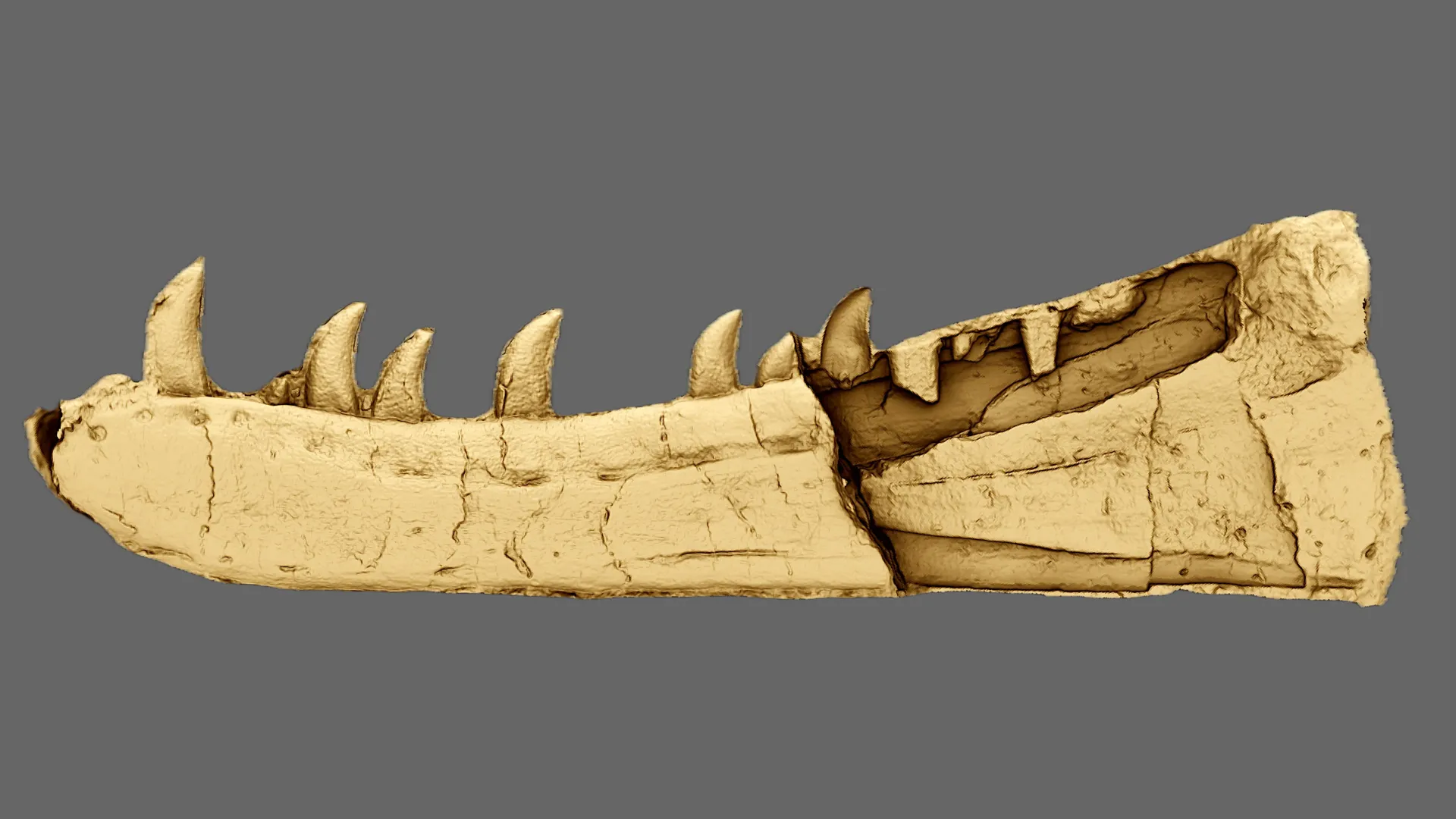
Paleontologists at the University of Bristol have officially identified a new species of dinosaur from Triassic fossil beds in South Wales, near Penarth – more than 125 years after the specimen was initially reported.
Using modern digital scanning techniques the researchers were able to shed new light on the fossil jawbone, which has been known since 1899 and been on display in the National Museum of Wales for many years, but was not correctly identified until now.
The fossil consists of natural molds of the jawbone in the rock and all the original bone has disappeared. So, using photo scanning, paleontology student Owain Evans was able to make a perfect 3D digital reconstruction to enable detailed study.
Owain Evans said: “This specimen has been referred to many times in scientific papers, but had yet to be successfully identified – we were not even sure whether it was dinosaur. It was named Zanclodon cambrensis by Edwin Tully Newton in 1899, but we knew the name Zanclodon had been abandoned as referring to a broad variety of early reptiles. Therefore, we name it after Newton, calling it Newtonsaurus. It is different from all other dinosaurs from around that time, and requires a distinctive name.”
Professor Michael J Benton, who is the senior author on the paper, said: “The natural molds of the inner and outer faces of the jawbone show amazing detail – every groove, ridge, tooth, and even the serrations along the edges of the teeth. We decided to use digital photography to make a 3D model. We began by surface scanning the fossil using photogrammetry. Once we had our digital scan, we then inverted it – essentially giving us a digital negative of the mold. It was then a simple case of fusing the two sides together and analyzing the anatomy from there. The digital reconstruction we have extracted from the specimen gives a much better idea of what the original structure of the bone would have looked like.”
Now that the fossil could be studied, the team was able to use its anatomy to piece together its position in the reptile family tree – and most crucially – whether it was a dinosaur or not.
Owain Evans said: “We can now confirm that this specimen very likely belonged to a large predatory theropod dinosaur, that roamed the shores of South Wales during the latest Triassic. It has some definite unique dinosaur features in the emplacement of the teeth, and it is a theropod — a predatory, flesh-eating dinosaur. Otherwise, it sits near the origins of both major divisions of Theropoda, the Coelophysoidea and the Averostra.
“Most unexpected is the size of the animal. The preserved jawbone is 28 cm long, and that is just the front half, so originally the jawbone was 60 cm long, corresponding to a dinosaur with a body length of 5-7 meters. This is unusually large for a Triassic theropod, most of which were half the size or smaller.”
Cindy Howells at the National Museum of Wales said: “These historical specimens are vitally important in paleontology and often yield new and exciting results – even if they have been sitting in collections for years. The Victorians were fascinated by the fossil record and prospected all across the UK for fossils. On top of this, the re-description of Newtonsaurus cambrensis once again highlights the significance of Wales in paleontological research. These Triassic beds are rare worldwide, and yet there are several across Wales. There might very well be another dinosaur waiting to be discovered.”
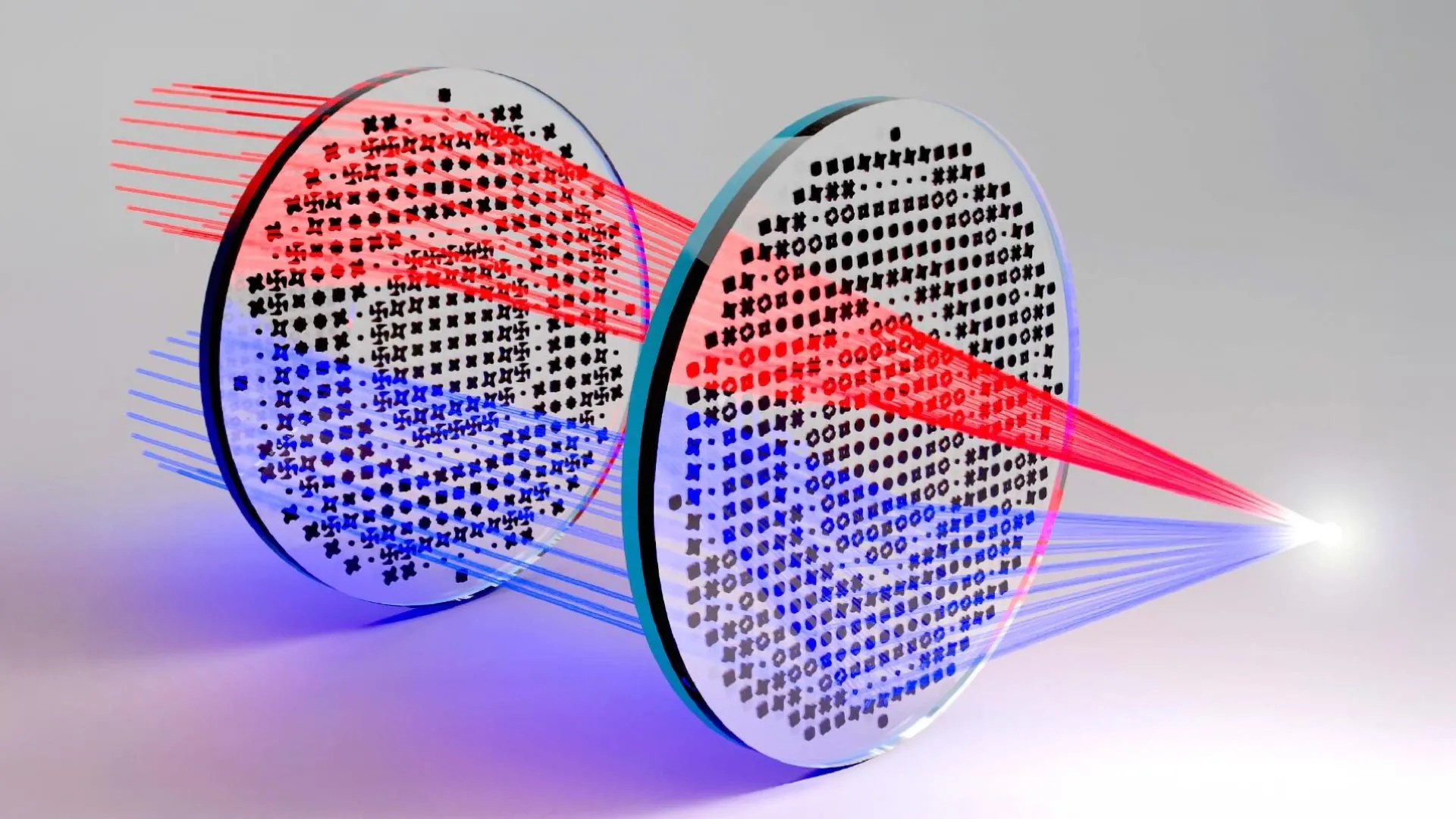
A new approach to manufacturing multicolor lenses could inspire a new generation of tiny, cheap, and powerful optics for portable devices such as phones and drones.
The design uses layers of metamaterials to simultaneously focus a range of wavelengths from an unpolarized source and over a large diameter, overcoming a major limitation of metalenses, said the first author of the paper reporting the design, Mr Joshua Jordaan, from the Research School of Physics at the Australian National University and the ARC Centre of Excellence for Transformative Meta-Optical Systems (TMOS).
“Our design has a lot of nice features that make it applicable to practical devices.”
“It’s easy to manufacture because it has a low aspect ratio and each layer can be fabricated individually and then packaged together, it’s also polarisation insensitive, and is potentially scalable through mature semiconductor nanofabrication platforms,” Mr Jordaan said.
The project was led by researchers from the Friedrich Schiller University Jena in Germany as part of the International Research Training Group Meta-ACTIVE. The paper reporting their design is published in Optics Express.
Metalenses have thickness mere fractions of the width of a hair, which is orders of magnitude thinner than conventional lenses. They can be designed to have properties such as focal lengths that would be impossibly short for conventional optics.
Initially the team attempted to focus multiple wavelengths with a single layer, but they hit up against some fundamental constraints, Mr Jordaan said.
“It turns out the maximum group-delay attainable in a single-layer metasurface has physical limitations, and these in turn set upper bounds on the product of the numerical aperture, physical diameter and operating bandwidth.”
“To work at the wavelength range we needed, a single layer would either have to have a very small diameter, which would defeat the purpose of the design, or basically have such a low numerical aperture that it’s hardly focusing the light at all,” he said.
“We realized we needed a more complex structure, which then led to a multi-layer approach.”
With the design shifted to incorporating several metalens layers, the team approached the problem with an inverse design algorithm based on shape optimization, with parameterization that meant a lot of degrees of freedom.
They guided the software to search for metasurface shapes that, for a single wavelength, created simple resonances in both the electric and magnetic dipole, known as Huygens resonances. By employing resonances, the team were able to improve on previous designs by other groups, and develop metalens designs that were polarization independent, and had greater tolerances in manufacturing specifications – crucial in the quest to scale fabrication to industrial quantities.
The optimization routine came up with a library of metamaterial elements in a surprising range of shapes, such as rounded squares, four-leaf clovers and propellers.
These tiny shapes, around 300 nm tall and 1000 nm wide, spanned the full range of phase shifts, from zero to two pi, enabling the team to create a phase gradient map to achieve any arbitrary focusing pattern – although they were initially just aiming for a simple ring structure of a conventional lens.
“We could, for example, focus different wavelengths into different locations to create a colour router,” Mr Jordaan said.
However, the multilayer approach is limited to a maximum of around five different wavelengths, Mr Jordaan said.
“The problem is you need structures large enough to be resonant at the longest wavelength, without getting diffraction from the shorter wavelengths,” he said.
Within these constraints, Mr Jordaan said the ability to make metalenses to collect a lot of light will be a boon for future portable imaging systems.
“The metalenses we have designed would be ideal for drones or earth-observation satellites, as we’ve tried to make them as small and light as possible,” he said.
