Sarah Spooner suffered such severe hyperemesis gravidarum, or extreme pregnancy sickness, that she felt she had no choice but to have an abortion.


Sarah Spooner suffered such severe hyperemesis gravidarum, or extreme pregnancy sickness, that she felt she had no choice but to have an abortion.
Olympic gold medalist Sophie Capewell talks about how periods impact female cyclists and athletes.
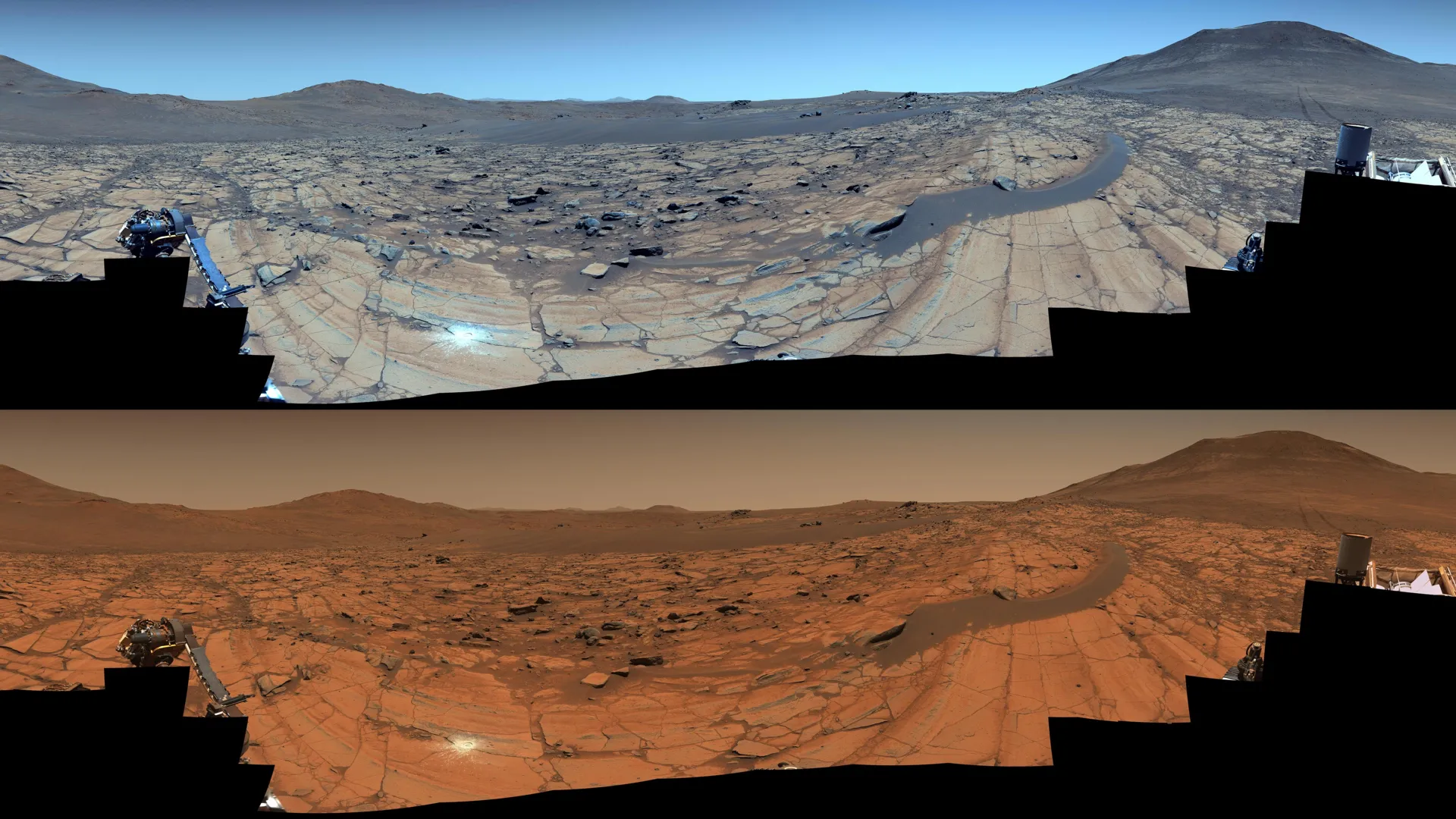
‘Float rocks,’ sand ripples, and vast distances are among the sights to see in the latest high-resolution panorama by the six-wheeled scientist.
The imaging team of NASA’s Perseverance Mars rover took advantage of clear skies on the Red Planet to capture one of the sharpest panoramas of its mission so far. Visible in the mosaic, which was stitched together from 96 images taken at a location the science team calls “Falbreen,” are a rock that appears to lie on top of a sand ripple, a boundary line between two geologic units, and hills as distant as 40 miles (65 kilometers) away. The enhanced-color version shows the Martian sky to be remarkably clear and deceptively blue, while in the natural-color version, it’s reddish.
“Our bold push for human space exploration will send astronauts back to the Moon,” said Sean Duffy, acting NASA administrator. “Stunning vistas like that of Falbreen, captured by our Perseverance rover, are just a glimpse of what we’ll soon witness with our own eyes. NASA’s groundbreaking missions, starting with Artemis, will propel our unstoppable journey to take human space exploration to the Martian surface. NASA is continuing to get bolder and stronger.”
The rover’s Mastcam-Z instrument captured the images on May 26, 2025, the 1,516th Martian day, or sol, of Perseverance’s mission, which began in February 2021 on the floor of Jezero Crater. Perseverance reached the top of the crater rim late last year.
“The relatively dust-free skies provide a clear view of the surrounding terrain,” said Jim Bell, Mastcam-Z’s principal investigator at Arizona State University in Tempe. “And in this particular mosaic, we have enhanced the color contrast, which accentuates the differences in the terrain and sky.”
Buoyant Boulder
One detail that caught the science team’s attention is a large rock that appears to sit atop a dark, crescent-shaped sand ripple to the right of the mosaic’s center, about 14 feet (4.4 meters) from the rover. Geologists call this type of rock a “float rock” because it was more than likely formed someplace else and transported to its current location. Whether this one arrived by a landslide, water, or wind is unknown, but the science team suspects it got here before the sand ripple formed.
The bright white circle just left of center and near the bottom of the image is an abrasion patch. This is the 43rd rock Perseverance has abraded since it landed on Mars. Two inches (5 centimeters) wide, the shallow patch is made with the rover’s drill and enables the science team to see what’s beneath the weathered, dusty surface of a rock before deciding to drill a core sample that would be stored in one of the mission’s titanium sample tubes.
The rover made this abrasion on May 22 and performed proximity science (a detailed analysis of Martian rocks and soil) with its arm-mounted instruments two days later. The science team wanted to learn about Falbreen because it’s situated within what may be some of the oldest terrain Perseverance has ever explored — perhaps even older than Jezero Crater.
Tracks from the rover’s journey to the location can be seen toward the mosaic’s right edge. About 300 feet (90 meters) away, they veer to the left, disappearing from sight at a previous geologic stop the science team calls “Kenmore.”
A little more than halfway up the mosaic, sweeping from one edge to the other, is the transition from lighter-toned to darker-toned rocks. This is the boundary line, or contact, between two geologic units. The flat, lighter-colored rocks nearer to the rover are rich in the mineral olivine, while the darker rocks farther away are believed to be much older clay-bearing rocks.
More About Perseverance
NASA’s Jet Propulsion Laboratory, which is managed for the agency by Caltech, built and manages operations of the Perseverance rover on behalf of NASA’s Science Mission Directorate in Washington, as part of NASA’s Mars Exploration Program portfolio. Arizona State University leads the operations of the Mastcam-Z instrument, working in collaboration with Malin Space Science Systems in San Diego, on the design, fabrication, testing, and operation of the cameras.

Weaver ants have solved a problem that has plagued human teams for centuries: individuals contribute less to tasks when more people join in. New research published in Current Biology on August 12 shows individual weaver ants instead get stronger as their group grows.
“Each individual ant almost doubled their pulling force as team size increased – they actually get better at working together as the group gets bigger,” says lead author Madelyne Stewardson from Macquarie University.
The longstanding problem in human teams was first published by French engineer Max Ringelmann in 1913 who measured students pulling on ropes and found that while total force increased as more people joined in, each individual’s contribution actually decreased.
The study shows weaver ants form super-efficient teams in which individuals actually increase their contributions as teams grow bigger, defying the declining performance affecting human teams.
These tiny, tree-dwelling ants (Oecophylla smaragdina) found in tropical Africa, Asia and Australia, are known for their nest-building behaviors, forming living chains to roll leaves and glue them with silk from their larvae.
Stewardson and behavioral ecologist Dr Chris Reid from Macquarie’s School of Natural Sciences worked with an international team to measure the force different sized ant teams could apply while building nests.
The researchers set up experiments enticing weaver ant colonies to form pulling chains to move an artificial leaf connected to a force meter.
“The ants split their work into two jobs: some actively pull while others act like anchors to store that pulling force,” says Stewardson.
How the ant team makes it work
Co-lead author Dr Daniele Carlesso from the University of Konstanz developed a theory called the ‘force ratchet’ to explain this mechanism.
“Ants at the back of chains stretch out their bodies to resist and store the pulling force, while ants at the front keep actively pulling,” says Dr Carlesso.
Dr David Labonte from Imperial College London, co-author on the paper, says the team found this method was key to increasing the contribution per individual as the team got bigger.
“Longer chains of ants have more grip on the ground than single ants, so they can better resist the force of the leaf pulling back,” he says.
Dr Reid says the discovery could help scientists design better robot teams. Current robots only output the same force when working in teams as when alone.
“Programming robots to adopt ant-inspired cooperative strategies could allow teams of autonomous robots to work together more efficiently,” says Dr Reid.
There is growing concern over Britons seeking overseas treatments such as hair implants and dental work.
The recommended UK price will rise by up to 170%, although the impact on consumers could be more limited.
Two new potential drugs have been designed by AI to kill drug-resistant bacteria, in a major Massachusetts Institute of Technology study.
There’ve been some amazing breakthroughs in treating certain kinds of blindness in recent years. But does everyone in the blind community want to be ‘cured’? Comedian Tom Skelton, who started losing his sight at 21, explores.
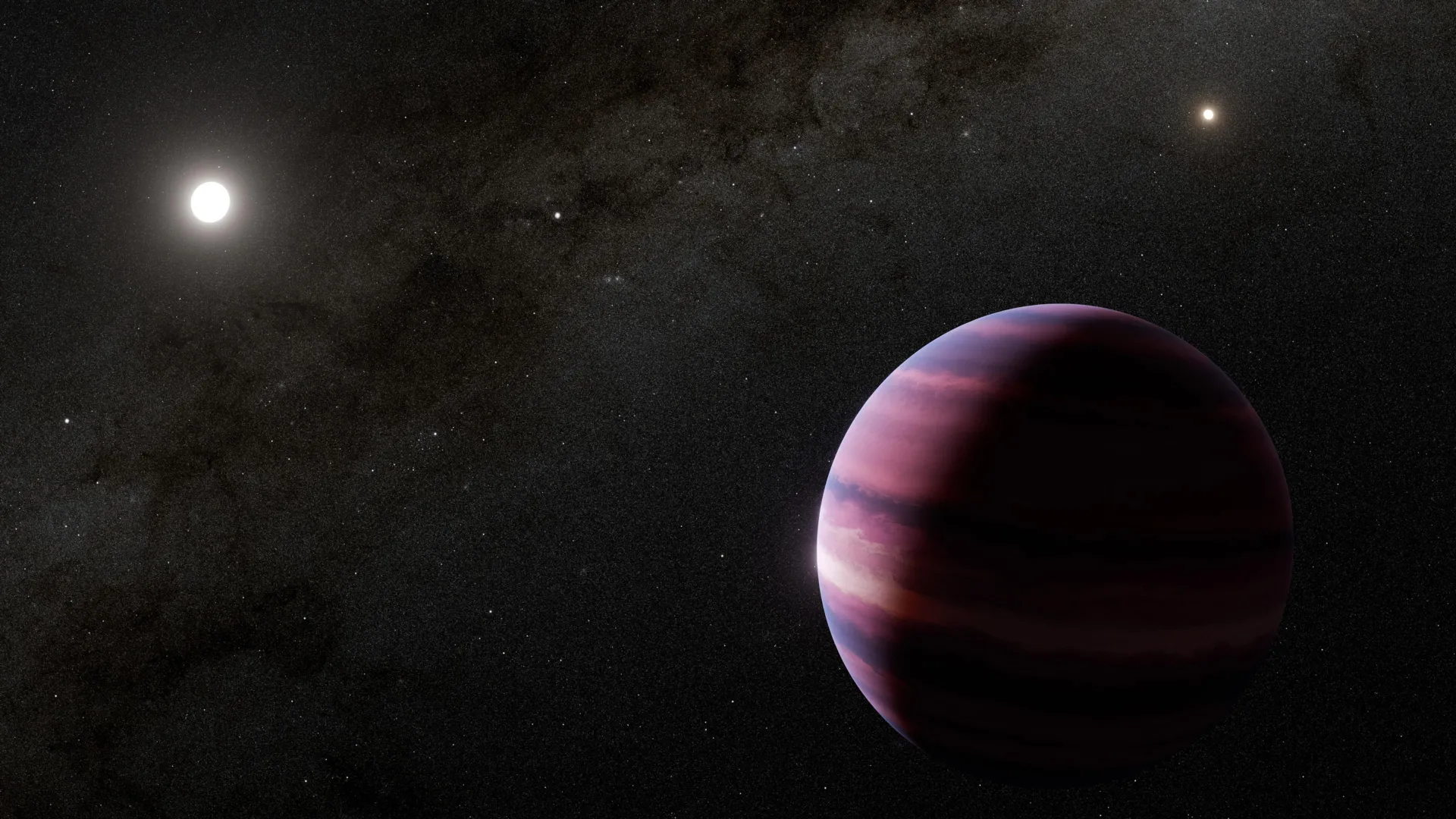
Found using the MIRI instrument on NASA’s Webb telescope, which was managed by JPL through launch, the possible planet would be easier to study than more far-flung worlds.
Astronomers using NASA’s James Webb Space Telescope have found strong evidence of a giant planet orbiting a star in the stellar system closest to our own Sun. At just 4 light-years away from Earth, the Alpha Centauri triple star system has long been a compelling target in the search for worlds beyond our solar system.
Visible only from Earth’s Southern Hemisphere, it’s made up of the binary Alpha Centauri A and Alpha Centauri B, both Sun-like stars, and the faint red dwarf star Proxima Centauri. Alpha Centauri A is the third brightest star in the night sky. While there are three confirmed planets orbiting Proxima Centauri, the presence of other worlds surrounding Alpha Centauri A and Alpha Centauri B has proved challenging to confirm.
Now, Webb’s observations from its Mid-Infrared Instrument (MIRI) are providing the strongest evidence to date of a gas giant orbiting Alpha Centauri A. The results have been accepted in a series of two papers in The Astrophysical Journal Letters.
If confirmed, the planet would be the closest to Earth that orbits in the habitable zone of a Sun-like star. However, because the planet candidate is a gas giant, scientists say it would not support life as we know it.
“With this system being so close to us, any exoplanets found would offer our best opportunity to collect data on planetary systems other than our own. Yet, these are incredibly challenging observations to make, even with the world’s most powerful space telescope, because these stars are so bright, close, and move across the sky quickly,” said Charles Beichman, NASA’s Jet Propulsion Laboratory and the NASA Exoplanet Science Institute at Caltech’s IPAC astronomy center, co-first author on the new papers. “Webb was designed and optimized to find the most distant galaxies in the universe. The operations team at the Space Telescope Science Institute had to come up with a custom observing sequence just for this target, and their extra effort paid off spectacularly.”
Several rounds of meticulously planned observations by Webb, careful analysis by the research team, and extensive computer modeling helped determine that the source seen in Webb’s image is likely to be a planet and not a background object (like a galaxy), foreground object (a passing asteroid), or other detector or image artifact.
The first observations of the system took place in August 2024, using the coronagraphic mask aboard MIRI to block Alpha Centauri A’s light. While extra brightness from the nearby companion star Alpha Centauri B complicated the analysis, the team was able to subtract out the light from both stars to reveal an object over 10,000 times fainter than Alpha Centauri A, separated from the star by about two times the distance between the Sun and Earth.
While the initial detection was exciting, the research team needed more data to come to a firm conclusion. However, additional observations of the system in February 2025 and April 2025 (using Director’s Discretionary Time) did not reveal any objects like the one identified in August 2024.
“We are faced with the case of a disappearing planet! To investigate this mystery, we used computer models to simulate millions of potential orbits, incorporating the knowledge gained when we saw the planet, as well as when we did not,” said Ph.D. student Aniket Sanghi of Caltech in Pasadena, California. Sanghi is a co-first author on the two papers covering the team’s research.
In these simulations, the team took into account both a 2019 sighting of the potential exoplanet candidate by the European Southern Observatory’s Very Large Telescope, the new data from Webb, and considered orbits that would be gravitationally stable in the presence of Alpha Centauri B, meaning the planet wouldn’t get flung out of the system.
Researchers say a non-detection in the second and third round of observations with Webb isn’t surprising.
“We found that in half of the possible orbits simulated, the planet moved too close to the star and wouldn’t have been visible to Webb in both February and April 2025,” said Sanghi.
Based on the brightness of the planet in the mid-infrared observations and the orbit simulations, researchers say it could be a gas giant approximately the mass of Saturn orbiting Alpha Centauri A in an elliptical path varying between one to two times the distance between the Sun and Earth.
“If confirmed, the potential planet seen in the Webb image of Alpha Centauri A would mark a new milestone for exoplanet imaging efforts,” Sanghi says. “Of all the directly imaged planets, this would be the closest to its star seen so far. It’s also the most similar in temperature and age to the giant planets in our solar system, and nearest to our home, Earth,” he says. “Its very existence in a system of two closely separated stars would challenge our understanding of how planets form, survive, and evolve in chaotic environments.”
If confirmed by additional observations, the team’s results could transform the future of exoplanet science.
“This would become a touchstone object for exoplanet science, with multiple opportunities for detailed characterization by Webb and other observatories,” said Beichman.
For example, NASA’s Nancy Grace Roman Space Telescope, set to launch by May 2027 and potentially as early as fall 2026, is equipped with dedicated hardware that will test new technologies to observe binary systems like Alpha Centauri in search of other worlds. Roman’s visible light data would complement Webb’s infrared observations, yielding unique insights on the size and reflectivity of the planet.
More About Webb and MIRI
The James Webb Space Telescope is the world’s premier space science observatory. Webb is solving mysteries in our solar system, looking beyond to distant worlds around other stars, and probing the mysterious structures and origins of our universe and our place in it. Webb is an international program led by NASA with its partners, ESA (European Space Agency) and CSA (Canadian Space Agency).
Webb’s MIRI was developed through a 50-50 partnership between NASA and ESA. A division of Caltech in Pasadena, California, JPL led the U.S. contribution to MIRI. JPL also led development of MIRI’s cryocooler, done in collaboration with Northrop Grumman in Redondo Beach, California, and NASA’s Goddard Space Flight Center in Greenbelt, Maryland.

Researchers think that members of the most recently identified “hominin” group (the Denisovans) mixed with early modern humans and passed along parts of their DNA. Evidence points to several separate interbreeding events, each leaving a genetic imprint that influenced the course of human history.
In 2010, scientists released the first draft of the Neanderthal genome. Comparing it with modern human DNA confirmed that Neanderthals and humans had interbred. Only months later, genetic analysis of a finger bone found in Denisova Cave in the Altai Mountains of Siberia revealed it came from a previously unknown hominin group. This group, now known as the Denisovans, also interbred with modern humans.
“This was one of the most exciting discoveries in human evolution in the last decade,” said Dr Linda Ongaro, Postdoctoral Research in Trinity College Dublin’s School of Genetics and Microbiology, and first author of a fascinating new review article published in leading international journal Nature Genetics.
“It’s a common misconception that humans evolved suddenly and neatly from one common ancestor, but the more we learn the more we realise interbreeding with different hominins occurred and helped to shape the people we are today.
“Unlike Neanderthal remains, the Denisovan fossil record consists of only that finger bone, a jawbone, teeth, and skull fragments. But by leveraging the surviving Denisovan segments in Modern Human genomes scientists have uncovered evidence of at least three past events whereby genes from distinct Denisovan populations made their way into the genetic signatures of modern humans.”
These events show varying degrees of genetic similarity to the Denisovan remains from the Altai region, hinting at a complex relationship among these closely related groups.
In their review, Dr Ongaro and Professor Emilia Huerta-Sanchez highlight evidence that Denisovans lived across a vast territory stretching from Siberia to Southeast Asia and from Oceania to South America. Different groups appear to have been adapted to their own specific environments.
They also detail several Denisovan-derived genes that gave humans survival advantages in different parts of the world.
Dr Ongaro noted: “Among these is a genetic locus that confers a tolerance to hypoxia, or low oxygen conditions, which makes a lot of sense as it is seen in Tibetan populations; multiple genes that confer heightened immunity; and one that impacts lipid metabolism, providing heat when stimulated by cold, which confers an advantage to Inuit populations in the Arctic.
“There are numerous future directions for research that will help us tell a more complete story of how the Denisovans impacted modern day humans, including more detailed genetic analyses in understudied populations, which could reveal currently hidden traces of Denisovan ancestry. Additionally, integrating more genetic data with archaeological information – if we can find more Denisovan fossils – would certainly fill in a few more gaps.”
