Hidden gene in leukemia virus could revolutionize HIV treatment

A research team from Kumamoto University has made a groundbreaking discovery that reveals how the human T-cell leukemia virus type 1 (HTLV-1) silently persists in the body, potentially laying the foundation for new therapeutic approaches. Their findings, published on May 13, 2025, in Nature Microbiology, identify a previously unknown genetic “silencer” element that keeps the virus in a dormant, undetectable state.

HTLV-1 is a cancer-causing retrovirus known to lead to adult T-cell leukemia/lymphoma (ATL), an aggressive and often fatal disease. Although most infected individuals remain asymptomatic for life, a fraction eventually develops leukemia or other inflammatory conditions. The virus achieves long-term persistence by entering a “latent” state, during which its genetic material hides inside the host’s genome with minimal activity — evading immune detection.

In this study, the research team, led by Professor Yorifumi Satou from the Joint Research Center for Human Retrovirus, Kumamoto University, identified a specific region within the HTLV-1 genome that functions as a viral silencer. This sequence recruits host transcription factors, particularly the RUNX1 complex, which suppresses the virus’s gene expression. When this silencer region was removed or mutated, the virus became more active, leading to greater immune recognition and clearance in lab models.

Remarkably, when the HTLV-1 silencer was artificially inserted into HIV-1 — the virus that causes AIDS — the HIV virus adopted a more latent-like state, with reduced replication and cell killing. This suggests that the silencer mechanism could potentially be harnessed to design better therapies for HIV as well.

“This is the first time we’ve uncovered a built-in mechanism that allows a human leukemia virus to regulate its own invisibility,” said Professor Satou. “It’s a clever evolutionary tactic, and now that we understand it, we might be able to turn the tables in treatment.”

The findings offer hope not only for understanding and treating HTLV-1, especially in endemic regions like southwestern Japan, but also for broader retroviral infections.

Share Button

Rutgers physicists just discovered a strange new state of matter

Scientists have discovered a new way that matter can exist – one that is different from the usual states of solid, liquid, gas or plasma – at the interface of two exotic, materials made into a sandwich.

The new quantum state, called quantum liquid crystal, appears to follow its own rules and offers characteristics that could pave the way for advanced technological applications, the scientists said.

Reporting in the journal Science Advances, a Rutgers-led team of researchers described an experiment that focused on the interaction between a conducting material called the Weyl semimetal and an insulating magnetic material known as spin ice when both are subjected to an extremely high magnetic field. Both materials individually are known for their unique and complex properties.

“Although each material has been extensively studied, their interaction at this boundary has remained entirely unexplored,” said Tsung-Chi Wu, who earned his doctoral degree in June from the Rutgers graduate program in physics and astronomy and is the first author of the study. “We observed new quantum phases that emerge only when these two materials interact. This creates a new quantum topological state of matter at high magnetic fields, which was previously unknown.”

The team discovered that at the interface of these two materials, the electronic properties of the Weyl semimetal are influenced by the magnetic properties of the spin ice. This interaction leads to a very rare phenomenon called “electronic anisotropy” where the material conducts electricity differently in different directions. Within a circle of 360 degrees, the conductivity is lowest at six specific directions, they found. Surprisingly, when the magnetic field is increased, the electrons suddenly start flowing in two opposite directions.

This discovery is consistent with a characteristic seen in the quantum phenomenon known as rotational symmetry breaking and indicates the occurrence of a new quantum phase at high magnetic fields.

The findings are significant because they reveal new ways in which the properties of materials can be controlled and manipulated, Wu said. By understanding how electrons move in these special materials, scientists could potentially design new generations of ultra-sensitive quantum sensors of magnetic fields that work best in extreme conditions – such as in space or inside powerful machines.

Weyl semimetals are materials that allow electricity to flow in unusual ways with very high speed and zero energy loss because of special relativistic quasi-particles called Weyl fermions. Spin ice, on the other hand, are magnetic materials where the magnetic moments (tiny magnetic fields within the material) are arranged in a way that resembles the positions of hydrogen atoms in ice. When these two materials are combined, they create a heterostructure, composed of atomic layers of dissimilar materials.

Scientists have found that new states of matter appear under extreme conditions, including very low temperatures, high pressures or high magnetic fields, and behave in strange and fascinating ways. Experiments such as the Rutgers-led one may lead to new, fundamental understanding of matter beyond the naturally occurring four states of matter, according to Wu.

“This is just the beginning,” Wu said. “There are multiple possibilities for exploring new quantum materials and their interactions when combined into a heterostructure. We hope our work will also inspire the physics community to explore these exciting new frontiers.”

The research was conducted using a combination of experimental techniques, led by the principal investigator for the project, Jak Chakhalian, the Claud Lovelace Endowed Professor of Experimental Physics in the Department of Physics and Astronomy and a co-author of the study. The work was theoretically supported by Jedediah Pixley, an associate professor in the Department of Physics and Astronomy, also a co-author of the study.

“The experiment-theory collaboration is what really makes the work possible,” Wu said. “It took us more than two years to understand the experimental results. The credit goes to the state-of-the-art theoretical modeling and calculations done by the Pixley group, particularly Jed Pixley and Yueqing Chang, a postdoctoral researcher. We are continuing our collaboration to push the frontier of the field as a Rutgers team.”

Most of the experiments were conducted at the National High Magnetic Field Laboratory (MagLab) in Tallahassee, Fla., which provided the unique conditions to study these materials at ultra-low temperatures and high magnetic fields.

“We had to initiate the collaboration and travel to the MagLab multiple times to perform these experiments, each time refining ideas and methods,” Wu said. “The ultra-low temperatures and high magnetic fields were crucial for observing these new phenomena.”

The research builds on previous Rutgers-led research published earlier this year by Chakhalian, Mikhail Kareev, Wu and other physicists. The report described how four years of continuous experimentation led to a novel method to design and build a unique, tiny, atoms-thick structure composed of a Weyl semimetal and spin ice. The quantum heterostructure was so difficult to create, the scientists developed a machine to make it: the Q-DiP, short for quantum phenomena discovery platform.

“In that paper, we described how we made the heterostructure,” said Chakhalian. “The new Science Advances paper is about what it can do.”

In addition to Chakhalian, Wu, Chang and Pixley, Rutgers researchers on the study included Ang-Kun Wu, Michael Terilli, Fangdi Wen and Mikhail Kareev.

Share Button

After 50 years, scientists finally catch elusive neutrinos near a reactor

Neutrinos are extremely elusive elementary particles. Day and night, 60 billion of them stream from the Sun through every square centimeter of the Earth every second, which is transparent to them. After the first theoretical prediction of their existence, decades passed before they were actually detected. These experiments are usually extremely large to account for the very weak interaction of neutrinos with matter. Scientists at the Max Planck Institute for Nuclear Physics (MPIK) in Heidelberg have now succeeded in detecting antineutrinos from the reactor of a nuclear power plant using the CONUS+ experiment, with a detector mass of just 3 kg.

Originally based at the Brokdorf nuclear power plant, the CONUS experiment was relocated to the Leibstadt nuclear power plant (KKL) in Switzerland in the summer of 2023. Improvements to the 1 kg germanium semiconductor detectors, as well as the excellent measurement conditions at KKL, made it possible for the first time to measure what is known as Coherent Elastic Neutrino-Nucleus Scattering (CEvNS). In this process, neutrinos do not scatter off the individual components of the atomic nuclei in the detector, but rather coherently with the entire nucleus. This significantly increases the probability of a very small but observable nuclear recoil. This recoil caused by neutrino scattering is comparable to a ping-pong ball bouncing off a car, with the detection being the changing motion of the car. In the case of CONUS+, the scattering partners are the atomic nuclei of the germanium. Observing this effect requires low-energy neutrinos, such as those produced in large numbers in nuclear reactors.

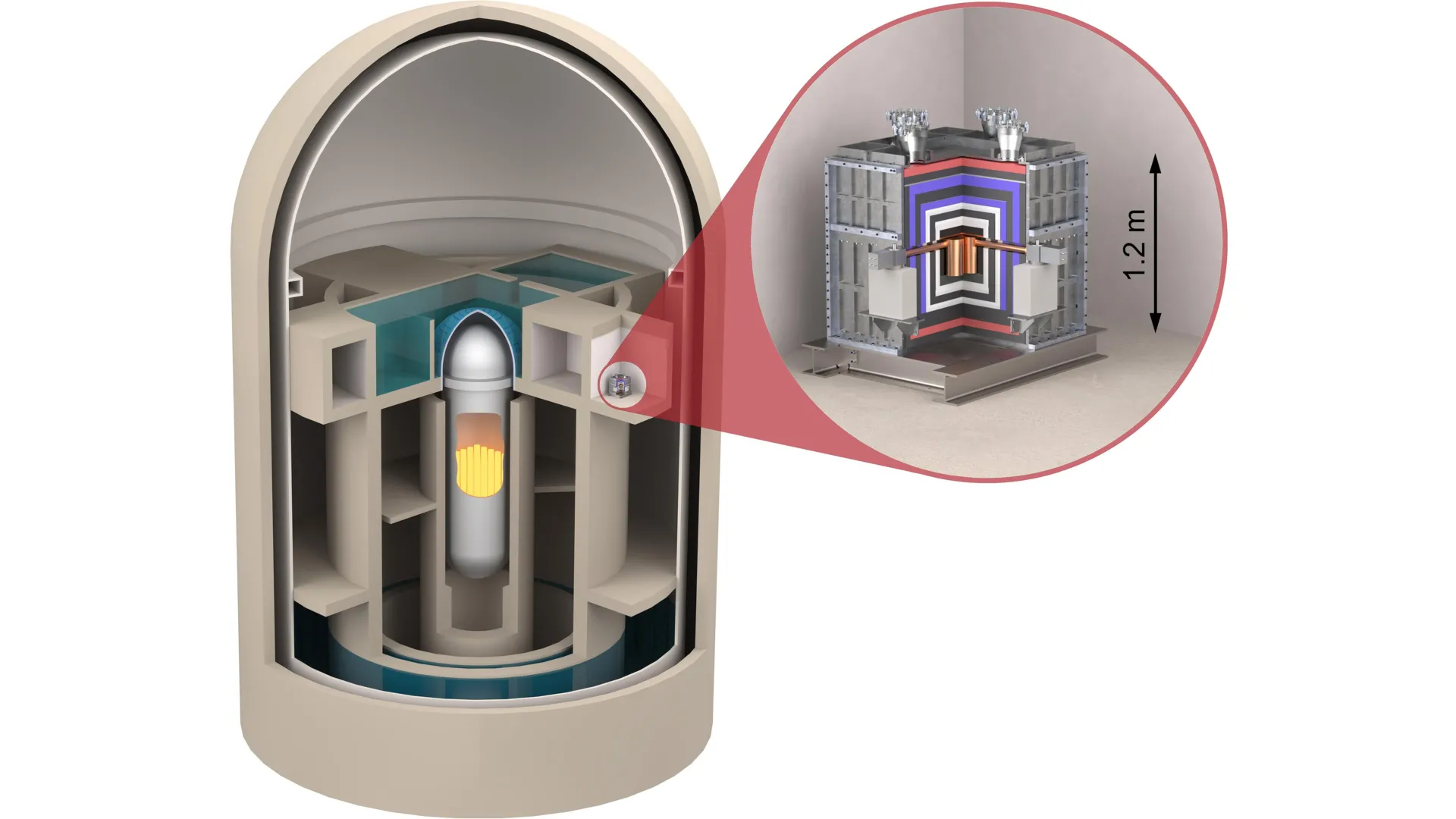
The effect was predicted as early as 1974, but was first confirmed in 2017 by the COHERENT experiment at a particle accelerator. The CONUS+ experiment has now successfully observed the effect at full coherence and lower energies in a reactor for the first time, as described in a recent Nature research article. The compact CONUS+ setup is located 20.7 m from the reactor core (see image above). At this position, more than 10 trillion neutrinos flow through every square centimeter of surface every second. After approximately 119 days of measurement between autumn 2023 and summer 2024, the researchers were able to extract an excess of 395±106 neutrino signals from the CONUS+ data, after subtracting all background and interfering signals. This value is in very good agreement with theoretical calculations, within the measurement uncertainty. “We have thus successfully confirmed the sensitivity of the CONUS+ experiment and its ability to detect antineutrino scattering from atomic nuclei,” explains Dr. Christian Buck, one of the authors of the study. He also emphasizes the potential development of small, mobile neutrino detectors to monitor reactor heat output or isotope concentration as possible future applications of the CEvNS technique presented here.

The CEvNS measurement provides unique insights into fundamental physical processes within the Standard Model of particle physics, the current theory describing the structure of our universe. Compared to other experiments, the measurements with CONUS+ allow for a reduced dependence on nuclear physics aspects, thereby improving the sensitivity to new physics beyond the Standard Model. For this reason, CONUS+ was already equipped with improved and larger detectors in autumn 2024. With the resulting measurement accuracy, even better results are expected. “The techniques and methods used in CONUS+ have excellent potential for fundamental new discoveries,” emphasizes Prof. Lindner, initiator of the project and also an author of the study. “The groundbreaking CONUS+ results could therefore mark the starting point for a new field in neutrino research.”

Share Button

Older driver rules ‘could have saved mum’s life’

Claire Eady is calling for new regulations after losing her elderly mother in a crash.

Share Button

Black holes don’t just swallow light, they sing. And we just learned the tune

Black holes embody the ultimate abyss. They are the most powerful sources of gravity in the universe, capable of dramatically distorting space and time around them. When disturbed, they begin to “ring” in a distinctive pattern known as quasinormal modes: ripples in space-time that produce detectable gravitational waves.

In events like black hole mergers, these waves can be strong enough to detect from Earth, offering a unique opportunity to measure a black hole’s mass and shape. However, precise calculation of these vibrations through theoretical methods has proven a major challenge, particularly for vibrations that are rapidly weakening.

This inspired a team of researchers at Kyoto University to try a new method of calculating the vibrations of black holes. The scientists applied a mathematical technique called the exact Wentzel-Kramers-Brillouin, orexact WKB analysisto carefully trace the behavior of waves from a black hole out into distant space. While this method has long been studied in mathematics, its application to physics — especially to black holes — is still a newly developing area.

“The foundations of the exact WKB methodwere largely developed by Japanese mathematicians. As a researcher from Japan, I have always found this field intellectually and culturally familiar,” says corresponding author Taiga Miyachi.

This method allowed the research team to follow wave patterns in great detail, even in regions that are difficult to analyze with other existing methods. Their approach involved examining space near the black hole by extending it into the complex number domain, revealing a rich structure of the black hole’s geometry.

This included a mathematical phenomenon called Stokes curves, which designate where the nature of a wave suddenly changes. While previous studies have often overlooked the infinitely spiraling Stokes curves and paths that branch off from black holes, the research team incorporated these complex features into their analysis.

The findings revealed that the team had succeeded in developing a method that systematically and precisely captures the frequency structure of rapidly weakening vibrations. This demonstrates the power of the exact WKB method as a practical tool for bridging theoretical predictions with observational data.

“We were surprised at how complex and beautiful the underlying structure of these vibrations turned out to be. We found spiraling patterns in our mathematical analysis that had been missed before, and these turned out to be key in understanding the full picture of quasinormal modes,” says Miyachi.

This study makes it possible to analyze the “ringing sounds” of black holes across a wide range of theoretical models. Ultimately, this may help improve the precision of future gravitational wave observations and lead to a deeper, more reliable understanding of the true nature of our Universe and its geometry.

Looking ahead, the research team plans to extend their approach to rotating black holes and to explore the application of exact WKB analysis in studies related to quantum gravity effects.

Share Button

Caffeine pouch craze: A teenage trend troubling some experts

Some social media influencers are pushing products to young gym-goers and students, health experts warn.

Share Button

The teenage caffeine pouch trend troubling US experts

Some social media influencers are pushing products to young gym-goers and students, health experts warn.

Share Button

Mums’ support group ‘buzzing’ at award nomination

Omagh group Support 2gether is a finalist in the BBC’s Make a Difference Awards.

Share Button

Former nurse loses legal challenge over private gender clinic

A High Court challenge over the registration of England’s first private gender clinic for teenagers has failed.

Share Button

Reversing Alzheimer’s damage: Two cancer drugs demonstrate surprising power

Scientists at UC San Francisco and Gladstone Institutes have identified cancer drugs that promise to reverse the changes that occur in the brain during Alzheimer’s, potentially slowing or even reversing its symptoms.

The study first analyzed how Alzheimer’s disease altered gene expression in single cells in the human brain. Then, researchers looked for existing drugs that were already approved by the Food and Drug Administration (FDA) and cause the opposite changes to gene expression.

They were looking specifically for drugs that would reverse the gene expression changes in neurons and in other types of brain cells called glia, all of which are damaged or altered in Alzheimer’s disease.

Next, the researchers analyzed millions of electronic medical records to show that patients who took some of these drugs as part of their treatment for other conditions were less likely to get Alzheimer’s disease.

When they tested a combination of the two top drugs — both of which are cancer medications — in a mouse model of Alzheimer’s, it reduced brain degeneration in the mice, and even restored their ability to remember.

“Alzheimer’s disease comes with complex changes to the brain, which has made it tough to study and treat, but our computational tools opened up the possibility of tackling the complexity directly,” said Marina Sirota, PhD, the interim director of the UCSF Bakar Computational Health Sciences Institute, professor of pediatrics, and co-senior author of the paper. “We’re excited that our computational approach led us to a potential combination therapy for Alzheimer’s based on existing FDA-approved medications.”

The findings appeared in Cell on July 21. The research was funded in part by the National Institutes of Health and the National Science Foundation.

Big data from patients and cells points to a new Alzheimer’s therapy

Alzheimer’s disease affects 7 million people in the U.S. and causes a relentless decline in cognition, learning, and memory. Yet decades of research have only produced two FDA-approved drugs, neither of which can meaningfully slow this decline.

“Alzheimer’s is likely the result of numerous alterations in many genes and proteins that, together, disrupt brain health,” said Yadong Huang, MD, PhD, senior investigator and director of the Center for Translational Advancement at Gladstone, professor of neurology and pathology at UCSF, and co-senior author of the paper. “This makes it very challenging for drug development — which traditionally produces one drug for a single gene or protein that drives disease.”

The team took publicly available data from three studies of the Alzheimer’s brain that measured single-cell gene expression in brain cells from deceased donors with or without Alzheimer’s disease. They used this data to produce gene expression signatures for Alzheimer’s disease in neurons and glia.

The researchers compared these signatures with those found in the Connectivity Map, a database of results from testing the effects of thousands of drugs on gene expression in human cells.

Out of 1,300 drugs, 86 reversed the Alzheimer’s disease gene expression signature in one cell type, and 25 reversed the signature in several cell types in the brain. But just 10 had already been approved by the FDA for use in humans.

Poring through records housed in the UC Health Data Warehouse, which includes anonymized health information on 1.4 million people over the age of 65, the group found that several of these drugs seemed to have reduced the risk of developing Alzheimer’s disease over time.

“Thanks to all these existing data sources, we went from 1,300 drugs, to 86, to 10, to just 5,” said Yaqiao Li, PhD, a former UCSF graduate student in Sirota’s lab who is now a postdoctoral scholar in Huang’s lab at Gladstone and the lead author of the paper. “In particular, the rich data collected by all the UC health centers pointed us straight to the most promising drugs. It’s kind of like a mock clinical trial.”

A combination therapy poised for primetime

Li, Huang, and Sirota chose 2 cancer drugs out of the top 5 drug candidates for laboratory testing. They predicted one drug, letrozole, would remedy Alzheimer’s in neurons; and another, irinotecan, would help glia. Letrozole is usually used to treat breast cancer; irinotecan is usually used to treat colon and lung cancer.

The team used a mouse model of aggressive Alzheimer’s disease with multiple disease-related mutations. As the mice aged, symptoms resembling Alzheimer’s emerged, and they were treated with one or both drugs.

The combination of the two cancer drugs reversed multiple aspects of Alzheimer’s in the animal model. It undid the gene expression signatures in neurons and glia that had emerged as the disease progressed. It reduced both the formation of toxic clumps of proteins and brain degeneration. And, importantly, it restored memory.

“It’s so exciting to see the validation of the computational data in a widely used Alzheimer’s mouse model,” Huang said. He expects the research to advance soon to a clinical trial so the team can directly test the combination therapy in Alzheimer’s patients.

“If completely independent data sources, such as single-cell expression data and clinical records, guide us to the same pathways and the same drugs, and then resolve Alzheimer’s in a genetic model, then maybe we’re onto something,” Sirota said. “We’re hopeful this can be swiftly translated into a real solution for millions of patients with Alzheimer’s.”

Authors: Other UCSF authors are Carlota Pereda Serras, MS, Jessica Blumenfeld, Xinyu Tang, PhD, Antara Rao, PhD, Sarah Woldemariam, PhD, Alice Tang, PhD, Tomiko Oskotsky, MD, and Michael J Keiser, PhD. Other Gladstone Institutes authors are Min Xie, PhD, Yanxia Hao, Elise Deng, You Young Chun, Julia Holtzman, Alice An, Seo Yeon Yoon, MBA, Alex Zhang, Jeffrey Simms, MA, and Iris Lo.

Funding: This study was supported by the National Institute on Aging (R01AG060393, R01AG057683, RF1AG076647, R01AG078164, and P01AG073082), the National Science Foundation (2034836), and the Dolby Family Fund.


Share Button