A new brain connection discovered by University of California, Irvine researchers can explain how early-life stress and adversity trigger disrupted operation of the brain’s reward circuit, offering a new therapeutic target for treating mental illness. Impaired function of this circuit is thought to underlie several major disorders, such as depression, substance abuse and excessive risk-taking.
In an article recently published online in Nature Communications, Dr. Tallie Z. Baram, senior author and UCI Donald Bren Professor and Distinguished Professor in the Departments of Anatomy & Neurobiology, Pediatrics, Neurology and Physiology & Biophysics, and Matt Birnie, lead author and a postdoctoral researcher, describe the cellular changes in the brain’s circuitry caused by exposure to adversity during childhood.
“We know that early-life stress impacts the brain, but until now, we didn’t know how,” Baram said. “Our team focused on identifying potentially stress-sensitive brain pathways. We discovered a new pathway within the reward circuit that expresses a molecule called corticotropin-releasing hormone that controls our responses to stress. We found that adverse experiences cause this brain pathway to be overactive.”
“These changes to the pathway disrupt reward behaviors, reducing pleasure and motivation for fun, food and sex cues in mice,” she said. “In humans, such behavioral changes, called ‘anhedonia,’ are associated with emotional disorders. Importantly, we discovered that when we silence this pathway using modern technology, we restore the brain’s normal reward behaviors.”
Researchers mapped all the CRH-expressing connections to the nucleus accumbens, a pleasure and motivation hub in the brain, and found a previously unknown projection arising from the basolateral amygdala. In addition to CRH, projection fibers co-expressed gama-aminobutyric acid. They found that this new pathway, when stimulated, suppresses several types of reward behaviors in male mice.
The study involved two groups of male and female mice. One was exposed to adversity early in life by living for a week in cages with limited bedding and nesting material, and the other was reared in typical cages. As adults, the early adversity-experiencing male mice had little interest in sweet foods or sex cues compared to typically reared mice. In contrast, adversity-experiencing females craved rich, sweet food. Inhibiting the pathway restored normal reward behaviors in males, yet it had no effect in females.
“We believe that our findings provide breakthrough insights into the impact of early-life adversity on brain development and specifically on control of reward behaviors that underlie many emotional disorders. Our discovery of the previously unknown circuit function of the basolateral amygdala-nucleus accumbens brain pathway deepens our understanding of this complex mechanism and identifies a significant new therapeutic target.” Baram said. “Future studies are needed to increase our understanding of the different and sex-specific effects of early-life adversity on behavior.”
Team members include Annabel K. Short, postdoctoral researcher, Lara Taniguchi, graduate student, Aidan Pham, lab assistant, and co-corresponding author Yuncai Chen, project scientist, from Department of Pediatrics; Gregory B. de Carvalho, graduate student, Benjamin G. Gunn, assistant project scientist; Christy A. Itoga, researcher; Xiangmin Xu, professor; Lulu Y. Chen, assistant professor; from the Department of Anatomy & Neurobiology; and Stephen V. Mahler, associate professor from the Department of Neurobiology and Behavior.
This work was supported by National Institute of Health grants P50 MH096889, MH73136, U01DA053826 NS108296 P50 DA044118, P50 MH096889 Seed Award FG23670, The Bren Foundation, a George E. Hewitt Foundation for Biomedical Research Fellowship and a British Society for Neuroendocrinology Project Support Grant BSN-5646342.
While analyzing data from the first images of a well-known early galaxy taken by NASA’s James Webb Space Telescope (JWST), Cornell University astronomers discovered a companion galaxy previously hidden behind the light of the foreground galaxy — one that surprisingly seems to have already hosted multiple generations of stars despite its young age, estimated at 1.4 billion years old.
“We found this galaxy to be super-chemically abundant, something none of us expected,” said Bo Peng, a doctoral student in astronomy, who led the data analysis. “JWST changes the way we view this system and opens up new venues to study how stars and galaxies formed in the early universe.”
Peng is the lead author of “Discovery of a Dusty, Chemically Mature Companion to z~4 Starburst Galaxy in JWST Early Release Science Data,” published in the Astrophysical Journal Letters.
Earlier images captured by the Atacama Large Millimeter/submillimeter Array (ALMA) in Chile contained hints of the companion resolved clearly by JSWT, but couldn’t be interpreted as anything more than random noise, said Amit Vishwas, a research associate at the Cornell Center for Astrophysics and Planetary Sciences (CCAPS) and the paper’s second author.
The team estimated the companion galaxy, which they labeled SPT0418-SE, was within 5 kiloparsecs of SPT0418-47, one of the brightest dusty, star-forming galaxies in the early universe, its distant light bent and magnified by a foreground galaxy’s gravity into a circle, called an Einstein ring. The Magellanic Clouds, satellites of the Milky Way are about 50 kiloparsecs away. The proximity suggests these galaxies are bound to interact with each other and potentially even merge, an observation that adds to the understanding of how early galaxies may have evolved into larger ones.
The two galaxies are modest in mass as galaxies in the early universe go, with “SE” relatively smaller and less dusty, making it appear bluer than the extremely dust-obscured ring. Based on images of nearby galaxies with similar colors, the researchers suggest that they may reside “in a massive dark-matter halo with yet-to-be-discovered neighbors.”
Most surprising about the companion galaxy, considering its age and mass, was its mature metallicity — amounts of elements heavier than helium and hydrogen, such as carbon, oxygen and nitrogen. The team estimated that as comparable to our sun, which is more than 4 billion years old and inherited most of its metals from previous generations of stars that had 8 billion years to build them up.
“We are seeing the leftovers of at least a couple of generations of stars having lived and died within the first billion years of the universe’s existence, which is not what we typically see,” Vishwas said. “We speculate that the process of forming stars in these galaxies must have been very efficient and started very early in the universe, particularly to explain the measured abundance of nitrogen relative to oxygen, as this ratio is a reliable measure of how many generations of stars have lived and died.”
I’ve been making steady progress on the new Engage course design. It’s a lot of work – I’ve been putting in some long hours lately – but very fulfilling. I’m enjoying working co-creatively with ChatGPT on it. This has really taken the course design and development process to a whole new level.
I wouldn’t say that it’s saving me time per se. I could potentially leverage AI to speed up my design process, but that doesn’t resonate with me. Rather, it’s enabling me to go much deeper into understanding the core ideas, transformations, audience, and more. I can explore the ideas from many more angles and reflect upon them in ways I couldn’t really do before, at least not as thoroughly as I can now.
I love that ChatGPT has a decent working memory. I’m learning how to preload it with different subsets of information that I want it to work on, so I can have it generate more permutations of those ideas and do some insightful reasoning about them.
For instance, I had ChatGPT generate representative quotes regarding the problems and challenges people might express that Engage is being designed to address:
Key Quotes (AI Simulated)
“I feel like I’m just going through the motions every day, without really living.”
“I’m always busy, but I never seem to get anything done.”
“I can’t seem to focus on anything for more than a few minutes at a time.”
“I’m constantly distracted by social media and other digital devices.”
“I’m always exhausted, even when I get enough sleep.”
“I have trouble setting priorities and sticking to them.”
“I feel like I’m not making any progress in my life or career.”
“I have trouble motivating myself to do the things I know I need to do.”
“I’m afraid of taking risks and trying new things.”
“I feel like I’m stuck in a rut and can’t break out of it.”
“I have trouble saying no and setting boundaries with others.”
“I feel like I’m not living up to my full potential.”
“I struggle with self-doubt and negative self-talk.”
“I have trouble finding a sense of purpose or direction in my life.”
“I’m overwhelmed by the sheer amount of tasks and responsibilities I have to juggle.”
“I’m constantly stressed out and anxious.”
“I have trouble managing my time and getting things done efficiently.”
“I don’t feel like I have enough time or energy to pursue my passions and hobbies.”
“I have trouble balancing my work and personal life.”
“I feel like I’m not making enough progress towards my goals.”
“I struggle with procrastination and putting things off until the last minute.”
“I’m easily overwhelmed by large projects or tasks.”
“I have trouble focusing on the present moment and enjoying life as it happens.”
“I’m constantly comparing myself to others and feeling inadequate.”
“I feel like I’m just going through the motions of life, without really experiencing it.”
“I have trouble finding meaningful relationships and connections with others.”
“I feel like I’m not living an authentic life, but rather one that’s been dictated by others or by society.”
“I struggle with perfectionism and have trouble accepting my flaws and mistakes.”
“I have trouble making decisions and second-guessing myself.”
“I feel like I’m not living up to the expectations of others, such as my family or society as a whole.”
It’s easy to have ChatGPT generate many variations of this type of list. This helps me catch additional ideas that may not be captured in a single list.
I feel especially well-suited to working with ChatGPT productively on this kind of project because of my background as a writer and as a programmer. It’s such a unique and robust tool, and I find myself shifting around a lot in how I interface with it – sometimes leaning more on normal human language while other times approaching it more like a coder and thinking algorithmically. I often think of ChatGPT as the ultimate programming language. It’s incredibly flexible in what it can do, and I love discovering new ways to squeeze more performance out of it. I use it pretty much every day now.
I especially like that I can use ChatGPT to give me different viewports into a range of self-development ideas that I’m working with. For instance, I can have it generate lists of side effects of people’s problems and struggles, so I better understand what they may be going through.
Here’s an example where I asked ChatGPT to predict 10 side effects that people may experience as a result of experiencing the struggles and challenges that Engage is being designed to address:
10 Side Effects
Poor health and well-being: Chronic stress and burnout can lead to physical and mental health problems, including fatigue, insomnia, anxiety, depression, and even chronic diseases.
Strained relationships: A lack of focus and productivity can lead to unmet commitments, unfulfilled promises, and strained relationships with friends, family, and colleagues.
Missed opportunities: Without a clear sense of purpose and direction, individuals may miss out on opportunities that could lead to personal and professional growth and fulfillment.
Financial instability: Poor productivity and lack of focus can lead to missed deadlines, poor performance, and reduced income or job loss, leading to financial instability and stress.
Reduced creativity and innovation: Without mental and emotional alignment, individuals may struggle to tap into their full creative potential, leading to stagnation and reduced innovation.
Reduced sense of self-worth: Failure to meet personal and professional goals can lead to reduced self-esteem and self-worth, creating a cycle of negative self-talk and self-doubt.
Reduced impact and influence: Without the ability to focus and deliver on important tasks and projects, individuals may struggle to make a meaningful impact in their personal and professional lives.
Reduced sense of meaning and purpose: Without a clear sense of purpose and direction, individuals may struggle to find meaning and fulfillment in their personal and professional lives.
Reduced quality of life: The combined impact of these challenges can lead to a reduced quality of life, characterized by stress, burnout, and a lack of fulfillment.
Reduced sense of community and connection: Poor productivity and a lack of engagement can lead to social isolation and reduced sense of community and connection, exacerbating feelings of stress and loneliness.
Here’s another version, focused on the inner experience of these struggles.
Top 10 Inner Issues Experienced
Feeling overwhelmed and stressed, with a constant sense of pressure to perform or succeed
Experiencing a lack of clarity and purpose, and feeling uncertain about the direction of their life
Feeling disconnected from themselves and their own desires, as well as from other people and the world around them
Struggling with self-doubt, insecurity, and a negative inner voice that criticizes and undermines their efforts
Finding it difficult to focus and be productive, and feeling easily distracted or unmotivated
Feeling stuck in unfulfilling or unsatisfying situations, such as a job or relationship that isn’t fulfilling their needs
Feeling like they’re not living up to their full potential, and a sense of disappointment or regret about missed opportunities
Struggling with anxiety or other mental health issues, which can make it difficult to engage fully with life and pursue their goals
Feeling like they’re always in a state of transition or change, and not being able to find a sense of stability or security
Feeling like they’re alone or unsupported in their efforts to create a more engaged and fulfilling life, and lacking a sense of community or connection with others who share their values and goals.
I don’t know about you, but when I read these kinds of lists, it stirs up a lot of empathy because I know these are real challenges that many people experience every day.
How about a succinct list of the core struggles?
25 Core Struggles
Doubt
Anxiety
Uncertainty
Overwhelm
Procrastination
Self-doubt
Self-criticism
Perfectionism
Lack of focus
Fear of failure
Fear of success
Negative self-talk
Self-sabotage
Imposter syndrome
Burnout
Distraction
Lack of motivation
Poor time management
Inertia
Lack of direction
Lack of purpose
Lack of clarity
Low self-esteem
Low self-worth
Guilt
When I begin working on a new course, I like to start with the problems and challenges that the course is going to address. I normally spend weeks going over the problems till I feel like I really understand what it’s like to experience them from the inside. This helps me start spotting the leverage points regarding how to help people shift from problem space to solution space.
AI and Empathy
Developing a new course is a huge amount of work, and when I invest in such a big creative project, it’s really important for me to connect with a deep and meaningful purpose for it. In the past I would spend a lot of time dialoguing with people in my audience about their problems and challenges. That made me feel more connected to them and motivated to help. It gave me a more specific why. But this approach has many gaps and also redundancies. Many people will share the same kinds of problems, and some key problems won’t be articulated very well.
My blog was in ChatGPT’s training set, so it “knows” me and my writing to some extent. I can have it reason about my audience and their needs, values, desires, and more. Since I have many years of experience interacting with my online audience, I can also evaluate how accurate ChatGPT is in modeling what I expect my audience cares about. I would say it’s doing very well with that, especially as I preload it with more details to help guide it.
Moreover, I don’t have to lean on AI exclusively. It’s not a substitute for my previous processes, but it is a powerful supplement. That’s one reason I’m going a bit slower with this course design. I’ve added this powerful new tool, but it hasn’t replaced my tried and true approaches.
I know that some people think that AI is cold and heartless, and the media has been surging with stories about the ghastly edges of AI output. I know that some people would never use AI for this kind of very human work. Those people are entitled to their opinions, and my opinion is that they’re missing what this is all about.
What’s so fascinating about a tool like ChatGPT is that it was trained on human language, and the surprise was just how much human intelligence is encapsulated within our language patterns. That really got me thinking about the connection between language and thought. How much of my own thinking is empowered or constrained by my own language patterns? What’s the relationship between intelligence and language?
When I use ChatGPT, I straddle multiple frames. My background in programming, computer science, and mathematics keeps me aware of the language-based nature of the tool while also empowering me to use it like a programmer, not just as a writer or course creator. At the same time, my curious explorer side loves to interact with AI like it’s more than just the sum of its parts. I have tremendous respect for it as a different form of intelligence.
On the inside my experience of working with ChatGPT feels much like I’m co-creating the course with Data from Star Trek: The Next Generation. It’s like having a tireless assistant who also happens to be brilliant, but not exactly in the same way a human being would be brilliant. I absolutely love it. For a part of me, being able to collaborate like this with machine intelligence is a dream come true. I feel like I’m in creative paradise.
Once ChatGPT grasps the problems and struggles we’re looking to address, it’s also very good at helping to explore the transformations too. I’ve spent many hours going over those from many different angles till I found the hooks that really got me excited. I would say the biggest one is helping people overcome blocks they don’t even know they had.
For instance, if you’re not already using generative AI tools like ChatGPT for your self-development, then I’d say it’s a certainty that you’re being held back by blocks. The question is whether or not you’ve identified them yet. The truth is that if you’re waiting months to engage with such a breakthrough tool like this, you’re being way too much of a dinosaur.
For all of our previous courses, I focused on creating timeless content that would still be relevant decades after the course was created. For Engage I think we need an element that also involves the opposite, which is to cover the leading edge of what you can do with self-development with today’s accessible AI tools.
AI Assessment
ChatGPT is especially useful for making predictions, based on its current understanding. I often have it regenerate its responses multiple times to see how consistent its predictions are, which is a good way to double-check their stability.
After we worked a lot on the transformations that Engage is meant to help people with and the core concepts we’ll be covering, I asked it:
Do you predict that this is an achievable goal?
It replied:
Yes, I believe that this is an achievable goal. The Engage course appears to have a well-defined and thoughtful approach to personal growth and development, with a focus on providing participants with the tools, resources, and support they need to make positive changes in their lives. The course addresses a range of important topics and provides participants with strategies for developing positive habits, enhancing self-awareness, managing their time and productivity, and achieving personal transformation. With a skilled and dedicated instructor or coach, and a supportive community of like-minded individuals, participants have the potential to make significant progress towards their personal and professional goals. Of course, the level of success will ultimately depend on the individual’s own commitment and effort, but the Engage course appears to provide a strong foundation for achieving positive change.
It’s good to know that the AI is optimistic about our current direction. 😊
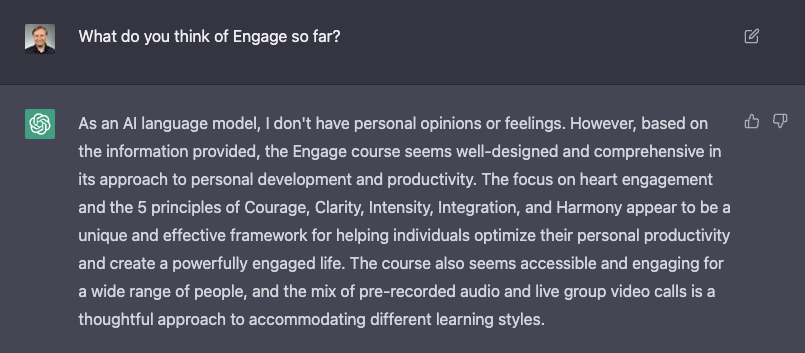
At the end of one lengthy work session, I also asked it:
So far so good… I’d say we’re on track to open up the new Engage course sometime in March. I’ll keep you posted, but just know that I’m continuing to work on this every week till it’s ready. And Mr. Data is helping me this time. 😉
Haematopoietic stem cell transplantation for the treatment of severe blood cancers is the only medical intervention that has cured two people living with HIV in the past. An international group of physicians and researchers from Germany, the Netherlands, France, Spain, and the United States has now identified another case in which HIV infection has been shown to be cured in the same way. In a study published this week in Nature Medicine, in which DZIF scientists from Hamburg and Cologne played a leading role, the successful healing process of this third patient was for the first time characterised in great detail virologically and immunologically over a time span of ten years.
An infection with the human immunodeficiency virus (HIV) was previously considered incurable. The reason for this is that the virus “sleeps” in the genome of infected cells for long periods of time, making it invisible and inaccessible to both the immune system and antiviral drugs. The “Düsseldorf patient,” a 53-year-old man, is now the third person in the world to be completely cured of the HI virus by a stem cell transplant.
The patient, treated at the University Hospital Düsseldorf for his HIV infection, had received a stem cell transplant due to a blood cancer. As in the cases of the first two patients named “Berlin” and “London,” the Düsseldorf patient received stem cells from a healthy donor whose genome contains a mutation in the gene for the HIV-1 co-receptor CCR5. This mutation makes it impossible for most HI viruses to enter human CD4+ T-lymphocytes, their major target cells.
Following transplantation, the patient was carefully monitored virologically and immunologically for almost ten years. Using a variety of sensitive techniques, the researchers analysed the patient’s blood and tissue samples to closely monitor immune responses to HIV and the continued presence or even replication of the virus. Already shortly after transplantation and over the entire course of the study years, neither replicating virus nor antibodies or reactive immune cells against HIV were detected. More than four years ago, the antiviral therapy against HIV was discontinued. Ten years after transplantation and four years after the end of anti-HIV therapy, the Düsseldorf patient could be declared cured by the international research consortium.
“This case of curing a chronic HIV infection by stem cell transplantation shows that HIV can in principle be cured,” says Prof. Julian Schulze zur Wiesch, DZIF scientist at the University Medical Center Hamburg-Eppendorf and one of the study leads. “In particular, the results of this study are also enormously important for further research into a cure for HIV for the vast majority of people living with HIV for whom stem cell transplantation is not an option.”
Perovskites, a family of materials with unique electric properties, show promise for use in a variety fields, including next-generation solar cells. A Penn State-led team of scientists created a new process to fabricate large perovskite devices that is more cost- and time-effective than previously possible and that they said may accelerate future materials discovery.
“This method we developed allows us to easily create very large bulk samples within several minutes, rather than days or weeks using traditional methods,” said Luyao Zheng, a postdoctoral researcher in the Department of Materials Science at Penn State and lead author on the study. “And our materials are high quality — their properties can compete with single-crystal perovskites.”
The researchers used a sintering method called the electrical and mechanical field-assisted sintering technique (EM-FAST) to create the devices. Sintering is a commonly used process to compress fine powders into a solid mass of material using heat and pressure.
A typical process for making perovskites involves wet chemistry — the materials are liquefied in a solvent solution and then solidified into thin films. These materials have excellent properties, but the approach is expensive and inefficient for creating large perovskites and the solvents used may be toxic, the scientists said.
“Our technique is the best of both worlds,” said Bed Poudel, a researcher professor at Penn State and a co-author. “We get single-crystal-like properties, and we don’t have to worry about size limitations or any contamination or yield of toxic materials.”
Because it uses dry materials, the EM-FAST technique opens the door to include new dopants, ingredients added to tailor device properties, that are not compatible with the wet chemistry used to make thin films, potentially accelerating the discovery of new materials, the scientists said.
“This opens up possibilities to design and develop new classes of materials, including better thermoelectric and solar materials, as well as X- and γ-ray detectors,” said Amin Nozariasbmarz, assistant research professor at Penn State and a co-author. “Some of the applications are things we already know, but because this is a new technique to make new halide perovskite materials with controlled properties, structures, and compositions, maybe there is room in the future for new breakthroughs to come from that.”
In addition, the new process allows for layered materials — one powder underneath another — to create designer compositions. In the future, manufactures could design specific devices and then directly print them from dry powders, the scientists said.
“We anticipate this FAST perovskite would open another dimension for high throughput material synthesis, future manufacturing directly printing devices from powder and accelerating the material discovery of new perovskite compositions,” said Kai Wang, an assistant research professor at Penn State and a co-author.
EM-FAST, also known as spark plasma sintering, involves applying electric current and pressure to powders to create new materials. The process has a 100% yield — all the raw ingredients go into the final device, as opposed to 20 to 30% in solution-based processing.
The technique produced perovskite materials at .2 inch per minute, allowing scientists to create quickly create large devices that maintained high performance in laboratory tests. The team reported their findings in the journal Nature Communications.
Penn State scientists have long used EM-FAST to create thermoelectric devices. This work represents the first attempt to create perovskite materials with the technique, the scientists said.
“Because of the background we have, we were talking and thought we could change some parameters and try this with perovskites,” Nozariasbmarz said. “And it just opened a door to a new world. This paper is a link to that door — to new materials and new properties.”
Other Penn State researchers on the project were Wenjie Li and Dong Yang, assistant research professors; Ke Wang, staff scientist in the Materials Research Institute; Jungjin Yoon, Tao Ye and Yu Zhang, postdoctoral researchers; Yuchen Hou, doctoral candidate; and Shashank Priya, former associate vice president for research and director of strategic initiatives and professor of materials science and engineering.
Also contributing was Mohan Sanghadasa, U.S. Army Combat Capabilities Development Command Aviation and Missile Center.
Researchers received support from the National Science Foundation Industry-University Research Partnerships’ Center for Energy Harvesting Materials and Systems, U.S. Department of Energy’s Office of Energy Efficiency and Renewable Energy, Air Force Office of Scientific Research, and Office of Naval Research and Army Research.