The Best Nighttime Skin Care Routine For Every Decade Of Your Life

What does the term “nighttime routine” bring to mind? If you’re a skin care aficionado, it may be your favorite part of your everyday routine. But if all the different products available to you feel overwhelming, don’t worry — we’ve enlisted the help of skin care experts to share the perfect nighttime routine for each decade of your life, from your 20s to your 80s.

Our skin changes over time due to various factors such as age, environmental issues, lifestyle changes and more. So it makes sense that the products a 20-something uses aren’t suitable throughout their life, and it’s important to make that distinction to support the skin’s needs. Our skin is our largest organ, after all.

The routines below serve as a general guide, depending on the needs of your skin during each decade of your life ― they cannot, of course, apply to everyone. But here’s one tip that does: Be gentle and have a consistent routine that won’t compromise your skin barrier.

“I always say to my patients: An ounce of prevention is worth a pound of cure. So it is always great to start incorporating key skin care ingredients early on, even before a problem develops,” Marisa Garshick, a board-certified dermatologist at MDCS Dermatology in New York, told HuffPost. She added that new products should only be added one at a time, and they should be layered from thinnest to thickest.

In your 20s

Having a basic, solid routine in your 20s is crucial. You can start by incorporating a retinoid to help with skin texture and to brighten your skin, according to Devan Jesmer, an aesthetician at Skin Remedy MD in north Texas. Plus, retinoids such as adapalene can help with breakouts that many people continue to have in their 20s, said both Jesmer and Garshick.

Even though we are focusing on nighttime routines, it’s worth noting that sunscreen should be part of your daily morning skin care.

“It’s always good to start the habit of sunscreen early and commit to it long term to get the most benefit,” Garshick said. “Sunburns, even in childhood and adolescence, can impact the long-term skin cancer risk.”

All the experts agreed on the importance of double cleansing, which thoroughly cleans the skin and removes makeup and sunscreen. If you’ve got oily skin, opt for a gel or foaming cleanser, and if your skin is on the dry side, choose a creamy or hydrating one, Garshick said. You can use two different cleansers for double cleansing — like a balm followed by a gel — or you can use the same cleanser twice.

Jesmer’s proposed routine in your 20s:

Garshick’s proposed routine in your 20s:

In your 30s

By your 30s, a stronger retinoid (like retinaldehyde) is advised. A retinoid eye product may also be beneficial, Jesmer said, as well as weekly exfoliation.

“When introducing a retinoid into a skin care routine, it is best to start low and slow, only using it two or three times per week and gradually increasing the frequency,” Garshick said, adding the caveat that retinoids shouldn’t be used if you’re pregnant or breastfeeding. ”For someone with dry or sensitive skin, it may be best to apply the moisturizer prior to the retinoid to reduce the potential for irritation.”

During this decade of your life, “the skin tends to get a little bit drier and collagen levels are starting to slowly decrease, but visible signs of aging are still minimal. The goal is to maintain our collagen stores and even glowy complexion,” Cristina Psomadakis, a dermatologist in London, told HuffPost.

Garshisk explained that we actually lose 1% of collagen every year during our 20s, and this becomes more obvious in our 30s in terms of appearance and fine lines.

Jesmer’s proposed routine in your 30s:

In your 40s

In your 40s, focusing on replenishing collagen production is key.

“If you can get your hands on prescription tretinoin, this is the most powerful form of retinol on the market and available via your dermatologist,” Psomadakis said.

Cell turnover, which is our skin’s ability to renew its cells, slows down with age, and that’s why an exfoliating product might be beneficial. This will help remove dead skin cells from the skin’s surface, and the skin will appear smoother. An exfoliator can be a cleanser, exfoliating pads, toner or serum. If your skin is sensitive, pick your exfoliator carefully, something like mandelic acid or lactic acid, or a polyhydroxy acid such as gluconolactone, Garshick said.

“For those with more normal to oily skin types, glycolic acid or salicylic acid can be considered, respectively,” she said. “It is best to avoid exfoliating the same nights that you use your retinoid to minimize the chance of irritation and to limit exfoliation to one to two times per week.”

Psomadakis’ proposed routine in your 40s:

Garshick’s proposed routine in your 40s:
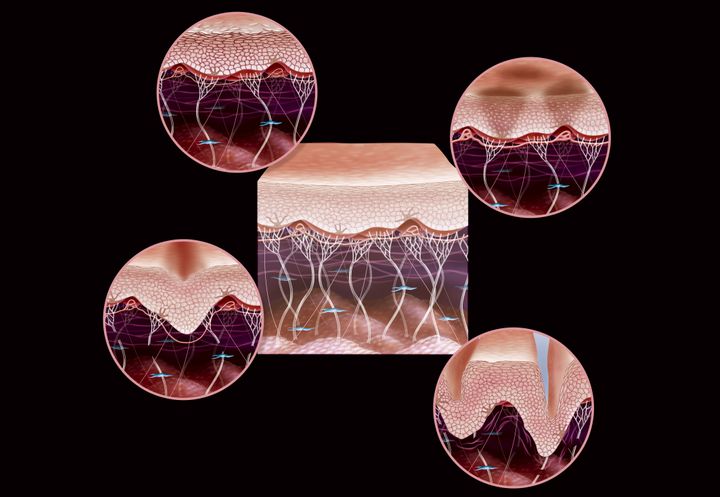
An illustration of the signs of aging in skin. In the center, a cross-section illustration features young skin and provides a comparison with different types of aging. The illustration in the top left shows the dulling of the epidermis, while the illustration in the top right shows spots. The illustration in the bottom left shows the loss of firmness due to diminished activity of the fibroblasts (blue), which are responsible for skin's elasticity, producing elastin and collagen. The bottom right illustrates wrinkles due to the deterioration of collagen (white vertical) and elastin (pink horizontal) fibers.

BSIP via Getty Images

An illustration of the signs of aging in skin. In the center, a cross-section illustration features young skin and provides a comparison with different types of aging. The illustration in the top left shows the dulling of the epidermis, while the illustration in the top right shows spots. The illustration in the bottom left shows the loss of firmness due to diminished activity of the fibroblasts (blue), which are responsible for skin’s elasticity, producing elastin and collagen. The bottom right illustrates wrinkles due to the deterioration of collagen (white vertical) and elastin (pink horizontal) fibers.

In your 50s

Skin laxity tends to be a big concern in our 50s, Garshick said, explaining, “People start to notice jowls forming as well as textural changes in the neck.”

It may be beneficial to add a separate neck cream in this decade. Other ingredients that may help include peptides, growth factors and antioxidants like resveratrol and vitamin C.

Garshick’s proposed routine in your 50s:

Psomadakis’ proposed routine in your 50s:

In your 60s

“Brown spots and hyperpigmentation are often a concern in your 60s, so while everything else still remains important, it is a good time to consider products and serums that also work to lighten discoloration and reduce pigmentation,” Garshick said.

The ingredients you should look into include antioxidants, alpha arbutin, tranexamic acid, kojic acid, niacinamide and azelaic acid. Retinoids continue to be essential as well as sunscreen in the morning.

Garshick’s proposed routine in your 60s:

In your 70s

The skin loses moisture as we age, so we have to replenish that with topical products and moisturizing creams, Garshick said.

“It may also be important to adjust the frequency of exfoliation, as well as the frequency and strength of the retinoid use if the skin begins to feel too dry, and look for products that help to repair the skin barrier,” she told HuffPost.

Garshick’s proposed routine in your 70s:

In your 80s

Hydration is more important than ever at this stage. Garshick recommended ingredients such as hyaluronic acid or glycerin, which contains humectants that will draw moisture in the skin, as well as firming peptides. For cleansing, a micellar might be preferred as a gentler option.

Garshick’s proposed routine in your 80s:

When in doubt, listen to your skin and consult a skin specialist who will be able to recommend products to suit your specific concerns. Also, remember that active ingredients such as retinoids take eight to 12 weeks of consistent use for noticeable results, so patience and consistency are key. If you catch any signs of irritation or sensitivity, strip back your routine to the basics.

HuffPost may receive a share from purchases made via links on this page. Prices and availability are subject to change.

Share Button

Covid: Boris Johnson expected to ease England’s Plan B measures

The decision on Plan B is “finely balanced” but current data is “encouraging”, the government says.

Share Button

Exercise addicts urged to build in rest days

A mental health charity is concerned some people are overdoing it to cope with stress and anxiety.

Share Button

Depression rise at Christmas linked to stress over Covid

Despite no lockdowns, a large survey found anxieties over being infected and long Covid were high.

Share Button

Rivers speeding up Arctic ice melt at alarming rate

Irina Panyushkina grew up in Siberia, near the Arctic Circle. She was raised on stories of explorers trudging through seas of ice to reach the North Pole.

Now, she is a climate scientist and associate research professor of dendrochronology in the University of Arizona Laboratory of Tree-Ring Research. And she is trying to understand how a warming world is transforming the place she once called home.

Someday, the Arctic Ocean may no longer host ice, since the northern regions of the world are warming are faster than the rest — a trend scientists refer to as Arctic amplification. As Arctic ice melts, new opportunities and challenges for humans will arise, researchers say.

Freshwater flowing into the Arctic Ocean from the continent is thought to exacerbate Arctic amplification, but the extent of its impact isn’t fully understood. New research led by Panyushkina measures how the flow of the Yenisei River — the largest freshwater river that flows into the Arctic Ocean — has changed over the last few hundred years, and describes the impact freshwater has had on the Arctic.

Previous studies have attributed recent changes in wintertime freshwater flow into the Arctic to warming air temperature, seasonal precipitation changes or snowpack. But more recent research, including Panyushkina’s study, suggests that the primary driver is actually degradation of permafrost — or frozen ground — as well as forest fires across southern Siberia.

Panyushkina’s research, funded by the National Science Foundation Polar Office, is published in the journal Environmental Research Letters.

What trees can tell us

Data collected by instruments at the upper reaches of the Yenisei River in Tuva, in southern Siberia, only goes back so far. To overcome this, Panyushkina and her team used tree-ring data to double the number of years’ worth of the stream flow data they had, allowing them to look back 300 years.

Stream flow, or the amount of water that moves through a certain area of a river over time, can be inferred by measuring changing tree-ring thickness over the years. Measurements of stream flow over specific seasons can even be teased out of the data.

Annual stream flow information is commonly used by water managers to reveal the average changes in stream flow trends. But Panyushkina and her team did something novel when they decided to also investigate winter stream flow specifically.

“We found an unprecedented increase in the winter flow rate over the last 25 years,” Panyushkina said. This winter flow rate is nearly 80% above the average seen over approximately 100 years.

“In contrast, annual flow fluctuated normally during the 300-year period, with only a 7% increase over the last 25 years,” Panyushkina said.

The winter stream flow data revealed the role of permafrost melt on Arctic ice.

Since ice covers rivers during winter in Siberia, the team’s stream flow measurements only captured information about river waterthat originated underground rather thanfrom the sky. That includes water from thawing permafrost, as well as water from sub-permafrost aquifers, as permafrost loss leads to an increased exchange of water between the river and aquifers. These two sources of groundwater are warm compared to the frigid air above, and when they eventually flow into the Arctic Ocean, they melt the ice.

An uncertain future

Forest fires are also thought to be a driver of Arctic ice melt.

“We know the frequency and intensity of forest fires in Siberia have been increasing,” Panyushkina said. “When fires happen in forests with permafrost, there is deep thawing under the fire event, and the affected area often doesn’t recover for up to 60 years. When we have large-scale fires and long-burning fires and more frequent fires, we’re maybe hitting the critical point when permafrost degradation cannot return to normal. Forest fires are also another process that increases connectivity between aquifers and stream flow.”

The combined effects of permafrost degradation and fires are very strong at the Yenisei River basin, with more fresh water and heat flowing into the Arctic Ocean in recent decades, according to the study. In turn, melting sea ice also exacerbates global warming.

“Research interest in the region is booming because the surface temperature is warming much faster here than anywhere else in the world,” Panyushkina said. “It’s a hot spot for climate research, and because I grew up there and understand how the system works, it’s a natural topic of study for me. I’m also very interested in knowing the impact of an ice-free Arctic on the surrounding landscape. Humans have never seen an ice-free Arctic before, ever. My mind still cannot comprehend how the Arctic Ocean can be free of ice.”

By the middle of the century, changing sea ice conditions are expected to lead to greater navigability for open water-vessels crossing the Arctic. A future trans-Arctic shipping route called the Supra Polar Route will link the Atlantic and Pacific Oceans through the Arctic, potentially paving the way for more trans-Arctic commerce.

There is a need to quantify the Arctic amplification impacts to manage and regulate Arctic seas of the future, Panyushkina said.

“This strong prospect of the global trade fleet entering the Arctic opens the Pandora’s box of near-future geopolitical and environmental issues and reinforces the urgency for a new regulatory framework by international organizations to ensure adequate environmental protections and vessel safety standards,” she said.

To understand more about Arctic amplification and its consequences, Panyushkina and her team plan to study other rivers in Siberia.

“There are two more Siberian rivers similar in size to the Yenisei,” she said. “If we can quantify the stream flow from those rivers, we’ll have more precise and clear understanding of its impact on the Arctic.”

Share Button

Nutritional value of huhu grubs assessed

Huhu grubs have long been prized as a traditional food source and their nutritional value has just been analysed by University of Otago researchers for the first time.

The study of the mineral and macronutrient composition of huhu grubs (Prionoplus reticularis larvae) was undertaken by Food Science PhD student Ruchita Rao Kavle and the results have recently been published in the International Journal of Food Science and Technology.

Miss Rao Kavle says the analysis found huhu grubs had a high fat content — for which they have traditionally been known — but it was the high levels of protein that really stood out.

“Across the four development stages of the huhu, protein ranged from 26.2 per cent to 30.5 per cent, which is high when compared to other common protein sources such as beef (21 per cent), lamb (20.3 per cent), chicken (17.4 per cent), soy (13 per cent), and chickpeas (20.5 per cent).

“We also found that the grubs were rich in essential minerals which all play vital roles in human health and nutrition, the most abundant been manganese, magnesium, phosphorus, iron, copper, and zinc,” she says.

The analysis was undertaken on wild huhu grubs during four different development stages of their life cycle, and which were harvested from a pine-forested site in Dunedin.

Miss Rao Kavle says based on the results, a person weighing 60kg would require around 170g of huhu, or about 75 huhu grubs, to meet the same daily protein requirement that could be sourced from 230g of beef.

“Compared to beef, a smaller amount of huhu needs to be consumed, but some people would find eating 75 grubs off-putting.”

Miss Rao Kavle’s research is also looking into options to process the grubs into more presentable forms such as flour and meals.

Study supervisor and co-author Dr Dominic Agyei says this pioneering study brings scientific evidence to highlight the nutritional value of the traditional food source.

He says that even though huhu grubs have not been accessible commercially in New Zealand, there is an ever-growing interest in sustainability in food production, alternative proteins, and the need to diversify food sources.

“A focus on indigenous foods, particularly their unique nutritional and health properties, and alternative proteins is surging. This study on the huhu comes on the back of other research we have also undertaken on the larvae of several edible insects such as mealworms and black soldier flies,” Dr Agyei says.

The research concluded that New Zealand wild-harvested huhu is nutritious and safe for consumption, however the authors point out that as with most foods, moderate consumption is recommended, and the importance of variety and balanced diets cannot be overruled.

Story Source:

Materials provided by University of Otago. Note: Content may be edited for style and length.

Share Button

Additional antibodies may protect against COVID, study shows

When we talk about antibodies against COVID-19, we tend to mean the so-called neutralising antibodies, that offer protection by blocking the virus from invading our cells. Now, a new study from Lund University in Sweden has revealed that non-neutralising antibodies may also be important in providing protection against Covid.

“Our results indicate that non-neutralising antibodies could also provide protection. This would mean that we have broader protection from antibodies than previously thought, making us less vulnerable to mutations of the virus. It warrants further investigation,” says Pontus Nordenfelt who led the study and is a researcher at Lund University.

In its efforts to produce vaccines and treatments, the research community has focused on neutralising antibodies, which prevent the spike protein of the virus from binding to the surface protein on our cells.

In a large project led by researchers at Lund University, a more detailed study has been carried out on how the immune system also fights off the virus by means of phagocytosis, the ability to ingest foreign particles, in Covid-19 patients.

Phagocytosis is a type of cleansing mechanism during which the immune system’s players target potential threats, such as bacteria or viruses, and ingests them, and this mechanism is facilitated if the harmful substance is marked by an antibody. The results, published in a themed issue of Frontiers in Immunology, indicate that non-neutralising antibodies are also important in the fight against Covid — through this mechanism.

“We observed that many of the antibodies that develop in response to Covid-19 are opsonising, i.e. they signal to the immune system’s phagocytes to ingest the virus. Our results indicate that non-neutralising antibodies, so long as they are able to opsonise, are also able to provide an effective response to the virus,” says Pontus Nordenfelt.

The findings are supported by experiments on mice, in which the non-neutralising antibodies protected the animals from Covid-19 infection.

The research team also discovered that the amount of neutralising antibodies affects the process of phagocytosis.

The team identified and isolated immune system cells from the blood of recovered Covid-19 patients. Using several techniques, they mapped which immune cells interact with the virus’s spike protein and identified the antibody binding sites. Then, using flow cytometry, they studied how these antibodies affect phagocytosis.

The researchers coated micrometre-sized beads with the spike protein and in doing so observed that the dosage of neutralising antibodies had an effect on the phagocytosis.

Opsonisation is the immune system mechanism in which an increase in bound antibodies triggers a stronger phagocyte response. Surprisingly, maximum opsonisation is already achieved at relatively low levels of antibodies. Beyond this, the researchers observed a reduction in the effect. The antibody-binding itself continued to increase linearly, even when the phagocytosis decreased, demonstrating that it is the spike protein that does something that causes this reduced phagocytosis.

To ensure that this was not due to other factors, the researchers set up the same experiment, but this time they used only monoclonal antibodies. This meant that just one type of antibody (clone) was used instead of the standard combination of thousands of different antibodies.

“It showed the same trend. Up to a certain level, there is a linear dosage effect from the antibodies. After that, it dips. Basically, when you give a dose that is too high you don’t get the protective effect,” says Wael Bahnan, researcher in infection medicine at Lund University and first author of the study.

“It looks like something is happening to the spike protein that results in reduced interaction with the white blood cells, leading to the immune system no longer binding to and neutralising the virus through phagocytosis. Similar phenomena have been described as the prozone effect and have been reported in experiments with pneumococcus and malaria. However, it has not been linked to reduced phagocytosis, so it is not certain that the effect relates to what we are observing in our experiments,” concludes Wael Bahnan.

Share Button

Covid: ‘Fussy eaters’ could have smell and taste disorder

Experts write a guide on a taste and smell disorder, which they say can go undiagnosed in children.

Share Button

Self-harm guidance to include advice for schools and prisons

It’s not just mental health professionals who have to spot self-harm, updated health guidance says.

Share Button

Specialist mental health unit failures exposed by patients

Patients say they’ve been placed in unsafe environments, often far from home.

Share Button