There has been controversy around aducanumab, which targets the cause rather than the symptoms.


There has been controversy around aducanumab, which targets the cause rather than the symptoms.
Rollout continues, with all over 25s able to book a Covid vaccine in England from Tuesday.

A research team from the University of Copenhagen and University of Helsinki demonstrates it is possible to predict individual preferences based on how a person’s brain responses match up to others. This could potentially be used to provide individually-tailored media content — and perhaps even to enlighten us about ourselves.
We have become accustomed to online algorithms trying to guess our preferences for everything from movies and music to news and shopping. This is based not only on what we have searched for, looked at, or listened to, but also on how these activities compare to others. Collaborative filtering, as the technique is called, uses hidden patterns in our behavior and the behavior of others to predict which things we may find interesting or appealing.
But what if the algorithms could use responses from our brain rather than just our behavior? It may sound a bit like science fiction, but a project combining computer science and cognitive neuroscience showed that brain-based collaborative filtering is indeed possible. By using an algorithm to match an individual’s pattern of brain responses with those of others, researchers from the University of Copenhagen and the University of Helsinki were able to predict a person’s attraction to a not-yet-seen face.
Previously the researchers had placed EEG electrodes onto the heads of study participants and showed them images of various faces, and thereby demonstrated that machine learning can use electrical activity from the brain to detect which faces the subjects found most attractive.
“Through comparing the brain activity of others, we’ve now also found it possible to predict faces each participant would find appealing prior to seeing them. In this way, we can make reliable recommendations for users — just as streaming services suggest new films or series based on the history of the users,” explains senior author Dr. Tuukka Ruotsalo of the University of Copenhagen’s Department of Computer Science.
Towards mindful computing and greater self-awareness
Industries and service providers are more and more often giving personalized recommendations and we are now starting to expect individually tailored content from them. Consequently, researchers and industries are interested in developing more accurate techniques of satisfying this demand. However, the current collaborative filtering techniques which are based on explicit behaviour in terms of ratings, click behaviour, content sharing etc. are not always reliable methods of revealing our real and underlying preferences.
“Due to social norms or other factors, users may not reveal their actual preferences through their behaviour online. Therefore, explicit behaviour may be biased. The brain signals we investigated were picked up very early after viewing, so they are more related to immediate impressions than carefully considered behaviour,” explains co-author Dr. Michiel Spapé.
“The electrical activity in our brains is an alternative and rather untapped source of information. In the longer term, the method can probably be used to provide much more nuanced information about people’s preferences than is possible today. This could be to decode the underlying reasons for a person’s liking of certain songs — which could be related to the emotions that they evoke,” explains Tuukka Ruotsalo.
But researchers don’t just see the new method as a useful way for advertisers and streaming services to sell products or retain users. As lead author Keith Davis points out:
“I consider our study as a step towards an era that some refer to as “mindful computing,” in which, by using a combination of computers and neuroscience techniques, users will be able to access unique information about themselves. Indeed, Brain-Computer Interfacing as it is known, could become a tool for understanding oneself better.”
Nevertheless, there is still a way to go before the technique can be applied beyond the laboratory. The researchers point out that brain-computer interface devices must become cheaper and easier to use before they find themselves in the hands or strapped to the heads of casual users. Their best guess is that this will take at least 10 years.
The researchers also underscore that the technology comes with a significant challenge for protecting brain-based data from misuse and that it is important for the research community to carefully consider data privacy, ownership and the ethical use of raw data collected by EEG.
ABOUT THE EXPERIMENT
In the experiment, participants were shown a large number of images of human faces and asked to look for those that they found attractive. While doing so, their brain signals were recorded. This data was used to train a machine learning model to distinguish between the brain activity when the participant saw a face that they found attractive versus when they saw a face that they did not find attractive.
With a different machine learning model, the brain-based data from a larger number of participants was used to calculate which new facial images each participant would find attractive. Thus, the prediction was based partly on individual participant’s own brain signals and partly on how other participants responded to the images.

When we inhale isolated coronavirus particles, more than 65% reach the deepest region of our lungs where damage to cells can lead to low blood oxygen levels, new research has discovered, and more of these aerosols reach the right lung than the left.
Lead author of the study Dr Saidul Islam, from the University of Technology Sydney, said while previous research has revealed how virus aerosols travel through the upper airways including the nose, mouth and throat — this study was the first to examine how they flow through the lower lungs.
“Our lungs resemble tree branches that divide up to 23 times into smaller and smaller branches. Due to the complexity of this geometry it is difficult to develop a computer simulation, however we were able to model what happens in the first 17 generations, or branches, of the airways,” said Dr Islam.
“Depending on our breathing rate, between 32% and 35% of viral particles are deposited in these first 17 branches. This means around 65% of virus particles escape to the deepest regions of our lungs, which includes the alveoli or air sacs,” he said.
The alveolar system is critical to our ability to absorb oxygen, so significant amounts of virus in this region, along with inflammation caused by our body’s immune response, can cause severe damage, reducing the amount of oxygen in the blood and increasing the risk of death.
The study also revealed that more virus particles are deposited in the right lung, especially the right upper lobe and the right lower lobe, than in the left lung. This is due to the highly asymmetrical anatomical structure of the lungs and the way air flows through the different lobes.
The research is backed up by a recent study of chest CT scans of COVID-19 patients showing greater infection and disease in the regions predicted by the model.
The researchers modelled three different flow rates — 7.5, 15 and 30 litres per minute. The model showed greater virus deposition at lower flow rates.
As well as improving our understanding of coronavirus transmission, the findings have implications for the development of targeted drug delivery devices that can deliver medicine to the areas of the respiratory system most affected by the virus.
“Normally when we inhale drugs from a drug delivery device most of it is deposited in the upper airways, and only a minimum amount of drugs can reach the targeted position of the lower airways. However, with diseases like COVID-19 we need to target the areas most affected,” said Dr Islam.
“We are working to develop devices that can target specific regions, and we also hope to build age and patient specific whole lung models to increase understanding of how SARS CoV-2 aerosols affect individual patients,” said co-author and group leader of the UTS Computer Simulations and Modelling group, Dr Suvash Saha.
The World Health Organisation recently updated its advice about the importance of aerosol transmission, warning that because aerosols can remain suspended in the air, crowded indoor settings and areas with poor ventilation pose a significant risk for transmission of Covid-19.
“When we use an aerosol deodorant, the smallest particles of that liquid fall on us under extreme pressure in the form of gas. Similarly, when an infected person speaks, sings, sneezes or coughs, the virus is spread through the air and can infect those nearby,” said Dr Saha.
The study has further applications, with researchers using portable devices to examine air quality — including PM2.5 and PM10 concentration and gasses such as carbon dioxide, formaldehyde and sulphur dioxide — in spaces such as train carriages. The researchers can then use this data to model the impact on our lungs.
The study, SARS CoV-2 aerosol: How far it can travel to the lower airways, was recently published in the journal Physics of Fluids.
The optional badges will be displayable on dating profiles as part of a government collaboration.
Matt Hancock says 21 June is a “not before” date for ending England’s remaining restrictions.
Boris Johnson will raise the target at a summit of the G7 group of advanced economies on Friday.
India has seen rising cases of the serious fungal infection, mostly in Covid patients.
Chris Hopson says vaccines seem to have “broken the chain” between infection and serious illness.
I sat in a friend’s backyard beside his new pool, sipping iced tea his wife had just set down for us. As a favor, Brian, a financial planner, had generously agreed to meet with me to take a look at my situation.
“You’re a 37-year-old childless woman married to an older man. Chances are, later in life you’re going to be alone,” he told me. “If you want to take care of yourself, you’re going to need money.”
His words made my head momentarily swim, but I nodded. He was right ― I needed a new plan.
For most of my adult life, I made a decent living teaching Pilates, and in my late 20s, I opened a tiny studio that I still own and operate myself ― a one-woman show with minimal overhead and lots of flexibility. Up until that moment, I felt I was good with money: no credit card debt, no student loans, a small but existent emergency fund. My husband had his own retirement sorted. A career firefighter, he would receive a pension, but that would disappear when he died.
As a couple, my husband and I have been fortunate enough to land in a place where we can pay our bills and still be left with some discretionary income, which is, I realize, a situation that many Americans and others around the world may never have.
Growing up white, at the lower end of the middle class with a stable two-parent household, had no doubt stacked the deck in my favor and provided me with privileges that paved the way for this backyard meeting and made the luxury of thinking about retirement and long term savings even possible.
Marrying young had also lent me a certain outlier quality among my childhood friends. As they were preparing to go off to college, I was buying my first house. As they traipsed around the globe on a gap year, I was already working. This meant I had arrived in my early 30s with several major life milestones already under my belt, and just enough discretionary income to try to make up for what sometimes felt like a thwarted youth.
It’s not surprising, then, that as a millennial ingrained with an “experience over stuff” mentality, all my extraneous income from the previous decade had gone to travel, filling my passport with stamps from foreign countries. I wore my outlier status as a badge of honor and, bent on solidifying this idealized independent status, I booked solo trips all over the world and leaned hard into that other millennial mainstay, minimalism. Aside from travel, sometimes all I wanted to do was sell all my stuff and move into a van.
My husband, an avid surfer and fellow traveler, would often leave home for months at a time, so I spent extended periods of time living alone. I told myself that, given my experience with traveling and living on my own, I would be fine to navigate old age by myself.
And yet here I sat, 37 years old, being handed an alarming dose of reality. A kind yet blunt financial planner was informing me that I was actually woefully unprepared to take care of myself in the years to come.
I realized I was surrounded by women who were all staring down a similar barrel: the potential of being alone at an older age, fending for ourselves, and with maybe not enough money.
My friend advised me to set aside enough cash to be able to hire help as I aged. Not a bad plan in itself, but looking at my income, my current lack of retirement savings and my penchant for foreign travel, this was going to be no easy feat. I also wasn’t too happy about the possibility of spending my final days among strangers. Still, his advice was not lost on me, and I set up my first investment accounts, thereby taking my adulting to the next level.
Hoping for some consolation and solidarity, I began polling my friends about their plans for aging. A couple of us are married, but most of my friends are not. A few of us have become parents, but most of us don’t have kids. But, honestly, these two mainstays of conventional aid for aging provide little protection against the peril women face later in life.
Women statistically outlive their male companions, and divorce takes one out of every two opposite-sex marriages. That percentage appears to be even higher in lesbian marriages, so regardless of sexual orientation, all women are at risk of finding themselves without a partner when they’re older.
Having children is not a sure bet either, as many parents still find themselves living out the end of their lives alone or placed in a home. To be a “childless woman,” whether by choice or by circumstance, can leave one feeling even more vulnerable. And in today’s U.S. economy, women are still only averaging 80 cents on the dollar of their male counterparts.
Looking around me, I realized I was surrounded by women who were all staring down a similar barrel: the potential of being alone at an older age, fending for ourselves, and with maybe not enough money.
But hadn’t we all just spent the last 20 years traveling with friends, living with friends, relying on friends? Did that have to change as we aged?
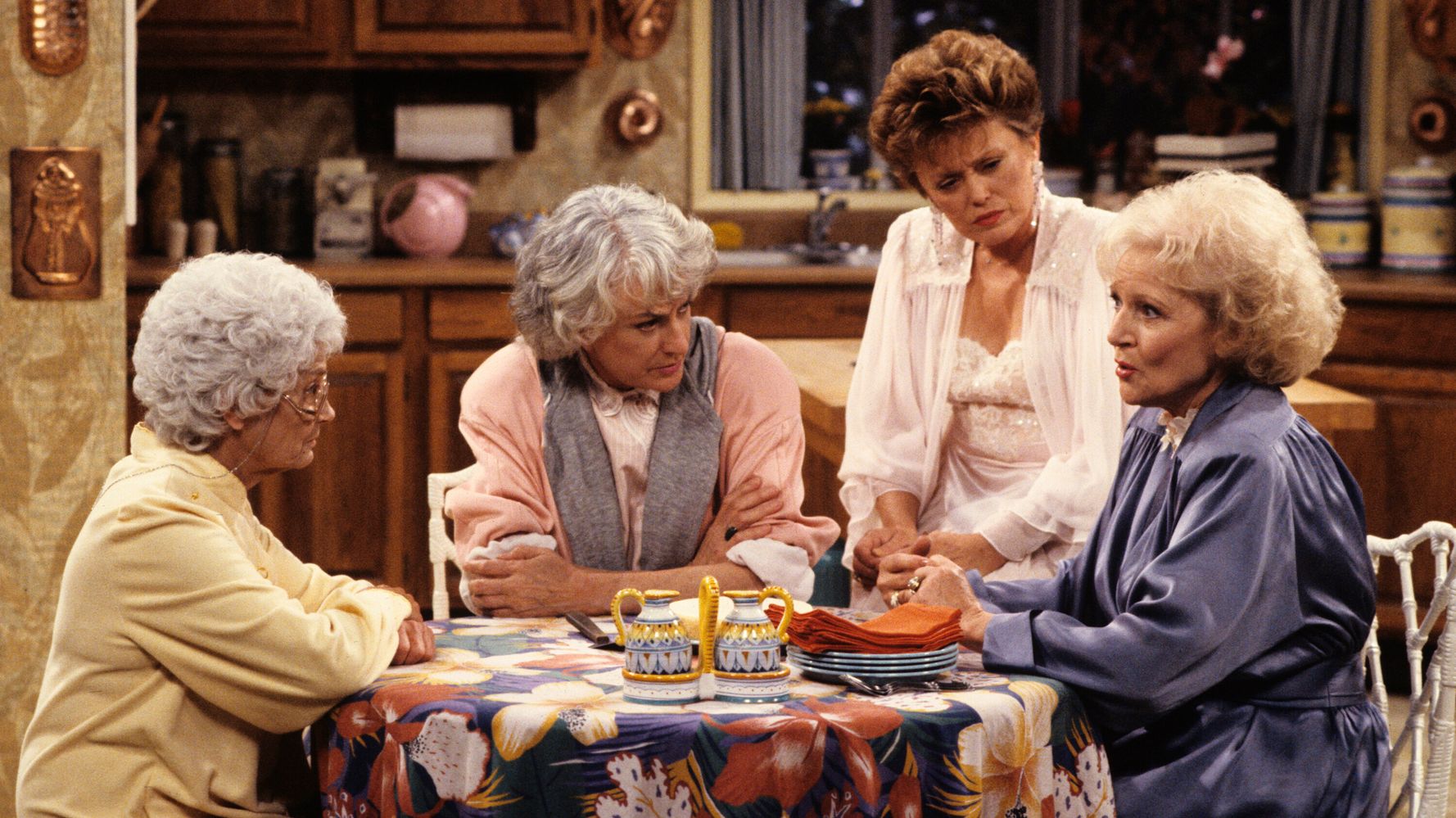
As a child, I had grown up watching “The Golden Girls” with my grandmother. In the 1980s classic sitcom, comedy ensues as four previously married 50-something women move in together in South Florida. They support each other through everything that comes at them ― from health scares to dating dilemmas ― and they make the kind of chosen family that many of us dream of having and want to create.
So, I reasoned, why couldn’t we use Blanche, Rose, Dorothy and Sophia as a model to plot our own post-midlife sorority setup? As my panic dissipated, I could see an alternative to the other less-than-appealing options I had been considering ― and I wasn’t the only one.
Two of my friends in their 40s have been joking for more than a decade about spending old age on a shared front porch, sipping lemonade in Juicy Couture velour tracksuits.
Another friend in her 50s had already started to hash out more concrete details of a timeshare-style retirement plan with former college classmates. At some point, each single, successful woman would purchase a small home or condo in some desirable locale around the globe to be shared by the group of friends, thereby creating a rotating ring of old lady tenants and roommates. Sick of someplace or someone? Simply book a ticket and change your current live-in buddy.
There are very few valiant knights, and more than likely, no one is coming to save us. Maybe it’s best to accept that our lives might not provide us with the traditional structure of having children or spouses to care for us in the end.
A quick Google search showed my little collective of friends wasn’t alone in the notion of retiring among women. All around the globe, women are choosing to spend their later years together, some even going as far as to build female-only co-ops from the ground up, complete with built-in hierarchies requiring the younger women to help the older ones with grocery store runs and prescription pickups.
This brought to mind a story told to me by a retired octogenarian NASA engineer. While she was still in her 40s, her then 90-year-old grandmother had told her, “By the time you’re 70, half your friends are dead. If you don’t want to be alone at 90, make younger friends ― take younger women under [your] wing.”
Clearly, women taking care of women is nothing new. The plans these women were making seemed to me a more stable — and dare I say, more enjoyable — way to grow old than living alone or in a van. The same can be said for queer people who have long formed their own chosen families and relied on each other through the good times and the bad.
The idea began to feel exciting ― a way not only to mitigate loneliness and retain autonomy but also to remain vibrant and have fun well into our golden years. I could already picture which of my friends would fall into the role of hedonistic Blanche, filling our imagined home with a parade of younger men, and who would be Dorothy, with her pragmatism and dry wit. We would not only care for each other but feed off each other, keeping ourselves vital and young-hearted as long as possible.
While this still does seem like a distant future to me, just the notion of living among friends into old age has taken a weight off me that I didn’t even realize I was carrying. It has long been a dream of mine to not just travel, but to one day live abroad, so I have started sending like-minded friends listings for cheap Italian homes in need of renovation and teaching myself French in the hopes that maybe some of us will be brave enough to see out our later years overseas.
The truth is though, it might not go that way at all. My husband may outlive me, or we might simply be fortunate enough to spend our later years together. Maybe he’ll end up living with me and my friends ― or maybe he’ll live across the street. Time will tell, but for now, as I make my new IRA contributions and daydream with girlfriends about what cities we all might want to grow old in together, what I’m actually left with is this: There are very few valiant knights, and more than likely, no one is coming to save us. Maybe it’s best to accept that our lives might not provide us with the traditional structure of having children or spouses to care for us in the end.
I think that’s OK. Because even if we do have kids or partners in the picture, we’re still completely capable of saving ourselves ― and each other.
No matter what my living situation looks like in the years to come ― whether I’m officially living the Golden Girls life or not ― I will still want to live out the end of my days surrounded by friends. Few things in life are guaranteed, but the power and support of a circle of women is certain, no matter what stage of life we’re in.
Ashley Brooks is a writer, journalist and owner of a boutique Pilates studio. She can be reached at ashley.brooks.writer@gmail.com.
Do you have a compelling personal story you’d like to see published on HuffPost? Find out what we’re looking for here and send us a pitch!
Calling all HuffPost superfans!
Sign up for membership to become a founding member and help shape HuffPost’s next chapter