The figure is now much closer to one – the point at which the virus starts spreading rapidly.


The figure is now much closer to one – the point at which the virus starts spreading rapidly.
Six rhesus macaque monkeys were vaccinated and then exposed to the virus.

The new coronavirus, named SARS-CoV-2, received its name for its crown-like spikes on its surface which can be seen under a microscope. However, according to a news release by EurekAlert, scientists from the biomedical visualisation studio, Visual Science, have recently created a three-dimensional (3D) model of the virus at atomic resolution, which allows for the incredible ability to view individual atoms.
To create an accurate model, the team of scientists and CGI specialists used the latest scientific research that looks at the structure of coronaviruses, and communicated with virologists currently working with SARS-CoV-2. Apart from their recent model, they also previously created models of Ebola, HIV, Zika and flu viruses. Their HIV virion model was awarded first place at the 2010 Science and Engineering Visualization Challenge (SEVC), according to EurekAlert.
“It [the model] shows, in great detail, the intact particle with its spike glycoproteins embedded in the membrane. A cutaway view reveals the viral nucleocapsid inside the particle.
“These gorgeous images will enhance our understanding of the virus particle, and for the non-scientist will make even more palpable the virus that is infecting millions of people,” Professor Vincent Racaniello at the Department of Microbiology & Immunology of Columbia University, New York, said.
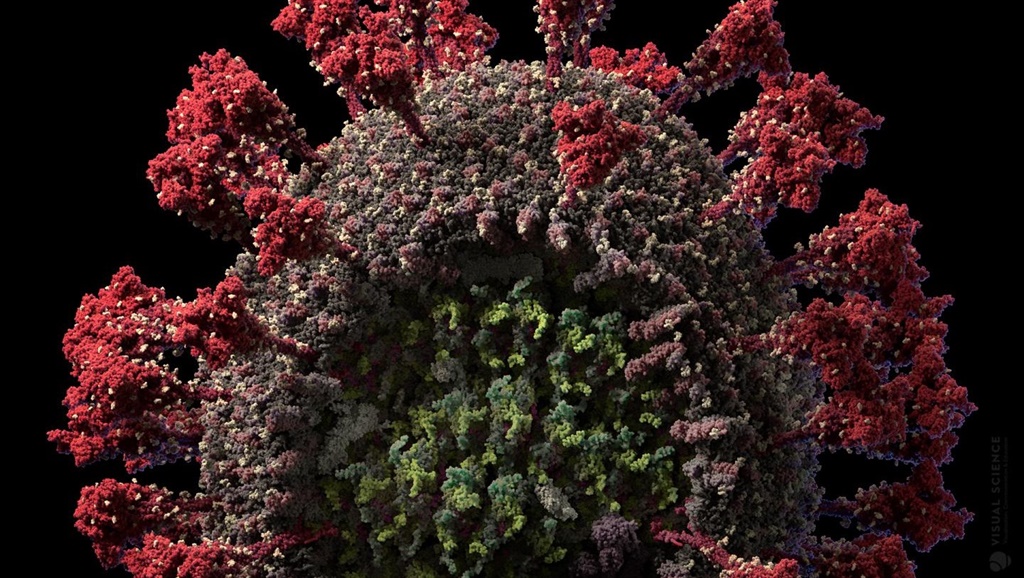
SARS-CoV-2 main model look. Image credit: Visual Science
READ | Coronavirus in SA: All the confirmed cases
READ | Why can two young and healthy individuals be affected so differently by coronavirus?
Image credit: Visual Science


The information on Health24 is for educational purposes only, and is not intended as medical advice, diagnosis or treatment. If you are experiencing symptoms or need health advice, please consult a healthcare professional. See additional information.

As Covid-19 continues to take centre stage in the world’s hospitals and clinics, concerns are mounting over the impact on ‘normal’ healthcare. This is particularly so in South Africa, where there are increased rates of cancer and diabetes besides severe HIV and tuberculosis (TB) epidemics. Spotlight asked a range of experts and frontline workers how this tension between Covid-19 and other healthcare services is playing out in our healthcare facilities.
Pressure builds for cancer care
Dr Lydia Cairncross, Head of Groote Schuur Hospital’s Breast and Endocrine Surgery Unit in Cape Town, told Spotlight that the pandemic was landing on top of South Africa’s pre-existing crisis for oncological services.
“At the beginning of the lockdown period we had a large number of women waiting for breast cancer surgery – over 80 [women],” she said. “We also have patients waiting for other forms of diagnostic surgery as well as treatments for other malignancies. What we’ve had to do is prioritise cancer surgery over other elective surgery. We’ve also had to put some patients onto alternative therapies where that has been possible.”
Cairncross said that so far, the hospital has had no major delays in cancer surgeries, except where a surgery requires long admission to hospital and intensive care.
Professor Jeannette Parkes, Head of Radiation Oncology at Groote Schuur, said that while a lot had changed in the department to protect patients, services were running in full force. “We’re running a full new patient service, full chemotherapy services and full radiotherapy services,” she said.
“Our concern is that we’ve looked at the lessons that have been learnt in some of the overseas departments and we know that cancer patients do worse from a Covid-19 point of view, and they do worse from a cancer point of view if they are having active treatment while they are infected.”
Routine follow-ups cancelled
Parkes said that patients coming in for treatment were getting what they needed to a large degree, but treatment strategies had been slightly changed. “We’ve cut down the number of chemotherapy and radiotherapy treatments, not the actual treatment but cutting down the number of fractions that we give patients to try and minimise their risk,” she said.
Parkes explained that where possible, using a method called “hypo-fractionation” which is treating radiotherapy in larger fractions in a shorter period to try to minimise risk, can cut down the number of times a patient has to visit the department.
Adding to this, Parkes said that they’ve cancelled all routine follow-ups, but that this was not sustainable. “Potentially you could have issues with patients who are not having new problems picked up,” she said.
Cairncross raised concerns that following the pandemic, there could be an epidemic of late diagnosis of cancer.
“The major problem for us is going to be the delay in diagnosis for many, many patients who can’t access the system at the moment. A lot of diagnostic surgery is being delayed and certainly our diagnostic clinics are not running at full-scale,” she said.
Parkes agreed. “Our concern is the patients who are not being diagnosed because they’ve got a symptom but they haven’t accessed primary care services or had a biopsy. I think everything is going to be overshadowed by this pandemic, not just cancer services,” she said. “It’s a concern that all non-Covid-19 healthcare will become secondary over a period of months.”
Cutting surgery and bracing for the backlog
Dr Kathryn Chu, Director of the Centre for Global Surgery, Department of Global Health at Stellenbosch University, said that surgical delivery has changed dramatically to prepare for Covid-19. She said that elective operations and clinic visits have been drastically reduced or cancelled to free up beds and resources.
An orthopaedic surgeon working in the Free State’s public sector told Spotlight that half of the operating theatres in their hospital had been re-designated for Covid-19, and that all orthopaedic surgeries, except for trauma cases, had been postponed.
Similarly, Dr Bruce Biccard, Professor and Second Chair of Anaesthesia and Perioperative Medicine at Groote Schuur, said that all purely elective surgeries at the hospital had been cancelled.
National Department of Health Spokesperson, Popo Maja, confirmed this. “All health services in both the public and health sector have not been stopped. What has been stopped is elective procedures.” Maja said there were enough intensive care unit (ICU) beds for surgical patients requiring emergency care or life-saving procedures.
Biccard gave an idea of the types of surgery that continue in the public sector in the Western Cape. “About 10% of surgeries are for cancer, 40% are for a range of emergencies, a further 10% for orthopaedic emergencies, and about 40% for Caesarean sections,” he said.
Decision-making difficult
In the Free State, Spotlight’s source said, one positive of cancelling elective surgeries was that trauma cases could be in and out of theatre within 24 hours. The source said that trauma case numbers were very low, which could be because of alcohol ban and restrictions on movement and travel.
According to Biccard, surgical decision-making during this time was very difficult. “For the surgical patient, a delay in surgery increases morbidity and mortality. Surgery is a necessary and essential part of the care of these patients. However, patients who have surgery, and either are infected with Covid-19 at the time of surgery, or who become infected post-operatively have poor outcomes with a high incidence of pneumonia and death,” he said.
With the community spread of the virus, Biccard said another concern was surgical patients who may be infected but are asymptomatic. Asymptomatic patients have the same poor outcomes after surgery as those with symptomatic infection, he said.
“Bringing a surgical patient into hospital who is infected, is a disaster, as it is a risk to everyone else in the hospital,” said Biccard. “Remembering that we have a finite healthcare workforce, if they get sick, we cannot provide care. It also puts other patients at risk, who are already in the hospital.”
In the pandemic’s aftermath, Chu said a main concern would be the backlog of surgical conditions needing care, and the collateral damage of lack of access to care during this time. “The long-term impact of Covid-19 on reducing access to care for non-Covid-19 [patients] is unknown, but should not be underestimated,” she said.
Risk to other healthcare
With the number of confirmed Covid-19 cases rising rapidly, the Western Cape government is worried about the possibility of other health conditions suffering during this time. Dr Keith Cloete, Head of the Western Cape Health Department, said in a media briefing last week that the potential for other conditions to be crowded out of the healthcare system during this time was a real concern.
“We are not crowding everything out for Covid-19. Our plan says we crowd out 50% of what we’ve done to this point, to make way for Covid-19, but it still means 50% of what we have as our capacity is to deal with everything else,” said Cloete.
Cloete said certain healthcare like child and maternal health and mental health services cannot stop during the pandemic. “The [conditions] we are concerned about, the area that Covid-19 potentially crowds out, is the competing adult medical conditions, which is where hypertension, diabetes, heart disease, HIV and TB comes in. The short answer is [that] all of those will suffer and has suffered under this. [It’s] the impact of that suffering, we need to keep an eye on,” said Cloete.
Maja also responded to concerns that other health conditions may be crowded out. “Covid-19 has not impacted negatively to the provision and access to health services.” However, Maja said, there was a decrease in people accessing primary healthcare facilities such as clinics. “[This is] largely because of lockdown regulations and partly because of fear of infection,” he said.
HIV and TB testing decreases
Spotlight earlier reported that since the lockdown, TB testing had decreased by half. Reasons behind this are unclear, ranging from patients being afraid of healthcare facilities, or patients only screened for Covid-19 and not for TB.
Mzimasi Gcukumana, Media Officer for the National Health Laboratory Services (NHLS), confirmed that during the lockdown both HIV and TB testing had decreased. The NHLS saw a decrease in sampling volumes from clinics. “Monitoring post lockdown will provide better insight,” he said.
Maja, however, said that the National Department of Health was not aware of a decrease in HIV and TB testing.
Gcukumana said between 8 April and 8 May this year the NHLS completed 35 604 viral load tests, 2 520 Early Infant HIV Diagnosis (EID) tests, and 57 497 TB tests. To place these numbers in context, Spotlight requested the testing numbers for the same period last year but did not receive the information by the time of publication.
People living with HIV should ideally get at least one viral load test per year. With over 4.5 million people on treatment in the public sector (a conservative estimate), it works out to at least 375 000 viral load tests per month – ten times the figure provided by Gcukumana.
Despite the decrease in testing, Gcukumana said test results show people’s viral load counts were not increasing during this time.
In the Western Cape, Cloete emphasised that HIV and TB, particularly TB, remained the province’s biggest healthcare challenge. “That’s not going to disappear with Covid-19.” Cloete said that one of the major things the province learned from HIV and TB, is how to manage patients outside of healthcare facilities, and that this has gone a long way in managing patients during the pandemic.
Community healthcare workers being diverted?
There are concerns that community healthcare workers (CHWs) are asked to work on Covid-19 screening and contact-tracing at the expense of their normal duties. CHWs are instrumental in TB contact tracing, among other health support services in communities.
Cairncross who is also a member of the People’s Health Movement of South Africa (PHMSA) said it is unclear if CHWs conducting Covid-19 screening, are also doing other work. “The PHMSA and other organisations have really tried to find out if the CHWs doing screening are the same [ones] that are part of the District Community Outreach Teams, and if so, what’s happening to the work they were doing before,” she said.
Cairncross said there is a call from many sectors within health for CHWs to do comprehensive screening, rather than just screen for Covid-19. “It doesn’t make sense for us to have a vertical one disease approach to this because people who have hypertension, diabetes and cancer are at higher risk of getting severe Covid-19,” she said.
Maja said CHWs are still working in communities providing integrated services other than Covid-19 screening.
The need to strengthen healthcare systems
“Strategically for us, we should argue as health workers that our response to Covid-19 has to embed within it, long-term strategies to strengthen the health system,” Cairncross said.
“We can’t just have emergency once-off measures, people employed temporarily, community health workers sent out but they’re not kept in the system, once-off grants for very specific periods of time. We actually need the investment that’s going into this epidemic management to be [one] that is sustainable for long-term health systems strengthening.”
*This article was produced by Spotlight – health journalism in the public interest. Sign up for our newsletter and stay informed.
Image credit: Unsplash

Hospitals face another “crucial test” when outpatient clinics and operations resume, health unions say.
Trauma experts say NHS staff are a high-risk group for PTSD in the aftermath of the pandemic.
In a recently published study, researchers from the University of Hawai’i at Mānoa School of Ocean and Earth Science and Technology revealed the largest and hottest shield volcano on Earth. A team of volcanologists and ocean explorers used several lines of evidence to determine Pūhāhonu, a volcano within the Papahānaumokuākea Marine National Monument now holds this distinction.
Geoscientists and the public have long thought Mauna Loa, a culturally-significant and active shield volcano on the Big Island of Hawai’i, was the largest volcano in the world. However, after surveying the ocean floor along the mostly submarine Hawaiian leeward volcano chain, chemically analyzing rocks in the UH Mānoa rock collection, and modeling the results of these studies, the research team came to a new conclusion. Pūhāhonu, meaning ‘turtle rising for breath’ in Hawaiian, is nearly twice as big as Mauna Loa.
“It has been proposed that hotspots that produce volcano chains like Hawai’i undergo progressive cooling over 1-2 million years and then die,” said Michael Garcia, lead author of the study and retired professor of Earth Sciences at SOEST. “However, we have learned from this study that hotspots can undergo pulses of melt production. A small pulse created the Midway cluster of now extinct volcanoes and another, much bigger one created Pūhāhonu. This will rewrite the textbooks on how mantle plumes work.”
In 1974, Pūhāhonu (then called Gardner Pinnacles) was suspected as the largest Hawaiian volcano based on very limited survey data. Subsequent studies of the Hawaiian Islands concluded that Mauna Loa was the largest volcano but they included the base of the volcano that is below sea level that was not considered in the 1974 study. The new comprehensive surveying and modeling, using methods similar to those used for Mauna Loa show that Pūhāhonu is the largest.
This study highlights Hawaiian volcanoes, not only now but for millions of years, have been erupting some of the hottest magma on Earth. This work also draws attention to an infrequently visited part of the state of Hawai’i that has ecological, historical and cultural importance.
“We are sharing with the science community and the public that we should be calling this volcano by the name the Hawaiians have given to it, rather than the western name for the two rocky small islands that are the only above sea level remnants of this once majestic volcano,” said Garcia.
This work was funded by the National Science Foundation, Schmidt Ocean Institute and the University of Hawai’i.
Story Source:
Materials provided by University of Hawaii at Manoa. Original written by Marcie Grabowski. Note: Content may be edited for style and length.

The information on Health24 is for educational purposes only, and is not intended as medical advice, diagnosis or treatment. If you are experiencing symptoms or need health advice, please consult a healthcare professional. See additional information.

Like crystal balls for the universe’s deeper mysteries, galaxies and other massive space objects can serve as lenses to more distant objects and phenomena along the same path, bending light in revelatory ways.
Gravitational lensing was first theorized by Albert Einstein more than 100 years ago to describe how light bends when it travels past massive objects like galaxies and galaxy clusters.
These lensing effects are typically described as weak or strong, and the strength of a lens relates to an object’s position and mass and distance from the light source that is lensed. Strong lenses can have 100 billion times more mass than our sun, causing light from more distant objects in the same path to magnify and split, for example, into multiple images, or to appear as dramatic arcs or rings.
The major limitation of strong gravitational lenses has been their scarcity, with only several hundred confirmed since the first observation in 1979, but that’s changing … and fast.
A new study by an international team of scientists revealed 335 new strong lensing candidates based on a deep dive into data collected for a U.S. Department of Energy-supported telescope project in Arizona called the Dark Energy Spectroscopic Instrument (DESI). The study, published May 7 in The Astrophysical Journal, benefited from the winning machine-learning algorithm in an international science competition.
“Finding these objects is like finding telescopes that are the size of a galaxy,” said David Schlegel, a senior scientist in Lawrence Berkeley National Laboratory’s (Berkeley Lab’s) Physics Division who participated in the study. “They’re powerful probes of dark matter and dark energy.”
These newly discovered gravitational lens candidates could provide specific markers for precisely measuring distances to galaxies in the ancient universe if supernovae are observed and precisely tracked and measured via these lenses, for example.
Strong lenses also provide a powerful window into the unseen universe of dark matter, which makes up about 85 percent of the matter in the universe, as most of the mass responsible for lensing effects is thought to be dark matter. Dark matter and the accelerating expansion of the universe, driven by dark energy, are among the biggest mysteries that physicists are working to solve.
In the latest study, researchers enlisted Cori, a supercomputer at Berkeley Lab’s National Energy Research Scientific Computing Center (NERSC), to automatically compare imaging data from the Dark Energy Camera Legacy Survey (DECaLS) — one of three surveys conducted in preparation for DESI — with a training sample of 423 known lenses and 9,451 non-lenses.
The researchers grouped the candidate strong lenses into three categories based on the likelihood that they are, in fact, lenses: Grade A for the 60 candidates that are most likely to be lenses, Grade B for the 105 candidates with less pronounced features, and Grade C for the 176 candidate lenses that have fainter and smaller lensing features than those in the other two categories.
Xiaosheng Huang, the study’s lead author, noted that the team already succeeded in winning time on the Hubble Space Telescope to confirm some of the most promising lensing candidates revealed in the study, with observing time on the Hubble that began in late 2019.
“The Hubble Space Telescope can see the fine details without the blurring effects of Earth’s atmosphere,” Huang said.
The lens candidates were identified with the assistance of a neural network, which is a form of artificial intelligence in which the computer program is trained to gradually improve its image-matching over time to provide an increasing success rate in identifying lenses. Computerized neural networks are inspired by the biological network of neurons in the human brain.
“It takes hours to train the neural network,” Huang said. “There is a very sophisticated fitting model of ‘What is a lens?’ and ‘What is not a lens?'”
There was some painstaking manual analysis of lensing images to help pick the best images to train the network from tens of thousands of images, Huang noted. He recalled one Saturday during which he sat down with student researchers for the entire day to pore over tens of thousands of images to develop sample lists of lenses and non-lenses.
“We didn’t just select these at random,” Huang said. “We had to augment this set with hand-selected examples that look like lenses but are not lenses,” for example, “and we selected those that could be potentially confusing.”
Student involvement was key in the study, he added. “The students worked diligently on this project and solved many tough problems, all while taking a full load of classes,” he said. One of the students who worked on the study, Christopher Storfer, was later selected to participate in the DOE Science Undergraduate Laboratory Internship (SULI) program at Berkeley Lab.
Researchers have already improved upon the algorithm that was used in the latest study to speed up the identification of possible lenses. While an estimated 1 in 10,000 galaxies acts as a lens, the neural network can eliminate most of the non-lenses. “Rather than going through 10,000 images to find one, now we have just a few tens,” he said.
The neural network was originally developed for The Strong Gravitational Lens Finding Challenge, a programming competition that ran from November 2016 to February 2017 that motivated the development of automated tools for finding strong lenses.
With a growing body of observational data, and new telescope projects like DESI and the Large Synoptic Survey Telescope (LSST) that is now scheduled to start up in 2023, there is heated competition to mine this data using sophisticated artificial intelligence tools, Schlegel said.
“That competition is good,” he said. A team based in Australia, for example, also found many new lensing candidates using a different approach. “About 40 percent of what they found we didn’t,” and likewise the study that Schlegel participated in found many lensing candidates that the other team hadn’t.
Huang said the team has expanded its search for lenses in other sources of sky-imaging data, and the team is also considering whether to plug into a broader set of computing resources to expedite the hunt.
“The goal for us is to reach 1,000” new lensing candidates, Schlegel said.
NERSC is a DOE Office of Science User Facility.
Study participants included researchers from the University of San Francisco, Berkeley Lab, the National Optical Astronomy Observatory, Siena College, the University of Wyoming, the University of Arizona, the University of Toronto and the Perimeter Institute for Theoretical Physics in Canada, and Université Paris-Saclay in France.
