Melting Antarctic ice may weaken a major carbon sink

A new study published in Nature Geoscience shows that changes in the West Antarctic Ice Sheet (WAIS) closely followed shifts in marine algae growth in the Southern Ocean during past glacial cycles. However, the relationship unfolded in a surprising way that challenges long-standing assumptions.

At the center of the discovery is sediment rich in iron that was carried into the ocean by icebergs breaking away from West Antarctica.

Iron usually acts as a nutrient that supports algae growth. Yet when scientists examined a sediment core collected in 2001 from the Pacific sector of the Southern Ocean, retrieved from more than three miles below the sea surface, they found that higher iron levels did not lead to faster algae growth.

“Normally, an increased supply of iron in the Southern Ocean would stimulate algae growth, which increases the oceanic uptake of carbon dioxide,” says lead author Torben Struve of the University of Oldenburg. Struve worked as a visiting postdoctoral research scientist in 2020 at the Lamont-Doherty Earth Observatory, which is part of the Columbia Climate School.

Why More Iron Did Not Boost Algae Growth

The research team traced this unexpected outcome to the chemical properties of the sediment delivered by icebergs. Their analysis indicates that much of the iron was highly “weathered,” meaning it had undergone extensive chemical alteration over time. During earlier warm periods, when more ice broke off from West Antarctica and drifted northward, the iron entering the ocean was often in this poorly soluble form.

Because algae cannot easily use this type of iron, increased delivery did not translate into stronger biological growth.

Based on these findings, the researchers conclude that continued loss of the West Antarctic Ice Sheet could reduce the Southern Ocean’s ability to absorb carbon dioxide as the climate warms.

How Iron Normally Fuels Carbon Uptake

In the waters surrounding Antarctica, iron often limits how much algae can grow. Previous studies have shown that during glacial periods, strong winds transported iron-rich dust from continents into the ocean. In regions north of the Antarctic Polar Front — a boundary where cold Antarctic waters meet warmer waters to the north — that dust helped fertilize algae.

As algae populations expanded, the Southern Ocean absorbed more carbon dioxide from the atmosphere. This increased carbon uptake helped strengthen global cooling at the onset of glacial periods.

The new study instead focuses on waters south of the Antarctic Polar Front. There, evidence from the sediment core shows that iron input was highest during warm intervals rather than during glacial periods. The size and makeup of the particles also revealed that the main source of iron was not dust, but icebergs calved from West Antarctica.

“This reminds us that the ocean’s ability to absorb carbon isn’t fixed,” says co-author Gisela Winckler, a professor at the Columbia Climate School and a geochemist at the Lamont-Doherty Earth Observatory.

Signs of Major Ice Loss in the Past

The findings also provide insight into how responsive the West Antarctic Ice Sheet is to rising temperatures. Struve notes that several recent studies suggest large-scale retreat occurred in this region during the last interglacial period around 130,000 years ago, when global temperatures were similar to those seen today.

“Our results also suggest that a lot of ice was lost in West Antarctica at that time,” says Struve.

As the ice sheet, which reached several miles thick in some areas, broke apart, it produced large numbers of icebergs. These icebergs scraped sediment from the bedrock beneath the ice and released it into the ocean as they drifted north and melted. The sediment record indicates especially high iceberg activity near the end of glacial periods and during peak interglacial conditions.

Why the Form of Iron Matters

“What matters here is not just how much iron enters the ocean, but the chemical form it takes,” says Winckler. “These results show that iron delivered by icebergs can be far less bioavailable than previously assumed, fundamentally altering how we think about carbon uptake in the Southern Ocean.”

The researchers suggest that beneath the West Antarctic Ice Sheet lies a layer of very old, heavily weathered rock. Each time the ice sheet retreated during earlier interglacial periods, increased iceberg activity carried large amounts of these weathered minerals into the nearby South Pacific. Despite the greater iron input, algae growth remained limited.

“We were very surprised by this finding because in this area of the Southern Ocean the total amount of iron input was not the controlling factor for algae growth,” Struve says.

What This Means for Future Climate Change

As global warming continues, further thinning of the West Antarctic Ice Sheet could recreate conditions similar to those seen during the last interglacial period.

“Based on what we know so far, the ice sheet is not likely to collapse in the near future, but we can see that the ice there is already thinning,” says Struve.

If retreat continues, glaciers and icebergs could erode weathered rock layers more rapidly. This process could lower carbon uptake in the Pacific sector of the Southern Ocean compared with today, creating a feedback that could further intensify climate change.

Share Button

No-one knows what to expect when you’re dying, but hospices are helping me

Hospices caring for people at the end of their lives are at risk because funding is “unsustainable”.

Share Button

Alleged bullying, harassment and toxic culture at hospital revealed in leaked report

A leaked review uncovers “bullying and harassment” and “violent behaviour” at Wales’ largest hospital.

Share Button

Government pledges 10,000 new foster care places in England

Rule changes aim to create thousands of new foster places and help full-time workers.

Share Button

Seven million cancers a year are preventable, says report

Scientists say there is a powerful opportunity to save lives because nearly 40% of cancers are preventable.

Share Button

New catalyst turns carbon dioxide into clean fuel source

A new study from scientists at Yale University and the University of Missouri shows that catalysts made with manganese can efficiently convert carbon dioxide into formate. Manganese is widely available and low cost, making it an attractive alternative to expensive metals. Formate is considered a promising material for storing hydrogen, which could help power the next generation of fuel cells.

The research was published in the journal Chem. The lead authors are Yale postdoctoral researcher Justin Wedal and University of Missouri graduate research assistant Kyler Virtue. Senior authors include Yale professor Nilay Hazari and University of Missouri professor Wesley Bernskoetter.

Why Hydrogen Fuel Cells Matter

Hydrogen fuel cells work by turning chemical energy from hydrogen into electricity, similar to how a battery operates. Although the technology holds promise for clean energy, large-scale adoption has been limited by the difficulty and cost of producing and storing hydrogen efficiently.

“Carbon dioxide utilization is a priority right now, as we look for renewable chemical feedstocks to replace feedstocks derived from fossil fuel,” said Hazari, the John Randolph Huffman Professor of Chemistry, and chair of chemistry, in Yale’s Faculty of Arts and Sciences (FAS).

Formate as a Hydrogen Carrier

Formic acid, the protonated form of formate, is already manufactured at an industrial scale. It is commonly used as a preservative, an antibacterial agent, and in leather tanning. Many scientists also see it as a practical source of hydrogen for fuel cells, provided it can be made in a sustainable and efficient way.

Today, most industrial formate production relies on fossil fuels, which limits its long-term environmental benefits. Researchers say a cleaner alternative would be to produce formate directly from carbon dioxide in the air. This approach would both reduce greenhouse gas levels and create a useful chemical product.

The Catalyst Challenge

Transforming carbon dioxide into formate requires a catalyst, and that has been a major obstacle. Many of the most effective catalysts developed so far depend on precious metals that are costly, scarce, and often toxic. More abundant metals tend to break down quickly, which reduces their ability to drive the chemical reaction.

How Manganese Outperformed Expectations

The research team developed a new strategy to overcome this problem. By redesigning the catalyst structure, they significantly extended the working lifetime of manganese-based catalysts. As a result, these catalysts performed better than most precious metal alternatives.

According to the researchers, the key improvement came from adding an extra donor atom to the ligand design (ligands are atoms or molecules that bond with a metal atom and influence reactivity). This change helped stabilize the catalyst and maintain its effectiveness.

“I’m excited to see the ligand design pay off in such a meaningful way,” said Wedal.

Broader Implications for Clean Chemistry

The team believes this approach could be applied beyond carbon dioxide conversion. Similar design principles may improve catalysts used in other chemical reactions, potentially expanding the impact of the work.

Yale researchers Brandon Mercado and Nicole Piekut also contributed to the study. Funding for the research was provided by the U.S. Department of Energy’s Office of Science.

Share Button

Scientists just mapped the hidden structure holding the Universe together

Scientists have produced the most detailed map ever created of dark matter that runs throughout the Universe, revealing how it has influenced the formation of stars, galaxies, and planets.

The research, which includes astronomers from Durham University in the UK, provides new insight into how this unseen substance helped draw ordinary matter together, forming galaxies such as the Milky Way and eventually planets like Earth.

The findings are based on new observations from NASA’s James Webb Space Telescope (Webb) and are published in the journal Nature Astronomy.

The international study was led jointly by Durham University, NASA’s Jet Propulsion Laboratory (JPL), and the École Polytechnique Fédéral de Lausanne (EPFL), Switzerland.

How Dark Matter Shaped the Universe We See Today

The newly created map confirms earlier studies while revealing finer details about the relationship between dark matter and the normal matter that makes up everything we can see, touch, and interact with.

At the beginning of the Universe, both dark matter and ordinary matter were likely spread thinly across space. Scientists believe dark matter began clumping together first. Its gravity then pulled in normal matter, creating dense regions where stars and galaxies could begin to form.

This process set the overall pattern for how galaxies are distributed across the Universe today. By allowing galaxies and stars to form earlier than they otherwise would have, dark matter also helped create the conditions needed for planets to develop. Without this early influence, the elements required for life may never have formed within our galaxy.

Research co-lead author Dr. Gavin Leroy, in the Institute for Computational Cosmology, Department of Physics, Durham University, said: “By revealing dark matter with unprecedented precision, our map shows how an invisible component of the Universe has structured visible matter to the point of enabling the emergence of galaxies, stars, and ultimately life itself.

“This map reveals the invisible but essential role of dark matter, the true architect of the Universe, which gradually organizes the structures we observe through our telescopes.”

Detecting the Invisible Through Gravity

Dark matter cannot be seen directly because it does not emit, reflect, absorb, or block light. It also moves through ordinary matter without interacting with it, much like a ghost.

Its presence is detected through gravity. The new map shows this effect with greater clarity than ever before. One key piece of evidence is how closely maps of dark matter line up with maps of normal matter.

According to the researchers, Webb’s observations show that this alignment is not accidental. Instead, it reflects dark matter’s gravitational pull drawing normal matter toward it throughout the history of the Universe.

Research co-author Professor Richard Massey, in the Institute for Computational Cosmology, Department of Physics, Durham University, said: “Wherever you find normal matter in the Universe today, you also find dark matter.

“Billions of dark matter particles pass through your body every second. There’s no harm, they don’t notice us and just keep going.

“But the whole swirling cloud of dark matter around the Milky Way has enough gravity to hold our entire galaxy together. Without dark matter, the Milky Way would spin itself apart.”

Webb’s Deep View of the Cosmos

The map covers a region of sky about 2.5 times the size of the full Moon, located in the constellation Sextans.

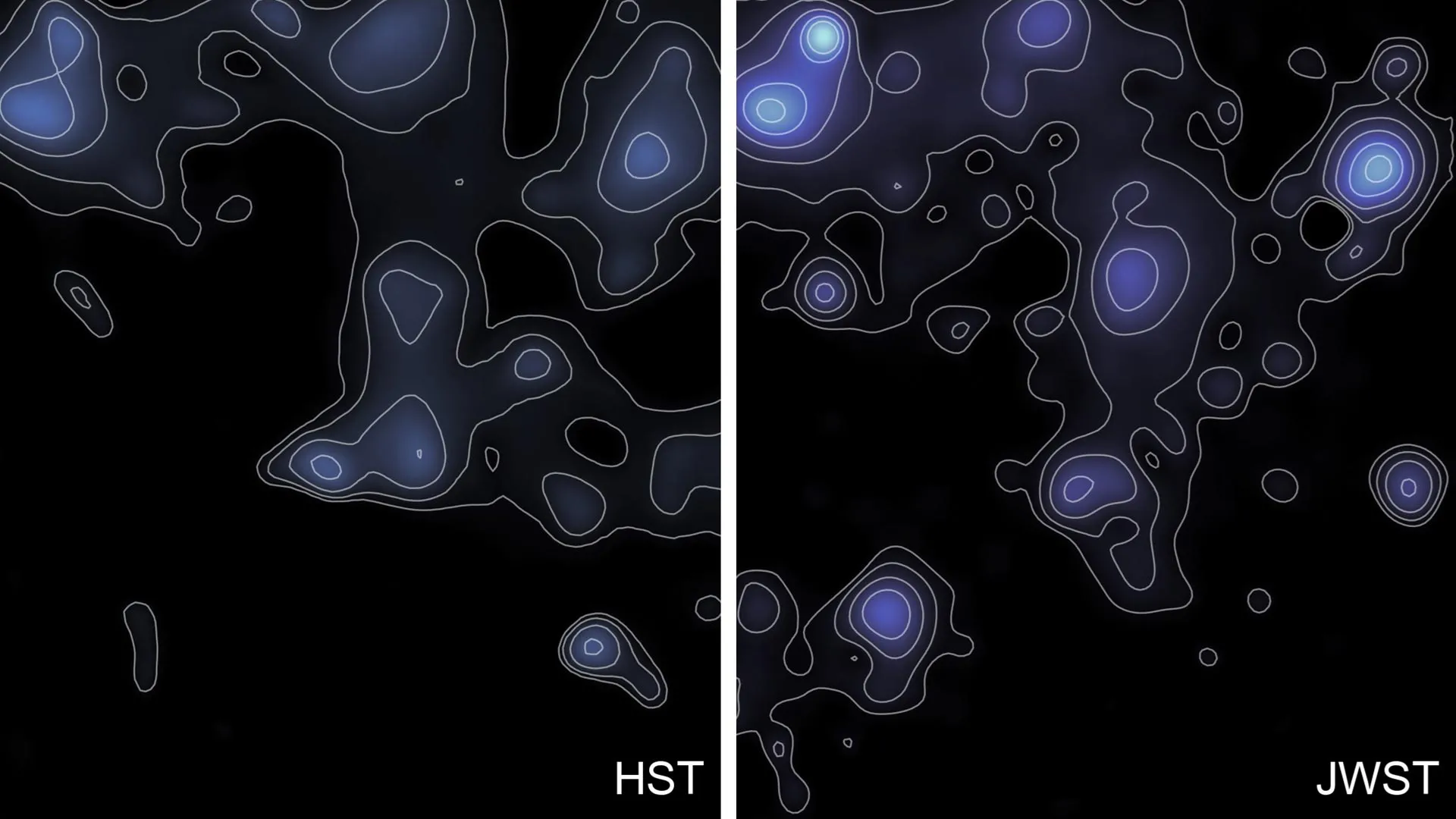
Webb observed this area for approximately 255 hours and identified nearly 800,000 galaxies, many of them seen for the first time. To locate dark matter, the team measured how its mass bends space, which in turn bends the light traveling to Earth from distant galaxies — as if that light had passed through a warped windowpane.

The resulting map includes roughly ten times more galaxies than earlier ground-based maps of the same region and twice as many as those produced using the Hubble Space Telescope. It reveals new concentrations of dark matter and provides a much sharper view of areas previously observed by Hubble.

Research co-lead author Dr. Diana Scognamiglio, of NASA’s Jet Propulsion Laboratory, said: “This is the largest dark matter map we’ve made with Webb, and it’s twice as sharp as any dark matter map made by other observatories.

“Previously, we were looking at a blurry picture of dark matter. Now we’re seeing the invisible scaffolding of the Universe in stunning detail, thanks to Webb’s incredible resolution.”

Instruments and Future Exploration

To improve distance measurements for many of the galaxies in the map, the research team used Webb’s Mid-Infrared Instrument (MIRI).

Durham University’s Centre for Extragalactic Astronomy contributed to the development of MIRI, which was designed and managed through launch by JPL. The instrument is especially effective at detecting galaxies hidden behind thick clouds of cosmic dust.

The team plans to expand their work by mapping dark matter across the entire Universe using the European Space Agency’s (ESA) Euclid telescope and NASA’s upcoming Nancy Grace Roman Space Telescope. These future observations will help scientists better understand dark matter’s basic properties and how it may have evolved over cosmic time.

The region of sky analyzed in this study will serve as a reference point, allowing future dark matter maps to be compared and refined with greater precision.

The latest research was funded by NASA, the RCUK/Science and Technology Facilities Council (STFC), the Swiss State Secretariat for Education, Research and Innovation (SERI), RCUK/STFC Central Laser Facility at the STFC Rutherford Appleton Laboratory and the Centre National d’Etudes Spatiales.

Share Button

This brain discovery is forcing scientists to rethink how memory works

A new study examining how memory functions in the brain suggests that different kinds of remembering may rely on the same brain regions. Instead of using separate neural pathways to retrieve different types of information, the brain appears to activate overlapping areas, a finding that could change how memory is defined and studied.

The research was conducted by scientists from the School of Psychology at the University of Nottingham and the Cognition and Brain Sciences Unit at the University of Cambridge. By combining task based experiments with fMRI data, the team found no measurable difference in brain activity between successful episodic and semantic memory retrieval. The study was published in Nature Human Behaviour.

What Makes Episodic and Semantic Memory Different

Episodic memory allows people to recall specific past experiences that happened at a particular place and time. This form of memory enables individuals to mentally revisit moments from their lives, often described as “mental time travel.”

Semantic memory, by contrast, involves recalling facts and general knowledge about the world. These memories are not tied to the original time or place where the information was learned and can be accessed independently of that context.

Testing Memory With Closely Matched Tasks

To directly compare how these two types of memory operate, the researchers designed tasks that were carefully aligned. Forty participants were asked to remember pairings between logos and brand names. Some pairings reflected real-world knowledge and formed the semantic task, while others were learned during an earlier study phase and served as the episodic task.

During these memory tasks, participants underwent fMRI (Functional Magnetic Resonance Imaging) scanning. In the semantic task, they recalled brand details based on prior knowledge. In the episodic task, they remembered information about the logo and brand pairings learned earlier.

fMRI is a non-invasive brain imaging technique that measures activity by tracking changes in blood flow. When specific brain regions become active during tasks such as thinking, speaking, or remembering, they receive increased amounts of oxygen-rich blood. This allows researchers to produce detailed 3D images showing which parts of the brain are engaged, supporting studies of brain function, neurological conditions, and surgical planning.

Unexpected Findings From Neuroimaging

Dr. Roni Tibon, Assistant Professor in the School of Psychology, led the study and said the results challenged long-held assumptions.

“We were very surprised by the results of this study as a long-standing research tradition suggested there would be differences in brain activity with episodic and semantic retrieval. But when we used neuroimaging to investigate this alongside the task based study we found that the distinction didn’t exist and that there is considerable overlap in the brain regions involved in semantic and episodic retrieval.”

She also noted that the findings could offer new insights into memory related illnesses.

“These findings could help to better understand diseases like, dementia and Alzheimer’s as we can begin to see that the whole brain is involved in the different types of memory so interventions could be developed to support this view.”

Rethinking How Memory Is Studied

For many years, episodic and semantic memory have been treated as separate systems, leading researchers to investigate them independently. This approach has resulted in relatively few studies that examine both memory types within the same experimental framework.

Dr. Tibon believes the new evidence could help shift that perspective.

“Based on what we already knew from previous research in this area we really expected to see stark differences in brain activity but any difference we did see was very subtle, I think these results should change the direction of travel for this area of research and hopefully open up new interest in looking at both sides of memory and how they work together.”

Share Button

Mental health chat encouraged at coffee mornings

Three coffee mornings are being held in Wolverhampton as part of a national mental health event.

Share Button

Like a screwdriver in my face – Life with ‘the world’s most painful known medical condition’

Trigeminal neuralgia is a rare condition where something as simple as a gust of wind can cause excruciating pain.

Share Button