Health24.com | Camel milk is the new milk craze in South Africa – should you try it?

In some parts of the world, camel milk is a local specialty. Dubbed the “white gold of the desert”, it’s been popular in the Middle East and certain parts of Africa for thousands of years, but has only recently made its way to South Africa. But what makes the milk so unique, compared to other kinds of milk on the shelves?

What does it contain?

Camel milk is highly nutritious and full of proteins and organic compounds with powerful anti-bacterial, antiviral and anti-microbial abilities, Carin Smit, clinical environmental and metal toxicologist told Health24.

“The protein in camel milk is totally different to the protein in cow’s milk. The protein in cow’s milk prunes neurocirculatory in the brain. That’s why when cow’s milk is given to an autistic child, the autism deepens, whereas camel milk does not contain that protein.”

Although most of the evidence on the link between camel milk and autism is anecdotal, there are a few small studies indicating potential therapeutic effects in children with autism.

Smit adds that the milk is also a rich source of insulin as there are 52 units of insulin-like protein in every litre of camel’s milk, making it a potential natural solution for diabetes.

If you have trouble digesting lactose (the natural sugar found in cow’s milk), or have milk allergies, camel milk can make you forget all about your excruciating digestive issues as it is lower in lactose and doesn’t contain the protein that causes an allergic reaction to cow’s milk.

Camel milk also has five times the amount of vitamin C and ten times more iron than its bovine counterpart, making it ideal for those with anaemia. Besides this, it’s also anti-inflammatory, can help treat skin disorders such as eczema and psoriasis, and can boost immunity.

We asked dietitian and Health24 expert, Ria Catsicas, to compare the nutritional benefits and average price of (long-life) cow’s milk and common milk alternatives.  
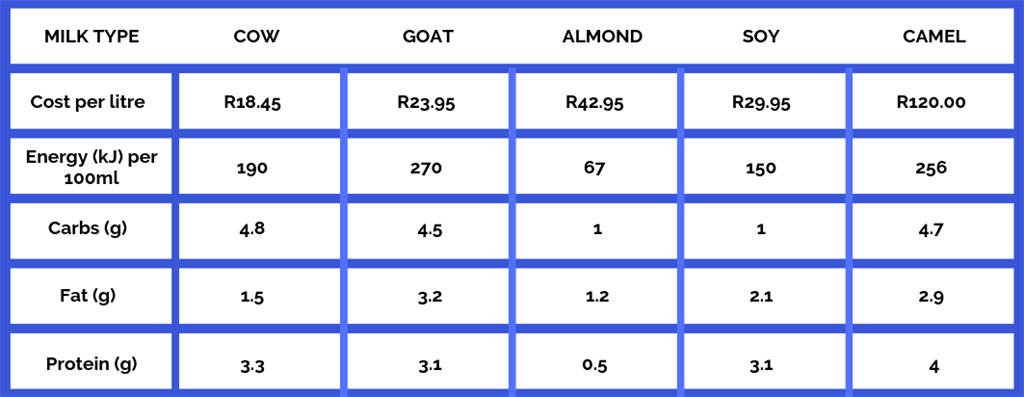
milk comparison

Why the high cost?

When compared to other kinds of the milk on the shelves, camel milk is considerably more expensive. This is because camels produce only a fraction of what a cow produces, and the fact that demand far outweighs supply. 

Where can I find it?

This novelty dairy contender hasn’t yet headed to the refrigerated section of South African supermarkets. It’s currently available fresh, as unpasteurised frozen milk in one litre bottles, and in milk powder form from Camel Milk South Africa. It has recently been released in its pasteurised form in Cape Town, but has yet to roll out to stores across the country.

The milk comes from free-ranging camels in the remote district of Askham in the Kalahari. It’s the only camel milk dairy in South Africa and is run by Hans Knoesen, a former banker whose family has been involved with farming for many years. 

The camels were once-wild camels that have become adapted to the Kalahari over the past 100 years and have been tamed, Smit tells us. “Once they’ve given birth, they don’t eat anything that is non-organic. They live on 50 Kalahari bushes, so it’s the purest, most ethically-raised milk that you can find in Southern Africa.” 

At the moment, the farm has a total of 44 camels that are milked. If you compare that to the fact that there are more than one million milking cows in South Africa, it helps to explain the high cost.

What does it taste like?

Camel milk looks almost identical to cow’s milk. In the video above, we asked people to try camel milk and most of them found it to be sweet and a little salty, but quite creamy. Most of the tasters said it tastes very similar to cow’s milk. Camels eat plants rich in salt, hence the hint of salt.  

The raw milk debate

Raw or pasteurised – which is better?

A big concern about camel milk for consumers is that many products are unpasteurised. Nutrition experts caution against drinking unpasteurised camel milk, which, like other kinds of raw milk, can cause food-borne illnesses.

Pasteurisation doesn’t change the milk’s nutrition profile; it only makes it safer to drink. However, Smit explains that the moment you heat the milk above 54 degrees Celsius, it loses its health benefits.

“When you pasteurise milk, you’re heating it to temperatures where nothing remains alive in the milk, so if there were good bacteria, they’d be lost.” It’s reduced to a sterile form. And although during the pasteurisation process, from heating to bottling, to capping, bacteria still get in, these bacteria are not probiotic, but pathogenic. 

This is why milk putrifies (rots) when it’s been pasteurised and doesn’t ferment, explains Smit, and emphasises that the camel milk ferments because of the probiotics. If you intend to use the milk as a wellness advancement, Smit suggests it’s used in its pure form and not heated when added to tea or coffee, for example.

On the question of diseases affecting cattle, Knoesen explained to Health24:

“We test our camels once a year for Brucella and TB. The previous test was done in April 2018. It’s a closed herd and we try not to bring new animals into the herd – and if we do, the new camels are tested and kept separate until the test results are known.”

Smit also weighs in:

“Nobody wants salmonella and Brucella, but that’s why all herds that produce the milk are tested by the state vet, and they are tested on a regular basis to see that none of the more serious conditions like brucellosis are passed on to a population of drinkers. 

“We also have to understand that camels have a very unique benefit in that they don’t get sick with the diseases that cows get. They don’t get foot-and-mouth disease (FMD); they aren’t affected by tick bites,” she says.

The worst sickness that can affect camels is the Middle Eastern Respiratory Virus (MERS). However, Smit mentions that this happens in the Middle East and that our camels in Southern Africa are not contaminated. If you want to err on the cautious side, it is best to purchase the powdered milk. Although it may not contain all the immunoglobulins that confer health and immunity, you will have peace of mind, says Smit.

The verdict

The main body of research about camel milk was initially published in Arabic, so very few people in the West knew about it and its efficacy. Although subsequent additional research looks promising, more studies are needed to ascertain its nutritional characteristics and for the camel milk sector to flourish in Southern Africa.

But one thing is certain: the camel milk hype is real and this unorthodox milk product is surging in popularity. According to market research firm Technavio, camel milk consumption is projected to grow by 7% globally each year for the next five years. People are embracing healthier foods and are turning away from industrial cow’s milk for several reasons, which means that camel milk might become a popular health fad in South Africa sooner than we think.

Image: iStock

NEXT ON HEALTH24X

Share Button

Health24.com | Is drinking small amounts of alcohol during pregnancy really safe?

In South Africa the numbers are staggering: we have the highest number of babies in the world (111 per 1 000) born with foetal alcohol syndrome (FAS), with the Western Cape at the front of the pack. To put it into perspective, the global average is only 7.7 per 1 000.

What is FAS?

Foetal Alcohol Syndrome Disorders (FASD) is an umbrella term for a group of permanent, life-long and irreversible conditions caused by the effects of alcohol on a foetus, with foetal alcohol syndrome (FAS) being the most extreme.

FAS is permanent brain damage caused by alcohol intake during pregnancy. Alcohol passes from the mother’s blood into the baby’s blood (via the placenta), and can damage a baby’s developing brain and body. It can result in serious physical and mental defects.

According to the KZN Department of Health, FAS is thought to be the third highest cause of congenital mental retardation – it is more common than spina bifida, autism and Down syndrome combined.

Symptoms include learning difficulties, hyperactivity, poor concentration, poor impulse control, and bad memory, among others. Unfortunately, the syndrome is permanent and irreversible, which means there is no cure or treatment. 

What about just a bit of alcohol?

Drinking any type of alcohol during pregnancy can cause irreversible brain damage in an unborn child. This is backed by scientific evidence, proving that these activities can have negative impacts on the health of the foetus.

While some studies suggest that a bit of alcohol during early pregnancy is safe, we don’t truly have the ability to accurately say what level of alcohol consumption is risk-free. So why take the risk? 

Kids with FAS really struggle

While activities like holding a pencil and drawing come easy to most kids, it can be a frustrating struggle for kids with FAS. This is because children with FAS experience delayed motor development and impaired fine motor skills. Apart from this, poor growth and seizures are also associated with the condition. 

Kids in the FAS spectrum can have intellectual disability, but can also have IQ’s above the normal range and be very smart. They might, however, at the same time be lacking in certain other areas such as abstract reasoning or the ability to control impulses. Basic learning can be a struggle, and they may need lifelong support because, cognitively, they’re unable to process things in a normal way.

Can fathers also be responsible for FAS?

Whether fathers’ drinking habits can cause significant foetal abnormalities has for long been a topic of discussion, but there are some studies that indicate that dads may need to put down the bottle as well, as his diet and lifestyle may also lead to birth defects. However, it’s not yet clear how much alcohol can make a difference for men, and until that is known, doctors suggest it’s best for fathers-to-be to also minimise their alcohol intake.

The best analogy for the risk associated with alcohol consumption in pregnancy, as Jen Gunter wrote in the NY Times, is driving with your newborn unbuckled in the back seat: Perhaps you’ll meet with a car accident, perhaps you won’t. But if you do, it could be a minor collision, or it could be catastrophic.

*Each year on September 9th, World Foetal Alcohol Spectrum Disorders Day is observed in an effort to bring necessary awareness to the detrimental impact of the consumption of alcohol during pregnancy.

Image: iStock

NEXT ON HEALTH24X

Share Button

Health24.com | Families of deceased firefighters still looking for closure

Speaking on behalf of the families who lost their loved ones in the Bank of Lisbon fire, Robert Moropane says that he won’t be able to find closure until he knows what led to the death of his son, firefighter Simphiwe Moropane.

The struggle continues 

“Three hundred and sixty-five days later, the mother [my daughter-in-law] of Simphiwe’s kids is still struggling for fend for those children. We are helping her here and there but it’s not enough because their father loved them and if he was still here, they wouldn’t be in the situation they are in.”

Moropane says it took him a while to receive the counselling promised to him and other families. 

“They gave us numbers of people from Emergency Medical Services (EMS) to phone so that they can arrange counselling for us. I made about four to five phone calls [but] they gave me excuses, so I stopped because I was the one making the effort and I didn’t know where else to turn to help the children.”

Despite finally receiving counselling through the provincial department of health, Moropane says not knowing what led to his son’s death makes it difficult for him to heal.

“Talking to the psychologist, I found that it isn’t easy to heal if there is something left behind, [in this case] the report of what happened. I called the EMS at least a hundred times just to find out what happened to my son so that we as a family can get our conclusion and move on.”

Becoming better 

Gauteng Health MEC, Dr Bandile Masuku says the commemoration of the fire is a way of signifying the change that the department wants to make.

“In terms of our priorities, we want to engage on issues that relate to Occupational Health and Safety (OHS) and one of the commitments we have made is that by the end of this financial year, all of our facilities across the province will be OHS compliant. We are [also] going to renovate and refurbish them.”

He also acknowledges the work that the firefighters were doing when they met their untimely deaths.

“We hope that this plaque will be put in one of our boardrooms where it will constantly remind everyone about the commitments that we have made to the public about our dedication and the sacrifice that civil servants put into their work.”

Not in vain 

Democratic Nursing Organisation of South Africa deputy provincial chairperson, Thabang Sonyathi, says that the death of the firefighters should not be in vain.

“What happened here last year must be a stepping stone [upon] our reflection, how do we do things better, how do we protect workers and how do we protect the people that we serve in general? May it be that our colleagues who have fallen here, that their death is not in vain but encourages us to thrive towards OHS excellence.”

He also calls on the investigation of the cause of the fire to be concluded.

“We are still waiting very eagerly for the report… so that it can give us closure.”

The unions are also calling on employers to ensure that the families of the deceased firefighters are taken care of, particularly their children’s education costs. 

The other two firefighters who died in the tragedy are Mduduzi Ndlovu and Khathutshelo Muedi.

– Health-e News

Image credit: iStock

NEXT ON HEALTH24X

Share Button

‘Supercool’ method triples organ survival

Researchers have been testing the technique in the lab and hope to move into human clinical trials.

Share Button

Too many hooked on prescription drugs – health chiefs

Half of those taking drugs including strong painkillers and sleeping pills are on them for more than a year.

Share Button

Once or twice weekly daytime nap linked to lower heart attack/stroke risk

A daytime nap taken once or twice a week may lower the risk of having a heart attack/stroke, finds research published online in the journal Heart. But no such association emerged for either greater frequency or duration of naps.

The impact of napping on heart health has been hotly contested. Many of the published studies on the topic have failed to consider napping frequency, or focused purely on cardiovascular disease deaths, or compared regular nappers with those not opting for a mini siesta, say the researchers.

In a bid to try and address these issues, they looked at the association between napping frequency and average nap duration and the risk of fatal and non-fatal cardiovascular disease ‘events,’ such as heart attack, stroke, or heart failure, among 3462 randomly selected residents of Lausanne, Switzerland.

Each participant was aged between 35 and 75, when recruited between 2003 and 2006 to the CoLaus study. This has been looking at the factors behind the development of cardiovascular disease.

Participants’ first check-up took place between 2009 and 2012, when information on their sleep and nap patterns in the previous week was collected, and their health was then subsequently monitored for an average of 5 years.

Over half (58%, 2014) of the participants said they didn’t nap during the previous week; around one in five (19%, 667) said they took one to two naps; around one in 10 (12%, 411) said they took three to five; while a similar proportion (11%, 370) said they took six to seven.

Frequent nappers (3-7 naps a week) tended to be older, male, smokers, weigh more, and to sleep for longer at night than those who said they didn’t nap during the day.

And they reported more daytime sleepiness and more severe obstructive sleep apnea — a condition in which the walls of the throat relax and narrow during sleep, interrupting normal breathing.

During the monitoring period, there were 155 fatal and non-fatal cardiovascular disease ‘events’.

Occasional napping, once to twice weekly, was associated with an almost halving in attack/stroke/heart failure risk (48%) compared with those who didn’t nap at all.

This association held true after taking account of potentially influential factors, such as age, and nighttime sleep duration, as well as other cardiovascular disease risks, such as high blood pressure/cholesterol.

And it didn’t change after factoring in excessive daytime sleepiness, depression, and regularly sleeping for at least 6 hours a night. Only older age (65+) and severe sleep apnea affected it.

But the 67% heightened cardiovascular risk initially observed for frequent nappers virtually disappeared after taking account of potentially influential factors. And no associations with cardiovascular disease ‘events’ were found for nap length (from 5 minutes to 1 hour plus).

This is an observational study, and as such, can’t establish cause, added to which the information on nap and sleep patterns relied on personal recall. But nap frequency may help to explain the differing conclusions reached by researchers about the impact of napping on heart health, suggest the study authors.

In a linked editorial, Drs Yue Leng and Kristine Yaffe, of the University of California at San Francisco, USA, point out that research in this area is hampered by the absence of a gold standard for defining and measuring naps, making it “premature to conclude on the appropriateness of napping for maintaining optimal heart health.”

But they add: “While the exact physiological pathways linking daytime napping to [cardiovascular disease] risk is not clear, [this research] contributes to the ongoing debate on the health implications of napping, and suggests that it might not only be the duration, but also the frequency that matters.”

And they conclude: “The study of napping is a challenging but also a promising field with potentially significant public health implications. While there remain more questions than answers, it is time to start unveiling the power of naps for a supercharged heart.”

Story Source:

Materials provided by BMJ. Note: Content may be edited for style and length.

Share Button

Why people gain weight as they get older

Many people struggle to keep their weight in check as they get older. Now new research at Karolinska Institutet in Sweden has uncovered why that is: Lipid turnover in the fat tissue decreases during ageing and makes it easier to gain weight, even if we don’t eat more or exercise less than before. The study is published in the journal Nature Medicine.

The scientists studied the fat cells in 54 men and women over an average period of 13 years. In that time, all subjects, regardless of whether they gained or lost weight, showed decreases in lipid turnover in the fat tissue, that is the rate at which lipid (or fat) in the fat cells is removed and stored. Those who didn’t compensate for that by eating less calories gained weight by an average of 20 percent, according to the study which was done in collaboration with researchers at Uppsala University in Sweden and University of Lyon in France.

The researchers also examined lipid turnover in 41 women who underwent bariatric surgery and how the lipid turnover rate affected their ability to keep the weight off four to seven years after surgery. The result showed that only those who had a low rate before the surgery managed to increase their lipid turnover and maintain their weight loss. The researchers believe these people may have had more room to increase their lipid turnover than those who already had a high-level pre-surgery.

“The results indicate for the first time that processes in our fat tissue regulate changes in body weight during ageing in a way that is independent of other factors,” says Peter Arner, professor at the Department of Medicine in Huddinge at Karolinska Institutet and one of the study’s main authors. “This could open up new ways to treat obesity.”

Prior studies have shown that one way to speed up the lipid turnover in the fat tissue is to exercise more. This new research supports that notion and further indicates that the long-term result of weight-loss surgery would improve if combined with increased physical activity.

“Obesity and obesity-related diseases have become a global problem,” says Kirsty Spalding, senior researcher at the Department of Cell and Molecular Biology at Karolinska Institutet and another of the study’s main authors. “Understanding lipid dynamics and what regulates the size of the fat mass in humans has never been more relevant.”

Story Source:

Materials provided by Karolinska Institutet. Note: Content may be edited for style and length.

Share Button

Scientists triple storage time of human donor livers

Scientists have greatly extended the amount of time human livers can be stored for transplantation by modifying a previous protocol to extend the viability of rat livers. Previously, human livers were only viable for an average of nine hours, but the new method of preservation maintains liver tissue for up to 27 hours, giving transplant doctors and patients a much longer timeframe to work with.

The research is supported by the National Institute of Biomedical Imaging and Bioengineering (NIBIB) and the National Institute of Diabetes and Digestive and Kidney Disease (NIDDK), both part of the National Institutes of Health.

Like a glass container broken by frozen water, when cells freeze, they often experience irreparable damage. Since human cells are especially sensitive, donor livers are stored above freezing at 4 degrees Celsius. As a result, doctors can typically only preserve human livers for nine hours before the chances of a successful transplantation drastically decrease. This short time frame makes it more difficult, and sometimes impossible, to get the organs to compatible patients who are located farther away.

“Delivering viable organs to matching recipients within the window of viability can often be the most challenging aspect of organ transplantation,” said Seila Selimovic, Ph.D., director of NIBIB’s Engineered Tissues program. “By giving doctors and patients more time, this research could someday affect thousands of patients who are waiting for liver transplants.”

In previous studies funded by NIH, Martin Yarmush, Ph.D., director of the Center for Engineering in Medicine, Korkut Uygun, Ph.D., associate professor of surgery, and their collaborators at Massachusetts General Hospital (MGH), Boston, had developed new techniques that extended the time that rat liver (hepatic) tissue can be stored at subzero temperatures without damage. They were able to do this by adding a modified glucose compound, 3-OMG, and PEG-35kD — an ingredient in antifreeze — to the protective solution that they use to cool the livers. The PEG compound lowers the temperature at which the cells freeze and 3-OMG acts as a protectant against the cold. With these additions, they were able to cool the rat livers to ?6 degrees Celsius without freezing them — a process called supercooling.

However, while the techniques worked with the rat livers in those earlier studies, it was unsuccessful when applied to human livers, which are 200 times larger. The size difference significantly increased the risk that ice crystals would start to spontaneously form (heterogenous ice nucleation), making the organ unusable for transplantation. In a paper published in Nature Biotechnology on Sept. 9, Reinier de Vries, M.D., a research fellow in surgery, Shannon Tessier, Ph.D., instructor in surgery at MGH and Harvard Medical School, Boston, and Uygun, and their collaborators at MGH detail three new steps to the protocol to avoid ice nucleation and preserve human livers for up to 27 hours.

“With supercooling, as the volume increases it becomes exponentially more difficult to prevent ice formation at sub-zero temperatures,” said de Vries. “Before, there were a lot of experts who said, ‘well this is amazing in small rats, but it will not work in human organs,’ and now we have successfully scaled it up 200 times from rat to human livers using a combination of technologies.”

The first step was to limit the contact of the storage liquid to air. When supercooled, the livers are submerged in the supercooling protective solution. The researchers found that the risk of ice crystals forming greatly increased in areas where the solution was in contact with air. To eliminate this risk, the scientists removed the air from the storage solution bag prior to supercooling, effectively eliminating the chance of spontaneous ice nucleation on the surface of the organ.

Next, the researchers included two additional ingredients to the protective solution to help protect the hepatocytes. The first additive, trehalose, helps to protect the cell as well as stabilize the cell membranes. The second, glycerol, supports the protective properties of the 3-OMG glucose compound added in the previous experiments. Both additives have been used in the cryogenic preservation of cells in the laboratory but had not been used in the preservation of organs for transplantation.

Finally, they developed a new method of delivering the preservation solution to the liver. The traditional method of delivery of the protective solution used in previous studies is to manually flush the preservation solution through the tissue. However, the new protective solution is thicker than the traditional solutions and can cause damage to the cell lining the inside of the blood vessels. In addition, the higher viscosity means that the solution is often not uniformly distributed throughout the organ, increasing the chance of ice nucleation spreading and freezing the liver. To combat this problem, the researchers used machine perfusion — a way of delivering oxygen and nutrients to capillaries in biological tissues while outside the body — at 4 degrees Celsius with the traditional protective solution. They then slowly lowered the temperature while increasing the concentration of the new protective additives. The staggered approach allowed the hepatic tissue time to adjust and the solution was able to spread throughout the organ more uniformly.

While the researchers have yet to implant a liver preserved using this new method into a human subject, traditional standards of assessing liver viability indicate that this process will not negatively affect the organ.

“This new liver preservation method exemplifies NIH’s goal to foster the discovery and translation of innovative ideas,” said Averell H. Sherker, M.D, NIDDK program director for liver diseases. “With further research, organs will be able to travel greater distances and benefit the most critically ill patients requiring liver transplantation.”

This work was supported by NIH’s National Institute of Biomedical Imaging and Bioengineering and the National Institute of Diabetes and Digestive and Kidney Diseases under award numbers R21EB023031, R01DK096075, R01DK107875, R01DK114506.

Share Button

Brain hack devices must be scrutinised, say top scientists

The UK’s Royal Society warns of the risk of companies accessing our thoughts and moods.

Share Button

Health24.com | Women who suffer from this disorder fear public humiliation, but one SA doctor is determined to change that

Pelvic floor disorders impact many women and can cause a variety of problems including incontinence. In Limpopo, patients were commonly referred to Johannesburg for treatment because the province didn’t have an integrated urogynaecology service.

Because of the difficulty this posed for patients, Dr Dakalo Arnold Muavha – who has super-specialised in the field of urogynaecology – decided to take his services to his birth province.

Muavha is the first black South African, and one of only four gynaecologists and obstetricians in the country, to have super-specialised in this field.

Urogynaecology is a relatively new sub-speciality globally, and Muavha has established the first private urogynaecology unit for the treatment of pelvic floor disorders at Netcare Pholoso Hospital in Limpopo. He opened his practice in August 2019. 

Whereas in the past many women would have been referred to a urologist for bladder problems, then sent to a gynaecologist for womb problems, only to be later referred to a colorectal surgeon to treat bowel disorders, the urogynaecologist is trained to deal with all issues related to the pelvic floor and organs, including the bladder, uterus or womb, and rectum. 

Embarrassing incontinence disorders

Pelvic floor disorders can lead to many problems including incontinence, and although these disorders are not life-threatening, Muavha says they occur quite commonly and can have a devastating impact on the lives of those affected. 

Read: 72% of women runners leak urine while running, but won’t say anything

“There are numerous older women in particular who live with severe and embarrassing incontinence disorders. Many are unaware that these can be treated, while others are too embarrassed about the condition to seek medical assistance.

“Some are discriminated against, lose their partners and become susceptible to anxiety and depression,” he said.

In Australia it’s estimated that at least half of women who have had more than one child have some degree of pelvic organ prolapse, and South African trends are believed to be similar to those recorded internationally, urologist Dr Preena Sivsankar told IOL.

According to Muavha, the impact extends economically on families when some women have to give up their jobs and still find the means to spend R1 200 a month or more on adult diapers. Muavha, who is skilled in the management of pelvic floor disorders as well as in laparoscopic surgery and medical research, says that because most women with the disorder can be treated with relative ease, it is “a great tragedy” that they aren’t receiving the help they need.

Older women at higher risk

Pelvic floor disorders have a variety of causes, but occur more commonly in women over the age of 50 who have given birth to a number of children, explains Muavha. However, the risk also increases in overweight individuals. 

Muavha says that he feels blessed to be afforded the opportunity to play an active role in this regard.

“It is my vision to improve access to care through new urogynaecology units within both the private sector at Netcare Pholoso Hospital, as well as the public sector via the Polokwane/Mankweng Hospital complex,” he said.  

Image: Supplied

Share Button