The normal human gut microbiome is a flourishing community of microorganisms, some of which can affect the human immune system. In a new paper published this week in Cell, researchers found that oral antibiotics, which can kill gut microorganisms, can alter the human immune response to seasonal influenza vaccination. The work was led by scientists at Stanford University and funded by the National Institute of Allergy and Infectious Diseases (NIAID), part of the National Institutes of Health.
The research team examined 33 healthy adult participants in their study. One group of 22 volunteers was studied during the 2014-2015 flu season, and the second group with 11 volunteers was studied during the 2015-2016 flu season. The group of 22 volunteers had high pre-existing immunity to the influenza virus strains contained in the 2014-2015 seasonal influenza vaccine. The group of 11 volunteers had low immunity to the 2015-2016 seasonal influenza vaccine’s virus strains.
All study participants received a seasonal influenza vaccine. Half the participants in each group also received a five-day course of a broad-spectrum antibiotic regimen (consisting of neomycin, vancomycin, and metronidazole) by mouth before receiving the vaccine. By analyzing stool and blood serum samples taken at various times up to one year after vaccination, the researchers tracked the participants’ immune response to the influenza vaccines, as well as the diversity and abundance of the organisms in their gut microbiomes.
As expected, most participants who received antibiotics experienced reduced levels of gut bacteria. In addition, among the 2015-2016 participants who had little prior immunity to the seasonal influenza virus vaccine strains, a course of antibiotics hindered their immune responses to one of the three influenza virus strains in the vaccine, an H1N1 A/California-specific virus. This likely indicates that should they be exposed to this H1N1 virus after vaccination, these participants would be less protected against infection with that strain than people who had not received antibiotics, according to the authors. This finding supports earlier research results in mice.
The researchers also found that people who took antibiotics experienced changes to their immune systems that promoted a pro-inflammatory state, similar to a condition seen in older adults who have received influenza vaccines. The investigators believe this pro-inflammatory state is related to the process by which the microbiome regulates the metabolism of bile acid — with fewer microorganisms, this process is disrupted. Humans’ microbiomes change naturally as they age, and the researchers suggest that further research on these pathways could provide insights into why older adults respond differently to influenza vaccination and why they have weaker immune systems overall.
Some dog breeds are incredibly fast runners and some, like the Bloodhound, are known for their smelling ability. Some are small, but what they lack in size they make up for in their activity levels.
Other dogs were bred specifically to be good companions. And then there are those strong and smart working dogs – such as the Great Dane and Boxer.
Brains tweaked as well
Whether it was for hunting, herding or guarding, dogs have been purposely bred by humans to perform specific tasks for hundreds of years.
Today, thanks to this selective breeding, there are more than 400 dog breeds in the world. In fact, dogs have more physical variation than almost any other animal on earth.
And now, for the first time, a new study has discovered that this practice has not simply tweaked dogs’ sizes, colours and behaviours, but also their brains.
The study’s lead author, Dr Erin Hecht, a neuroscientist studying dog cognition at Harvard University and his colleagues mention that although dog breeds are known to vary in cognition, temperament, and behaviour, the neural origins of the variations were previously unknown.
The research, published in JNeurosci, investigated the effects of selective breeding on the brain structure of 62 dogs from 33 dog breeds through magnetic resonance imaging scans. The dogs had the neurological evaluations done at the University of Georgia Veterinary Teaching Hospital. The scientists found that there was wide variation in brain structure that was not simply related to body size or head shape.
Greatest variance across breeds
The team also went on to examine the areas of the brain that vary the most across breeds. This led to maps of six brain networks that were each linked to at least one behavioural characteristic. All six brain networks had proposed functions varying from social bonding to movement. The maps showed that the variations in behaviours across different dog breeds were correlated with anatomical variations.
Purpose of the study
The researchers of the study claim that studying this neuroanatomical variation in dogs offers a unique opportunity to study the evolutionary relationship between brain structure and behaviour. All 62 dogs in the study were pets and not working dogs.
Dr Hecht explained that her team is also trying to better understand why and to what extent variations between “high-skill performers and low-skill performers” in the same breed occur. “For example, [the difference between] border collies who are winning herding competitions out in the real world and siblings of those dogs who, for whatever reason, would rather just sit on the couch,” she said.
If the researchers have managed to find a reason for these differences, Jeffrey Stevens, director of the Canine Cognition and Human Interaction Lab at the University of Nebraska at Lincoln commented: “Imagine what might be discovered in the brains of working dogs.”
Daniel Horschler, a PhD student at the University of Arizona’s Canine Cognition Centre, said the variation found across the breeds could also prove to be an important model for understanding how brains work in general.
Plants can do many amazing things. Among their talents, they can manufacture compounds that help them repel pests, attract pollinators, cure infections and protect themselves from excess temperatures, drought and other hazards in the environment.
Researchers from the Salk Institute studying how plants evolved the abilities to make these natural chemicals have uncovered how an enzyme called chalcone isomerase evolved to enable plants to make products vital to their own survival. The researchers’ hope is that this knowledge will inform the manufacture of products that are beneficial to humans, including medications and improved crops. The study appeared in the print version of ACS Catalysis on September 6, 2019.
“Since land plants first appeared on earth approximately 450 million years ago, they have developed a sophisticated metabolic system to transform carbon dioxide from the atmosphere into a myriad of natural chemicals in their roots, shoots and seeds,” says Salk Professor Joseph Noel, the paper’s senior author. “This is the culmination of work we’ve been doing in my lab for the past 20 years, trying to understand plant chemical evolution. It gives us detailed knowledge about how plants have developed this unique ability to make some very unusual but important molecules.”
Previous research in the Noel lab looked at how these enzymes evolved from non-enzyme proteins, including studying more primitive versions of them that appear in organisms such as bacteria and fungi.
As an enzyme, chalcone isomerase acts as a catalyst to accelerate chemical reactions in plants. It also helps to ensure the chemicals that are made in the plant are the proper form, since molecules with the same chemical formula can take two different variations that are mirror images of each other (called isomers).
“In the pharmaceutical industry, it’s important that the drugs being made are the correct version, or isomer, because using the wrong one can lead to unintended side effects,” says Noel, who is director of Salk’s Jack H. Skirball Center for Chemical Biology and Proteomics and holds the Arthur and Julie Woodrow Chair. “By studying how chalcone isomerase works, we can learn more about how to accelerate the manufacture of the correct isomers of pharmaceuticals and other products that may be important to human health.”
In the current study, the investigators used several structural biology techniques to investigate the enzyme’s unique shape and how its shape changes as it interacts with other molecules. They pinpointed the part of chalcone isomerase’s structure that allowed it to catalyze reactions incredibly fast while also ensuring it makes the proper, biologically active isomer. These reactions lead to a host of activities in plants, including converting primary metabolites like phenylalanine and tyrosine into vital specialized molecules called flavonoids.
It turned out that one particular amino acid, arginine, that was one of many amino acids linked together in chalcone isomerase sat in a location, shaped by evolution, that allowed it to play the key role in how chalcone isomerase reactions were catalyzed.
“By doing structural studies and computer modeling, we could see the very precise positions of arginine within the enzyme’s active site as the reaction proceeded,” says first author Jason Burke, a former postdoctoral research in Noel’s lab who is now an assistant professor at California State University San Bernardino. “Without that arginine, it doesn’t work the same way.”
Burke adds that this type of catalyst has been long sought by organic chemists. “This is an example of nature already solving a problem that chemists have been looking at for a long time,” he adds.
“By understanding chalcone isomerase, we can create a new toolset that chemists will be able to use for the reactions they’re studying,” Noel says. “It’s absolutely vital to have this kind of foundational knowledge to be able to design molecular systems that can carry out a particular task even in the next generation of nutritionally dense crops capable of transforming the greenhouse gas carbon dioxide into molecules essential for life.”
As fires throughout the nation have demonstrated over the last few weeks, fire season isn’t ending any time soon.
While it’s impossible to predict just where the next wildfire will start, new Department of Defense-sponsored research from Brigham Young University’s Fire Research Lab is getting into the microscopic details of how fires initiate to provide more insight into how wildfires burn through wildland fuels.
“We are working on a small scale and hopefully that gives us some insight into what happens on a large scale,” said fire expert Thomas H. Fletcher, BYU professor of chemical engineering. “We’re trying to take some of the unpredictability out of fire by doing experiments in well-controlled environments.”
For their experiments, Fletcher and co-authors loaded leaves of 14 shrub species (including the likes of Inkberry, Wax Myrtle, Fetterbush, Dwarf Palmetto and Sparkleberry) into the crucible of a thermogravimetric analyzer and slowly turned the heat up to 800 degrees Celsius. As they watched the leaves burn, they categorized the speed at which the plant broke down and the chemicals produced by the heat. They also compared the impact of two heat sources: convective (think of wind-driven fires) and radiative (from burning plant particles or flames).
The research found that the chemistry of shrubs makes a big difference in how fast they break down before they combust. That’s important to know because the type of plant found on a mountain hillside may help predict how a fire will burn and how quickly it might jump to another plant species.
“Very detailed models that already exist take up to two weeks to run on very big computers and by that time, the fire has moved and it’s not in the same place anymore,” Fletcher said. “We’re aiming towards giving answers on how a fire might propagate in the next 20 minutes or half hour instead of the next two weeks.”
The studies are aimed at improving predictive models for both prescribed burns and for unplanned wildfires. With wildfires costing the Forest Service and state agencies billions of dollars to control annually, any research that can help make fire management more efficient is a high priority.
Case in point: The Pole Creek Fire that burned 102,000 acres in south Utah County last year started with a lightning strike that was left to burn out naturally. Unfortunately, hot, dry winds pushed it into a major threat to Spanish Fork, Elk Ridge and Mapleton. The fire, which later merged with another wildfire — the Bald Mountain Fire — ended up costing more than $6 million to contain.
“With all we’ve done to research them, fires are still out of control,” Fletcher said. “Our model can’t prevent a fire, but it can help with decisions on how to do manage fires so that when a fire starts, it doesn’t blow up into a huge, uncontrollable fire.”
Reality TV brought fame and fortune to Nigel Lythgoe. So, it’s no surprise he can spin entertaining tales about the real-life drama he experienced with his heart.
But the man once dubbed “Nasty Nigel” for his bluntness as a talent show judge sounded downright empathetic as he explained why he tells those tales.
A household name
“Listen,” he said, “I suffered a heart attack before I realised how important it was to look after my heart. I hope other people realise long before they have a heart attack, and they live a long and healthy and happy life.”
Lythgoe’s ability to tell a good story has made him one of the world’s most successful TV figures. A creator and judge for “So You Think You Can Dance”, his long list of credits includes, perhaps fittingly, being director and producer on the British version of “Survivor”. He became a household name in Britain as a judge on “Popstars” and was a longtime executive producer of “American Idol”.
His first heart crisis struck in January 2003. He had just returned from a vacation in Barbados with “Idol” judge Simon Cowell, whom Lythgoe jokingly blames for what happened.
“He had me dancing all around this hotel,” Lythgoe said, before adding: “I used to smoke three packs of cigarettes a day as well. Which obviously didn’t help.”
He was in the editing suite working on the second season of “Idol” when it happened. “I was literally in the edit with Ruben Studdard and Clay Aiken.”
He thought he had indigestion and lay down to rest. “The next day I was still feeling bad,” he said, but he kept working. Finally, on the third day, his wife convinced him to see his doctor.
He looked healthy
“He examined me and said, ‘Oh my God – you’re having a heart attack!'”
Which was a surprise, he said, because he looked healthy, with his post-vacation glow. “I was tanned and brown to the point that my doctor said, ‘I’m calling an ambulance for you. Can you try and look ill?'”
Doctors found a blocked heart artery and used a stent to open it up. But about eight years later, his heart had another nasty surprise in store.
He had gone to see a movie – “Cloud Atlas” – one afternoon and was alone in the theatre when he suddenly felt dizzy. He staggered out of the cinema.
“I saw the poor girl behind the popcorn counter. I said, ‘Call an ambulance, please.’ And with that I keeled over.”
He was diagnosed with an irregular heartbeat and ended up needing a pacemaker, a defibrillator and three ablation procedures to destroy heart tissue that was causing his heart’s electrical malfunctions. “Since 2012, I’ve been good,” said Lythgoe, who turned 70 in July.
He felt invulnerable
Looking back now, he understands the mistakes he made when it came to his health. A longtime dancer, he choreographed for hundreds of TV episodes, working with the likes of Ben Vereen, Shirley Bassey and the Muppets.
“There was never a point in my life when I felt vulnerable to anything.” He was arrogant, he said, and thought, “Oh, I can eat fries. I can do this. I can do that. I’m a dancer. I keep my shape.”
But as he sees it, “The great thing about surviving a heart attack is you really do then take care of yourself. If you’re lucky enough to survive it.”
He’s since given up smoking, sugar and dairy, and does Pilates twice a week.
He’s serious about working to help others not make the same mistakes he made. He and “Hairspray” director Adam Shankman were together in Los Angeles and San Diego this spring to help with a collaboration between the American Dance Movement, a non-profit they founded to build healthy communities through dance, and the American Heart Association’s Kids Heart Challenge and American Heart Challenge.
Lythgoe’s message about the lessons he’s learned is, once again, direct.
“Nobody in this life gets out alive. But the big thing for me is to just stick around as long as you can. And if you don’t look after your heart, if you don’t look after your entire body, you’re not going to be around as long as you should be.”
If you don’t indulge in fizzy drinks but love your chocolate bar, you might want to continue reading.
As we know, a tax on sugary drinks has been implemented in South Africa to help fight obesity levels. But new research suggests that there is a measure that may be even more effective.
A ‘snack tax’
A new study in The BMJ stated that taxing high sugar snacks such as biscuits, cakes and sweets might be more effective at curbing growing obesity rates worldwide, according to a news report.
According to this study, in the UK, high sugar snacks add more to the national sugar intake than sugary drinks. Therefore, reducing the purchase of these goods may make a bigger impact on the population’s health.
While currently there is no new research on figures in South Africa, the study focused on food purchase data for 36 324 UK households and National Diet and Nutrition Survey Data for 2 544 adults.
Results were grouped by household income and body mass index (BMI) to determine any changes in weight and prevalence of obesity during the course of a year.
The results suggest that for all income groups combined, increasing the price of biscuits, cakes, chocolates, and sweets by 20% would reduce annual average energy intake by around 8 900 calories per person, leading to an average weight loss of 1.3kg over one year, stated the news report.
Compared to sugary snacks, a similar price increase of sugary drinks would only result in an average weight loss of 203g.
“The results also suggest that price increases in high sugar snacks could also make an important contribution to reducing health inequalities driven by diet related disease,” the study concluded.
Is this a definite solution?
Of course it’s important to point out study limitations such as the short time frame, but researchers indicate that there is strong rationale to use fiscal policy to help improve diet and health.
There is also still the argument that a fiscal policy might be useful, but doesn’t help to incentivise healthy eating habits any further.
Cut your sugar
While this is still merely a research suggestion, viewing sugary snacks as a treat, instead of a household staple, and consuming these in moderation is the first step to a balanced diet and a reduced sugar intake.
Our dietitians at Nutritional Solutions acknowledge that your body needs natural sugars to provide much-needed energy, but also add that you should be wary of processed, packaged snacks.
“We are often unaware of the sugar content of foods as it is added to many processed foods such as sauces, breakfast cereals, health and energy bars, yoghurt, milky drinks, instant coffee, flavoured coffee sachets and rusks,” says Ria Catsicas, a registered dietitian at Nutritional Solutions.
But limiting your sugar doesn’t need to be hard – start with adopting a healthy, balanced diet to keep you full and avoid cravings for sugary snacks. Read this article for more information.
On July 14, 1956, when I married the only husband I’ve ever had, I was 18 years old, a high school graduate and a long-distance telephone operator. My husband, Ed, was 23, just a year out of the Marines and working as an electronic technician at a small shop near Detroit.
We lived five houses apart, but, since I was in the ninth grade when he joined the Marines, our paths weren’t likely to cross. Three years later, in September, we met through mutual friends, and we were engaged by Christmas. If I had doubts about getting married so young, they were drowned out by the potential spectacle of a grand wedding. I remember thinking, in the wee hours before I said, “I do,” if this doesn’t work out, I can always come back home. My parents weren’t that crazy about him, anyway.
My mother had other plans for me. She hoped all of those expensive singing, acting and dance lessons I had taken would eventually pay off. She wanted me to be the first in our family to go to college. She never dreamed I would give it all up to marry this boy I barely knew, this boy who was nothing like me, this boy who had habits I should have hated, who she believed showed no promise and would no doubt break my heart.
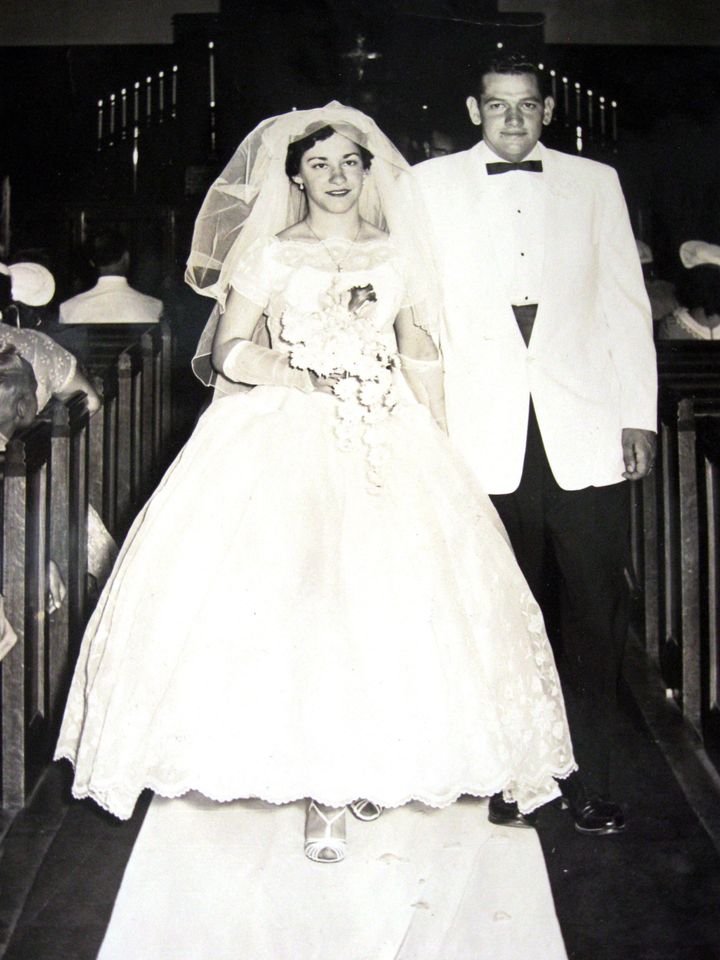
I ignored her fears. All I wanted was a big wedding. I loved how my boatneck, cap-sleeved, embroidered organdy wedding gown fit my wasp waist and showed off my curves. I paid $99 for it, using an installment plan, and wearing it was the closest I would ever come to feeling like a princess.
I couldn’t stop what I’d put in motion then, even if I’d wanted to. I couldn’t throw all that pomp away. I was about to star in my own carefully planned production and whatever might come afterward was a sacrifice I was willing to make.
Ed hated every minute of it. He hated being in the spotlight and thought it was crazy to spend that kind of money on a single day of glory. But he did it. He put on his tuxedo and went along with it.
And from that day forward I was a married lady. I took his last name and our lives became so intertwined, I barely remember what it was like before he came along. We had three children, and our children had children, and one day Ed and I woke up and laughed at how carelessly we had joined, and how grateful we were that we had lived for the moment and couldn’t see ahead until it was too late ― until we were so entrenched as a couple we couldn’t imagine our lives any other way.
Courtesy of Ramona GriggWe’re hitched! A photo from our wedding, which took place in Royal Oak, Michigan, on July 14, 1956.
So, how did we do it? How did we get this far without running away or killing each other? You’ll have to give me a minute. Sifting through more than six decades of memories to find those nuggets isn’t easy. And, as you can imagine, some of it I’d really prefer to forget. Still, the memories that count ― that stay with me ― are the happy ones.
As couples went, we couldn’t have been more different. Ed was an ex-Marine who liked baseball and Dixieland jazz and didn’t get literature or the arts at all. I was a bookworm, a dreamer, a romantic, a writer-in-hiding, a singer — and a soprano, at that. I liked classical music and singers like Mario Lanza and Deanna Durbin.
Ed smoked and drank and I didn’t. In fact, I hated both of those vices. He also didn’t especially like or want children. I, even at 18, couldn’t wait to have them. But from our very first dates, beyond the usual red-hot lusting, we discovered we actually had many things in common that just might make our unlikely pairing work.
We talked. A lot. We were both FDR liberals who wanted to change the world. We both loved our parents and our families. We didn’t go in for ostentation or bragging and preferred quiet evenings to parties and noise. We were both curious and interested in the world around us, and saw ourselves exploring every bit of it together. Fearlessly.
So there was that.
We had three children in 10 years, and damned if Ed didn’t love each of them, right from the start. Later we had three grandchildren, and, if they didn’t invent wrapping their grandfather around their little fingers, they became major experts at it.
But neither of us were saints and the waters sometimes seemed to roil as often as they stayed calm. You can’t live for more than six decades with someone who started out as a stranger without some major gnashing and clashing. If there are no fights, it’s a sign that one of you has given up, waved the white flag and ultimately surrendered. The key is in how you handle the fights.
Both of us, thankfully, are good at getting over whatever it is that has us going at it. We apologize and we forgive. Early on, we adopted that old adage, “Never go to sleep mad,” and most of the time we can do that. Though not always. But holding grudges is exhausting and, luckily, neither of us has ever been very good at it. It also helps that we’re both really, really bad at remembering what happened ― even yesterday.
You can’t live for more than six decades with someone … without some major gnashing and clashing. If there are no fights, it’s a sign that one of you has given up, waved the white flag and ultimately surrendered. The key is in how you handle the fights.
Through the years we’ve had our share of upsets and heartache and even sheer terror. We’ve experienced life lessons so painful it still hurts to think about them. Ed has had heart problems, and I’ve lost a breast to cancer. Depression runs rampant in my family, and it strikes in every generation.
At times we’ve been the helpers, and at other times we’ve needed help. We’ve buried all four of our parents, along with siblings who died too young. Those weren’t events we would have chosen to face, but with each one we grew stronger together. We became battle buddies, bound forever, each of us grateful that the other was there by our side when things went wrong.
Ed and I aren’t romantic in the usual sense. We don’t write each other love notes, or work for weeks to find or make the right gifts. If we do give each other a gift it’s usually spontaneous and something inexpensive ― and not always on a birthday or a holiday.
Ed once bought me a bright yellow sweater, miles too big for my 5-foot frame, with a cowl neckline that threatened to devour me, simply because he’s colorblind and can only see bright yellow as a true color. It called out to him and he bought it. I wore it and he loved it. One year I bought him a dozen orange golf balls, forgetting that his colorblindness makes green and orange look the same to him, so he couldn’t find them on the fairways.
We don’t hold hands when we walk, or kiss in public. We say “I love you” at least once a day, but in private, so nobody will hear. And it works in his favor that he’s never once called me “the wife.”
But I am a wife, and I was a full-time wife during the volatile women’s liberation era. Those years were hard on us. I had grown used to being called by my husband’s name (Mrs. Edward Grigg), and it didn’t seem odd to me then that I couldn’t get a credit card without my husband’s signature, or have my name on the car title. He was the breadwinner and I was the stay-at-home mom. That’s just the way it was.
Then, in 1964, with the publication of her best-selling book, “The Feminine Mystique,” Betty Friedan came along and showed us housewives we had many reasons to be dissatisfied. She opened our eyes to our own self-worth and suddenly the men in our lives came to be seen as obstacles to our freedom. They got in the way of our achieving our true potential.
Those days were lethal to a lot of marriages. Ours survived, but not without a lot of push and pull. It was as if the earth began to shake underneath us, and when it stopped, the terrain was never the same.
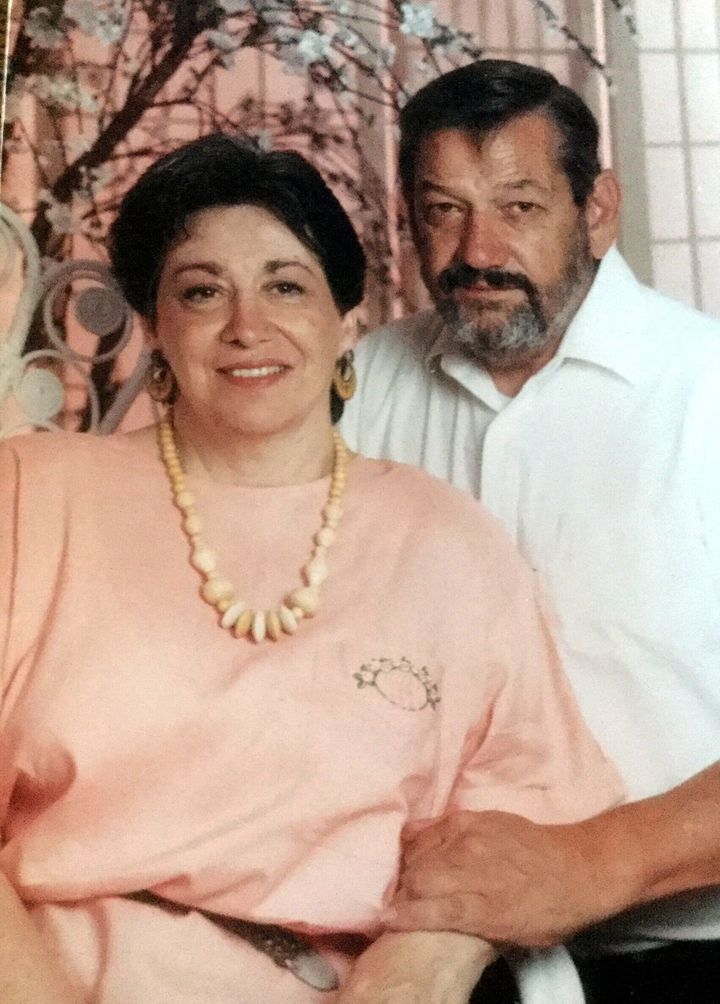
Courtesy of Ramona GriggA photo of Ramona and Ed taken as a remembrance of their 35th wedding anniversary.
By 1971, when I became a charter member of Ms. magazine, subscribing even before the first issue came out, I called myself a feminist. I saw feminism as a call for equality and as a movement to shine a light on the abuses many women endured at the hands of the men they wanted to love and trust. But I couldn’t disavow the men in my own life: I loved my husband, my father, my father-in-law, my brothers and my son. I did not see them as the enemy.
I also read Marilyn French’s “The Women’s Room” and understood, on one level, the reason for the rage. Women had been held back for centuries, treated as chattel, as second-class citizens, as expendable baby carriers. I got it, and I wanted to help, but I couldn’t feel the hate that so many other women seemed to be inspired by. I was, in fact, often repelled by their rage.
I felt guilty that I was reasonably happy, even though, as a housewife and a mother, I wasn’t particularly productive ― at least I wasn’t productive in the sense that I was accomplishing anything outside my home, or taking advantage of these new and hard-earned freedoms the feminist movement was shining a light on.
In an effort to find any euphemism that might legitimize the mostly thankless work we did in our homes, and to give us some sense of stature, we housewives became “homemakers” or “domestic engineers.” For the first time, women were ashamed to stay at home.
It didn’t help that husbands everywhere, including mine, didn’t get it at first. They still lived with the notion that they were “babysitting” any time they had to watch the kids. We had grown up with specific roles in place: The husbands were the breadwinners and the wives held down the domestic front. Our husbands did home repairs and car repairs, and yardwork, but, for the most part, wives were expected to take care of everything else. There was no time for outside work ― or so the story went.
I give Ed a lot of credit for taking only a little time to come around. I’m sure the whole women’s lib prospect threw him for a loop, but I don’t remember arguing about it. I don’t remember ever making a decision about my own life, only to have him tell me I couldn’t do it. That wasn’t the way it worked with us.
When my youngest child was in school all day, I got my real estate license and went to work. I sucked at it. I loved houses but hated selling them. I thought the houses should sell themselves. I even thought I should point out the problems potential buyers might have missed. I didn’t last long.
I lucked into a job as secretary to a nursing director in a large hospital, even though my typing skills weren’t anywhere near the minimum requirements. She liked me, and that was enough. I loved working but I found I loved being at home, too. So when I quit after a few years to take care of my first grandchild, I found some semblance of balance by working as a freelance writer. I had dabbled in writing since I was a child, and it was the best of both worlds: I could watch my grandson grow and I could work from home.
By that time Ed was traveling a lot as a civilian tech associate working on government projects. He was away more than he was home — and I immersed myself in the thriving writing community in and around Detroit. Over time, I saw my main role as a writer and not as a housewife, which meant, as a couple, we were at another crossroad. I didn’t see it as moving on — I saw it as growing right where I was and blooming in a garden that, before, had been lying fallow.
A good long marriage is a gift but it won’t come without determination, dedication and a whole lot of love. … You forget those ugly words both of you threw out there specifically to hurt. You remember what brought you together in the first place, and you relive the moments that brought you joy.
I was a different person but so was Ed. And, miracle of miracles, once we got over our fears about growing apart, we began to talk. Again. His job and his travels all over the country gave him new stories worth telling. My experiences as a writer, an instructor, a conference speaker, a resident at writers retreats and a grant recipient gave me new stories to tell him.
He’s now my first reader and he’s good at it.
For a man who came of age in the ’50s, Ed had no real problem with helping his daughters turn into strong women. His awareness grew as the two of them grew, and they taught him more than I ever could about feminism. He gets it and he isn’t afraid to express it, something that delights the three of us to no end.
Ed and I moved away from the Detroit suburbs more than 20 years ago. We now live on an island in the north woods of Michigan, which is so remote we have to take a car ferry and drive the back roads for an hour to get to the nearest McDonald’s. Or the nearest hospital.
Healthy as we both thought we were, bouts of heart disease and cancer eventually caught up to us. With each scare, we become more and more desperate to hang on to each other.
We’ve grown old together ― something our young selves couldn’t even imagine. At 18 and 23, we couldn’t fathom ourselves in our 80s, still saying, “I love you,” grateful that we didn’t go through with any of our threats over the years to call it quits.
A good long marriage is a gift but it won’t come without determination, dedication and a whole lot of love. You learn after a while not to sweat the small stuff. You forget those ugly words both of you threw out there specifically to hurt. You remember what brought you together in the first place, and you relive the moments that brought you joy.
You become a family, not by blood, but by heart and by endurance. You come to that point where, together, your old selves replace your young selves, and “until death do us part” doesn’t seem like such a long shot.
Ramona Grigg is a longtime columnist, essayist and blogger. Her political blog, Ramona’s Voices, ran for 10 years, starting on Barack Obama’s Inauguration Day in 2009. Ramona and her husband live on an island off the eastern coast of Michigan’s Upper Peninsula until the snow flies, and then they join a huge flock of snowbirds and head south for the winter. Some of her more recent work appears here, where she is editor of her own publication, Indelible Ink. You can find and follow Ramona on Twitter here.
Do you have a compelling personal story you’d like to see published on HuffPost? Find out what we’re looking for here and send us a pitch!
MORE FROM HUFFPOST PERSONAL…
REAL LIFE. REAL NEWS. REAL VOICES.
Help us tell more of the stories that matter from voices that too often remain unheard.
On May 26, 2016, I took my phone out and deleted contact information for every single man I had casually slept with, dated, or sexted in the last 10 years. There were a lot of them.
At age 37, I had spent years in casual relationships but never found anything close to what my heart truly craved—a healthy, balanced relationship with a partner. In a moment of brutal but necessary self-actualization, I saw the common thread in each of these relationships—it was me. At that moment, I made a decision: I was tired of feeling alone and done with feeling invisible.
A few months before this realization, my body had started to give out on me. My left knee had a habit of buckling from underneath me, my feet would go numb, and my lower back was in constant pain. Daily tasks most people take for granted—like walking through Target or standing to do the dishes at the sink—were becoming really hard. I started to limit what I did, and the orbit of my life was getting smaller and smaller.
If I had told a stranger that I was unhappy, that person would have just said, “If you’re an unhappy fat woman, why don’t you just go on a diet?” As if I hadn’t thought of that before!
The truth is, I’ve been on dozens of diets in my lifetime—and none of them had any lasting success. This time, I decided to take stock of where I was with my body and my life. Once I really started thinking about it, here’s what I knew for sure: I ate at night when I was lonely, in the car when I was bored, and a whole lot of other times—very few of which were actually tied to hunger. My relationship to food was totally out of whack. My physical body was keeping me from experiencing life the way I wanted. And, finally, I threw myself into shallow connections that were sometimes frenzied, many times oblivious, and more often than not, ended in my wondering why I was wasn’t good enough for guys to want to date me.
How was I going to find a diet that would address all of that? My light-bulb moment was realizing there wasn’t a diet in the world that could fix the emotional pain I was in. I didn’t know what would heal the hurt, but I had to do something different.
I want to be clear: I am not saying that losing weight is bad—heck, in the years since, I have lost weight and I’ll probably lose more. I am saying that a “diet” will never be the catalyst that leads to happiness. Being thinner doesn’t make you better or happier.
Three years later, I’m unearthing a beautifully flawed, perfectly imperfect, eternal-work-in-progress version of myself that I never knew existed. I do Pilates. I strength-train. I meditate. Most important, I do the emotional work that helps me understand why I’ve done the things I did.
Diet culture is a dysfunctional system of beliefs. Weight loss is a tool. But personal growth? That’s where the magic actually happens.
So the next time you find yourself cursing your body and thinking that shedding weight will “abracadabra” your perfect life into existence, ask yourself: “What is it I am really aching for? Am I running from something? Do I need to heal any hurt?”
Start there—build your self-love, and begin your journey from the inside out.
To learn more about Sarah Sapora and her size-inclusive wellness offerings, visit sarahsapora.com
To get our top stories delivered to your inbox, sign up for the Healthy Living newsletter