Health Feedback: Take Our Latest Health Magazine Poll

take-our-poll

Want to have your voice heard and help our editors out? Take our most recent health surveys.

Health Confessions: Have You Ever Done This?
Embarrassing moments happen all the time, especially with health and body issues. We also do things (like taking medicine that wasn't prescribed for us) that we might not readily confess. What past experiences do you least like to admit? Take the survey!

Is Your Sex Life Fizzling Out or Sizzling?
Hows your sex life holding up in these crazy times? Has your passion sunk right along with the economy—or are you fending off stress with a lot more bedroom action? Engaged in any Facebook-flirting lately? Wonder how well Barack and Michelle are keeping the fire alive? Take the survey!

Share Button

The Health Hangover Handbook

'Tis the season to overdo it, from eating to talking to whooping it up. So how do you survive the morning after? Try our sneaky little tricks.

Theres more than one way to overindulge during the holiday season. You can carol until you get a sore throat, or scarf too many cookies at the office party. You can stress over the perfect prime rib, or try to work off 5 pounds in a day so you can fit into that slinky cocktail dress that night. Sometimes you go too far, and then comes the morning after. But dont despair: Weve come up with easy cures for almost every imaginable holiday hangover. Before you know it, youll feel ready to deck the halls all over again.


You ate the whole thing
Potato pancakes, penne quattro formaggio, double-fudge macaroons. It was your neighbors holiday shindig, and you didnt want to insult her by not trying everything, at least once. Now you feel bloated, nauseated, and disgusting. “Its the ultimate yuck feeling,” says Cindy Yoshida, MD, a gastroenterologist in Charlottesville, Virginia, and author of No More Digestive Problems. “Higher-fat foods empty a lot more slowly from the stomach,” she says, which means part of last nights meal might still be with you the next day.

Our get-better-fast plan
Give your tummy a break. Dont eat until youre hungry. “And then have smaller meals that are relatively low in calories and fat and high in fiber for the rest of the day,” Yoshida says. That will stimulate your gastrointestinal tract and get things moving.

Rehydrate early and often. Not only will fluids help re-balance your bodys salt-to-water ratio, which fights bloating, but “they also empty from the stomach better than solids do,” Yoshida explains.

Mellow out with mint. A peppermint lozenge or pepper-mint tea can increase gastric emptying, which will relieve pain, Yoshida says. (If you have heartburn, skip peppermint, which can aggravate it. Try an antacid like Pepcid Complete instead.)


Youre stressed to the max
Your least-favorite relative insisted on a holiday visit this year. As usual, she showers the kids with love and loot and drives you insane with subtle cut-downs. After 24 hours youve turned into a snapping turtle, youre exhausted, and you can almost feel the steam coming out of your ears. Yes, you have a stress hangover. Stress hormones sweeping through your body can make you restless, wound-up, and unable to sleep, says Amy Flowers, PhD, a psychologist in private practice in Macon, Georgia.

Our get-better-fast plan
Take a walk. Exercise can help the stress hormones beat a hasty retreat, Flowers says.

Distract yourself. Do something you enjoy. Even 30 minutes of cooking, painting, or reading can lighten your mood and help you cope.

Let it out. Jot down your feelings in a journal or talk to a trusted friend about what youre going through.


You talked too much
Maybe you led the caroling at the office bash, or stayed up all night gabbing with your sisters the one time a year you get together. But today? You are hoarse, and even a whisper is painful. Thats your vocal cords, red, irritated, and swollen, telling you theyre overused, says C. Richard Stasney, MD, director of the Texas Voice Center and a clin-ical associate professor of otolaryngology at the Baylor College of Medicine in Houston.

Our get-better-fast plan
Shh. Ideally, rest your voice for a day or two. But even a few hours will help, Stasney says.

Drink up. If people were smoking at the party and you were downing wine, youre probably dehydrated, and your vocal cords may be irritated. Consume 2 quarts of water during the day to rehydrate your body and lubricate your pipes.

Soothe the soreness. A steaming bowl of chicken soup will pamper your poor cords. Or, gently gargle for 2 minutes with a solution of 6 ounces of warm, distilled water mixed with 1/2 teaspoon of salt, 1/2 teaspoon of baking soda, and 1/2 teaspoon of light corn syrup; this strange-but-potent combo may help stimulate mucous flow in your dry throat. Or try Entertainers Secret ($15 for two bottles; 800-308-7452), a throat spray with aloe vera.


You went a little wild
Who has time for bedroom gymnastics when youve got a gazillion gifts to buy? Certainly not you … until last night, that is, when you and hubby caught Julia Roberts and Jude Law in Closer on cable. By the flicks end, you were so charged up you had the best sex of your life. Youre not too sorry, except its uncomfortable even to sit down this morning. Just one night of passion can cause tiny tears in the entrance to your vagina, says David E. Soper, MD, a professor of obstetrics and gynecology at the Medical University of South Carolina in Charleston. And if youre running to the bathroom every 30 seconds and it burns when you pee, you have typical symptoms of “honeymoon cystitis.”

Our get-better-fast plan
Baby your bottom. A warm bath or cool compresses can be soothing; afterward, pat the area dry. Also, wear loose cotton clothes to avoid friction.

Call for help. If youve got a peeing problem, phone your doctor and describe your symptoms. Shell probably prescribe a 3-day course of antibiotics and perhaps an oral painkiller (such as Pyridium) that relieves urinary tract pain, Soper says.

Avoid irritants. Dont put creams or even strong soap on your vagina, Soper says. Theyll dry you out, which can make tiny cracks in the skin worse.


You hoisted a few too many
A glass of your favorite pinot noir seemed like the perfect way to celebrate the season. But that second bottle probably wasnt such a good idea. Now you have a classic hangover: headache, nausea, fatigue, and shakiness. Otherwise known as veisalgia, these symptoms are the result of dehydration (because alcohol impairs the kidneys ability to hold onto fluids), poor sleep (because alcohol alters levels of certain neuro-transmitters, causing brain cells to be hyperexcitable), and inflammation (because the impurities in most alcoholic drinks lead to an inflammatory response that produces flulike symptoms like achy muscles), says hangover researcher Jeffrey Wiese, MD, an associate professor of medicine at the Tulane University Health Sciences Center in New Orleans.

Our get-better-fast plan
Sleep in or take a nap. “It may help to try to get a couple of extra hours of sleep in the morning,” Wiese says. “Every additional hour you can get will help you recover.”

Sip right. Replenishing fluids is important. Sports drinks, which contain essential nutrients, are best, followed by juices, and then water, Wiese says. “The more you can drink, the better, since it will help the hangover go away faster.” Start before you go to sleep.

Take vitamins. Popping 50 to 100 milligrams of thiamine, or B1, and 10 milligrams of B6 per day may make up for deficits and ease hangover symptoms, says Bankole Johnson, MD, PhD, chairman of the department of psychiatric medicine at the University of Virginia in Charlottesville. Keep taking them for a couple of days to restore the losses caused by overindulging.

Relieve pain. Its fine to take ibuprofen to reduce aches and underlying inflammation, Wiese says. You can even take it at bedtime. But “stay away from acetaminophen,” he adds, “because it wont help with inflammation and can damage the liver if used with alcohol.”


You ODd on caffeine
The boss wont fault you for gulping down extra-strength venti lattes so you can finish all your projects before the holidays. But your body probably will. You might feel restless and nervous, and your thoughts may race at breakneck speed. “Caffeine in high doses can feel like a panic or anxiety attack,” says Jim Lane, PhD, a professor of medical psychology at Duke University Medical Center in Durham, North Carolina. So when the boss has a few questions about those projects, you may overreact. “Caffeine also triggers the release of adrenaline, which seems to magnify the stress response,” Lane explains.

Our get-better-fast plan
Know the signs. The kick typically starts within 20 to 30 minutes, and it takes about 4 hours for half of the caffeine in your blood to be eliminated, Lane says. You cant hasten its exit, but it might help to acknowledge why you feel jumpy and realize the feeling will go away.

De-stress. Soothing music may help while youre waiting for the buzz to wear off. “Silver Bells,” anyone?


Youre running on empty
A wee-hours Web-shopping blitz is sure to cheat you out of major shut-eye. That means youll wake up feeling foggy, groggy, and totally unprepared to tackle a to-do list. “If you sleep only 4 hours a night, youll perform as well as if you were legally drunk,” says Joyce Walsleben, RN, PhD, a sleep expert at the New York University School of Medicine and co-author of A Womans Guide to Sleep. A lack of sleep can also curb your ability to fight off infections.

Our get-better-fast plan
Lighten up. The morning after, sit near a sun-drenched window or take a walk in the sun for 20 minutes; the light promotes alertness by turning off your bodys production of melatonin, which makes you sleepy.

Take a nap. “A 10- to 20-minute nap helps you collect sleep and revive your performance level, especially before you drive,” Walsleben says.

Caffeinate. Have a cup about 20 minutes before you want your performance to kick into high gear. Eat lightly. Stick with small meals of complex carbohydrates (vegetables, fruits, whole grains) and lean pro-tein. Avoid turkey, dairy, fish, and peanuts; they have an amino acid (tryptophan) that makes you sleepy.


You hit the gym … and it hit you back
A kickboxing class plus your usual routine seemed like a perfect way to work off holiday bloat. But supersizing your workout can lead to delayed onset muscle soreness, or DOMS, when it hurts to get out of bed. “You may actually have caused some microscopic tears to the muscle tissues and the tendon attachments,” explains Cedric Bryant, PhD, chief science officer for the American Council on Exercise. “While your body tries to repair itself, inflammation impinges on the nerves surrounding the muscles, producing pain.” DOMS usually goes away in 48 to 72 hours.

Our get-better-fast plan
Hop back on the horse. Whole-body exercise (swimming, for instance, or riding a stationary bike with movable handlebars) at a gentle intensity will restore range of motion to your muscles, Bryant says.

Stretch carefully. Target the sore areas and do some gentle stretching.

Treat yourself. Get a massage. The kneading of sore muscles can boost blood flow to the tissues, which can speed the healing process. Ask your doctor or a friend to recommend a good massage therapist.



Share Button

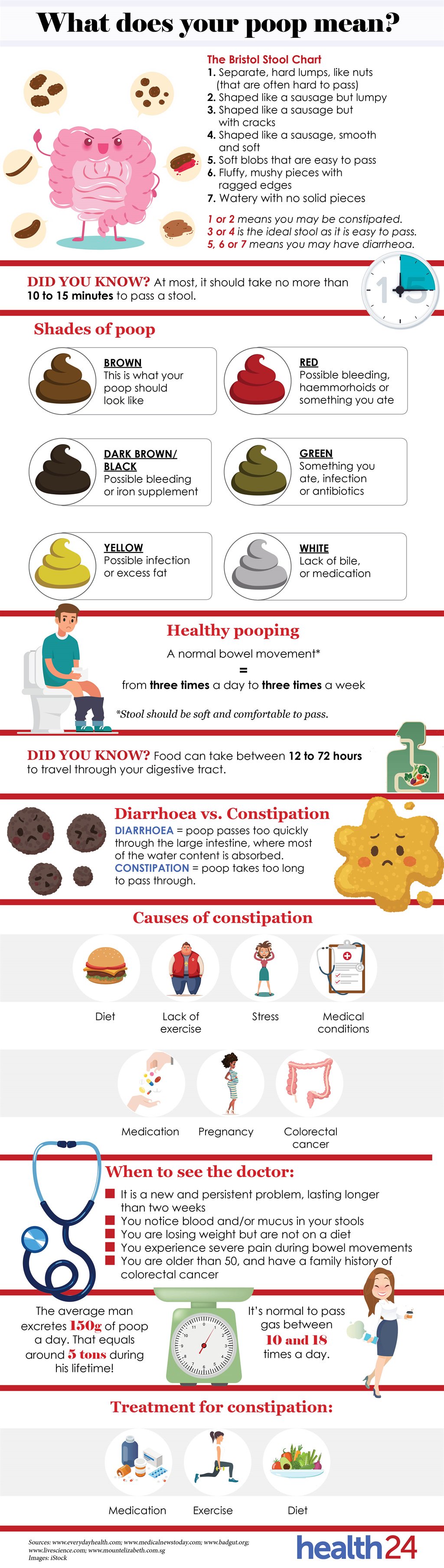
Health24.com | What’s your poop telling you?

The information on Health24 is for educational purposes only, and is not intended as medical advice, diagnosis or treatment. If you are experiencing symptoms or need health advice, please consult a healthcare professional. See additional information.

Share Button

Gently stroking babies ‘provides pain relief’

A study monitored the brain activity of babies when they had a blood test while being stroked.

Share Button

NHS Fife offers patients hip replacement day surgery

NHS Fife is the first health board in Scotland to perform hip replacements as day surgery for suitable patients.

Share Button

The full story on climate change requires the long view

The science is clear that human activities over the last century have contributed to greenhouse-like warming of the Earth’s surface. Much of the global conversation around climate change fixates on what individual countries or regions are contributing to the problem, and what they will do (or not do) to reverse the tide.

But Colorado State University’s A.R. Ravishankara, University Distinguished Professor who holds joint appointments in the departments of chemistry and atmospheric science, says the full picture is longer and more complex than meets the eye. It involves a legacy of past actions, as well as irreversible commitments for the future.

Ravishankara and co-author Daniel Murphy of the National Oceanic and Atmospheric Administration offer a new calculation that provides the long view of what nine different world regions have contributed to climate change since 1900. They also show how that breakdown will likely look by 2100 under various emission scenarios. Their study is in Proceedings of the National Academy of Sciences, Dec. 17.

They call their calculation “cumulative radiative forcing” because it integrates the ebb and flow of climate factors throughout the past century, rather than just a snapshot of what it is today. “Radiative forcing” is a metric that measures the sun’s energy that is retained by Earth. Global warming is the result of positive radiative forcing, or more energy being retained by Earth than escaping back into space.

Their study also underscores the insidious two-sided role of particulate matter pollution in the atmosphere, the result of burning fossil fuels, wildfires, and other human activities that have spewed pollution and dust into the atmosphere over many decades. Such aerosols are short-lived in the atmosphere, but they have a net cooling effect due to their interaction with sunlight and clouds. While carbon dioxide and other greenhouse gases linger in the atmosphere and continue contributing to warming for many years, aerosols dissipate, along with their net cooling effects, more quickly. In total, the presence of aerosols has masked some of the effects of global warming.

In their analysis, the researchers found that, for example, between 1910 and 2017, China, Europe and North America each had periods of nearly no net contributions to warming. These periods were characterized by rapid industrialization and growth of GDP, when fossil fuel emissions increased but few air quality controls were enforced. The study further shows that each region’s contribution to radiative forcing due to carbon dioxide (and other greenhouse gases) emissions from 2018 to 2100 will be larger than the total warming contributed during the last century.

“To date, China has contributed very little,” Ravishankara said. “China has essentially paid for their carbon dioxide emissions through bad air quality.”

But as China implements clean air standards moving forward, and the nation’s emissions increase at a slower rate, its share of contributions to climate change will increase, according to the study. North America is the largest contributor now and will remain so even in 2100.

The two-sided coin of aerosols — short-lived cooling, but harmful to human health — is starkly illustrated in a separate study authored by CSU postdoctoral researcher Liji David, Ravishankara and other colleagues, to be published online in GeoHealth. The researchers estimate that more than 1 million premature deaths per year in India are due to exposure to “ambient particulate matter” — air pollution in the form of breathable particles like sulfate aerosols, dust and soot. In India, residential energy use — biomass burning in homes for heating and cooking — is the dominant contributor to this premature mortality rate.

Of the estimated 1.1 million premature deaths in 2012 from small particulate matter in India, about 60 percent were due to anthropogenic pollutants emitted within the region, according to the study.

Yet to date, India’s contribution to climate change has been minimal as shown by Murphy and Ravishankara in PNAS, as it will be even by 2100, compared with other nations. As India implements clean air policies and works to reduce premature deaths from air pollution, its role in climate change may increase due to the aerosols playing less of a role in offsetting climate change, but human health will improve.

Ravishankara stresses that people should look at effects of emissions holistically. Future climate scenarios must take into account all warming contributions to date, and the effects of those contributions moving forward. Emissions reductions would not only help climate, but also human health, he says. Aggressively reduced carbon dioxide and other emissions, for the sake of the planet and for the sake of human health, are the only viable options.

“We need to ask not only what is our commitment going forward but also what is our legacy?” Ravishankara said.

Story Source:

Materials provided by Colorado State University. Original written by Anne Manning. Note: Content may be edited for style and length.

Share Button

Switch-in-a-cell electrifies life

Scientists at Rice University have developed synthetic protein switches to control the flow of electrons.

The proof-of-concept, metal-containing proteins made in the Rice lab of synthetic biologist Joff Silberg are expressed within cells upon the introduction of one chemical and are functionally activated by another chemical. If the proteins have been placed in the cell, they can simply be turned on and off.

“This is not a metaphor for a switch, it is a literal electrical switch built from a protein,” Silberg said.

The proteins could facilitate next-generation bioelectronics, including complete biological circuits within cells that mimic their electronic counterparts. The possible applications include living sensors, electronically controlled metabolic pathways for chemical synthesis and active pills that sense their environment and release drugs only when needed.

The work appears in Nature Chemical Biology. “Biology is really good at sensing molecules,” said Silberg, a professor of biosciences and bioengineering. “That’s an amazing thing. Think about how complex the cell is, and how proteins evolve that can respond to a single prompt in a sea of information. We want to leverage that exquisite ability to build more elaborate biomolecules and use these to develop useful synthetic biology technologies.”

The Rice team takes advantage of those innate abilities. “Natural proteins that move electrons more or less act as wires that are always there,” said Systems, Synthetic, and Physical Biology graduate student and lead author Josh Atkinson. “If we can turn these pathways on and off, we can make cells operate more efficiently.”

Rice’s metalloprotein switches — so called for their iron content — are quick, Silberg said. Nature typically controls electron flow by using genetic mechanisms to control the production of the protein “wires.”

“It’s all transcriptional,” he said. “Even in a fast-growing E. coli bacteria, it takes many minutes. By contrast, protein switches function on a time scale of seconds.”

To make the switch — which they use in a synthetic electron transfer pathway — the researchers needed a stable protein that could be reliably split along its peptide backbone to allow for the insertion of protein fragments that complete or break the circuit. They based the switch on ferredoxin, a common iron-sulfur protein that mediates electron transfer in all the domains of life.

Atkinson built switches embedded in E. coli that can be turned on in the presence (or off in the absence) of 4-hydroxytamoxifen, an estrogen receptor modulator used to fight breast and other cancers, or by bisphenol A (BPA), a synthetic chemical used in plastics.

Their E. coli bacterium is a mutant strain that is programmed to only grow in a sulfate medium when all of the components of the ferredoxin electron transport chain — including electron donor and acceptor proteins — are expressed. That way, the bacteria could only grow if the switches turn on and transfer electrons as planned.

Silberg said the discovery should lead to custom-designed switches for many applications, including contact with external electronic devices. “It’s why we’ve been so gung-ho about this idea of bioelectronics, a whole field that’s emerging as synthetic biology gets more control over the design,” he said. “Once you can standardize this, there are all kinds of things we can build with cells.”

That could include smart pills that release medications only on demand, or gut biome detectors that report on conditions. Or perhaps electrical circuits contained entirely within cells.

“We can already map a lot of what electrical engineers do with capacitors and resistors onto metabolism, but until now, there have been no switches,” Silberg said.

He suggested multiple switches could also turn a cell into a biological processor. “Then we could see digital parallel processing in the cell,” he said. “It changes the way we look at biology.”

Story Source:

Materials provided by Rice University. Note: Content may be edited for style and length.

Share Button

Health24.com | Constipation during and after pregnancy – what you should know

Pregnancy is a happy, but challenging time with some discomfort during the journey. Constipation is one of those unpleasant side-effects, with up to half of all pregnant women suffering from constipation at some stage during their pregnancy.

What causes pregnancy constipation?

There are a couple of possible culprits that cause constipation in general – this includes a diet lacking in fibre, not enough water or not enough exercise. Constipation can also be part of other digestive conditions such as IBS.

During pregnancy, hormones fluctuate and can cause the relaxation of intestinal muscles. It’s especially the increase in the levels of progesterone in your body that relaxes all the “smooth” muscles in the body. This causes your digestive system to slow down, causing waste to move more slowly than usual.

Taking iron tablets to avoid iron-deficiency anaemia during pregnancy can also cause constipation, especially high doses.

In the later stages of pregnancy, the pressure of the growing uterus on your rectum can also be responsible for constipation.

Should I be concerned about constipation during pregnancy?

The physical changes in your body during pregnancy will normally cause constipation, which is nothing to worry about. But sometimes constipation can signal other health problems. If you ever experience constipation along with severe abdominal cramps, bleeding in your stool or alternating diarrhoea, you should contact your doctor.

If you leave constipation untreated and it lasts longer than two weeks, it could lead to other complications such as haemorrhoids.

And postpartum constipation?   

Constipation does not only occur during pregnancy, but can continue after giving birth. There are several reasons for this:

  • You still have high progesterone levels in your body and this might take a while to normalise. 
  • You might have after-effects from the anaesthetic following a Caesarean.
  • You might have tearing near the rectal area, which makes bowel movements uncomfortable.
  • You might have given birth to a large baby.
  • You might have had damage to the pelvic floor muscles, which makes it harder to pass stools.

What you can do to relieve constipation

These are the steps you can take to help relieve constipation during and after pregnancy:

  • A diet consisting of plenty of fruit and vegetables, whole grains and legumes will not only add plenty of antioxidants to your diet to ensure a healthy pregnancy, but you will also get your daily intake of fibre that may help relieve constipation.
  • Get regular exercise to help things moving along. If you are not sure if you should continue your pre-pregnancy workout regime, talk to your doctor to ensure a safe workout.
  • Stay hydrated.
  • Eat smaller, more frequent meals as larger meals might overload your stomach and slow down digestion even more.
  • Talk to your doctor about the use of a pregnancy-safe laxative to help things along.
  • If you are taking an iron supplement, ensure that you are taking the correct dose as too much iron may cause more severe constipation.

Image credit: iStock

Share Button

Health24.com | Anti-seizure drug may be new weapon against depression

A drug used to control seizures may be a potent weapon against depression in patients who don’t find relief with antidepressants, a small pilot study suggests.

Some of the 18 patients taking ezogabine (Potiga) experienced a 45% reduction in depression and an increase in their ability to feel pleasure, as well as an increase in resilience and the capacity to recover from extremes of trauma and stress, the researchers reported.

“This drug might be relevant for patients who don’t do well with conventional antidepressants,” said lead researcher Dr James Murrough. He is director of the mood and anxiety disorders programme at the Icahn School of Medicine at Mount Sinai, in New York City.

Ezogabine was approved in 2011 by the US Food and Drug Administration as an anti-seizure medication. Shortly after its approval, concerns were raised about the drug’s effect on the retina and the possibility of it causing blindness.

SSRIs don’t always work

The FDA ordered the drug’s maker, GlaxoSmithKline, to do further safety studies. After reviewing those studies, the FDA ruled in 2015 that the drug did not appear to affect vision. Still, the company withdrew ezogabine from the US market in 2017, citing poor sales.

Even so, psychiatrists noted that if the drug proves effective against depression in larger studies, other drugs that target this area of the brain could be developed.

Some 15 million Americans suffer from major depressive disorder, which is a leading cause of disability. Treatments include selective serotonin reuptake inhibitors (SSRIs) such a Prozac and Paxil, but they are not effective across the board, the researchers noted.

It may be that depression is not one disease, but several that affect different areas of the brain, Murrough said.

That’s why new approaches are needed to increase the number of drugs available that target different areas of the brain where depression arises and help patients cope with depression’s various forms, he said.

“Ongoing research is trying to find new ways to treat depression based on understanding what’s going on in the brain when someone gets depressed and how can we reverse that,” Murrough said.

Ezogabine works by increasing the activity of the area in the brain that controls potassium. Murrough explained animal studies have shown that depression can reduce the activity of this potassium channel and that ezogabine can increase its activity, thus relieving depression.

Activates brain’s ‘reward system’

To see if the drug could work in humans, Murrough and his colleagues treated 18 people suffering from major depression with daily doses of ezogabine for 10 weeks.

MRI scans of the participants found that the drug activated the brain’s so-called reward system, which resulted in a significant reduction of depressive symptoms.

Not all patients responded to the drug, which might mean that their condition has a different cause, Murrough said.

The researchers said they are currently conducting a larger trial that will compare ezogabine with a placebo, to get a better idea of how effective the drug is at treating depression.

The report was published online in the journal Molecular Psychiatry.

Dr Victor Fornari is a psychiatrist at Lenox Hill Hospital in New York City. He said, “We need to find newer ways to treat depression,” and ezogabine might be one of these new approaches.

“This study doesn’t change treatment – yet,” he added. “At least this is preliminary evidence that this potassium channel target might be another avenue for treatment.”

Image credit: iStock

Share Button

New discovery pushes origin of feathers back by 70 million years

An international team of palaeontologists, which includes the University of Bristol, has discovered that the flying reptiles, pterosaurs, actually had four kinds of feathers, and these are shared with dinosaurs — pushing back the origin of feathers by some 70 million years.

Pterosaurs are the flying reptiles that lived side by side with dinosaurs, 230 to 66 million years ago. It has long been known that pterosaurs had some sort of furry covering often called ‘pycnofibres’, and it was presumed that it was fundamentally different to feathers of dinosaurs and birds.

In a new work published today in the journal Nature Ecology & Evolution, a team from Nanjing, Bristol, Cork, Beijing, Dublin, and Hong Kong show that pterosaurs had at least four types of feathers:

  • simple filaments (‘hairs’)
  • bundles of filaments,
  • filaments with a tuft halfway down
  • down feathers.

These four types are now also known from two major groups of dinosaurs — the ornithischians, which were plant-eaters, and the theropods, which include the ancestors of birds.

Baoyu Jiang of Nanjing University, who led the research, said: “We went to Inner Mongolia to do fieldwork in the Daohugou Formation.

“We already knew that the sites had produced excellent specimens of pterosaurs with their pycnofibres preserved and I was sure we could learn more by careful study.”

Zixiao Yang, also of Nanjing University, has studied the Daohugou localities and the pterosaurs as part of his PhD work. He said: “This was a fantastic opportunity to work on some amazing fossils.

“I was able to explore every corner of the specimens using high-powered microscopes, and we found many examples of all four feathers.”

Maria McNamara of University College Cork, added: “Some critics have suggested that actually there is only one simple type of pycnofibre, but our studies show the different feather types are real.

“We focused on clear areas where the feathers did not overlap and where we could see their structure clearly. They even show fine details of melanosomes, which may have given the fluffy feathers a ginger colour.”

Professor Mike Benton from the University of Bristol’s School of Earth Sciences, said: “We ran some evolutionary analyses and they showed clearly that the pterosaur pycnofibres are feathers, just like those seen in modern birds and across various dinosaur groups.

“Despite careful searching, we couldn’t find any anatomical evidence that the four pycnofibre types are in any way different from the feathers of birds and dinosaurs. Therefore, because they are the same, they must share an evolutionary origin, and that was about 250 million years ago, long before the origin of birds.”

Birds have two types of advanced feathers used in flight and for body smoothing, the contour feathers with a hollow quill and barbs down both sides.

These are found only in birds and the theropod dinosaurs close to bird origins. But the other feather types of modern birds include monofilaments and down feathers, and these are seen much more widely across dinosaurs and pterosaurs.

The armoured dinosaurs and the giant sauropods probably did not have feathers, but they were likely suppressed, meaning they were prevented from growing, at least in the adults, just as hair is suppressed in whales, elephants, and hippos. Pigs are a classic example, where the piglets are covered with hair like little puppies, and then, as they grow, the hair growth is suppressed.

Professor Benton added: “This discovery has amazing implications for our understanding of the origin of feathers, but also for a major time of revolution of life on land.

“When feathers arose, about 250 million years ago, life was recovering from the devasting end-Permian mass extinction.

“Independent evidence shows that land vertebrates, including the ancestors of mammals and dinosaurs, had switched gait from sprawling to upright, had acquired different degrees of warm-bloodedness, and were generally living life at a faster pace.

“The mammal ancestors by then had hair, so likely the pterosaurs, dinosaurs and relatives had also acquired feathers to help insulate them.

“The hunt for feathers in fossils is heating up and finding their functions in such early forms is imperative. It can rewrite our understanding of a major revolution in life on Earth during the Triassic, and also our understanding of the genomic regulation of feathers, scales, and hairs in the skin.”

Share Button