Scientists have successfully transplanted a bioengineered lung into a pig.


Scientists have successfully transplanted a bioengineered lung into a pig.
Drinking alcohol while breastfeeding is a bit of a controversial topic, says Catherine Pereira, Association for Dietetics in South Africa spokesperson, registered dietitian and lecturer at the University of the Western Cape.
But, she warns that drinking alcohol while breastfeeding is quite different to drinking alcohol while you are pregnant.
“During pregnancy, alcohol can move across the placenta, is toxic to the developing foetus, and in high amounts can cause serious damage. With breastfeeding, the alcohol does not transfer straight into the breastmilk. Any food or drink that a mother consumes needs to be digested first, so will transfer through her whole gastrointestinal tract (stomach, intestines etc.), get broken down and then individual nutrients are absorbed into the blood,” says Pereira.
She adds that there are many factors that influence the composition of breastmilk, and the production of breastmilk is largely controlled by the hormones prolactin and oxytocin as well as the frequency (how often) a mother breastfeeds.
So, is it safe to consume alcohol while breastfeeding?
Pereira refers to Dr Jack Newman, a renowned and recognised breastfeeding advocate, who recently compiled a Facebook post summarising his recommendations regarding breastfeeding and alcohol.
Dr Newman says, “The alcohol content in breast milk immediately after drinking is equivalent to a 0.0274 proof beverage. That’s like mixing 1 oz of 80 proof vodka (one shot) with 2 919 oz of mixer. By the way, 2 919 oz is over 70 liters [sic].”
“The take-home message of this is that the amount of alcohol that eventually is present in breastmilk is so low that it is unlikely to affect the baby,” says Pereira. In South Africa, however, the recommendation is that if people do drink alcohol, they do so in moderation.
The National Institute on Alcohol Abuse and Alcoholism says that low-risk drinking can be defined as consuming up to one unit of alcohol per day, with no more than three drinks on a single day and no more than seven drinks per week for women; while for men it’s up to two drinks per day with no more than four drinks per day for men and then no more than 14 units of alcohol per week.
“Don’t forget, though, that what you consider to be one unit of alcohol is often much less than one drink!” says Pereira.
If you do choose to drink alcohol while breastfeeding, Pereira advises that you do so straight after a feed so that your body has the maximum amount of time to metabolise the alcohol before your baby’s next feed.
Breastfeeding guidelines
If you are worried about the wellbeing of your baby while breastfeeding, Dr Ronald Marino, chief of the division of general paediatrics at NYU Winthrop Hospital in Mineola, New York, advises on erring on the side of caution. “Most things do get into breast milk, and we need to understand this more because we don’t know if there’s a safe exposure level for babies. But it’s probably better not to be exposed.
“Your baby’s brain is developing so much in the first year of life, you want to give them every chance to have high function. Try to stay as pure as you can when breastfeeding – [avoiding] marijuana, alcohol or even herbal remedies,” he said.
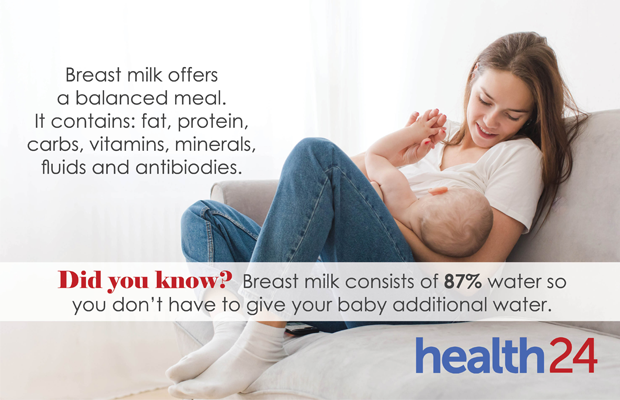
Here are some important breastfeeding guidelines, according to a previous Health24 article:
10 additional messages
Pereira also points to the National Department of Health, which offers 10 important infant feeding messages:
1. During their first six months of life, the World Health Organization recommends that babies need breastmilk and nothing else (no porridge, water, tea or other foods and liquids).
2. Breastfeeding is the normal way to provide babies with food for healthy growth and development.
3. It is safe for HIV positive mothers to breastfeed their babies while using antiretroviral treatment.
4. Mothers should be supported and shown how to initiate breastfeeding within the first hour after birth.
5. Mothers need to be supported to breastfeed successfully. Support them to get the baby to latch. Proper attachment encourages release of breast milk.
6. Almost all mothers will have enough breast milk to feed their babies exclusively during the first six months.
7. Everyone should support a mother to breastfeed her baby for a better, healthier life.
8. Happy breastfeeding moms make happy employees – employers must offer them privacy and time to express at work.
9. Continue to breastfeed and start introducing freshly prepared foods (such as fish, meat, vegetables and fruits) when the baby is six months old.
10. Babies should be taken to the clinic every month to check their growth and development.
Image credit: iStock

NEXT ON HEALTH24X

There is a general perception that humans don’t hear as well as animals – mainly because they can hear many sounds we can’t.
Added to this is the fact that humans have become less dependent on their senses for survival. As hunter-gatherers, our forefathers relied on especially their sight and hearing to stay alive – which changed when humans became agriculturalists around 10 000 years ago.
Were we just never as sharp as our animal friends, is it a case of “use it or lose it”, or are there other factors at play?
Loudness and pitch
According to Widex, the human audible range is dependent on the pitch (high or low) and loudness of sound. We use Hertz (Hz) to measure pitch and decibels (dB) to measure loudness.
As far as pitch is concerned, human hearing starts at about 20Hz and ends at 20 000Hz, but our hearing is most sensitive between 2 000 and 5 000Hz. The pitch of a dog whistle is too high and the roar of a wind turbine too low for humans to hear.
When it comes to loudness, in our most sensitive range humans can actually hear softer sounds than dogs and cats.
We can safely be exposed to sounds ranging from 0 to 85dB. Anything louder than that can eventually damage our hearing. An ambulance siren is about 125dB, and normal human speech around 65dB.
Hearing loss usually starts by affecting our upper pitches, which means that we will have difficulty hearing sounds like birdsong and instruments, such as flutes and piccolos. By middle age our upper range can drop to between 12 000 and 14 000Hz.
Some interesting animal hearing facts



In defence of modern humans
It is true that humans cannot detect sounds occurring at all frequencies – but neither can animals.
A study done by researchers at Binghamton University in New York found that early humans could hear better than both chimpanzees and modern humans at certain frequencies. They studied the anatomy and reconstructed the hearing capabilities of some of our ancestors who lived in South Africa.
The researchers found that our early ancestors were especially good at hearing frequencies between 1 500 and 3 500Hz, which would include the sounds of rustling leaves – and nowadays vacuum cleaners, telephones and hard consonants.
Instead of regressing as one might expect, modern humans’ hearing ability has become even more acute in the slightly higher frequencies. In fact, as mentioned above, modern humans are proficient at hearing sounds from 2 000 to 5 000Hz, and actually fare better than other primates in that range.
Being able to excel at higher frequencies is good for “complex short-range vocal communication”. This explains why we are better at having an intimate conversation across a dinner table than grunting and howling at each other out in nature. Chimps for instance have trouble hearing some sounds we use in spoken language.
Image credit: iStock


According to a Health24 review, cholesterol is a fatty substance which is essential to the human body. It forms part of the lining (membrane) of every cell; it is the basic substance used for the production of hormones; it’s needed for the production of bile for digestion – and numerous other bodily processes.
The main causes of high cholesterol are:
When should you be worried? South Africans are particularly vulnerable to developing high cholesterol, especially taking our high obesity rate into account.
Health24 has two tools that might be useful:
Could I have high cholesterol?
Is your diet cholesterol-healthy?

NEXT ON HEALTH24X

Staff shortages and overcrowding blamed for a rise of more than a third in two years in recorded deaths.
Okay, okay, I’ll admit it… I’m hella lazy and probably stubborn too. But I still want to be fit and healthy. That’s why I was super excited about taking up Pilates as part of the three-month #WHGetsFit winter fitness challenge. In my mind it was easy and pain-free. Boy, was I wrong. No regrets though – because it’s toned my body and done incredible things for my core.
Why you should focus on your core
A strong core isn’t just about showing off washboard abs in a crop top – though there is that… Your abs, obliques and lower back muscles all help your body maintain proper posture and exercise form too. These four moves in particular showed me flames, but were also very effective.
Read more: 5 easy pilates stretches that’ll finally sort out your lower back pain
1. Hundreds
Hundreds might look like an unassuming move, but it’s a killer – and if you’re not particularly fit (like me), you’ll feel it at take 40 already. But it works like magic to tone those abs and strengthen your core.
How to do it
Lying face-up, lift both legs up towards the ceiling and lower them halfway, so they’re at an angle. (If you have tight hamstrings, bend your knees slightly – as shown in the video.) Slightly curl your head up, reaching your arms alongside your body, palms facing down. Pump your arms up and down as you inhale for five counts and exhale for five counts. Repeat this breathing pattern 10 times while holding the position.
Read more: The core-crunching workout you can do anywhere
2. Double leg reach
When done right, these are the ideal core-strength builder. They’re challenging, but still great for beginners – that’s how simple they are to do.
Read more: Get killer legs with this lower body blitz workout
How to do it
Do these on a mat or any other comfortable surface. Lying on your back, extend your legs up to a 45-degree angle, toes pointed. Shoot your legs and arms out towards your head at the same time. Then bring your knees towards your chest, with hands lightly touching knees. Remember to inhale and exhale as you go. Repeat at least 10 times for beginners.
Ready to reveal an insane core? Just tag these simple exercises onto your next workout – and keep at it for best results.
This article was originally posted on www.womenshealthsa.co.za
Image credit: iStock

NEXT ON HEALTH24X

The changes are similar to those seen in the early stages of heart failure, experts say.
The process, where the tongue is cut in half, can lead to blood loss and nerve damage, experts say.
During germination, the embryo within the seed must develop into a young seedling capable of photosynthesis in less than 48 hours. During this time, it relies solely on its internal reserves, which are quickly consumed. It must therefore rapidly create functional chloroplasts, cellular organelles that will enable it to produce sugars to ensure its survival. Researchers from the University of Geneva (UNIGE) and the University of Neuchâtel (UniNE), Switzerland, have revealed in the journal Current Biology the key elements that control the formation of chloroplasts from proplastids, hitherto poorly studied organelles. Such a mechanism ensures a rapid transition to autonomous growth, as soon as the seed decides to germinate.
The surprising propagation and diversification of flowering plants in terrestrial environments are mainly due to the appearance of seeds during evolution. The embryo, which is dormant, is encapsulated and protected in a very resistant structure, which facilitates its dispersion. At this stage, it cannot perform photosynthesis and, during germination, it will thus consume the nutritive reserves stored in the seed. This process induces the transformation of a strong embryo into a fragile seedling. “This is a critical stage in the life of a plant, which is closely regulated, notably by the growth hormone gibberellic acid (GA). The production of this hormone is repressed when external conditions are unfavorable,” explains Luis Lopez-Molina, Professor at the Department of Botany and Plant Biology of the UNIGE Faculty of Science.
Import proteins submitted to the cell shredder
The awakening of the embryo causes the differentiation of its proplastids into chloroplasts, biological factories capable of producing sugar thanks to photosynthesis. “Thousands of different proteins must be imported into the developing chloroplasts, and this process can only take place in the presence of a protein called TOC159. If it is lacking, the plant will be depleted in chloroplasts and will remain albino,” explains Felix Kessler, Director of the Plant Physiology Lab and Vice-Rector of the UniNE.
How does the seed decide whether to keep the embryo in a protected state or, on the contrary, to take a chance and let it germinate? “We have discovered that, as long as GA is suppressed, a mechanism is set up, which ensures that TOC159 proteins are transported to the cellular waste bin in order to be degraded,” explains Venkatasalam Shanmugabalaji, researcher within the Neuchâtel group and first author of the study. In addition, other proteins needed for photosynthesis, of which TOC159 facilitates importation, suffer the same fate.
A high-performance biomechanism
When external conditions become favorable for germination, the GA concentration increases in the seed. The biologists discovered that high concentrations of this hormone indirectly block the degradation of TOC159 proteins. The latter can therefore be inserted into the membrane of the proplastids and enable the import of photosynthetic proteins cargoes, which also escape the cellular waste bin.
The genesis of the first functional chloroplasts, implemented in less than 48 hours, therefore ensures a rapid transition from a growth depending on the embryo’s reserves to an autonomous development. This high-performance mechanism contributes to the survival of the seedling in an inhospitable environment, in which it will have to face many challenges.
Story Source:
Materials provided by Université de Genève. Note: Content may be edited for style and length.

Among the most significant scientific advances in recent years are the discovery and development of new ways to genetically modify living things using a fast and affordable technology called CRISPR. Now scientists at The University of Texas at Austin say they’ve identified an easy upgrade for the technology that would lead to more accurate gene editing with increased safety that could open the door for gene editing safe enough for use in humans.
The team of molecular biologists found conclusive evidence that Cas9, the most popular enzyme currently used in CRISPR gene editing and the first to be discovered, has less effectiveness and precision than one of the lesser-used CRISPR proteins, called Cas12a.
Because Cas9 is more likely to edit the wrong part of a plant’s or animal’s genome, disrupting healthy functions, the scientists make the case that switching to Cas12a would lead to safer and more effective gene editing in their study published Aug. 2 in the journal Molecular Cell.
“The overall goal is to find the best enzyme that nature gave us and then make it better still, rather than taking the first one that was discovered through historical accident,” said Ilya Finkelstein, an assistant professor of molecular biosciences and a co-author of the study.
Scientists are already using CRISPR, a natural mechanism used by bacteria to defend against viruses, to learn more about human genes, genetically modify plants and animals and develop such science-fiction-inspired advances as pigs that contain a fat-fighting mouse gene, leading to leaner bacon. Many expect CRISPR to lead to new treatments for human diseases and crops that have higher yield or resist droughts and pests.
But the CRISPR systems found in nature sometimes target the wrong spot in a genome, which — applied to humans — could be disastrous, for example, failing to correct for a genetic disease and instead turning healthy cells into cancerous cells.
Some previous studies have hinted that Cas12a is choosier than Cas9, but the research before now was inconclusive. This latest study, the researchers say, closes the case by showing that Cas12a is a more precise gene-editing scalpel than Cas9 and explaining why.
The team, led by graduate student Isabel Strohkendl and professor Rick Russell, found that Cas12a is choosier because it binds like Velcro to a genomic target, whereas Cas9 binds to its target more like super glue. Each enzyme carries a short string of genetic code written in RNA that matches a target string of genetic code written in the DNA of a virus. When it bumps into some DNA, the enzyme starts trying to bind to it by forming base pairs — starting at one end and working its way along, testing to see how well each letter on one side (the DNA) matches the adjacent letter on the other side (the RNA).
For Cas9, each base pair sticks together tightly, like a dab of super glue. If the first few letters on each side match well, then Cas9 is already strongly bound to the DNA. In other words, Cas9 pays attention to the first seven or eight letters in the genomic target, but pays less attention as the process goes on, meaning it can easily overlook a mismatch later in the process that would lead it to edit the wrong part of the genome.
For Cas12a, it’s more like a Velcro strap. At each point along the way, the bonds are relatively weak. It takes a good match all along the strip for the two sides to hold together long enough to make an edit. That makes it much more likely that it will edit only the intended part of the genome.
“It makes the process of base-pair formation more reversible,” Russell said. “In other words, Cas12a does a better job of checking each base pair before moving on to the next one. After seven or eight letters, Cas9 stops checking, whereas Cas12a keeps on checking out to about 18 letters.”
The researchers said that Cas12a still isn’t perfect, but the study also suggests ways that Cas12a can be improved further, perhaps one day realizing the dream of creating a “precision scalpel,” an essentially error-proof gene-editing tool.
“On the whole, Cas12a is better, but there were some areas where Cas12a was still surprisingly blind to some mispairing between its RNA and the genomic target,” Finkelstein said. “So what our work does is show a clear path forward for improving Cas12a further.”
The researchers are currently using these insights in a follow-on project designed to engineer an improved Cas12a.
The study’s other co-authors are graduate student James Rybarski and former undergraduate student Fatema Saifuddin.
This work was supported by grants from the National Institute of General Medical Sciences and the Welch Foundation.

