Health24.com | Here’s how to train your bladder

According to Health24, urinary incontinence develops when the pelvic floor muscles, which support the bladder and the bowel, weaken. The weakened pelvic floor muscles cause a loss of control with regards to urine as well as flatulence. The implications of this are partial or total leakage of urine and even uncontrolled bowel moments.

An old bladder can learn new tricks

Training your bladder involves strengthening your pelvic floor muscles. Thankfully, strengthening your pelvic floor muscles doesn’t involve going to the gym. All you need to do is implement new habits involving your loo breaks. The benefits of training your bladder now, despite not having any problems with incontinence at this stage, is that it will correct possible bad habits you may have. It may also help prevent incontinence later on in life.   

Follow this step-by-step training programme to train your bladder:
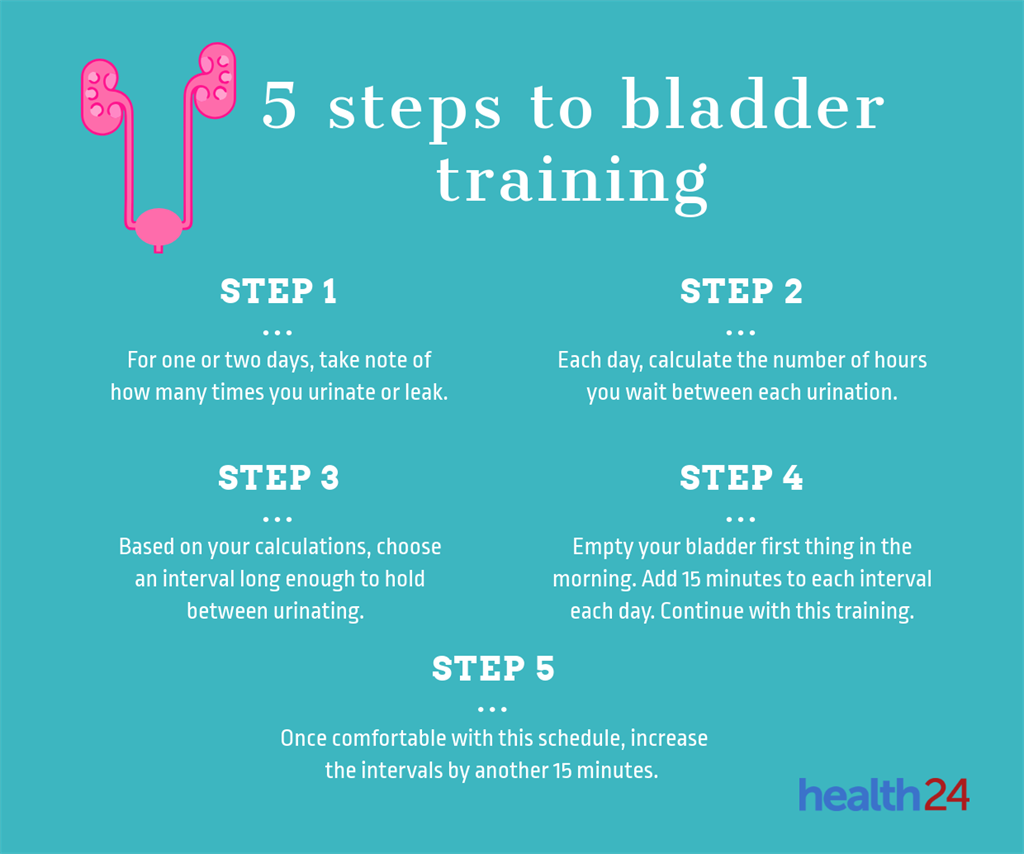
Another form of training of the urinary muscles is to pause in mid urination until the stream has completely come to a halt and then continue urinating. Do this multiple times as you relieve yourself – it is a great way to start exercising your pelvic muscles and regain control.

There are four different types of urinary incontinence:

Stress incontinence

The pressure caused by coughing, sneezing or even laughing causes the weakened bladder neck to leak urine. This is often a temporary situation. 

Urge incontinence

This occurs when the bladder cannot hold sufficient volumes of urine and the person feels the immediate urgency to urinate because of the inability to control the bladder.

Overflow incontinence 

This is when the bladder is constantly full to bursting. The kidneys produce urine but there is difficulty urinating, so the bladder fills up quickly. This is caused by an obstruction in the bladder or a dysfunction of the bladder muscle. 

Total incontinence

This happens when there is complete loss of bladder control for a prolonged time. It is more common in the elderly, and affects women more often than men.  

We can form bad habits and not realise that they are detrimental to our health. When you regularly urinate before your bladder is full, you can increase your risk of developing urinary incontinence in the future. When you relieve yourself before your bladder is full you are actually training it not to work properly.

Do you think you are clued up on how often you are supposed to wee? Take this fun quiz to find out.

Image credit: iStock

Share Button

Cannabis debate: I appealed to the prime minister

Hannah Deacon, whose son suffers from epilepsy, says she was given a pledge by Theresa May

Share Button

Health24.com | How your mucus can be a guide to sinusitis treatment

Chronic sinusitis can be extremely painful, and those with the condition may feel sick for weeks and find it difficult to participate in everyday life or complete simple tasks.  

According to a recently published Vanderbilt University study, a person’s nasal mucus could provide vital information to predict the type of chronic sinusitis, which could ultimately assist doctors in determining whether surgery or medical treatments will be the most effective. 

What does the research entail and what does this mean for the future treatment of chronic sinusitis? 

What is chronic sinusitis? 

The sinuses are hollow, moist spaces that drain through the nose. When the sinuses are prevented from draining due to either an infection or allergic reaction, fluid and mucus remain trapped. This results in the inflammation and irritation of the sinuses, which is referred to as sinusitis.

Chronic sinusitis is sinusitis that lasts for a long time, usually longer than three months. People with asthma and allergies are usually more vulnerable to chronic sinusitis. There are various types of sinusitis: 

  • Acute sinusitis: typically lasts up to a month
  • Sub-acute sinusitis: longer than one month 
  • Chronic sinusitis: longer than three months

While chronic sinusitis lasts longer than acute sinusitis, the symptoms are the same and include: A cough, thick nasal mucus, post-nasal drip, headaches, fever, congestion, facial pain and swelling. 

However, chronic sinusitis sufferers may also develop nasal polyps, which are growths on the tissue of the nose and sinuses, resulting in difficulty breathing. 

Biological markers

The study, published online in the Journal of Allergy and Clinical Immunology, collected and analysed the mucus of patients by simply putting a small medical grade sponge into the nostrils of the patients. The mucus was then analysed for cytokines, small secreted proteins that allow cells to talk to each other. The cytokine profiles were found to determine six different clusters of chronic sinusitis patients.

Dr Justin Turner, associate professor of Otolaryngology-Head and Neck Surgery and the study’s lead author, speaking to Vanderbilt University News, said it is the first study to use biological markers to identify endotypes of chronic sinusitis. “The problem is that those patients tend to have very different responses to surgery,” he said.

What becomes apparent is the reasoning behind the study, to identify which patients will have better outcomes ahead of the time. “Some patients may be better served with surgery, others with medical treatment,” Dr Turner explained. 

“When we look at the postoperative outcomes for those patients, which we assess through a quality of life measure that assesses patient symptom burden, we find that at one year follow up, patients in certain clusters do much better than patients in other clusters,” Dr Turner said.

Future of chronic sinusitis treatment 

According to Dr Turner, the findings should pave the way for more personalised medication and treatment options for chronic sinusitis patients, instead of the one-size-fits-all option that is currently in use.

Presently, chronic sinusitis patients are examined to determine how much previous treatment they have undergone and are then administered courses of anti-inflammatory medications such as antibiotics. Only once this has taken place the surgical options are explained to the patient. 

“In theory, going forward, this is something that could be used in a point-of-care fashion before making a decision to take a patient to surgery. Perhaps some patients may do better with continued medical therapy, or with biologic medications.” Dr Turner emphasised. 

Image credit: iStock

Share Button

Increased risk of birth defects in babies after first-trimester exposure to lithium

 Researchers from the Icahn School of Medicine at Mount Sinai found an elevated risk of major congenital malformations in fetuses after first-trimester exposure to lithium, in the largest study ever to examine the risk of birth defects in lithium-exposed babies.

Nearly one and one-half times as many babies exposed to lithium during the first trimester experienced major malformations compared to the unexposed group (7.4 percent compared with 4.3 percent). In addition, risk for neonatal hospital readmission was nearly doubled in lithium-exposed babies compared to the unexposed group (27.5 percent versus 14.3 percent). However, lithium exposure was not associated with pregnancy complications or other delivery outcomes, such as pre-eclampsia, preterm birth, gestational diabetes, or low birth weight. In addition, the researchers found that the risk of birth defects in lithium-exposed infants was lower than previously thought, because previous studies did not look at large enough populations.

The study will be published online in The Lancet Psychiatry.

The study examined the risk of congenital malformations such as heart defects and pregnancy complications in a meta-analysis of primary data from 727 lithium-exposed pregnancies compared to a control group of 21,397 pregnancies in mothers with a mood disorder who were not taking lithium. The data was taken from six study sites in Denmark, Canada, the Netherlands, Sweden, the United Kingdom, and the United States. The researchers also measured delivery outcomes and neonatal hospital readmissions within 28 days of birth.

Lithium therapy is widely recommended as a first-line treatment for bipolar disorder, which affects approximately 2 percent of the world’s population. Lithium helps to prevent severe depression and mania. In the United States, bipolar disorder is more commonly treated with anti-psychotic drugs instead of lithium. “Women should be informed on malformation risk in first-trimester exposed infants, but also about very high relapse risks for mental illness both during pregnancy and during the postpartum period,” said the study’s senior author, Veerle Bergink, MD, PhD, Professor of Psychiatry and of Obstetrics, Gynecology, and Reproductive Science, Icahn School of Medicine at Mount Sinai. “Given the well-documented effectiveness of lithium in reducing relapse in the perinatal period, some important clinical considerations are either to continue lithium in a lower dose during the first trimester or to restart lithium after the first trimester or immediately postpartum.”

Story Source:

Materials provided by The Mount Sinai Hospital / Mount Sinai School of Medicine. Note: Content may be edited for style and length.

Share Button

Carbon nanotube optics provide optical-based quantum cryptography and quantum computing

Researchers at Los Alamos and partners in France and Germany are exploring the enhanced potential of carbon nanotubes as single-photon emitters for quantum information processing. Their analysis of progress in the field is published in this week’s edition of the journal Nature Materials.

“We are particularly interested in advances in nanotube integration into photonic cavities for manipulating and optimizing light-emission properties,” said Stephen Doorn, one of the authors, and a scientist with the Los Alamos National Laboratory site of the Center for Integrated Nanotechnologies (CINT). “In addition, nanotubes integrated into electroluminescent devices can provide greater control over timing of light emission and they can be feasibly integrated into photonic structures. We are highlighting the development and photophysical probing of carbon nanotube defect states as routes to room-temperature single photon emitters at telecom wavelengths.”

The team’s overview was produced in collaboration with colleagues in Paris (Christophe Voisin) who are advancing the integration of nanotubes into photonic cavities for modifying their emission rates, and at Karlsruhe (Ralph Krupke) where they are integrating nanotube-based electroluminescent devices with photonic waveguide structures. The Los Alamos focus is the analysis of nanotube defects for pushing quantum emission to room temperature and telecom wavelengths, he said.

As the paper notes, “With the advent of high-speed information networks, light has become the main worldwide information carrier. . . . Single-photon sources are a key building block for a variety of technologies, in secure quantum communications metrology or quantum computing schemes.”

The use of single-walled carbon nanotubes in this area has been a focus for the Los Alamos CINT team, where they developed the ability to chemically modify the nanotube structure to create deliberate defects, localizing excitons and controlling their release. Next steps, Doorn notes, involve integration of the nanotubes into photonic resonators, to provide increased source brightness and to generate indistinguishable photons. “We need to create single photons that are indistinguishable from one another, and that relies on our ability to functionalize tubes that are well-suited for device integration and to minimize environmental interactions with the defect sites,” he said.

“In addition to defining the state of the art, we wanted to highlight where the challenges are for future progress and lay out some of what may be the most promising future directions for moving forward in this area. Ultimately, we hope to draw more researchers into this field,” Doorn said.

Story Source:

Materials provided by DOE/Los Alamos National Laboratory. Note: Content may be edited for style and length.

Share Button

Phoneme project creates new haptic communications future

Communication could step beyond reading a cellular phone screen with a new technique by Purdue College of Engineering researchers to learn and read messages through a person’s sense of touch.

Hong Tan, a professor of electrical and computer engineering, was the lead professor on the haptic research that developed a method to receive messages by learning to interpret signals such as a buzzing sensation and others through the skin on the forearm.

The research results were presented Friday (June 15) at the Proceedings of EuroHaptics 2018 conference in Pisa, Italy.

The yearlong project was done with researchers from the Massachusetts Institute of Technology and Facebook Inc.

Tan, founder and director of Purdue’s Haptic Interface Research Laboratory, said while the research lends itself to being used by hearing-impaired and visually impaired users, the study is also being looked at on general terms for any number of possible uses.

“We are collaborating with Facebook through the company’s Sponsored Academic Research Agreement. Facebook is interested in developing new platforms for communication and the haptic research we are doing has been promising,” she said.

“I’m excited about this … imagine a future where you’re able to wear a sleeve that discreetly sends messages to you — through your skin — in times when it may be inconvenient to look at a text message,” Tan said. “I’m really hoping this takes off as a general idea for a new way to communicate.

“When that happens, the hearing-impaired, the visually-impaired, everyone can benefit.”

In the study, subjects used a material cuff encircling the forearm from the wrist to below the elbow. The instrument, wrapped around the test subject’s non-dominant arm, featured 24 tactors that, when stimulated, emitted a vibration against the skin, changing quality and position in the process.

Tan said the 39 phonemes (units of sound in a language that distinguish one word from another) in the English language were mapped using signals from specific tactors. The sounds of consonants such as K, P and T were stationary sensations on different areas of the arm while vowels were indicated by stimulations that moved up, down or around the forearm.

For video on vowel sensations, go to https://www.youtube.com/watch?v=CYfqcdnvMyE&feature=youtu.be.

“We used anything that can help you establish the mapping and recognize and memorize it,” Tan said. “This is based on a better understanding of how to transmit information through the sense of touch in a more intuitive and effective manner.”

Twelve subjects learned haptic symbols through the phoneme-based method at a schedule of 100 words in 100 minutes for the research, while 12 others learned using a word-based system with the haptic signals on their arm.

Research results showed the phonemes worked better than a word-based approach by providing a more consistent path for user learning in a shorter period of time. Performance levels varied greatly among the test subjects for each method, but with the phoneme-based approach at least half could perform at 80 percent accuracy while two subjects reached 90 percent accuracy.

Tan said using phonemes was more efficient compared to letters, noting there are less phonemes in a word compared with the number of letters.

She said the reasoning behind the project is the thought that there are many ways to encode speech into feelings. The project goal is to demonstrate one way that actually works.

“For this research, the learning progress is one of the key things,” Tan said. “With this, not only do we have a system that works, but we’re able to train people within hours rather than months or even years.”

For the study, a concentrated, intense training regimen was developed where the test subjects worked for about 10 minutes a day. They were then tested on their progress.

“It is more efficient than if they sit here for three hours to study,” Tan said. “You can’t keep good concentration for that long.”

“People who are hearing-impaired may be motivated to spend additional time to training themselves, but the general public probably doesn’t have the patience,” she added.

Share Button

Couple’s anger after ‘stillborn’ son died in their arms

Ellie and Chris James’s newborn son died in their arms – minutes after being told he was already dead.

Share Button

Wales ‘behind’ in technology to detect prostate cancer

The mpMRI scan is currently available in just three out of seven Welsh health boards.

Share Button

Emotional eating ‘learned by children not inherited’

Genes are significant in most eating behaviours but not emotional under- or overeating, say experts.

Share Button

Adaptive Clothing Brands That Make Getting Dressed Easier

It’s been a good year for inclusive fashion.

Still, shoppers with special needs are looking for clothing with very specific features, like tear-away tags, zipperless designs, no buttons, sensory-friendly and clinically accessible for certain treatments. They can be hard to find, but not impossible to find.

Fortunately, places like Target and Zappos are expanding their adaptive clothing collections to fit the needs of more people than ever before. To make the search easier, we’ve pulled together some of the best and most well-known brands creating clothing for a variety of special needs.

Below, 14 adaptive clothing brands that make getting dressed easier: 

HuffPost may receive a share from purchases made via links on this page.

Share Button