Nutrient pollution makes ocean acidification worse for coral reefs

A study published recently by a team of researchers, alumni and students from the University of Hawai’i at Manoa School of Ocean and Earth Science and Technology (SOEST) showed that local impacts of humans — nutrient pollution from activities on land — may accelerate the negative impacts of global ocean acidification on coral reefs.

Coral reefs provide critical ecosystem services including food security and shoreline protection to coastal communities. These services largely depend on the highly complex three-dimensional structure of coral reefs. For coral reefs to thrive, calcifying organisms, such as corals, must build the reef faster than bioeroding organisms and natural dissolution break the reef down.

“There is a long history of examining the impacts of nutrient pollution and ocean acidification on coral reefs,” said lead author Nyssa Silbiger, assistant professor at California State University, Northridge and alumna of the UH Manoa Hawai’i Institute of Marine Biology (HIMB) at SOEST. “However, little is known about how these two stressors interact and influence coral reef ecosystem functioning.”

Prior research showed that stressors associated with human-derived carbon dioxide (CO2) emissions, such as ocean acidification, are shifting coral reefs towards net loss, which would lead to the loss of the three-dimensional framework in the future. The new study in Proceedings of the Royal Society B: Biological Sciences showed that nutrient pollution could make coral reefs more vulnerable to ocean acidification and accelerate the predicted shift from net growth to overall loss.

At HIMB, the team used a state-of-the-art system in which they continuously added nutrients (nitrate and phosphate) to aquariums housing different members of the coral reef community, including corals, seaweeds, dead reef rubble, or sand. They then compared this with an experiment mimicking natural systems with a mixed community containing all four constituents and measured critical “ecosystem functions” of coral reef communities: calcification, dissolution, photosynthesis, and respiration.

“We showed that nutrient pollution decreases overall reef growth and disrupts the natural chemical dynamics on coral reefs,” said Silbiger. “In nutrient polluted seawater, calcifiers were less able to capitalize on the dissolved compounds that make up the building blocks of coral reefs. Nutrient pollution reduced calcification rates — a measure of how quickly reef builders are creating the skeletal framework — nearly tenfold in waters that would otherwise promote reef growth, and enhanced both skeletal dissolution and the growth of seaweed competitors.”

Nutrients from fertilizers are often thought to impact reefs indirectly, for example by giving an advantage to weedy seaweeds that can overtake reefs, an observation reinforced by this study.

“These ‘phase shifts’ to algal reefs are occurring globally, causing a major change in how reefs function,” said co-author Craig Nelson, faculty at UH Manoa in Oceanography and Sea Grant. “But until now we never quantified how nutrient pollution can directly reduce corals’ ability to build reef structure.”

What this work revealed is that the nutrients also change the local pH environment by compromising how corals and other reef organisms breathe, which influences the chemistry of the reef.

“The relationship between nutrients and reef metabolism exacerbates pH change, which can make the whole system more susceptible to global threats such as ocean acidification,” said co-author Hollie Putnam, assistant professor at University of Rhode Island and alumna of HIMB.

“Nutrient pollution negatively effects reef growth both directly and indirectly, creating a double whammy for coral reefs already stressed by ocean acidification around the world,” said co-author Megan Donahue, researcher at HIMB. “Our data indicate that both local management efforts such as reducing nutrient run-off and seepage into groundwater, and global actions, such as reducing global carbon dioxide emissions, are required to protect reefs from rapidly declining.”

In the future, the research team will focus on how other reef constituents such as fishes interact with these processes to impact coral reef ecosystem functioning, because reefs are complex networks and these interactions are critical to resilience.

Story Source:

Materials provided by University of Hawaii at Manoa. Note: Content may be edited for style and length.

Share Button

Large-scale and sustainable 3D printing with the most ubiquitous natural material

Cellulose is one of the most abundant and broadly distributed organic compound and industrial by-product on Earth. Yet, despite decades of extensive research, the bottom-up use of cellulose to fabricate 3D objects is still plagued with problems that restrict its practical applications: derivatives with vast polluting effects, used in combination with plastics, lack of scalability and high production cost.

However, researchers from the Singapore University of Technology and Design (SUTD) have recently demonstrated the use of cellulose to sustainably manufacture/fabricate large 3D objects. Their approach diverges from the common association of cellulose with green plants and is inspired by the wall of the fungus-like oomycetes, which is reproduced introducing small amounts of chitin between cellulose fibers. The resulting fungal-like adhesive material(s) (FLAM) are strong, lightweight and inexpensive, and can be molded or processed using woodworking techniques.

This material is completely ecologically sustainable as no organic solvents or synthetic plastics were used to manufacture it. It is scalable and can be reproduced anywhere without specialised facilities. FLAM is also fully biodegradable in natural conditions and outside composting facilities. The cost of FLAM is in the range of commodity plastics and 10 times lower than the cost of common filaments for 3D printing, such as PLA (polylactic acid) and ABS (Acrylonitrile Butadiene Styrene), making it not only more sustainable but also a more cost-effective substitute. The researchers have furthermore developed an additive manufacturing technique specific for the material.

Co-lead of this research, SUTD Assistant Prof Javier Gomez Fernandez, also known for the development of Shrilk said: “We believe this first large-scale additive manufacturing process with the most ubiquitous biological polymers on earth will be the catalyst for the transition to environmentally benign and circular manufacturing models, where materials are produced, used, and degraded in closed regional systems. This reproduction and manufacturing with the material composition found in the oomycete wall, namely unmodified cellulose, small amounts of chitosan — the second most abundant organic molecule on earth — and low concentrated acetic acid, is probably one of the most successful technological achievements in the field of bioinspired materials.”

Co-lead SUTD Assistant Prof Stylianos Dritsas, added: “We believe the results reported here represent a turning point for global manufacturing with broader impact on multiple areas ranging from material science, environmental engineering, automation and the economy. So far we have been focusing on fundamental technology development, and little time has been invested in specific target applications. We are now at the stage of seeking industrial collaborators to bring this technology from the laboratory to the world.”

With the increase in waste and pollution, the urgency for more sustainable manufacturing processes is growing. The establishment of a technology based on unmodified compostable polymers of great abundance that does not require cropland or forest resources, will foster the transition to environmentally benign manufacturing and a sustainable society.

This research was published in the 5th June edition of the journal Scientific Reports.

Story Source:

Materials provided by Singapore University of Technology and Design. Note: Content may be edited for style and length.

Share Button

Disaster recovery requires rebuilding livelihoods

The short-term losses people suffer when natural disasters strike can turn into long-term poverty if reconstruction policies don’t consider how people are going to make a living.

Areas rich in biodiversity raise those stakes even more as people’s needs compete with environmental protections, according to a new Michigan State University (MSU) study that is the first to focus on the “livelihood portfolio” of families when evaluating disaster recovery. It appears in this month’s journal Ecological Economics. The result of a disaster can be a cycle of long-term devastation such as poverty.

“This poverty may, in turn, prompt destructive use of natural resources and lead to poverty-environment traps in which poverty exacerbates environmental degradation and environmental degradation worsens poverty,” the article authors write.

More people across the world are exposed to more natural disasters thanks to ecological degradation and climate change. Massive hurricanes, floods and earthquakes not only wreak substantial damage to ecosystems. Natural disasters often cause tremendous socioeconomic losses to human communities.

A group of natural and social scientists at MSU looked at the well-being of people after a disaster. Their focus was on the recovery of the massive 2008 Wenchuan Earthquake in the Wolong Nature Reserve in southwestern China, but the results have relevance for areas worldwide that seek to balance sustainability recovery with the long-term well-being of people.

In Wolong, governmental agencies were eager to replace homes and infrastructure and move people out ofResidents of a housing resettlement in Wolong, China the mountainous hills of the nature reserve and closer to more flat areas such as towns and roads. The intentions were good and provided what seemed like multiple levels of solutions. People once living in the high mountains had more access to work in towns, and people were moved further from the fragile biodiversity that is home to the threatened and iconic giant pandas and other valuable animals and plants.

Yet the scientists, led by PhD student Hongbo Yang of the MSU Center for Systems Integration and Sustainability (CSIS), measured what constituted well-being for the quake’s human victims and found as yet unidentified losses.

To build new housing, cropland was eliminated, as were opportunities for income from farming. Many people from Wolong were able to find work in distant urban areas, but city work came with hardships and stress, such as increased living expenses and an unfair education system for their children and a lack of sense of belonging in the cities. Unintended consequences, in essence, were in many ways eroding their well-being.

These were examples of how factors distant from the earthquake’s epicenter could have an impact on the people there. These socioeconomic and environmental interactions over distances, known as telecouplings, can significantly influence on disaster recovery, both in Wolong as well in areas decimated by other natural disasters hurricanes, volcanoes, floods.

“In these times of tremendous global connectivity, a natural disaster will be felt far from its point of occurrence, and as people strive for recovery, they will be affected by solutions far away,” said senior author Jianguo “Jack” Liu, MSU Rachel Carson Chair in Sustainability and CSIS director. “It has become imperative we are able to look at solutions systemically and holistically to avoid unintended consequences and make sure we don’t just rebuild — but also we preserve the well-being of people.”

Story Source:

Materials provided by Michigan State University. Note: Content may be edited for style and length.

Share Button

Health24.com | ‘I was diagnosed with stage 3 bone cancer – I thought my life was ending’

She thought her life was ending after she was diagnosed with stage 3 bone cancer. “But when I started my first cycle of chemotherapy [she underwent 18], I realised there was no turning back,” says Nomsa Tshingowe.

Today, Tshingowe is a 27-year-old social worker who wants to share her cancer journey and help raise awareness. 

A life-changing diagnosis

“I think the symptoms had always been there, but I wasn’t aware that it might be something serious until I moved from Ha-Mulima to Sekhukhune, where I currently live,” she says. Her symptoms worsened over time. “My right knee was swollen – it was incredibly painful and I couldn’t walk. My symptoms seemed to be triggered by cold weather.”

This went on for a year – Tshingowe’s treatment consisted of pain medication from the local clinic. But she couldn’t continue like this. “In 2014, I demanded a referral to the hospital.”

She finally had a biopsy on 5 September 2014. “In October, at the age of 23, I was diagnosed with stage 3 osteosarcoma cancer. I thought my life was ending.”

It was a terrifying time for Tshingowe. “I was young; I had just got a permanent job. I did not understand how a young person could have cancer,” she says. “My life came to a standstill. I had to deal with chemotherapy treatment and surgery; the after effects were the worst. I remember asking the doctor to stop giving me the treatment; I just wanted him to end my suffering.”

But she didn’t give up and says her family was incredibly supportive. “They were always there by my side – seeing them beside my hospital bed gave me courage to fight even more. I had highly skilled doctors, supportive friends and colleagues.”

Nomsa Tshingowe, bone cancer, survivor, quote, pul

Losing her leg

Tshingowe endured endless blood transfusions, blood tests, scans and pain all over her body during treatment. On 27 April 2015 she had her last surgery – a total knee replacement where doctors removed her right leg and gave her a prosthesis.

“I remember coming out of theatre,” she says. “I couldn’t move, I couldn’t feel my leg and cried uncontrollably. I had to use a walking stick and other walking support devices for months.”

Offering advice

“The day you were diagnosed with cancer, that’s the day you won your first battle,” says Tshingowe. “And chemotherapy? That’s just another battle. Instead of getting angry or sad, use the energy to document your journey for other survivors –every survivor is the inspiration to the other survivor. I am here because of well documented cancer journeys of other people.

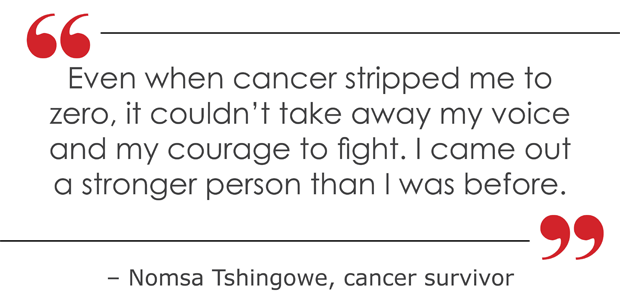
“Even when cancer stripped me to zero, it couldn’t take away my voice and my courage to fight. I came out a stronger person than I was before.”

What she’s doing today

In 2016, she decided to start creating awareness around cancer.

“I created Cancer 0 Thirty 5 Awareness when I realised there is a lack of cancer knowledge, especially in our black communities. It is aimed at promoting cancer education and awareness. The main targets are children and youth in Limpopo and the mission is to provide support to children and youth cancer survivors and their families so that they can also enjoy quality life.”

Tshingowe is currently doing her Masters in Public Health at the University of Limpopo.

Image credit: Supplied

Share Button

Health24.com | Are yawns really contagious?

We’ve all “caught” yawning from other people, but why that happens is unclear, according to a psychologist who has researched the behaviour.

“In short, we don’t know why yawns are contagious,” said Meredith Williamson, a clinical assistant professor at Texas A&M College of Medicine.”

Not just when you are sleepy

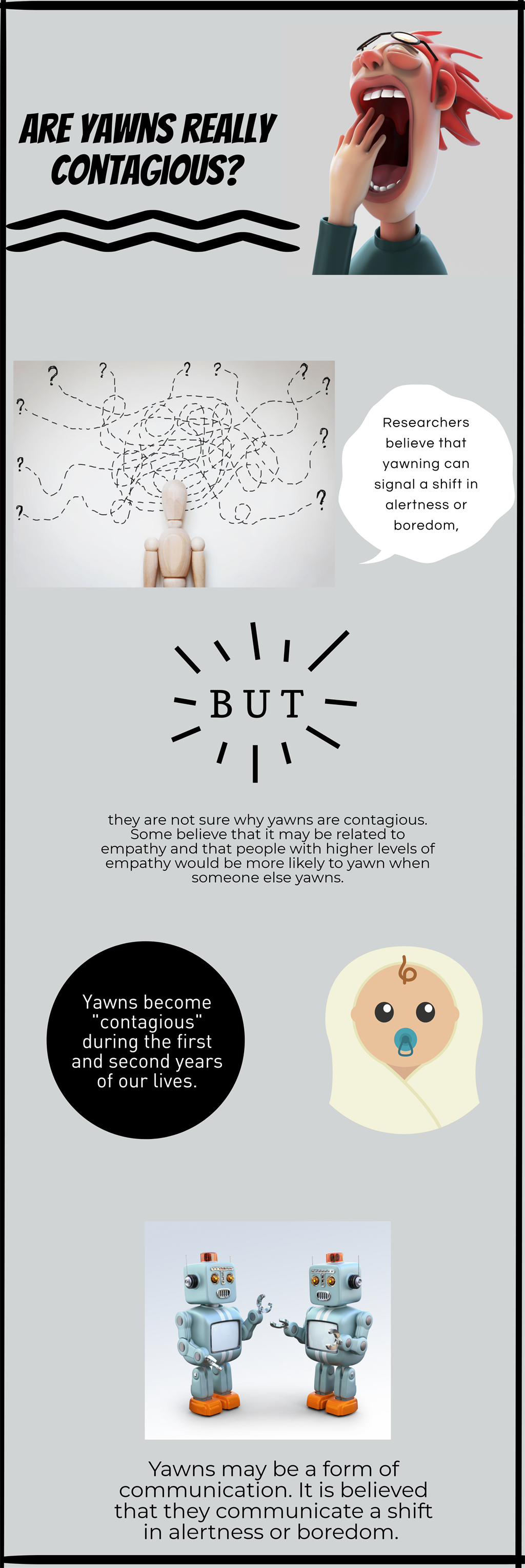
Researchers used to think that yawning only signals a need for sleep, but now they believe that it can also communicate a shift in alertness or boredom.

One theory is that contagious yawning is related to empathy, and that people with higher levels of empathy yawn more often when someone else yawns, compared to people with lower levels of empathy or those with a mental disorder.

“Researchers have seen that yawning may not be as contagious to people with autism or schizophrenia,” Williamson said in a university news release. “More research is being done to determine the cause of this.”

She also noted that children under the age of four and older adults are less likely to yawn in response to somebody else yawning.

Not unique to humans

Yawning may be an unspoken form of communication, but it’s not unique to people, Williamson added. Some species of primates and canines also yawn in response to each others’ yawns, and dogs will even yawn after a person yawns.

Yawning is “multifactorial. It could be partly an innate form of communication or it could be related to empathy, or a bit of both combined with other factors,” she suggested.

Image credit: iStock

NEXT ON HEALTH24X

Share Button

100 Women: The modern face of the ‘DIY abortion’

Global online searches for abortion pills have more than doubled over the last decade, BBC analysis of Google searches shows.

Share Button

Health24.com | Can the air conditioner make you sick?

We all appreciate air conditioning on scorching summer days, but during winter these very systems come under criticism as being the source of germs that cause colds and flu. Is there any truth to this?

Health24’s enviro-health expert, Olivia Rose-Innes agrees that air conditioning may possibly be harmful; however, she points out that this is hard to prove.

She explains that poorly maintained systems can harbour organic contaminants like bacteria and mould spores that may aggravate respiratory tract infections and illnesses in susceptible people.

“People in offices with air conditioning report more symptoms than those in offices with natural ventilation.

“Symptoms are varied, from headaches to respiratory-tract problems, including sinusitis, but are seldom linked to a specific cause.”

AC unlikely to spread flu

Rose-Innes says that although it is possible that infectious diseases like colds and flu may be spread by air conditioning, it’s probably rare. She says individuals are more likely to catch a cold in an indoor office with no natural ventilation or simply through contact with contaminated surfaces.

“The temperature the aircon is set at won’t make you sick – though it can certainly raise stress levels if it’s at a temperature you find uncomfortable,” Rose-Innes says. 

Allergies 

Another common misconception is that air-conditioning units can cause allergies. 

Dr Adrian Morris, Health24’s in house allergy expert, says although there might be a connection between air conditioning and one’s health, one cannot be allergic to air-conditioning systems.

“You can’t be allergic to air conditioning; it’s a machine that cools air just like your fridge.”

He says air-conditioning systems may, however, dry the nose and aggravate sinus issues.

Dr Morris notes that mould spores do thrive in air-conditioning machines, so make sure you clean the filters regularly. “Mould spores may grow in a wet conditioner, which could trigger allergies.” 

Image credit: iStock

Share Button

‘How a TV show led to my cancer diagnosis’

Maren and Margaret saw journalist Victoria Derbyshire speak about her breast cancer on The Real Full Monty.

Share Button

Why beige carbs are the ones to avoid – Dr Xand van Tulleken

Low-carb diets have been around for a while but did you know the colour of the carbs you eat also matters, says Dr Xand van Tulleken.

Share Button

Why It’s So Hard To Recover After Drinking As You Get Older

Chances are hangovers feel worse and recovery after a long night gets to be a difficult process the more birthdays you have under your belt. It’s no surprise from a biological standpoint: When your body changes as you age, its ability to process alcohol also changes.

“When you’re young, you have a lot of plasticity in how you respond to things that are toxic,” said George Koob, director of the National Institute on Alcohol Abuse and Alcoholism. “You lose some of that as you get older.”

As you age, a long night of imbibing can get riskier. In recent years, alcohol abuse and dependence have more than doubled among older people. Your body also just can’t keep up in the moment.

“What used to be a normal amount of alcohol you could drink and not get overly intoxicated now changes,” explained James Galligan, a professor of pharmacology and toxicology at Michigan State University. “Because your system doesn’t work as well [when you’re older], you’re likely to end up with higher blood alcohol levels than you would’ve when you were much younger.”

So how exactly does your body respond to alcohol when you’re no longer in your 20s?

Your body doesn’t metabolize alcohol as effectively when you’re older

Alcohol is neutralized in a two-step process that takes place in the liver, according to David Sack, the chief medical officer of Elements Behavioral Health. 

“Alcohol is converted to acetaldehyde, which is responsible for a lot of the negative effects of alcohol like headaches, flushing and dizziness,” he said. It’s then converted to acetic acid, which is excreted in urine.

The system works well in younger people, Galligan said.

“But just like anything else, when you get older, things don’t work like they used to,” he added. “As people begin to get into their 60s or 70s, the enzymes that metabolize alcohol don’t work as well.”

Just like anything else, when you get older, things don’t work like they used to. James Galligan, professor of pharmacology and toxicology at Michigan State University

“Some of that may be the result of the normal aging process, but part of it may be due to illness,” Sack said. “Moderate to heavy drinkers can cause injury to their liver. They have changes in the efficiency in which their liver processes alcohol.”

A recent study found that both the brain and the liver are more sensitive to the toxicity of alcohol as you age, affecting your response to liquor. In turn, what you normally drank when you were younger will have a greater effect when you get older, Galligan noted.

A number of lifestyle factors play a role in how you process alcohol as you age

Your proportion of body fat as you get older is one factor in how your body processes alcohol, Sack said.

“Alcohol, unlike most other drugs, is only distributed in the water parts of the body. So if you have less water to body fat, more of the alcohol reaches the organ,” he said. 

Other illnesses can also contribute to the inefficient metabolism of alcohol. Hepatitis C, for instance, can affect the liver’s ability to clear alcohol and other drugs, Sack noted.

Using more medications can also play an enormous role in how you process alcohol, according to Koob. “The elderly tend to take a lot of medications, and some can interact in a bad way with alcohol like Xanax or Valium, for instance,” he said.

How long you’ve consumed alcohol across a lifetime can also affect how you process liquor

If you ever drank while underage, that may also play a role in how you metabolize alcohol, Koob said. In fact, underage drinking is even associated with impairment of cognitive function.

“Excess drinking can affect the frontal cortex, which is the slowest part of the brain to mature and why they advocate against underage drinking,” he added.

And over time, heavy drinking itself can affect how you process alcohol in the future, Sack noted.

“There are people who started drinking in their 20s and 30s and are now in their 60s that tend to have more emotional problems like depression, drink more continuously and have more treatment for alcohol-related problems,” Sack said. “And there are those who start drinking when they’re older, as in their 50s and 60s, who tend to be healthier and have fewer consequences.”

The liver has a lot of excess capacity if you don’t keep injuring it. David Sack, chief medical officer of Elements Behavioral Health

While the health benefits of drinking a glass of red wine or two have made headlines recently, the studies are mixed and moderation is ultimately key to your health, Sack said. And surprisingly, hangovers don’t always worsen with age, as one study found ― but it truly depends on your lifestyle.

“The liver has a lot of excess capacity if you don’t keep injuring it,” Sack said. “It’s an amazing organ.” 

Share Button