Health24.com | Most restaurants back ban on smoking sections

Not too long ago Health Minister, Dr Aaron Motsoaledi, said that he “hates” the tobacco industry and promised stricter legislation, such as abolishing the 25% smoking space in public buildings.

Should these laws be passed, one of the new laws will make it mandatory that smoking sections in restaurants and other hospitality establishments be done away with.

A University of Cape Town (UCT) study, published in the South African Medical Journal, conducted an analysis of smoking policies of restaurants, how they’ve changed over the years and what management thought of the new, proposed laws.

Health24 also spoke to two popular franchises about giving up smoking sections in their restaurants.

Attitudes have changed

Many franchised restaurants have done away with their smoking sections out of their own volition, like Wimpy restaurants.

Jacques Cronje, Marketing Executive for Wimpy, told Health24 that they support the pending legislation. “We have already voluntarily commenced in removing smoking sections as we revamp our outlets nationwide,” added Cronje.

The Harbour House Group, which has restaurants such as Tiger’s Milk, La Parada and Harbour House in their stable, also supports the shift.

Group Operations Manager, Radley Dijkers, also told Health24 that they don’t anticipate the new regulations having a major, negative impact on their business.

“As restaurant operators, we have to be very conscious of our customers’ needs and expectations. There has been a massive shift in the public’s perception on smoking tobacco due to case studies, mainstream media, social media and because of the Department of Health’s strong regulations,” said Dijkers.

‘Majority of owners support amendment’

The UCT study was put together by the director of the Economics of Tobacco Control Project (ETCP) Professor Corné van Walbeek and researcher Megan Little. The ETCP is a project of the Southern Africa Labour and Development Research Unit at the UCT School of Economics.

Over the years, we’ve seen many restaurants and hospitality establishments do away with their smoking sections of their own volition. This was also noted in the study.

In a statement issued by UCT, Little said that it seemed that over time attitudes have changed.

“There was a massive push-back from the hospitality and tobacco industries some 20 years ago when the idea of a complete ban on smoking in hospitality establishments was first floated.

“We’ve found the majority of restaurant owners and managers support the proposed amendment that would ban smoking in restaurants completely.”

In the study, more than 750 restaurants across South Africa were interviewed and varied from franchises to independently owned establishments.

restaurant owners and managers support complete ba

A shift for the better

The study also detailed a pattern between rural and urban establishments, which showed that restaurants with smoking sections inside tended to be in smaller towns and rural areas, but those without smoking sections or outside smoking sections were found predominantly in urban settings.

Prof Van Walbeek said that there has been a shift for the better in restaurants’ smoking policies in the past decade.

“Businesses all over the world respond to consumer preferences and the hospitality industry is no different. The fact that restaurants voluntarily adjusted their smoking policies in the past decade, in some cases taking a tougher stance than the law requires, is indicative of the healthier lifestyle demands of urban restaurant patrons.

“This suggests that a significant number of South Africans are ready for the ban on restaurant smoking,” said Prof Van Walbeek.

What are your thoughts about a complete ban on smoking sections in restaurants, pubs and bars, along with other hospitality establishments? Share your thoughts by emailing healthnews@health24.com and we may publish your story. Should you wish to remain anonymous, please let us know.

Image credit: iStock

NEXT ON HEALTH24X

Share Button

Health24.com | Are you using the correct treatment for your sinusitis?

You’ve probably experienced the painful, annoying symptoms of sinusitis. It occurs when the membranes of the nose become inflamed – which may be caused by a number of factors.

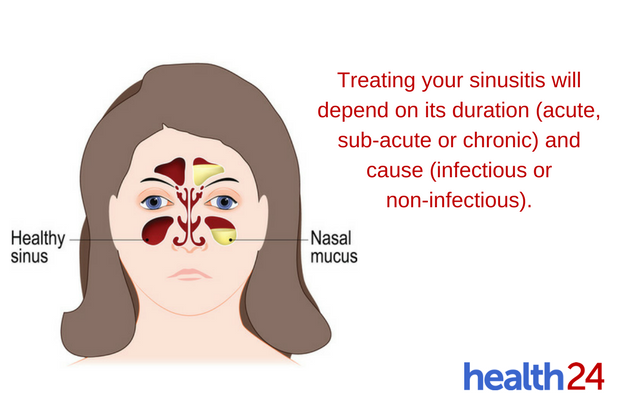
There are different types of sinusitis, and the more clued up you are about the type of sinusitis you have, the easier it will be to treat. 

It’s important to know that sinusitis differs from person to person and can be caused by several factors – whether it’s a viral or bacterial infection or an allergy, according to Dr Anna Bouknight from the Sinus Center of South Carolina, USA. 

A previous Health24 article explains that the types of sinusitis are classified according to their time span, as well as the type of inflammation causing the sinusitis.

  • Acute sinusitis
  • Subacute sinusitis
  • Chronic sinusitis

Sinusitis can also be divided according to cause, i.e. whether it’s caused by infection or something else.

  • Infectious sinusitis is caused by an overgrowth of bacteria and usually occurs after a cold or flu.
  • Non-infectious sinusitis is caused by allergies (dander, pollen climate) or physical reasons such as a deviated septum, tumours or polyps in the nasal cavities.

types of sinus

Treatment

The first step towards successfully treating your sinusitis is to determine the type and cause. This should be done by your doctor, who will identify the cause of your sinusitis and treat it accordingly. 

Here are the different types of treatments recommended for different types of sinusitis:

1. Acute sinusitis

Symptoms: A stuffy nose, pressure headache, facial pain and slightly discoloured mucus.

Likely causes: Usually a viral or bacterial infection, especially if it clears up in under 10 days.

Treatment: If the symptoms don’t persist for longer than 10 days, there is no need for antibiotics. Treat symptoms with over-the-counter decongestants to relieve congestion and painkillers, such as paracetamol, to relieve pain.

2. Subacute sinusitis

Symptoms: The same as the above – the duration of the symptoms will be more than a month, but no longer than three months.

Likely causes: A more serious, longer-lasting viral or bacterial infection.

Treatment: In the case of subacute sinusitis, your doctor will prescribe a course of antibiotics and a nasal steroid to clear up the infection and congestion. 

3. Chronic sinusitis

Symptoms: The same as the above, although nasal polyps may start to develop when you have chronic sinusitis.

Likely causes: Chronic sinusitis that persists for more than three months is usually caused by allergies to dander or pollen or by physical factors such as a deviated septum or possible tumours.

Treatment: Your doctor might refer you to an ear nose and throat (ENT) specialist to investigate the cause of your sinusitis. In the case of allergies, your doctor will suggest treatments like decongestants.

According to Health24’s resident allergy expert Dr Adrian Morris, it’s a good idea to begin regular antihistamine medication a month before the pollen season starts if you are prone to seasonal allergies.

Nonsedating, long-acting antihistamines include Telfast, Zyzal and Deselex.

Image credit: iStock

Share Button

Potential new cure found for baldness

The lead researcher says the discovery could “make a real difference to people”.

Share Button

Health24.com | How to manage dermatitis associated with incontinence

People who have incontinence may experience incontinence-associated dermatitis (IAD) at some point. 

IAD occurs when moisture from urine or stool remains on the skin, causing the tissue to break down. This can be a painful and costly situation as well as difficult to identify, which increases chances of infection and chronic wounds.

Diagnosis and immediate treatment are important when dealing with IAD.

What exactly is IAD?

The condition is caused by inflammation of the skin when the area around the anus or genitals is exposed to urine or stool for long periods of time. The American Journal of Clinical Dermatology explains how elderly people – particularly those living in long-term care facilities – are at a higher risk of both incontinence and this irritating condition. 

IAD is often confused with pressure ulcers and other skin conditions, but the growing amount of research in the field is making it easier for doctors to diagnose the condition more accurately and efficiently. 

How does IAD happen? 

It was previously believed that the moisture from the urine and stool were the cause of the dermatitis occurring around the genitals and anus area. Further research, however, has proved this theory false. It has been proven that what actually causes the skin condition is what is contained in these fluids. The alkaline substances in urine, for instance, damage the tissue of your skin, making it more vulnerable to abrasion.

Symptoms of IAD include:

  • Itchy skin
  • Burning sensation 
  • Pain
  • Tender and warm skin
  • Redness and inflammation of the skin

If you are experiencing any of these symptoms, speak to your doctor as soon as possible. They should ask about your incontinence in order to diagnose your skin condition properly. Symptoms can be unclear at times; it is therefore important to rule out certain conditions that have the same symptoms as IAD:

How can it be treated? 

  • Change your absorbent pads/diapers regularly, even if they are dry, in order to maintain good hygiene. Typically people use four to six pads daily.
  • Wash the area with a cleanser that balances your skin’s pH level.
  • Properly moisturise your skin, use hydrogel or petroleum-based products to protect your skin. 
  • Your doctor may be able to recommend a product that cleanses, moisturises and protects simultaneously. 

If you’ve developed any infection as a result of IAD, your doctor may have to prescribe an antifungal or oral antibiotic medication. 

In order to manage IAD, there needs to be proper management of incontinence. Make sure you consult your doctor to discuss management strategies for both conditions. The only way to reduce your risk for IAD is to be diligent in your treatment plan. 

Image credit: iStock

Share Button

Health24.com | Does coffee cause cancer?

While scientists have not yet come up with a final verdict on whether coffee is good or bad for you, an American judge has. A Californian judge has called for coffee sellers in the state to place cancer warnings on the coffee they sell. 

The problem is the chemical produced during the roasting process, known as acrylamide, a carcinogen, has been in the middle of an eight-year legal battle between a small non-profit organisation and major coffee companies in the US.

While this battle has reached a conclusion in court, scientists are still debating whether coffee can actually cause cancer. We take a closer look.

Inconsistent results

A recent study, published in the European Journal of Cancer Prevention, did a meta-analysis and found that “coffee consumption is not associated with overall cancer risk”.

However, the results for bladder cancer were inconsistent, and a few studies analysed in the meta-analysis found that there was an increased risk of childhood leukaemia after mothers had drunk coffee during their pregnancy. 

It is also important to note that, in the same report, the International Agency for Research on Cancer (IARC) concluded that drinking hot drinks (over 65 degrees) may increase the risk of oesophageal cancer. The oesophagus is the passage that connects the mouth and stomach. 

Coffee may reduce cancer risk

According to Majorie McCullough, ScD, and Susan Gapstur, PhD, researchers from the American Cancer Society, the development of cancer in the liver, pancreas, breasts as well as the uterine endometrium is significantly reduced when one consumes coffee on a daily basis. This is due to the antioxidants found in coffee.

Although research is unclear as to how coffee affects patients with colon cancer, assistant professor and colon cancer expert Syed Kazmi has noted that patients who consume coffee tend to live longer than patients who do not. 

Coffee drinking is associated with a reduced risk of liver cancer, possible decreased risk in oral/pharyngeal cancer as well as advanced prostate cancer. 

Concerns have eased

Scientific evidence on coffee has been oscillating between benefits and risks. However, as a result of new studies finding more health benefits of coffee, concerns have eased. If you are a regular coffee drinker, the new studies indicate that you are probably not increasing your risk of cancer.

If you are not a coffee drinker, you might, however, not want to take this new evidence as a reason to start. The evidence is still uncertain, and if subsequent research does reveal a positive effect, it most likely will be small, much smaller than any benefits gained from maintaining a healthy weight or cutting down on alcohol.

Image credit: iStock 

Share Button

Health24.com | 4 numbers you need to know next time you have to see the doctor

Your life may depend on this hurry-up healthcare offensive, so it’s a good idea to know these numbers so you can hack the waiting room and your appointment.

1. The waiting room

0:20:00

According to the American Medical Association, that’s the average amount of time you spend in the germ-filled waiting room. A study in the Journal of Medical Virology reports that cold viruses can linger for 24-plus hours on hard surfaces, so bring your own pen and magazine.

And while you (should) know that touching your mouth with a contaminated hand can spread gastrointestinal viruses, head- and chest-cold viruses can enter through membranes in your eyes and nose, too. So if you touch any surface, don’t rub your eyes or scratch your nose until you’ve treated your hands with sanitiser.

Read more: 6 solutions to common problems you have with your doctor – and how to get the most out of your appointment

2. Doctor time

0:07:00

That’s the average length of time a doctor spends with each patient. Your preparation for the doctor shouldn’t be just booking the appointment – carefully record your symptoms beforehand. Once inside, monitor who’s guiding the consultation. While you’re here for expert advice, don’t let the precious minutes be dominated so you’re out the door before you’ve gotten any answers.

You can maximise that time by taking advantage of an often-underutilised ally – the nurse. “Nurses are better educated on ways to help patients understand,” says Dr Judith Hall, co-author of Doctors Talking With Patients/Patients Talking With Doctors.

Read more: Doctor’s orders: These are the 7 foods doctors prescribe for your health

3. Bonus time

0:02:00

Improve on the seven-minute appointment average by seeing a female physician. A 2004 Johns Hopkins study reports that visits with female doctors are, on average, two minutes longer than those with their male counterparts.

“Patients of female physicians also felt more comfortable disclosing medical information, which is crucial for proper care,” says study author Dr Debra Roter, a professor at Johns Hopkins school of public health.

Read more: A sleep doctor reveals the 4 fastest ways to stop snoring

4. Talk time

0:00:18

That’s how long you have to explain your symptoms before your doctor interrupts, says an Annals of Internal Medicine study. The disruption often causes patients to become flustered and forget the other reasons for the visit, says Dr Roter.

Overcome the distraction by writing a comprehensive list of your symptoms before you walk in the door. Include details such as how long you’ve had them and how often and how severe they are, as well as questions you want to ask.

This article was originally published on www.mh.co.za

Image credit: iStock

Share Button

HPV jab safe and effective, study finds

Trials show the vaccine is low risk and protects girls and young women against a virus linked to cervical cancer.

Share Button

Mental health plans ‘failing a generation’, say MPs

Government’s child mental health plan leaves hundreds of thousands without proper care, says report.

Share Button

Hunting dogs may benefit from antioxidant boost in diet

Free radicals, those DNA-damaging single-oxygen atoms, are produced in spades during exercise. Dogs that exercise a lot, like hunting dogs, may need to consume more antioxidants than their less-active counterparts to protect against this damage. But what diet formulation best meets the needs of these furry athletes? A new University of Illinois study provides some answers in a real-world scenario.

Researchers visited a kennel of American Foxhounds in Alabama over the course of a hunting season, providing one group a high-performance commercial diet and another group a test diet similar to the commercial diet, but with added antioxidants (vitamins C and E, and lutein), zinc, and taurine. During the study, dogs from both groups went on two to three hunts per week, each 2 to 5 hours in length.

“We think of it as unstructured endurance exercise. They’re not running the entire time. They might stop to sniff or go more slowly to pick up a scent,” says Kelly Swanson, corresponding author on the study and Kraft Heinz Company Endowed Professor in Human Nutrition in the Department of Animal Sciences and the Division of Nutritional Sciences at U of I.

Before starting the diets and on four occasions during the seven-month study, researchers took blood samples from the dogs to examine oxidative stress markers and other blood metabolites.

“We hypothesized that dogs fed the test diet would have a lower concentration of oxidative stress markers and improved performance compared to the dogs fed the commercial diet,” Swanson says. “It turns out performance wasn’t affected by diet, but the test diet did improve indirect measures of oxidative stress. Therefore, improved performance may be expected with more strenuous exercise when metabolic demands are higher.”

The amino acid taurine, once thought to be non-essential for dogs but now recognized as an important nutrient for heart health, declined over the course of the season for dogs fed the commercial diet. The same pattern occurred with vitamin E. Although one dog did come close to a critically low level of taurine during the study, all dogs fed the commercial diet stayed within the normal range for all blood metabolites.

For dogs fed the test diet, taurine and vitamin E levels were maintained at or above the baseline. The results suggest to Swanson and his co-authors that these compounds are compromised in athletic dogs over months of unstructured exercise, and more-active dogs such as sled dogs may experience greater depletion.

“We can conclude that athletic dogs may benefit from supplementation of vitamin E and taurine to minimize oxidation and maintain taurine status,” he says.

Story Source:

Materials provided by University of Illinois College of Agricultural, Consumer and Environmental Sciences. Note: Content may be edited for style and length.

Share Button

Climate change threatens Marine Protected Areas

New research from the University of North Carolina at Chapel Hill and collaborators found that most marine life in Marine Protected Areas will not be able to tolerate warming ocean temperatures caused by greenhouse gas emissions. Marine Protected Areas have been established as a haven to protect threatened marine life, like polar bears, penguins and coral reefs, from the effects of fishing and other activities like mineral and oil extraction. The study found that with continued “business-as-usual” emissions, the protections currently in place won’t matter, because by 2100, warming and reduced oxygen concentration will make Marine Protected Areas uninhabitable by most species currently residing in those areas.

The study, which will be published on May 7 in Nature Climate Change, predicts that under the Intergovernmental Panel on Climate Change’s Representative Concentration Pathway 8.5 emissions scenario, better known as the “business as usual scenario,” Marine Protected Areas will warm by 2.8 degrees Celsius (or 5 degrees Fahrenheit) by 2100.

The study concludes that such rapid and extreme warming would devastate the species and ecosystems currently located in Marine Protected Areas. This could lead to extinctions of some of the world’s most unique animals, loss of biodiversity, and changes in ocean food-webs. It could also have considerable negative impacts on the productivity of fisheries and on tourism revenue. Many of these marine species exist as small populations with low genetic diversity that are vulnerable to environmental change and unlikely to adapt to ocean warming.

The study also estimated the year in which Marine Protected Areas in different ecoregions would cross critical thresholds beyond which most species wouldn’t be able to tolerate the change. For many areas in the tropics, this will happen as soon as the mid-21st century.

“With warming of this magnitude, we expect to lose many, if not most, animal species from Marine Protected Areas by the turn of the century,” said John Bruno, lead author, marine ecologist, and biology professor in the College of Arts and Sciences at UNC-Chapel Hill. “To avoid the worst outcomes, we need to immediately adopt an emission reduction scenario in which emissions peak within the next two decades and then decrease very significantly, replacing fossil fuels with cleaner energy sources like solar and wind.”

Key takeaways include:

  • There are 8,236 Marine Protected Areas around the world, although they only cover about 4 percent of the surface of the ocean.
  • The projected warming of 2.8 degrees Celsius (or 5 degrees Fahrenheit) by 2100 would fundamentally disrupt the ecosystems currently located in Marine Protected Areas.
  • Mean sea-surface temperatures within Marine Protected Areas are projected to increase 0.034 degrees Celsius (or 0.061 degrees Fahrenheit) per year.
  • Marine Protected Areas in the Arctic and Antarctic are projected to warm especially quickly, threatening numerous marine mammals like polar bears and penguins.
  • The Marine Protected Areas at the greatest risk include those in the Arctic and Antarctic, in the northwest Atlantic, and the newly designated no-take reserves off the northern Galápagos islands Darwin and Wolf.

“There has been a lot of talk about establishing marine reserves to buy time while we figure out how to confront climate change,” said Rich Aronson, ocean scientist at Florida Institute of Technology and a researcher on the study. “We’re out of time, and the fact is we already know what to do: We have to control greenhouse gas emissions.”

Story Source:

Materials provided by University of North Carolina at Chapel Hill. Note: Content may be edited for style and length.

Share Button