Experts say the findings suggest the NHS could better spend the £23m each year it costs for the treatment.


Experts say the findings suggest the NHS could better spend the £23m each year it costs for the treatment.
They were made in a dish from mouse stem cells and resembled an embryo of about three days old.
A man said his wife might have survived breast cancer if she had been scanned and diagnosed earlier.
A flint flake from the Middle Paleolithic of Crimea was likely engraved symbolically by a skilled Neanderthal hand, according to a study published May 2, 2018 in the open-access journal PLOS ONE by Ana Majkic from the University of Bordeaux, France and colleagues. The authors developed a detailed framework for interpreting engravings on stone artifacts.
Engraved stone artifacts are important clues to the history of human culture and cognition. Incisions on the cortex (soft outer layer) of flint or chert flakes are known from Middle and Lower Paleolithic sites across Europe and the Middle East. However, it can be difficult to determine the action that created an incision: was it an accidental scrape or purposeful engraving? To address this issue, Majkic and colleagues created an interpretive framework that allows researchers to classify the structure and patterns of engraved cortexes and cross-check these attributes with a list of possible causal actions.
They tested this methodology with an engraved flake from the cave site of Kiik-Koba in Crimea. The many stone artifacts at the site are associated with Neanderthal remains and date to around 35,000 years ago. Following microscopic examination of the grooved lines on the flint cortex, the researchers concluded that the incisions represent deliberate engravings that would have required fine motor skills and attention to detail. These engravings appear to have been made with symbolic or communicative intent.
If this interpretation is correct, this engraved flake would join a growing list of signs that Neanderthals engaged in symbolic activities, along with evidence of intentional burial, personal ornaments, and other decorated objects. This has implications for the question of when and how many times this sort of cultural expression has evolved among hominin populations. The researchers hope to hone their framework further for use with artifacts of varying ages and cultural contexts.
Story Source:
Materials provided by PLOS. Note: Content may be edited for style and length.

The humble glass microscope slide may be primed for a makeover.
A study published online today (May 2, 2018) in the journal Nature Communications describes how an updated version of this centuries-old tool can now enable scientists to see tiny objects while also measuring their temperature.
The advancement, made possible by a new transparent coating at the forefront of optics theory, has the potential to streamline and enhance scientific research worldwide, from clandestine government biology labs to high school chemistry classes.
It may also have implications in other industries, such as computers and electronics, whose products require measurement and control of heat in highly confined spaces.
“We have instruments that magnify incredibly small objects. And we have tools that measure heat, like infrared thermometers. But we haven’t been able to combine them in a low-cost and reliable manner. This new coating takes a big step in that direction,” says the study’s co-lead author Ruogang Zhao, PhD, assistant professor in the University at Buffalo Department of Biomedical Engineering.
The department is a multidisciplinary unit formed by UB’s School of Engineering and Applied Sciences and the Jacobs School of Medicine and Biomedical Sciences at UB.
Zhao collaborated with researchers at the University of Pennsylvania, including co-lead author Liang Feng, PhD, assistant professor of materials science and engineering, and electrical and systems engineering.
For decades, researchers have tried to combine thermal imaging and microscopy. Images produced from systems that use thermocouples lack resolution and are often too coarse for modern science. Terahertz and infrared thermal mapping techniques interfere with the microscope’s lenses. Other techniques are expensive and time-consuming.
The new coating is made of a layer of acrylic glass (the same material used in most eyeglasses) that’s sandwiched between two layers of transparent gold. The gold is transparent because it’s only 20 nanometers thick; a typical sheet of paper is 100,000 nanometers thick.
Engineers fabricated the coating so that “exceptional points” — the sweet spots where unusual light behavior happens — can develop within the tri-layered structure. The coating, which significantly enhances the slide’s sensitivity to light detection, would be added to slides during the manufacturing process. Either the slide or cover slip could receive the coating.
To make use of the new coating, a laser is needed. Zhao says a common helium-neon laser, which can be seamlessly integrated with most microscopes, will do the job.
Common slides, which are often bought in bulk, typically cost around 5 cents. The new coating would likely add a few pennies to the cost, Zhao says.
The research is supported by funding from the National Science Foundation and the National Institutes of Health.
Story Source:
Materials provided by University at Buffalo. Note: Content may be edited for style and length.

While the Western Cape High Court ruled on the use of medical cannabis last year, most South Africans remain confused on the issue, including some members of the South African Police Service.
The confusion has arisen because although the courts ruled that the use of cannabis by people at home is now legal, the matter was taken to the Supreme Court of Appeal where a final ruling will be made.
People still being arrested
The Western Cape High Court’s groundbreaking ruling is that people may use cannabis only at their homes, and may grow their own cannabis at home. The ruling was met with huge excitement by Rastafarians who claimed victory for cannabis users. But months later people are still being arrested for growing and using the herb at home.
Rastafarian Mpho Kaloto from Potchefstroom says he thought the battle was won, and still doesn’t understand why he was arrested.
“I was watching on the news last year when a judge said we can grow dagga and smoke it in our homes, so I fail to understand why I was arrested after my neighbours called the cops on me. I thought what I was doing was legal,” said Jah Mpho.
The 38-year-old Rastafarian said he spent a weekend in a holding cell and was charged with drug possession, and ordered to pay a R500 fine.
“I spent a whole weekend in jail, and I was fined with R500 because of two small trees that where found at my yard. Now I have a criminal record and I’m not even a criminal. I am still confused. Right now as I feel like the law has let us down. As Rastas, dagga is a part of how we live,” he said.
Ruling not yet in effect
Judge Dennis Davis, who made the ruling, said the police can still go into a home and arrest a person for cannabis, but those arrested would be afforded the opportunity to use their right to privacy as a defence when charged. The judge also ruled that it’s not up to the courts to decide whether or not there were social problems linked to drugs, or that drug-related problems should be ignored, it was up to parliament.
Witness Phele, a lawyer who has represented people accused of cannabis possession, says that the ruling hasn’t come into effect and cannabis is still illegal in South Africa.
“The case is now before the Supreme Court of Appeal. As soon as we get an SCA Judgement the law will be applicable,” he said.
According to Phele, the law currently remains the same as it was before the judgement was passed in the Western Cape High Court.
“Nothing has changed until legislature changes the Act,” he said.
Arrested in confusion
According to Mpho, the police who arrested him were also confused after he told them about the ruling.
“I read the ruling to them, and that confused them. So the police arrested me in confusion, but I guess they thought they were doing their job.”
People suffering from severe and chronic pain related to mulitple sclerosis, cancer and HIV/Aids were expected to be the ones to have access to medical cannabis.
Marita Schalk, who has suffered from severe back pain and has experienced heart problems says cannabis oil has assisted her for the past two years.
“I was living on a lot of medication until my doctor recommended cannabis oil two years ago. It didn’t remove all of my pain, but one thing for sure is that I feel much better now. It has helped with my heart problems, and also I used to have severe back pain all the time. Things have improved very much and so I really hope it is legalised. People need something like this,” she said. – Health-e News.
Image credit: iStock


A chronic illness is so much more than discomfort and constantly checking into the hospital. “Socially it’s been the biggest problem,” Maddie Beale, a Crohn’s disease sufferer, says. Just over a week ago today marks a year since she was diagnosed with Crohn’s.
“You end up in the hospital and people are all gaga to come visit you for the first admission, or the second one… and then eventually it’s, ‘Ag she’s back there again! That’s so annoying.’”
Chronic illnesses are often invisible. There is constant pain that, as a friend of a sufferer, can be hard to relate to. Here is the truth about this disease, as told by Maddie.
Crohn’s disease: the diagnosis
“It took a while for me to be diagnosed, but it actually wasn’t as long as [it takes for] a lot of people,” Maddie begins. “Looking back, I realise that I’ve had symptoms for years!”
But the journey towards a diagnosis really began in October 2016. “Something just wasn’t right. My heart was racing and I was so tired; I had an upset stomach that just wasn’t going away,” Maddie says. Her GP wasn’t convinced, but sent her for blood tests. “I went straight from Pathcare to the hospital,” she says.
After a week of hospital tests, Maddie was told her intestines were inflamed. “But the doctors decided to treat it as if it’s acute and sent me home, loaded with antibiotics and steroids,” she said. It didn’t get better, and around February last year, she found herself back in the hospital.
After a CAT scan and urine samples, she was sent home yet again, having been told she was fine and was simply trying to get a day off varsity. “I couldn’t move. I was in screaming pain,” she recalls.
Read more: The truth about chronic inflammation and what it means for your health
In March, Maddie and her family decided to take things into their own hands. They made an appointment with a gastroenterologist (a doctor who specialises in conditions of the digestive tract).
“I explained my whole story and he said he could probably confidently diagnose me from just this.” After an MRE scan, which provides the doctor with detailed images of the small intestine and bowel, the expert confirmed his suspicions: Crohn’s. “It was a long process, but I know some people that took four or five years to diagnose. It could have been a lot worse…”
Dealing with Crohn’s
Finding out that you have a chronic illness is far from fun. “[But] in a way, you feel so relieved,” says Maddie. “After being told that you’re just making it up and it’s all in your head… There is a reason – that’s a relief.” But, of course, it’s also devastating. “You tell yourself that you’re fine, that you’ll get a course of antibiotics and then everything will be okay. You want people to understand that the pain is real, but you don’t want to be stuck with it forever.”
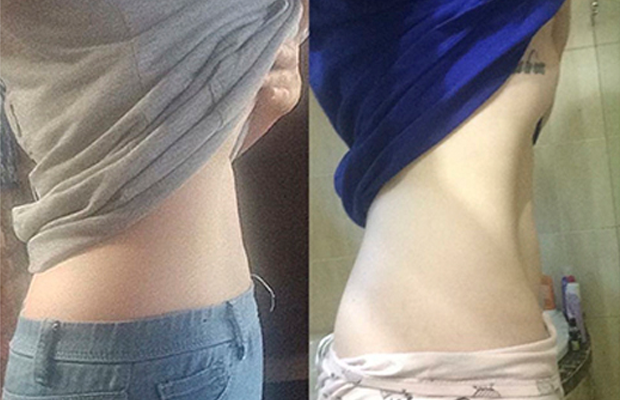
“My symptoms are much better now, but in the beginning – uncontrolled diarrhoea,” Maddie says with a laugh, “That’s why no one wants to talk about Crohn’s – because it’s ugly.” The symptoms include major blood loss through the ulcerations on your intestines. “I experienced massive weight loss. I dropped 10 kilos – like that!”
It was scary, yet Maddie still had people telling her how lucky she was to lose weight so quickly. “No, that’s not fun. What’s fun is going and working out – just having your weight fall off you is not nice.”
Read more: “I developed an invisible illness – here’s what it’s like”
Fatigue is another symptom. “That is probably my main struggle now,” Maddie adds. There are other things that she didn’t even think would be connected to this disease. “I had ulcers in my mouth all the time and my eye sight [was affected].”
Then there’s the pain, which includes severe joint pain because Crohn’s causes inflammation everywhere. Not to mention the lack of appetite and subsequent weight loss. “I had seven hospitalisations last year because my symptoms were just too much to handle.”
The treatment
Maddie was first put on a high dose of cortisone. “Anyone who has ever been on cortisone can tell you that it’s the worst thing ever,” she adds. “It makes you swell up and get a nice round moon face.” A side effect of cortisone is insomnia. “You’re so exhausted and feeling so sick, but you’re also buzzing.”
Maddie then went on to Imuran, a drug used to stop organ rejection after organ transplants. “It’s an auto-immune disease so the best thing is immunosuppressants – if you just wipe out the immune system…” she explains. But this made her so ill that she ended up with pancreatitis.
“I’m now on Mezavant. It’s much milder, but I’m on a high dose and it seems to be controlling things. It doesn’t damage your immune system and I’m really hoping that I can stay on it for as long as possible!”
Living with it
“Obviously my diet has changed a lot – I go through stages when I’m just on baby food,” Maddie says. There are a lot of foods she’s had to give up too: “I’m not allowed to eat anything high in fibre – the more processed, the better it is for me.” Any vegetables need to be cooked to mush. “When I explain what I can eat to people, they get a bit of a horrified look on their faces. I can eat that McDonald’s, but no salad for me!” Her favourite snack, nuts – out. “And no popcorn! How do I go to the movies now?” She jokes.
Varsity life has been a bit of a tricky adjustment. After the 45-minute drive to campus, “I’ve got a full day sitting there and I’m in pain. I don’t want to eat, but then I get low blood sugar so I’m shaky and miserable. I end up just staying home. My lecturers have been really supportive, though. I did fail a couple of subjects last year, but I’m impressed I passed what I did because I missed so much!” This year is going much better with the new meds.
Read more: What this Instagram yogi wants you to know about living with chronic pain
“Socially it’s been the biggest problem,” Maddie says. At first, friends are understanding when you say, “I can’t come out with you because I’m not doing well, or I’m too tired, or I can’t drink because I’m on medication and it will kill me if I do.” But the sympathy turns to irritation quite quickly, especially when there’s nothing you can physically see. “But you also learn who your real friends are really quickly,” she adds.
Another thing that was especially rough was the lack of independence. “I went through a stage when I couldn’t even get out the bath on my own,” Maddie says. And when it came to Christmas shopping, she did it by wheelchair. “You realise the prejudices people have – they assume that if you’re in a wheelchair, your legs don’t work. Anything else and you’re just being lazy.”

Maddie’s advice to fellow Crohnies
“The main thing, and I think this goes for anyone who has any form of chronic illness, is not to let it define you. It is a big part of your life, but don’t make your life about the illness.” It’s an easy pit to fall into and Maddie says she’s been there. “You can be so sick and just go into a ball of pity,” she adds. “But you are perfectly capable of carrying on with your life.”
Maddie has made many friends with Crohn’s or other chronic illnesses through Instagram. It’s so important to have a support system, “and just because they’re a stranger you met online doesn’t mean they won’t understand you – maybe they will [understand you] even better than those directly in your life.”
And finally, “don’t throw away your goals and dreams – adapt them! No one is ever going to look down on you for changing the way you reach your goals. Just do it.”
This article was originally published on www.womenshealthsa.co.za
Image credit: Supplied

Areas above the limit include London and Manchester, with the Welsh town Port Talbot the worst.

The information on Health24 is for educational purposes only, and is not intended as medical advice, diagnosis or treatment. If you are experiencing symptoms or need health advice, please consult a healthcare professional. See additional information.

Addenbrooke’s Hospital in Cambridge will use a technique which can keep a liver “alive” outside the body.
