Lea DeLaria Gets Candid About Her Wild Tour Days, Sex With Younger Women And Turning 60

No, your eyes aren’t deceiving you: Lea DeLaria is about to turn 60.

From becoming the first openly gay comic to perform on broadcast TV in America in 1993 to winning accolades for her performance as Big Boo on HBO’s “Orange Is The New Black,” the preternaturally youthful star has lived many lives during her almost six decades on our fair planet. And she doesn’t intend to give up the spotlight ― or her penchant for younger women ― anytime soon.

A month before she celebrates the big milestone ― and takes to the stage in New York City with her friends Jesse Tyler Ferguson, Sandra Bernhard and Alan Cumming for a special birthday show titled “This Is What 60 Looks Like, Bitches!” ― DeLaria talked to HuffPost about growing older in Hollywood, the perks of becoming a “daddy” and why she never worries about dying.

It’s honestly really odd for me to be turning 60 next month because I never thought I’d make it this far. In my 20s I was convinced that I was going to be shot by some creepy Christian at a gay pride rally. By the time I was 30, I was certain I’d be dead by the time I was 40 — and if you knew me then, you’d understand why.

I was living an incredibly wild life in my 30s. I had become a very well-known performer in San Francisco when I was in my 20s and then, in 1993, I became well-known around the world because I was the first openly gay comic to perform on television in America.

Back then I was traveling all over the fucking place performing constantly in front of lesbians in every country. Anywhere that people understood English, there I was being a very out, very in-your-face dyke and enjoying the insane life that came with that kind of intense touring.

Scott Thompson, from The Kids in the Hall, loves to tell a story about when he was staying with me at the Edinburgh Festival in 1993. He came downstairs to the bedroom I was staying in and said, “Lea, there’s someone here for you at the door,” and I said, “Oh yeah, that’s Nicki, I’ve got a date with her tonight.” And he goes, “Yes, well, remember the girl you fucked last night? She’s here too! It’s like a French farce!” Scott loves that story — the fact that there were these two women in my living room waiting for me really summed up my life at that time.

So I was shocked that I made it to 40. And then once I hit 40, I became a leading lady on Broadway and I assumed my demise would come at the hands of some jealous chorus girl. I always think I’m never going to make it through whatever decade I’m in, but here I am at 60 and absolutely fucking no one believes I’m this old. I have been blessed with amazing genes because looking this young has absolutely nothing to do with taking care of myself, I assure you!

This is who I am and I’m not going to tame my radical dyke image and personality just because I’m getting older. That’s just not going to happen.

Since I’ve been moderately famous since I was 22 — essentially my entire adult life — I’m never quite sure how to respond when someone asks me, “How is getting older different when you’re famous?” I guess they’re usually referring to the ultra fame that I have achieved thanks to “Orange Is The New Black.”

Because of that fame, I think everything in my life is more scrutinized and, in some ways, I’m always under the microscope, but part of me doesn’t give a fuck — for certain there will never be any fucks given! That’s why I get my crowds to chant, “Fuck Trump!” This is who I am and I’m not going to tame my radical dyke image and personality just because I’m getting older. That’s just not going to happen. But the flip side of that is, now that I’m older, I also pick and choose my battles more carefully.

When I was younger, I was full of a lot of rage — and rightfully so. The world was a very different place 40 years ago — especially for someone who looked like me. I mean, they have clubs for gay people in high school now! You know what the club for lesbians at my high school was called? PE. Because I was filled with so much rage and the hubris of youth, I wasted a lot of time preaching feminism to straight boys that didn’t give a fuck. I refuse to do that now. I’ve learned to be smarter with my time and energy. So you’re not going to find me going to a KKK rally and talking about gay rights with those assholes, but if they come at me, I’m going to have a lot to say to them.

It’s obviously much harder to get older as a woman — famous or not — because our society doesn’t allow women to grow old gracefully. That’s just part of living in a heterosexist society. Men are always allowed to become “an older gentleman.” If I’m considered the lesbian Jack Nicholson — which we all know I am — and I go out with a younger woman, people tend to let that slide. But if I was a straight woman and I went out with a younger man, they’d make a note of that, wouldn’t they? Men can go out with young women and nobody ever says a fucking thing about it. They write parts for older men. They don’t write parts for older women.

Even in this supposed “Year of the Woman,” during pilot season I saw a lot of things that have been written for women, but it’s always the same kind of role. There were a few roles for older women too, but when people in the industry talk about championing diversity, there’s still such a narrow definition of what is considered acceptable. The casting directors and producers and executives still only want thin, beautiful women. For all of the talk about how “Orange Is The New Black” changed television by offering diversity and showing the different kinds of women that exist in the world, it’s still business as usual in Hollywood.

That being said, in my personal life, it could not be a better time for me to be an older butch dyke. Now the whole “daddy” thing is really big with dykes. It’s always been a part of gay male culture but not so much in lesbian culture. But now, all the younger women are really into getting with an older butch — a daddy, basically. And honey, I am the personification of a daddy! [Laughs] I’ve always been into younger women — just look at the women I’ve dated. It’s mostly because I’m deeply immature. I’m a 16-year-old boy in a suit — that’s who I am. That’s also one of the reasons that I think younger women are attracted to me. Women my own age have very little patience for me. [Laughs]
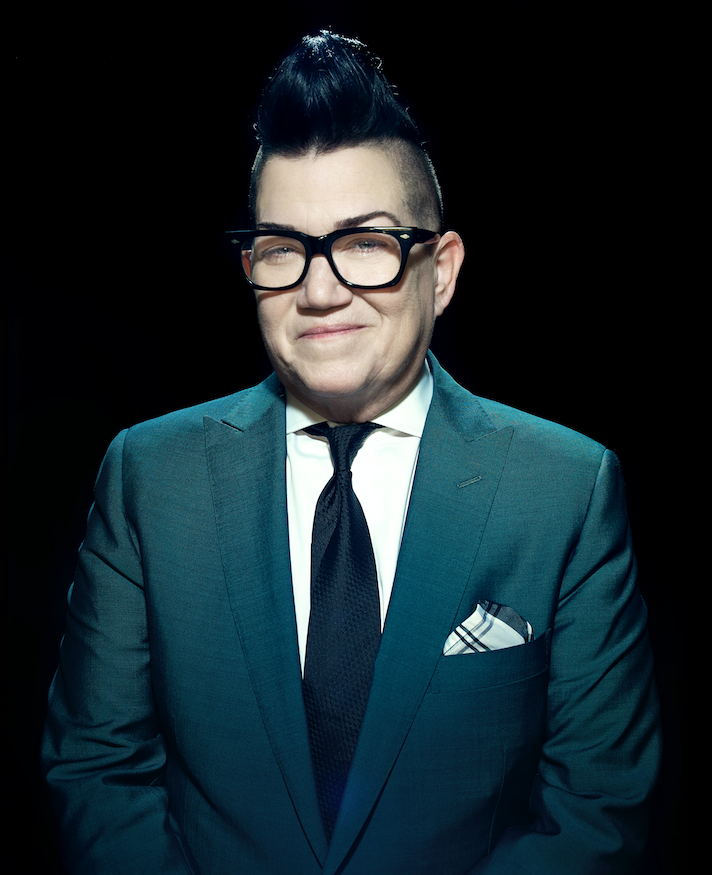
Lea DeLaria says she's "still incredibly active sexually and I've never really been monogamous."

Sex hasn’t changed for me at all. In fact, my ex-fiancée, Chelsea Fairless — we’re keeping the age-old lesbian tradition of remaining incredibly close after breaking up — said, “I think you should fuck every woman in the world because every woman in the world should have that experience at least once.” [Laughs] It was an amazing compliment. Chelsea is 26 years younger than me and not only was I keeping up with her — I was running her ragged!

I’m still incredibly active sexually and I’ve never really been monogamous — ever. In my 20s, my girlfriends always thought I was monogamous, but I wasn’t! [Laughs] I’ve always been that person. When I came out, feminism was a big part of being a lesbian and we were all lesbian feminists and feminists believe that monogamy is a tool that the patriarchy uses to enslave women. So, in order to be a good feminist, you had to fuck as many women as you could — and I was a pretty great feminist! [Laughs] I’m still out there banging away.

My comedy hasn’t changed either — because I staunchly refuse to change it. My work has always been observational and personal and political. As a result of approaching my comedy in this way, I can always talk about what’s currently going on in my life — like going through menopause, for example. To me, that’s so fucking political because nobody talks about menopause. Nobody! There are so many things about menopause — even as a feminist — that I had no fucking clue about! The way I approach that on stage is like “let me be the one to tell you this shit because apparently nobody else will.” All anyone ever talks about is how you’re going to be bitchy! So it’s funny and it’s observational and it’s from that political feminist perspective that says we need to be in control of our own bodies.

If you see me on stage at any point — whether I’m giving a concert, whether I’m speaking at a university, or whether it’s purely stand-up — you’re going to be hearing me use “fuck” as a noun, a verb and a gerund in every sentence just like I always have and you’re going to hear me screaming at the current presidential administration. That’s been my take on stand-up comedy since I started doing it when I was just 22 years old. I could never waste my time talking about something stupid like losing my fucking socks in the dryer and I can’t imagine that ever changing.

Still, getting older has meant that I’ve had to do some things differently. I love when people say “middle age” — this is not middle age. I’m in the twilight of my life, so I have to consider the things that people do at this age. And as great as my genes are, I have had some physical issues. I just had my left knee replaced four months ago. I contracted diabetes three years ago and everything related to my food intake and exercising has changed for me since then. I’ve lost almost 60 pounds because of it.

But I still stay out until 4 o’clock in the morning. I can still dance all night. That’s why the title of my concert is “This Is What 60 Looks Like, Bitches!” I think in a lot of ways — and it’s not just me, it’s everywhere — the way our culture thinks about aging is significantly different now than how it used to be. People used to think of 60 as very old. I don’t think people think that way about 60 anymore. Maybe very young people do? So I have to accept that I have to take certain medication and I need a certain amount of exercise a day — especially with my knee — but I’m still going out every night and I’m still enjoying my life. I still have that joie de vivre that I’ve always had and hopefully nothing will slow that down. I’m planning on being George Burns and living well into my 100s, all the while surrounded by gorgeous women.

I’m definitely not worrying about dying. … I came of age during the AIDS crisis. I’ve seen so much death because of it and I literally have no clue how many of my friends died from the disease. I stopped counting at 86.

Until then, I intend to commemorate every milestone I reach. I’ve always been crazy about my birthday and I celebrate it for an entire week like Hanukkah. Every day I do something different and then the week culminates with the big day and cake and everything else the best birthday party you can imagine would have. I will go out all night long, I will party with my friends, I will tell everyone I meet that it’s my birthday all day long every second of the day.

I remember when I was in the Broadway revival of “The Rocky Horror Show” and the whole cast went out every night of my birthday week. At the time, Jesse Tyler Ferguson, who is my best friend and who is joining me on stage next month for my birthday show, came out with me every single night. I’m 20 years older than him — I was in my 40s and he was in his 20s ― and he was like, “How can you do this?!” He was dying. He was just dying. So on the seventh day, at 4 o’clock in the morning, I said, “I’m having so much fun, I think I’m going to have a birthday fortnight!” And Jesse stood up and said, “I’m out! I have to get some sleep! You’re doing the second week without me!” [Laughs]

But I’ve never been worried about getting enough sleep and even though I’m approaching my last chapter, so to speak, I’m definitely not worrying about dying — at all. Every day I get closer to death and I accepted that a long time ago. I think part of that was because I came of age during the AIDS crisis. I’ve seen so much death because of it and I literally have no clue how many of my friends died from the disease. I stopped counting at 86. I was there fighting. I sang at Bobbi Campbell’s memorial. This is what we dealt with. I’ve been looking death in the face my whole life — my whole life.

Living through that time taught me to live every moment. “Now is the time” is my motto. That means to be present. Be aware. Listen. Listening is a really important tool that most of us do not use. It’s probably the most important tool that we need to survive. Listen. Be present. Believe in yourself. Love yourself. Give no fucks. Then go. That’s what I think I know now. These are the things that I learned from living through that time. Oh, and take every chance you get to celebrate your life, whether it’s your birthday — or birthday week — or just a regular Tuesday.

Lea DeLaria’s birthday show, “This Is What 60 Looks Like, Bitches!” will take place on May 23, 2018, at Sony Hall in New York City. For ticket information, head here. For more from DeLaria, including other upcoming appearances, visit her official website and follow her on Twitter and Instagram. 

Do you have a personal story you’d like to see published on HuffPost? Find out what we’re looking for here and send us a pitch!

Share Button

Health24.com | Here’s why your leg cramps while you sleep – and how to treat it

Up to 60% of adults experience the occasional nocturnal leg cramp, which can feel like a painful spasm, tightening or twinge. They develop when the nerves that carry signals to your muscles fire off too many messages at once.

This causes your muscles to contract in an uncomfortable way, says Dr Scott Garrison, director of the department of family medicine at the University of Alberta.

Read more: Make a muscle cramp vanish

Sitting or lying down for a long time – like when you’re sleeping – can trigger the nerve malfunction. That’s why you tend to get cramps in the middle of the night. And weirdly, these cramps are more common in warmer months, according to a study from Dr Garrison and his team.

It might be because you have higher levels of vitamin D in the summer, thanks to increased sun exposure. The nutrient plays a role in regulating the growth and repair of your muscle fibres, says Dr Garrison.

But more growth and repair may also send the muscle mechanism behind your cramps into overdrive, he says.

Read more: Is muscle soreness really a sign of an effective workout

Nocturnal leg cramps become more common – and painful – as you age, says Dr Garrison. After you hit 50, you start losing more of the nerve cells that send messages from your brain to your muscles. The cells that are left have to work harder, which experts speculate might cause cramping.

Fortunately, the spasms are usually harmless. But in rare cases, they can signal electrolyte imbalance or neuromuscular disorders like amyotrophic lateral sclerosis (ALS), known as Lou Gehrig’s disease.

Stretching your calves, hamstrings and quads before bed will stop cramps before they start. In fact, a 2012 study from the Netherlands found that older adults who suffered from these cramps experienced fewer, less severe spasms when they stretched their legs for three minutes prior to hitting the sack.

Read more: This is what would happen to your muscles if you stretched for 10 minutes every day

If a spasm does strike in the middle of the night, ease the pain by using the same stretches. Your usual first line of defence – hopping out of bed and walking around for a minute – will help relieve tightness, too.

This article was originally published on www.menshealth.com

Image credit: iStock

Share Button

Health24.com | This is how Viagra can help you live longer

Once you’ve had a heart attack, getting back your sex life can feel scary. But it might come with an important health benefit – especially if you use certain erectile dysfunction (ED) drugs to get there.

That’s because taking ED drugs like Viagra after a heart attack might protect your heart and cut your chances of dying prematurely, new research from Sweden suggests.

Read more: Why you shouldn’t take Viagra for ‘fun’

Researchers followed more than 43 000 men for three years who were hospitalised for a heart attack. Of these guys, 7% were prescribed meds for ED. The researchers discovered that men who were treated for ED were 40% less likely to be hospitalised for heart failure, and were 33% less likely to die of any cause during the follow up.

But then the scientists delved a little deeper into how the patients were treated for their ED, and a clearer picture emerged. It seemed that only men taking oral ED drugs called PDE5 inhibitors, such as Viagra or Cialis, had the longer-living benefit.

Men taking PDE5 inhibitors after their heart attack were 38% less likely to die during follow up than those not taking any ED medicine, or than those taking alprostadil, an injectable ED drug. In fact, there was no link between risk of early death and alprostadil use.

Read more: This breakthrough treatment is the Viagra of the future

That’s important, because otherwise, the link between premature death and ED treatment might be explained by sex itself – seeking treatment for ED might indicate a more active sex life, which could contribute to, or be a sign of, a more healthier lifestyle overall.

But the fact that the longevity benefit was seen just in guys taking PDE5 inhibitors seems to suggest that it may be something with how that specific class of drug works that’s protecting the heart. And the researchers have a few theories: PDE5 inhibitors may reduce the stiffness in your arteries, as well as allowing for more blood flow to your heart.

Read more: What to do if Viagra doesn’t work

Still, more research is needed to clarify the link, as well as to study whether having untreated ED, or an active sex life without taking ED meds, might have played a role.

In the meantime, guys who have had a heart attack can rest assured that taking ED meds like Viagra is likely a safe choice, the researchers said in a press release.

This article was originally published on  www.menshealth.com

Image credit: iStock   

Share Button

Why a faecal transplant could save your life

Patient’s lives are being saved by poo, but how far can microbial medicine go?

Share Button

Dodo’s violent death revealed

The famous Oxford Dodo died after being shot in the back of the head, according to breakthrough research by Oxford University Museum of Natural History and WMG at the University of Warwick.

Using revolutionary forensic scanning technology and world-class expertise, researchers have discovered surprising evidence that the Oxford Dodo was shot in the neck and back of the head with a shotgun.

The significant and unexpected findings, made by Professor Paul Smith, director of the Museum of Natural History, and Professor Mark Williams from WMG at the University of Warwick, only became apparent when mysterious particles were found in the specimen during scans carried out to help analyse its anatomy.

Subsequent analysis of the material and size of the particles revealed that they are lead shot pellets, typically used to hunt wildfowl during the 17th century.

The findings cast doubt on the popular theory that the Oxford Dodo is the remains of a bird kept alive in a townhouse in 17th-century London.

Held at Oxford University Museum of Natural History, the Oxford Dodo represents the most complete remains of a dodo collected as a living bird — the head and a foot — and the only surviving soft tissue anywhere in the world.

The researchers have shown that this famous specimen was shot in the back of the head and the neck, and that the shot did not penetrate its skull — which is now revealed to be very thick.

To conduct this research, the Dodo remains were securely transferred from Oxford to Professor Williams’ state-of-the-art scanning laboratory at WMG, where he used CT scanning technology and specialist 3D analysis software to analyse the bird’s skull and create a three-dimensional digital replica of it.

Professor Williams and his team gained an unprecedented level of insight to the precious dodo remains, looking inside the skull of the bird and discovering crucial information about its anatomy, as well as how it lived and died.

The Oxford Dodo originally came to the University of Oxford as part of the Tradescant Collection of specimens and artefacts compiled by father and son John Tradescant in London in the 17th century. CT scanning technology allowed researchers to see inside the famous specimen for the first time, revealing details without disturbing the remains or taking them apart.

Professor Paul Smith, Director of Oxford University Museum of Natural History, commented: “The Oxford Dodo is an important specimen for biology, and because of its connections with Lewis Carroll it is of great cultural significance too. The new findings reveal an unexpected part of history of this specimen as we thought the bird had come to the museum after being displayed as a live specimen in London.”

The researchers at WMG produced detailed scans of the dodo remains, and created a 3D model of the bird, which was analysed by the researchers at Oxford, who were able to confirm the findings.

The results of three years of collaborative research, these findings deliver ground-breaking fresh knowledge about this famous but mysterious creature that has been extinct since the mid-17th century.

Dodos were endemic to the island of Mauritius in the Indian Ocean. The first European accounts of the bird were made by Dutch explorers in 1601, after they rediscovered the island in 1598. The last living bird was sighted in 1662, and the dodo has subsequently become an icon of human-caused extinction.

Professor Mark Williams, leader of the Product Evaluation Technologies and Metrology Research group at WMG, University of Warwick, commented: “When we were first asked to scan the Dodo, we were hoping to study its anatomy and shed some new light on how it existed. In our wildest dreams, we never expected to find what we did.

“Although the results were initially shocking, it was exciting to be able to reveal such an important part of the story in the life of the world’s most famous extinct bird. It just goes to show that when you are carrying out investigative research, you never quite know what you are going to find.”

Dr Jay Warnett, Assistant Professor at WMG, commented: “At its core, the technology is the same as what is used in medical X-ray CT scanning. But because we weren’t limited by dose (because we were scanning an inanimate object rather than a person), it meant we were able to get a much higher resolution.

“Because of this higher resolution — going down to a fraction of the size of a human hair — this meant that we had a much bigger data challenge.”

Professor Mark Williams has employed the same digital forensics techniques to provide crucial evidence in over sixty major police trials, and to conduct crucial automotive research.

He has also used it to reveal long-lost details of other landmark historical and archaeological artefacts — providing answers that are only possible through using this pioneering scanning technology at WMG.

Share Button

Allied Healthcare: Home care provider seeks rescue plan

Allied Healthcare, one of the UK’s biggest providers of in-home care, blames a “challenging environment”.

Share Button

Scientists discover gene controlling genetic recombination rates

Genetics is a crapshoot. During sexual reproduction, genes from both the mother and the father mix and mingle to produce a genetic combination unique to each offspring. In most cases, the chromosomes line up properly and crossover. In some unlucky cases, however, “selfish DNA” enters the mix, causing abnormal crossovers with deletions or insertions in chromosomes, which can manifest as birth defects.

Scientists have long recognized that the exchange of genetic material by crossing over — known as recombination — is vital to natural selection. Yet some species display far more crossover than others. Why? Researchers hypothesize that crossover rates have evolved to balance the benefits of crossing over with the risks of selfish DNA.

“There’s a bit of a mystery being solved now about how certain molecular, biological, and genome phenomena have evolved in response to selfish genetic elements,” says Daven Presgraves, a dean’s professor of biology at the University of Rochester. “The role of natural selection in an ecological context is essentially a solved problem, but the role of natural selection in response to selfish genetic elements is still being worked out.”

Presgraves and PhD candidate Cara Brand recently accomplished an important milestone in learning about these evolutionary dynamics. By studying two species of fruit flies, they discovered a gene, MEI-218, that controls the rate of recombination. In a paper published in Current Biology, they explain how MEI-218 controls differences in the rate of crossing over between species and the evolutionary forces at play.

“This is the first gene I know of that anyone has shown to be responsible for the evolution of recombination rates,” Presgraves says.

The team focused on two closely related species of fruit flies — Drosophila melanogaster and its sister species, Drosophila mauritiana — because large differences have evolved in their rates of recombination: D. mauritiana does about 1.5 times more crossing over than D. melanogaster. When they compared genes in the two different species, the researchers found that the DNA sequences of MEI-218 were extraordinarily different.

“Natural selection works best when there’s a diversity of genotypes to act upon,” says Brand, the lead author of the paper. “Shuffling combinations of alleles through recombination generates the diversity upon which natural selection acts.”

Recombination is therefore important for two main reasons:

1. Imagine two chromosomes with genes A and B. On one chromosome you might have a “good” (beneficial) A allele and a “bad” (deleterious) B allele. On the other chromosome you might have the opposite; a bad A allele and a good B allele. Which chromosome would be a better? “It’s a mixed bag where one chromosome can’t necessarily outcompete the other,” Brand says. “Recombination can shuffle our allele combinations so that one chromosome can end up with the good A and B alleles together, while the other can get the bad A and B alleles together. Now when these chromosomes compete, the two good alleles will win out in future generations.”

2. We have combinations of alleles that are good in our current environment, but the environment is always changing. The good alleles that are adaptive and healthy now may not be so in the next generation. Recombination can shuffle these combinations of genes so that some will be bad and those offspring will die, but some will be good and these offspring will survive.

“Recombination is important — it’s not hard to convince anyone of that — but when we look across different species, we see that the rates of crossing over are different,” Brand says. “Why increase or decrease the recombination rate?”

There is no single ideal rate or distribution of crossovers, Brand says. Crossovers are necessary to produce viable offspring, but crossing over also has risks. Selfish DNA sequences known as transposons — repetitive genetic elements that do not seem to have benefits to their hosts — are distributed throughout the genome. Transposons are akin to viruses, but instead of injecting themselves in cells, they invade genetic material. If abnormal crossovers occur between transposons in different locations on the chromosomes, the chromosomes do not line up properly and important genes may be duplicated or deleted.

Brand and Presgraves hypothesize that the change in recombination rates between D. mauritiana and D. melanogaster may have evolved because the species have different amounts of transposons in their genomes. The D. melanogaster genome has more transposons than D. mauritiana, so D. melanogaster may therefore have evolved a lower rate of crossing over in order to avoid the higher risk of harmful crossovers between transposons.

This means, then, that the MEI-218 gene is constantly evolving to an ever-changing optimum. The evolution of MEI-218 is similar to genes involved in immunity, Presgraves says. “That should make some intuitive sense because genes involved in immunity are constantly adapting to the changing community pathogens that are challenging us all the time.”

Evolutionary biologists refer to these kinds of evolutionary dynamics as “evolutionary arms races” because, through positive natural selection, genes are chasing a constantly changing fitness optimum. “Maybe you just adapted, but a few generations from now you’re not at the optimum anymore. You have to evolve again and again and again,” Presgraves says.

The MEI-218 gene has so far only been investigated in fruit flies, but the research into recombination has applications for humans. “During meiosis at least one crossover per chromosome, in general, is required to make sure the chromosomes separate properly,” Brand says. “Either a lack of crossing over or crossing over in the wrong regions of the genome is what leads to many birth defects like Down Syndrome.”

Share Button

Cystic fibrosis: Company urged to lower cost of life-changing drug

Health ministers call on company to lower price of cystic fibrosis drug Orkambi so the NHS can afford it.

Share Button

Health24.com | Why women are opting to get their virginity restored through hymenoplasty

Hymenoplasty. It’s a thing. And it’ll set you back by around R1 500 to R2 000. Here’s the low-down on the surgery, what exactly it entails and the two main reasons women are opting to put their bits under the knife…

Read more: ‘I had sex for the first time on my wedding night – this is what happened’

What Is hymenoplasty?

Hymeoplasty is essentially medical repair of the hymen.

“The hymen has a secondary layer that is sown up to cover the torn skin,” says obstetrician and gynaecologist Dr Kim Sonntag.

As it grafts together once more, the hymen will appear intact. The procedure will take about 45 minutes and you’ll need to be put under anaesthetic. The recovery period is quite quick – about a week.

Read more: 6 things you might not understand about vaginas

Why women are doing it

In most cases, it’s for cultural or religious reasons, says Dr Natalia Novikova, a gynaecologist and endoscopic surgeon. In some cultures, having an intact hymen signifies chastity.

But hymenoplasty is also sometimes performed as part of a psychological healing process for women who’ve been raped or sexually abused.

Read more: 10 women share their favourite masturbation techniques

What you need to know

“Hymenoplasty is a relatively safe procedure that tends to carry few risks and side effects,” says Dr Novikova. As with any operation, there’s a small risk of infection and prolonged bleeding, as well as risks associated with anaesthetic. But complications from hymen repair are very rare.

Occasionally there can be over-correction, where the opening of the vagina becomes narrowed, making your next sexual encounter difficult. But this rarely causes problems in the long term.

“This procedure should only be done by a specialist with the correct experience and knowledge of the procedure,” says Dr Sonntag. “It’s still a fairly new procedure in South Africa and not offered widely. And remember: A woman’s hymen can still tear with the insertion of a tampon or during vigorous exercise.”


This article was originally published on  www.womenshealthsa.co.za

Image credit: iStock  

Share Button

Is marathon running bad for you?

Some 40,000 runners are due to take part in the London Marathon, but are those 26.2 miles doing us harm?

Share Button