Having life-saving cancer treatment at 21 would be hard enough for anyone, but Erin Lavery was told she may never be able to have children too.


Having life-saving cancer treatment at 21 would be hard enough for anyone, but Erin Lavery was told she may never be able to have children too.
An obstetrician says he treats women from Wales every other week at an abortion clinic in London.
Multiple children are feared to have been conceived using sperm and egg donors which were not the ones selected by the parents.

Scientists have identified the bacteria that help give three British artisan cheeses their distinctive flavors, and some of those microbes may also have potential benefits for human health.
Researchers in the Food Microbial Sciences Unit at the University of Reading tracked the microbial and biochemical changes that occurred as three locally made Oxfordshire cheeses matured. Their findings suggest that some of the bacteria responsible for developing each cheese’s unique character may also be useful to the people who eat them.
The study, published in ACS Food Science & Technology, focused on three varieties made by Nettlebed Creamery in Oxfordshire. These included a soft white rind cheese aged for a little more than a week, a washed rind semi-soft cheese that matures over several weeks, and a semi-hard cheese aged in hay for about nine months.
Helpful Bacteria Shape Flavor and Texture
Lead author Sabrina Longley, a PhD researcher in the Department of Food and Nutritional Sciences, said: “Good cheese is delicious, and the artisan varieties we studied are full of microbial life that could have benefits to your gut health.
“The aging process creates more complex aromas and textures through the work of an army of helpful bacteria. The matrix of fats and proteins in the cheese may also help protect the bacteria as they travel along the digestive tract, making cheese an excellent vehicle for delivery of probiotics to the gut.”
To follow how the cheeses changed over time, the researchers collected samples at multiple stages of maturation and analyzed both their bacterial communities and chemical composition.
All three cheeses contained bacteria with recognized probiotic potential, meaning they may help support populations of beneficial microbes in the gut. Streptococcus thermophilus, which is also commonly used as a yogurt starter, remained dominant in the semi-soft and harder cheeses throughout the maturation process. Lactococcus lactis was detected in all three cheeses from start to finish.
The washed rind cheese and hay-aged cheese also contained Propionibacterium freudenreichii. This bacterium produces propionic acid, a compound associated with anti-inflammatory properties, reduced cholesterol synthesis, and appetite regulation.
Cheese Rinds May Have Prebiotic Potential
Cheese lovers who enjoy eating the rind may have another reason to do so. The white mold Penicillium candidum, which forms the characteristic rind on the soft cheese studied, produces chitin, a dietary fiber that may act as a prebiotic.
Prebiotics serve as food for beneficial bacteria in the gut, potentially encouraging positive changes in the gut microbiota.
The hay aging process also appeared to have a striking effect on the harder cheese. As it matured, the diversity of bacterial species increased substantially. The fully mature cheese contained nearly four times as many bacterial species as the same cheese did earlier in the aging process.
Mature Cheese Contained Very Little Lactose
The researchers also found that lactose, the sugar in cow’s milk that some people have difficulty digesting, was almost entirely absent from all three cheeses once they had matured.
During fermentation, lactic acid bacteria broke down most of the lactose, leaving very little behind by the time the cheeses were ready to eat.
Sabrina Longley is also a cheesemaker at the independent Nettlebed Creamery in Oxfordshire, which part-funded the research. She is carrying out her PhD research part-time with support from a University of Reading regional bursary, a program designed to help people from the local area pursue research studies.
The researchers caution that more work is still needed. Further research (dietary intervention trials) will be necessary to determine how these bacterial populations behave and change within the gut microbiota after the cheeses are consumed, as well as what effects they ultimately have on the human body.
Cleaning can be an inevitable, repetitive chore that’s hard on the body and the mind. Of course, as you kind of have to do it regularly, you may as well try to make it as easy as possible. Lucky for you, we spotted a 10-in-1, versatile, lightweight steam cleaner that reviewers love for tackling stubborn messes all around their home, without needing to bend or strain. In fact, this thing makes chores so enjoyable reviewers call it a “magical contraption” that’s “like a cleaning carnival that I never want to leave.” Even better? This thing is currently on sale for under $70, the lowest price it’s been in weeks.
Advertisement

Whether you’re tackling tiles, toilets, windows, carpets, stove tops, furniture or even clothing, this versatile steamer cleaner is there to make it a whole lot easier. With over a dozen attachments, including a carpet glider, window squeegee, scraper tool, garment cloth, scrub brush and scouring pad, it’s a one-time buy you’ll keep finding new uses for.
Advertisement
The removable shaft offers 4-5 feet of extra reach, eliminating bending, reaching and straining, with a 13-foot extension cord for extra room. Or, rock with the detachable handheld steamer for cleaning tight corners, bathrooms, windows and more. However you use it, fans say the slender machine is “lightweight and portable,” and demands “minimal effort” to use — making it a great option for older folks or people with mobility limitations.
“Getting older means it’s harder to reach into that tub and scrub! Not anymore,” shopper Tessa wrote. “This has made my life so much easier. I actually use it for many things. I don’t know what I’d do without it now!” “Our family no longer has to use elbow grease to clean the shower walls and tub,” another wrote. “My dad who’s 80 years old loves to use it to clean. This is a godsend to use.”
“I have arthritis in my back and I’m 4’11 and I can’t believe how easy this made scrubbing the bath tub and how easy it made getting to top corners of the ceiling,” Jessie wrote. “It’s back on the charger as we speak so I can go for downstairs and clean the other 2 bathrooms!!”
Another shopper with self-described “physical limitations” said their floors and bathroom were never as clean as they wanted. Yet, after trying this “incredibly sturdy, and very well-made” tool, they feel better in their space. “…I can get behind the toilet with this thing! Even do the corners that are curved in my shower! The tile walls! And oh my gosh cleaning the baseboards? Wow,” they said. “Don’t waste your money trying anything different, this is the one!”
In fact, one user, who was physically unable to clean their tub writes they almost paid a professional cleaner to do it, before grabbing this tool, calling it an “affordable gamble” “I am so pleased,” they wrote. “…The higher speed was a little much for me but the normal speed started to make those deep set stains disappear. I am doing small sections at a time. But the difference between what I have done and what I need to do is amazing.”
Advertisement

With a 10-second heat-up time and an army of attachment heads, fans say this cleaner isn’t just powerful — it’s enjoyable to use. Releasing up to 248 degrees of steam for 12-15 minutes of continuous cleaning (between water tank refills), it removes the need for stinky cleaners and chemicals, allowing you to tackle messes simply with water and heat. Because it makes chores so effortless, shoppers say they actually look forward to using it.
Advertisement
“I used to dread cleaning, but with this magical contraption, it’s become strangely… dare I say it… FUN?!” shopper Scarlett wrote. “…I’ve caught myself giggling while tackling stubborn stains because, honestly, who knew cleaning could be so entertaining?”
Shoppers say it’s the type of purchase that once you use it, you’ll wonder how you ever lived without it, as it cuts home cleaning in effort but also time.
“This scrubber moves faster than a caffeinated cheetah with a turbo boost,” Scarlett said. “…I’ve even started timing myself to see if I can beat my own record. It’s like a game show, and the prize is a squeaky clean home.”
Advertisement
“I deep cleaned a whole bathroom in less than 15 minutes,” Trisha wrote. “My stove and oven looks new. My baseboards and trim look amazing! I’m still trying to find more things to scrub, I seriously love this product.”
Some love it so much, they’ve started recommending and even gifting it to their friends.
“As I get older, it’s more difficult to scrub the shower and tub, but this device made it easy and saved me from a backache later in the day,” Rebecca wrote, noting “I liked this so well, that I recommended the electric spin scrubber to my friends and family.”
Advertisement
“Getting older means it’s harder to reach into that tub and scrub! Not anymore! This has made my life so much easier. I actually use it for many things. I don’t know what i’d do without it now!” — tessa burch
“This is beyond my expectations. It is so easy to use and works so well. Hate to admitted I am a getting a little older and being on the ground scrubbing shower floors just isn’t possible. This was so quick and easy to use. Cleaned very well, even in the corners.” — Heather Frost
“Ummm where has this thing been my whole life?! I deep cleaned a whole bathroom in less than 15 minutes. My stove and oven looks new. My baseboards and trim look amazing! I’m still trying to find more things to scrub, I seriously love this product. The spinner does not stop or sputter when pressure is applied. If you’re getting older or are just over breaking your back scrubbing bathtubs and showers by hand, buy this!!” — Trisha
“Oh boy, hold on to your mop handles because this automatic scrubber brush is about to take your cleaning game on a wild ride! 🌪️ I mean, seriously, who needs a calm, leisurely cleaning session when you can have a tornado of cleanliness instead? I strapped into this cleaning rollercoaster, and boy, am I still catching my breath from the exhilarating ride! Let’s talk about zipping through cleaning tasks – this scrubber moves faster than a caffeinated cheetah with a turbo boost! I used to spend hours and hours scrubbing away at grime, but now I feel like I’ve turned into a cleaning ninja on a mission. The dirt doesn’t stand a chance! I’ve even started timing myself to see if I can beat my own record. It’s like a game show, and the prize is a squeaky clean home. But wait, there’s more! Not only does this scrubber save time, but it also transforms cleaning into a dance party. Picture this: you, me, and the scrubber, all grooving to the rhythm of sparkling floors and shining tiles. I’ve named mine Scrubby McScrubFace, and we’ve become quite the dynamic duo. It’s like we’re partners in crime, except our crime is committing germ genocide. Now, let’s get real for a second. I used to dread cleaning, but with this magical contraption, it’s become strangely… dare I say it… FUN?! It’s like a cleaning carnival that I never want to leave. I’ve caught myself giggling while tackling stubborn stains because, honestly, who knew cleaning could be so entertaining? In summary, if you’re looking for a cleaning sidekick that’s faster than a speeding bullet, more powerful than a locomotive, and able to scrub tall messes in a single pass, then this automatic scrubber brush is your hero. It’s turned my cleaning routine into a wild adventure, and I’m giving it a solid 5 stars for making cleanliness a blast. So go ahead, embrace the hurricane of awesomeness, and let the cleaning frenzy begin! 🌟🧼🎉” — Scarlett Tribo
The Real Deal: We use deal trackers and commerce experience to sift through “fake” hike-and-drop deals and other deceptive sales tactics. Products will usually be rated at least 4 stars with a minimum 15% discount. (And when there’s an exception, we’ll tell you why.)
Advertisement

A low-fat vegan diet can reduce the energy density of the foods people eat by about 30%, helping them consume fewer calories while still eating satisfying amounts of food. The approach was also associated with weight loss, even though participants were not instructed to restrict calories, according to new research published in JAMA Network Open.
In a randomized clinical trial involving adults with overweight, participants who followed an ad libitum low-fat vegan diet substantially reduced the number of calories per gram of food they consumed. Researchers found that greater reductions in energy density were tied to lower calorie intake and greater weight loss, despite the absence of any instructions to eat less.
“This helps answer a question people often have about plant-based eating: How can you lose weight without counting calories or going hungry?” said Hana Kahleova, MD, PhD, director of clinical research at the Physicians Committee for Responsible Medicine and lead author. “The answer is energy density. Plant foods are rich in water and fiber, so you can fill your plate, feel full, and still take in fewer calories.”
How the Low-Fat Vegan Diet Was Tested
The findings come from an analysis of a 16-week randomized trial involving adults with overweight. Participants were assigned either to an ad libitum low-fat vegan diet centered on fruits, vegetables, grains, and legumes, or to a control group that continued eating as usual without making any dietary changes.
Neither group was given a calorie target or told to limit how much they ate. Researchers measured each participant’s dietary energy density by comparing total daily energy intake with the total weight of food consumed, expressed as total energy (kcal per day) divided by total food weight (grams per day).
The study produced several notable findings:
Same Amount of Food, Fewer Calories
The difference came largely from changes in the types of foods participants were eating. The vegan diet removed calorie-dense animal foods including meat, dairy, and eggs while increasing consumption of foods that provide more volume for relatively few calories, particularly vegetables and legumes.
Because these plant foods generally contain fewer calories per gram, participants could continue eating generous portions while taking in less energy overall.
“This isn’t about willpower or smaller portions,” Dr. Kahleova said. “It’s about choosing foods that naturally deliver fewer calories in every bite. A 30% reduction in energy density is a substantial shift that would be very hard to achieve and sustain through portion control alone.”
Why Energy Density Can Affect Weight Loss
Energy density refers to the number of calories contained in each gram of food. Scientists have studied it for years because it can influence how much people eat and how satisfied they feel after a meal.
Controlled feeding studies have shown that reducing the energy density of meals can help people feel full while lowering the amount of energy they consume. Importantly, the physical volume of food can remain similar even when the calorie content drops.
“When the foods you eat are lower in energy density, your body’s natural appetite signals work in your favor,” Dr. Kahleova said. “You eat until you’re satisfied, and you simply end up with fewer calories. That’s a sustainable way to manage weight.”
A Different Approach to Weight Management
Weight-loss advice often emphasizes calorie restriction and smaller portions. These findings point to another possible strategy: changing the composition of the food on the plate rather than simply reducing the amount of food eaten.
Choosing more water-rich, high-fiber plant foods may help people lower their calorie intake while still eating enough to feel satisfied. That could make weight management easier for some people by reducing the sense of deprivation that can come with traditional calorie-cutting approaches.
“From a clinical standpoint, targeting energy density offers a realistic strategy for weight loss,” Dr. Kahleova said. “Instead of telling people to eat less, we can help them eat differently — and the results follow.”
The Bottom Line
The findings suggest that a low-fat vegan diet can substantially reduce dietary energy density, allowing people to consume fewer calories and lose weight without intentionally restricting their calorie intake.
“You don’t have to eat less,” Dr. Kahleova said. “You can eat more food, feel full, and still lose weight — by choosing foods that are naturally lower in energy density.”

The search for life on Mars or on icy moons such as Europa and Enceladus may capture more attention, but another major astrobiology mystery is much closer to home. Scientists are still trying to understand when the first eukaryotes appeared on Earth and how those organisms helped set the stage for complex life.
That question matters because microbial organisms dominated Earth for roughly 90 percent of the planet’s history. Reconstructing the transition from a world populated almost entirely by microbes to one filled with plants, animals, and fungi could also help scientists understand whether complex life might develop elsewhere in the universe.
From Microbes to Complex Life
Life originated on Earth more than 3.5 billion years ago, according to Ross Anderson, a paleontologist at the University of Oxford in the U.K. Cyanobacteria and oxygen-producing photosynthesis were present by at least 2.3 billion years ago, while eukaryotes had appeared by at least 1.7 billion years ago.
Algae followed at least one billion years ago and probably emerged even earlier. Animals appeared at least 570 million years ago, and possibly somewhat before that.
To reach the common ancestor shared by the plant and animal kingdoms, Anderson says researchers must look back to around 1.6 billion years ago.
Crown eukaryotes, which are among the earliest eukaryotic forms scientists are trying to trace, played a crucial role in the emergence of complex life on Earth. Anderson considers eukaryotes to represent the planet’s first complex life.
What Makes Eukaryotes Different?
Eukaryotic cells contain a nucleus that encloses their DNA. They also contain organelles, which are specialized structures inside the cell. One example is the mitochondrion, which helps provide the energy needed to support more demanding forms of life.
Eukaryotes ultimately gave rise to complex multicellular organisms and large visible life forms. Every animal, plant, and fungus around us today is eukaryotic.
Finding their earliest ancestors, however, is extremely difficult.
Organisms older than 500 million years did not yet possess shells or skeletons. Because those hard structures had not evolved, paleontologists must rely on rare environments capable of preserving fragile cells and soft tissues.
That leaves scientists with relatively little information about how life changed during an enormous span covering about 90 percent of Earth’s history.
Searching for the Transition to Multicellular Life
Anderson’s research focuses on one of the biggest transitions in biological history: how Earth changed from a planet dominated by bacteria into one inhabited by complex multicellular organisms.
Because fossils of these early multicellular organisms are difficult to find, he studies the chemistry of ancient rocks to identify the environments most likely to have preserved them.
Another major obstacle is time itself. Eukaryotic microfossils have endured billions of years of geological alteration and degradation, making already tiny remains even harder to detect.
Scientists do know that the transition from single-celled life to multicellular organisms happened more than once in different parts of the world. Anderson is particularly interested in understanding how that process eventually produced the remarkable diversity seen among animals today.
Much of the foundation for modern animal diversity appeared around the Ediacaran/Cambrian transition roughly 540 million years ago. This period marked a major evolutionary shift from predominantly soft-bodied organisms toward the Cambrian explosion, when animals with greater mobility, shells, and skeletons became increasingly prominent.
Where Scientists Search for Ancient Microfossils
Finding fossils from much earlier periods requires searching in places where delicate biological material had an unusual chance of surviving.
Anderson and his colleagues are especially interested in a roughly 100sq. km region near Svalbard, Norway. About 80 degrees North, this remote island area was once covered by a shallow sea.
Australia has also produced important evidence. Just last year, researchers there discovered some of the oldest known eukaryotic microfossils, dating to roughly 1.75 billion years ago.
Ancient coastal environments are especially promising places to search. Eukaryotes living in these settings would have had access to abundant nutrients and organic material, conditions that could have supported greater diversity and the development of multicellularity.
Researchers often target pristine locations or regions that have received relatively little scientific sampling. Anderson specializes in studying areas where enormous deposits of clay may have helped preserve ancient eukaryotic remains.
Today, many of the best places to conduct this work are deserts or Arctic landscapes. With little or no vegetation covering the ground, ancient rocks remain exposed and accessible.
Why the Fossil Hunt Is So Difficult
Even in ideal locations, finding eukaryotic microfossils is an enormous challenge. The organisms were microscopic, lacked protective hard tissues, and have been exposed to billions of years of geological degradation.
According to Anderson, one of the greatest problems is simply that the fossil record from this period remains poorly sampled.
Researchers are nevertheless making progress. Scientists are becoming better at identifying the types of rocks most likely to contain early fossils, providing new evidence that can help reconstruct the history of Earth’s earliest life.
What Earth’s Earliest Life Could Tell Us About Alien Life
The search has implications far beyond understanding Earth’s biological past.
Anderson says much of his work involving clay deposits was originally motivated by the search for life on other planets. By learning which environments preserve ancient organisms on Earth, scientists may become better equipped to recognize possible signs of life elsewhere.
Understanding how life emerged and became increasingly complex on our own planet is therefore an important part of astrobiology. If scientists want to estimate how likely life is to arise and evolve elsewhere, they first need a clearer picture of how that process unfolded here on Earth.
DNA serves as the genetic blueprint for every living organism, but it is also an extraordinarily dense way to store information. A single gram can hold about 215 million gigabytes of data. Bringing that remarkable storage capacity into electronics could lead to more efficient data centers, faster processing and systems capable of handling increasingly complex information.
The challenge has been finding a way to make biological DNA function effectively alongside electronic materials. Penn State researchers have now developed an approach designed to overcome that incompatibility.
The work, published in Advanced Functional Materials and the subject of a patent application, relies on two key components. One is synthetic DNA, made from commercially available, chemically engineered molecules arranged into short genetic sequences tailored for specific electronic requirements. The other is crystalline perovskite, a semiconductor already used in technologies including solar cells, lasers and data storage devices.
“Biology and electronics are different domains,” said Kavya S. Keremane, co-corresponding author and postdoctoral researcher in materials science and engineering at Penn State. “Bridging these two fields required developing an entirely new materials platform that allows them to function seamlessly together. By combining the information storage capabilities of DNA with the exceptional electronic properties of perovskite semiconductors, we created a bio-hybrid system that fundamentally changes how low-power memory devices can be designed.”
Building a Low Power Memory Device
Using these materials, the team created a memory resistor, known as a “memristor,” that operates with very little energy. Unlike ordinary resistors, which maintain a set resistance to electrical current in devices ranging from cell phones to space shuttles and lose their stored information when power disappears, memristors can preserve a record of previous electrical activity. They can remember the direction in which current previously flowed even after the power source is removed.
That ability allows information to be stored and processed in the same place, resembling the way neurons function in the brain. Such an arrangement could support more simultaneous and sophisticated forms of data processing. According to the researchers, however, practical commercial systems would still require enough storage capacity and electrical power to become costly and inefficient without DNA’s ability to pack enormous amounts of information into a very small space while consuming little energy.
“As the demand for artificial intelligence (AI) grows, we need a new strategy for low-power, high-storage devices,” said Bed Poudel, co-corresponding author and research professor of materials science and engineering at Penn State.
Poudel said AI and other emerging technologies are expected to depend increasingly on neuromorphic computing, which is designed to operate more like the human brain. Such systems can evaluate multiple inputs at once while making decisions informed by previous experiences and future priorities.
“Usually, it takes more power to store more information. Our device, however, consumes 100 times less power and the storage capacity is higher than traditional storage devices, like flash drives.”
Engineering DNA to Conduct Electricity
To construct the device, the researchers added silver nanoparticles to a layer of customized DNA sequences — specially designed to be of certain compositions and lengths — that was integrated with thin films of perovskite.
This technique, called “doping,” involves introducing a small amount of another material to produce specific properties. In this case, adding the silver nanoparticles allowed the DNA to conduct electricity while also helping its molecular units line up in a more orderly arrangement.
Synthetic DNA offered another important advantage over natural DNA. Unlike natural DNA — long, entangled strands that behave like wet spaghetti when handled — short and rigid pieces of synthetic DNA can be arranged with much greater precision at extremely small scales.
According to co-author Neela H. Yennawar, research professor and director of the Penn State Huck Institutes of the Life Sciences’ Biomolecular Interactions Core Facility, molecularly engineered DNA can provide structural organization, adjustable electrical conductivity and functional control that natural DNA cannot achieve when incorporated into thin films.
“We can computationally determine exactly which sequences we need and how long they should be, and then we can rationally design them with synthetic DNA,” Yennawar said. “These structures can be systematically doped with silver and other ions and engineered to interface seamlessly with perovskites — transforming DNA from a biological macromolecule into a programmable, multifunctional nanomaterials platform.”
DNA and Perovskite Work Better Together
When combined, the silver-doped DNA and perovskite formed bio-hybrid pathways that directed the flow of electrical current through the device.
The researchers found that electrons moved reliably when they applied less than 0.1 volt — for comparison, standard U.S. outlets have 120 volts — and the device responded predictably when the direction of the current was changed.
The carefully designed DNA structures, combined with the perovskite, also helped make the device unusually stable. According to the team, it continued operating consistently at temperatures approaching 250 degrees Fahrenheit and remained functional at room temperature for more than six weeks, substantially exceeding the performance standards of existing perovskite-based memory storage devices.
The researchers also reported that the new system could perform the same memory function as comparable technologies while consuming only one-tenth as much power. That level of efficiency could make the approach especially attractive for future electronics designed to handle large amounts of information with lower energy demands.
“Using just the DNA or just perovskite alone did not produce near as robust a result as the combination,” Keremane said. “It’s this combination that enables a very high memory storage density that requires very little power.”
A New Direction for Bio-Inspired Electronics
The team now plans to improve the technology further and explore additional uses for bio-inspired electronic systems.
“Nature has the solution — we just have to find it and apply it,” Poudel said. “This work of integrating DNA into electronics to do amazing things gives a glimpse into what is possible.”
In addition to Keremane, Yennawar and Poudel, other Penn State co-authors include co-corresponding author Luyao Zheng, postdoctoral research in materials science and engineering; Haodong Wu, doctoral student in materials science and engineering; Jiamao Zheng, who was a master’s student in materials science and engineering at the time of research and has since graduated from Penn State; Shashank Priya, who was a professor of materials science and engineering at the time of research; and Chiranth C. Ravi, who was a master’s student in the Huck Institutes of the Life Sciences at the time of research and has since graduated from Penn State. Abhinav Gorthy and co-corresponding author Rashmi Jha, chemical engineering and materials science, University of Minnesota, also contributed.
The U.S. National Science Foundation, the National Institutes of Health, Penn State and the University of Minnesota supported this research.

A low dose of digoxin may help people with heart failure avoid hospitalization and reduce the risk of death, according to three studies led by UMCG cardiologists Dirk Jan van Veldhuisen, Kevin Damman, and Peter van der Meer. The researchers believe the new findings could eventually influence heart failure treatment guidelines and make this inexpensive medication available to many more patients.
Heart failure is a serious and growing health problem. More than 500,000 people in the Netherlands are estimated to have the condition, and that number is expected to increase in the years ahead. In people with heart failure, the heart cannot pump blood as effectively as it should. This can lead to severe shortness of breath, fatigue, and repeated trips to the hospital.
Digoxin Could Join the ‘Fantastic Four’
Standard heart failure care currently relies on a combination of four medications, commonly known as the ‘Fantastic Four.’ Cardiologists have long investigated whether digoxin could provide additional benefits as a fifth treatment.
Three UMCG studies now provide evidence supporting that possibility. The findings were published in publications including Nature Medicine and the Journal of the American Medical Association (JAMA) and were also presented at the ESC Heart Failure Congress in Barcelona.
Heart Failure Hospitalizations Fell by 25%
One of the studies included 1,000 people with heart failure who were treated at 43 centers across the Netherlands. Half received a low dose of digoxin in addition to their usual treatment for an average of three years, while the other half received a placebo.
Among those taking digoxin, deaths from cardiovascular disease and worsening heart failure were reduced (by 19%). However, that individual result did not reach statistical significance.
The researchers then combined the findings with data from two earlier studies in a meta-analysis, creating a much larger group of patients. With the additional data, they found that digoxin produced a meaningful and statistically significant benefit, even when patients were already taking the four standard heart failure medications.
The clearest benefit was a reduction in hospital admissions for heart failure, which fell by an average of 25%. Low-dose digoxin was also found to be safe and relatively easy to use.
Problems Increased After Digoxin Was Stopped
A third study followed approximately 600 of the original 1,000 participants who had been assigned either digoxin or placebo.
Researchers found that people who had been taking digoxin and then had to stop experienced significantly more problems during the first six weeks compared with people who had never taken the drug. Among 288 patients, 14 were hospitalized or died.
According to the researchers, this finding does not directly prove that digoxin is effective. Still, they considered the size and timing of the effect both impressive and surprising.
A Heart Failure Drug That Costs Less Than Ten Cents a Day
The researchers believe the results of the three studies could eventually lead to changes in heart failure guidelines, potentially allowing many more patients to receive digoxin.
Its low price makes the findings especially notable. Digoxin has been used in medicine for centuries and costs less than ten cents per day. By comparison, many newer heart failure medications cost several euros each day.
Why a Low Dose of Digoxin Matters
Digoxin (digitalis) is the oldest and least expensive medicine used to treat heart failure. At a low dose, the drug primarily works by reducing several harmful compensatory responses that occur when the heart is struggling. For example, digoxin suppresses stress hormones (such as adrenaline) in the blood, which can benefit the heart.
Higher doses of digoxin were commonly prescribed in the past. Those doses caused heart muscle cells to contract more strongly, but that effect ultimately proved less helpful. For a weakened heart muscle, reducing strain is preferable to forcing it to work harder.
During the past 25 to 30 years, several effective new treatments for heart failure have become available. As a result, digoxin use has steadily declined, and only about 15 percent of heart failure patients now receive it.
Earlier research had already suggested that patients given low doses of digoxin did considerably better than those receiving higher doses. Until the new UMCG research, however, randomized, prospective studies had not directly investigated and confirmed this effect.
Funding Made the Digoxin Studies Possible
Research involving older and inexpensive medications can be difficult to fund, even when those drugs have the potential to improve patient care while lowering costs.
Hartstichting therefore provided 3 million euros for this research through its collaboration with ZonMw as part of the Good Use of Medicines program.
New findings from the STAR detector at the Relativistic Heavy Ion Collider (RHIC) are challenging a familiar picture of what gives protons one of their defining quantum properties. The results suggest that gluons, the particles that act as the glue holding quarks together, may play a key role in carrying and conserving baryon number.
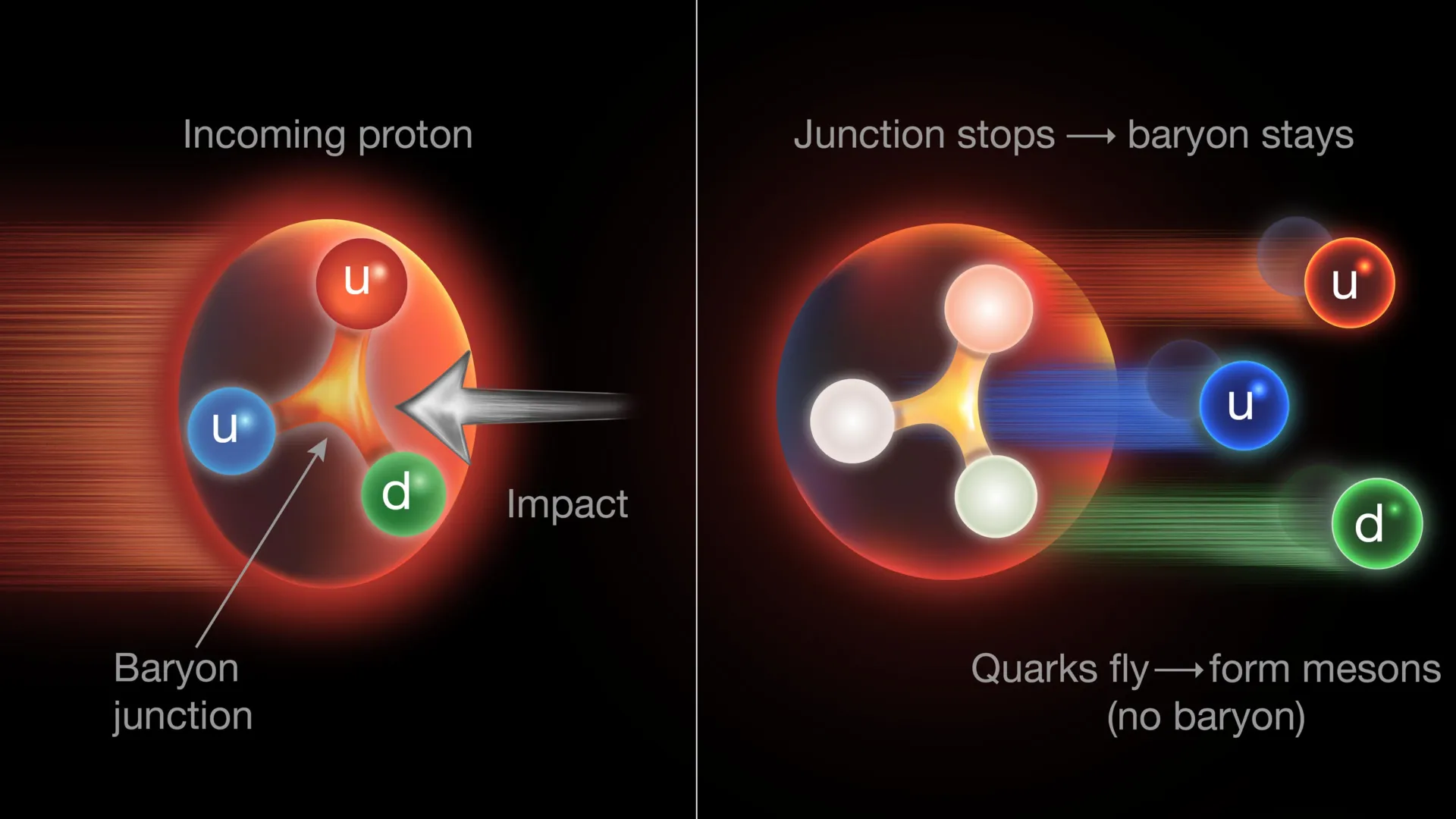
The evidence comes from high-energy particle collisions at RHIC, a U.S. Department of Energy (DOE) Office of Science user facility for nuclear physics research that operated at DOE’s Brookhaven National Laboratory from 2000 to early 2026. According to the new study, published in Science, baryon number may be associated with a Y-shaped “junction” of gluons connecting the proton’s three main quarks. If confirmed, that would challenge the long-standing assumption that baryon number belongs exclusively to those quarks.
“Traditionally, scientists have assumed that each of the three main ‘valence’ quarks inside a proton or neutron carries one-third of the baryon number,” said Zhangbu Xu, a professor at Kent State University with a joint appointment at Brookhaven Lab.
A Decades-Old Idea About Gluons
Physicists first proposed the baryon junction, also called a gluon junction, in the 1970s as a way to describe how gluons connect the valence quarks inside a proton. In 1996, four years before RHIC began operating, Dmitri Kharzeev, a theoretical physicist at Stony Brook University and Brookhaven Lab, proposed that this junction might do something even more fundamental. Rather than the valence quarks carrying baryon number, the junction itself could be responsible.
The STAR collaboration has now developed a way to test that possibility using several types of collisions produced at RHIC.
“Using data collected from different types of particle collisions at RHIC, our results suggest that the baryon number is not simply carried by individual quarks,” Xu added. “Our findings strongly support the idea that baryon number is more favorably carried and transported by gluons, the particles that hold quarks together, when arranged in this special configuration.”
Why Baryon Number Matters
Determining what actually carries baryon number matters far beyond the internal structure of a proton. In RHIC collisions, conservation of baryon number means that the total number of baryons, three-quark particles such as protons and neutrons, must remain unchanged before and after the collision. The same conservation principle also applies on the scale of the universe.
“Since the Big Bang, the number of protons and neutrons all together never changes as a function of time,” said Nicole Lewis, a STAR physicist at Rice University who started this project as a postdoc at Brookhaven Lab in 2020. “The reasons for this conservation are not well understood. It’s one of the mysteries of the universe, related to why we have more matter than antimatter,” she said.
Baryon number conservation also has a much more tangible consequence. It helps explain the extraordinary stability of protons, which form a central part of atomic nuclei and do not appear to decay under ordinary circumstances.
“It’s believed that the lifetime of a proton is longer than the lifespan of the universe,” Lewis said. “This allows atomic nuclei to form and be stable — which means matter, as we interact with it in the universe, can exist.”
A More Complicated Proton
The possibility that gluons carry baryon number would overturn the standard simplified description found in many textbooks. In that picture, a proton has a baryon number of plus one, divided equally among its three main valence quarks. Each quark therefore carries plus one third of the baryon number, much as the proton’s electric charge is distributed among its three valence quarks.
But real protons are much more complicated than that simplified model suggests.
“In the naïve quark model, there are three quarks inside a proton, but nothing else,” said Tommy Tsang, formerly a postdoc at Kent State University, now at DOE’s Argonne National Laboratory. “But if we look at details inside, there are not only three quarks but also a lot of gluons interacting, connecting between those quarks, and there are also quarks and antiquarks that pop up from the vacuum, so it’s actually a really complex object.”
Quantum chromodynamics (QCD), the theory used to describe these interactions, has been highly successful in explaining the strong force that acts among quarks and gluons. Even so, models inspired by QCD often need additional assumptions to reproduce some of the particle patterns observed when RHIC smashes nuclei together at nearly the speed of light.
An Unexpected Excess of Baryons
One observation in particular caught the STAR team’s attention. The detector repeatedly records more baryons than antibaryons emerging sideways from the collisions, perpendicular to the direction of the incoming beams.
“In the STAR detector, we consistently see an excess of baryons coming out of the collisions perpendicular to the direction of the colliding beams,” Tsang said. “The fact that we end up with more baryons than antibaryons — or more matter than antimatter — is not surprising since our collisions start with matter,” he said.
These extremely energetic collisions convert tremendous amounts of energy into thousands of newly created particles. What puzzled the researchers was not simply that more baryons than antibaryons were produced. It was where the excess baryons appeared.
If valence quarks alone carried the baryon number, explaining the excess away from the beamline would require all three valence quarks from one colliding proton to stop near the center of the detector. They would then have to undergo a conversion from matter into energy and back into matter, producing new baryons that move outward perpendicular to the beam.
The STAR researchers suspected there might be another explanation.
Electric Charge Provides a Test
The team found a way to investigate the mystery by taking advantage of another property of valence quarks: electric charge. Scientists compared the net baryon number measured in different RHIC nuclear collisions with the way electric charge was redistributed in those same events.
“Measuring the electric charge coming out perpendicular to the collision gives you a definitive way of measuring how many quarks are stopped and transformed into new particles,” said Zebo Tang, a professor at the University of Science and Technology of China who led a group of students performing data analyses and model simulations.
The comparison revealed a striking mismatch. Researchers observed roughly twice as many baryons as should have been produced based on the electric charge associated with stopped quarks.
According to models based on QCD, that means too few quarks were being stopped to account for all the baryons appearing in the detector.
That left an important question: What was carrying the extra baryon number?
The STAR physicists argue that gluons offer a possible answer, specifically the three-pronged gluon junction that connects the proton’s valence quarks.
How the Gluon Junction Could Carry Baryon Number
The proposed mechanism depends on what happens when protons inside colliding nuclei reach enormous energies. According to the STAR team, the “gluon junction” or “baryon junction” that links the quarks may be much easier to stop in a collision than the three quarks themselves.
If the junction is stopped, its energy can be converted into newly produced baryons that travel outward in directions perpendicular to the beams. Meanwhile, the valence quarks that were previously connected by the junction can continue moving forward along the beampipe.
Understanding why requires looking at the changing internal structure of a proton as its energy increases.
“The baryon junction is always there even as protons are accelerated to higher and higher energy,” Prithwish Tribedy, a STAR physicist at Brookhaven Lab. “But at high energy, gluons within the proton split and multiply.”
As the number of gluons increases, the proton’s momentum becomes spread among more of them. Each individual gluon, including those forming the junction, therefore carries a smaller portion of the proton’s total momentum. The valence quarks, however, continue to carry much of the proton’s forward motion.
As a result, when the collision occurs, the comparatively slower three-pronged gluon junction should be easier to stop and convert into new particles than the rapidly moving quarks.
Stopping one connected structure is also simpler than stopping three separate quarks, making such an interaction more likely, according to Tribedy.
“In the collision, the baryon junction gets held behind, and the quarks continue on,” he noted.
Building New Particles After the Collision
Quarks and gluons cannot remain isolated, so after the collision they quickly combine with other particles.
In a simplified example, a quark continuing down the beampipe could join with an antiquark and form a two-quark particle called a meson. At the same time, the three-pronged gluon junction could behave somewhat like a Y-shaped magnet, drawing in three newly created quarks from the vacuum and producing a new baryon.
Actual RHIC collisions are considerably more violent and complex.
“Even though we start with nuclei that contain roughly 100 protons and 100 neutrons, these collisions create thousands of new particles; 99% of the energy is transformed into new particles,” said Rongrong Ma, a Brookhaven Lab physicist.
The STAR team found that collisions producing larger numbers of particles also showed a greater excess of “midrapidity” baryons compared with predictions based on the simpler picture in which quarks alone carry baryon number.
The fact that so many of these baryons emerge perpendicular to the beamline provides strong evidence, according to the researchers, that the baryon junction exists and plays an important role in transporting baryon number.
Rethinking a Fundamental Property of Matter
The results suggest that one of the proton’s defining quantum properties may not reside solely in its three valence quarks. Instead, the gluon structure connecting those quarks could be central to how baryon number is carried through energetic collisions.
“Our research challenges the long-held idea that baryon number is simply divided among and carried by the three quarks,” said Ma. “This new understanding reshapes how we think about the structure of matter and deepens our knowledge of the most fundamental element that is responsible for the universe in its current form.”
The research was supported by the DOE Office of Science, the U.S. National Science Foundation (NSF), and numerous international agencies and organizations listed in the scientific paper. Researchers also used the Open Science Grid, which is supported directly by NSF, along with computing resources at Brookhaven Lab’s Scientific Data and Computing Facilities and the National Energy Research Scientific Computing Center (NERSC), another DOE Office of Science user facility located at DOE’s Lawrence Berkeley National Laboratory.
