World’s first successful embryo transfer in rhinos paves the way for saving the northern white rhinos from extinction

BioRescue, an international consortium of scientists and conservationists, succeeded in achieving the world’s first pregnancy of a rhinoceros after an embryo transfer. The southern white rhino embryo was produced in vitro from collected egg cells and sperm and transferred into a southern white rhino surrogate mother at the Ol Pejeta Conservancy in Kenya on September 24, 2023. The BioRescue team confirmed a pregnancy of 70 days with a well-developed 6.4 cm long male embryo. The successful embryo transfer and pregnancy are a proof of concept and allow to now safely move to the transfer of northern white rhino embryos — a cornerstone in the mission to save the northern white rhino from extinction.

On September 24, 2023, the BioRescue scientists and veterinarians, led by the Leibniz Institute for Zoo and Wildlife Research (Leibniz-IZW), transferred two southern white rhino embryos into Curra, a southern white rhinoceros, selected as a surrogate mother at the Ol Pejeta Conservancy in Kenya. The oocytes used in producing the embryos were retrieved from Elenore, a southern white rhinoceros living in the Pairi Daiza Zoo in Belgium. The sperm used for fertilisation originated from the male Athos from the Zoo Salzburg in Hellbrunn, Austria. The oocytes from Elenore were fertilised in vitro by intracytoplasmic sperm injection (ICSI) and developed into blastoscysts at Avantea’s laboratories in Cremona, Italy. For the embryo transfer in Kenya, the BioRescue scientists transferred two embryos to increase the chance of a successful outcome.

So far, the BioRescue team has performed 13 embryo transfers in rhinoceroses, three in Kenya and ten in Europe. Previously, an embryo transfer, which is a widely used technique in domestic species, has never been attempted in rhinos. BioRescue scientists developed the necessary techniques, by building on decades of their own research.

Currently, there are only two northern white rhinos left in the world: The female Najin and her daughter Fatu. Additionally, living cells from 12 different northern white rhino individuals are stored in liquid nitrogen. The last two females currently live in Kenya, at Ol Pejeta Conservancy, where they are guarded and cared for day and night. Since 2019, the BioRescue conservation science programme produced and cryopreserved 30 northern white rhino embryos. These are currently stored in liquid nitrogen at minus 196 degrees Celsius in Berlin, Germany, and Cremona, Italy, awaiting embryo transfer into southern white rhino surrogate mothers. The successful transfer of a southern white rhino embryo is a proof of concept that allows to take this crucial step — an embryo transfer with a northern white rhino embryo — for the first time.

The embryo transfer in this subspecies is entirely new ground as a veterinary and scientific procedure, and all protocols, methods and pieces of equipment had to be newly developed from scratch. As it is the established routine with all BioRescue procedures, the embryo transfers are accompanied by an ethical assessment conducted by Padua University. This was also the case in September, when all participants of the embryo transfer filled out a questionnaire that proposed any possible scenarios during the procedure, and attendant risks to animals and participants.

The vasectomised, sterile teaser bull Ouwan mated with Curra on September 17 and 18, signalling the ideal timing for the embryo transfer, which took place on September 24. After the procedure until November 2023, Curra was monitored on a daily basis in the enclosure at the Ol Pejeta Conservancy. During this period, Ouwan showed no further interest in Curra, a first sign of a successful embryo transfer resulting in pregnancy. The BioRescue team was scheduled for November 28 to perform a pregnancy check in Curra, but the teaser bull Ouwan was found dead on November 22 and Curra was found dead on November 25. Apparently, extremely heavy rains led to a flooding of the surrogate enclosure and set free dormant clostridianbacteria spores. The dissection of the animals revealed a severe systemic infection by a clostridian bacterial strain and resultant intoxication by the bacterial toxin. It also revealed that Curra was pregnant with a 70 days old male fetus that was 6.4 cm long. Tissue samples of the fetus were collected and transported to the Max Delbrück Centre for Molecular Medicine and the Leibniz-IZW in Berlin, Germany. In January 2024, it was confirmed through the analysis of the fetus DNA that the pregnancy resulted from the embryo transfer.

When the BioRescue team arrived in Kenya on November 28, the preliminary results indicated an intoxication with the clostridian bacterial strains Paraclostridium bifermentans and Paenicolostridium sordellii. Immediately after the incident, the BioRescue team, including Kenya Wildlife Service, Wildlife Training Research Institute, Ol Pejeta Conservancy and Safari Park Dvur Králové formed a crisis team on site and established fast and effective measures to protect all current semi-captive rhinos including the last two northern white rhinos Najin and Fatu. The measures included a vaccination programme, quarantine of affected areas and fencing of new emergency enclosures.

The next steps in the BioRescue research programme included the selection and preparation of a new teaser bull. The bull will allow the scientists to know when a possible surrogate female is ready to receive an embryo implantation. The team also has to select the next surrogate mothers. After these steps, which will take several months, an embryo transfer with a northern white rhino embryo will be attempted.

The BioRescue research programme is supported by the German Federal Ministry of Education and Research (BMBF) over a time-period of six years with up to around 6 million Euros.

Thomas Hildebrandt, BioRescue project head, Leibniz-IZW said, “The embryo transfer technique is well established for humans and for domesticated animals such as horses or cows. But for rhinos, it has been completely uncharted territory and anything from the approach over procedure protocols to required equipment had to be invented, developed, tried and tested to be safe for use. Together with the team and many professional partners, I developed the devices that can actually find and access the required location where to insert the tiny embryo into a 2-ton animal. It took many years to get it right and we are overwhelmed that we now have proof that this technique works perfectly. It is bitter that this milestone is confirmed under such tragic circumstances with the death of the surrogate Curra and her unborn calf, but I am certain that this proof of concept is a turn of the tide for the survival of the northern white rhino and the health of Central-African ecosystems. It comes just in time to achieve a pregnancy for northern white rhinos: we want the offspring to live together with Najin and Fatu for years to learn the social behaviour of its kind. Although embryos can be stored in liquid nitrogen for a very long time, we are in a rush to bring a northern white rhino baby to the ground — with this proof of concept it can become a reality in two to three years. BioRescue is only so successful because we were capable to form such a great team called the BioRescue Consortium. Most likely this is one of the significant differences to other challenging conservation approaches.”


Share Button

Shining a light on the hidden properties of quantum materials

Certain materials have desirable properties that are hidden, and just as you would use a flashlight to see in the dark, scientists can use light to uncover these properties.

Researchers at the University of California San Diego have used an advanced optical technique to learn more about a quantum material called Ta2NiSe5 (TNS). Their work appears in Nature Materials.

Materials can be perturbed through different external stimuli, often with changes in temperature or pressure; however, because light is the fastest thing in the universe, materials will respond very quickly to optical stimuli, revealing properties that would otherwise remain hidden.

“In essence, we shine a laser on a material and it’s like stop-action photography where we can incrementally follow a certain property of that material,” said Professor of Physics Richard Averitt, who led the research and is one of the paper’s authors. “By looking at how constituent particles move around in that system, we can tease out these properties that are really tricky to find otherwise.”

The experiment was conducted by lead author Sheikh Rubaiat Ul Haque, who graduated from UC San Diego in 2023 and is now a postdoctoral scholar at Stanford University. He, along with Yuan Zhang, another graduate student in Averitt’s lab, improved upon a technique called terahertz time-domain spectroscopy. This technique allows scientists to measure a material’s properties over a range of frequencies, and Haque’s improvements allowed them access to a broader range of frequencies.

The work was based on a theory created by another of the paper’s authors, Eugene Demler, a professor at ETH Zürich. Demler and his graduate student Marios Michael developed the idea that when certain quantum materials are excited by light, they may turn into a medium that amplifies terahertz frequency light. This led Haque and colleagues to look closely into the optical properties of TNS.

When an electron is excited to a higher level by a photon, it leaves behind a hole. If the electron and hole are bound, an exciton is created. Excitons may also form a condensate — a state that occurs when particles come together and behave as a single entity.

Haque’s technique, backed by Demler’s theory and using density functional calculations by Angel Rubio’s group at Max Planck Institute for the Structure and Dynamics of Matter, the team was able to observe anomalous terahertz light amplification, which uncovered some of the hidden properties of the TNS exciton condensate.

Condensates are a well-defined quantum state and using this spectroscopic technique could allow some of their quantum properties to be imprinted onto light. This may have implications in the emerging field of entangled light sources (where multiple light sources have interconnected properties) utilizing quantum materials.

“I think it’s a wide-open area,” stated Haque. “Demler’s theory can be applied to a suite of other materials with nonlinear optical properties. With this technique, we can discover new light-induced phenomena that haven’t been explored before.”

Funding provided by the DARPA DRINQS Program (D18AC00014), the Swiss National Science Foundation (200021_212899), Army Research Office (W911NF-21-1-0184), the European Research Council (ERC-2015-AdG694097), the Cluster of Excellence ‘Advanced Imaging of Matter’ (AIM), Grupos Consolidados (IT1249-19), Deutsche Forschungsgemeinschaft (170620586), and the Flatiron Institute.

Share Button

New research challenges hunter-gatherer narrative

The oft-used description of early humans as “hunter-gatherers” should be changed to “gatherer-hunters,” at least in the Andes of South America, according to groundbreaking research led by a University of Wyoming archaeologist.

Archaeologists long thought that early human diets were meat based. However, Assistant Professor Randy Haas’ analysis of the remains of 24 individuals from the Wilamaya Patjxa and Soro Mik’aya Patjxa burial sites in Peru shows that early human diets in the Andes Mountains were composed of 80 percent plant matter and 20 percent meat.

The study, titled “Stable isotope chemistry reveals plant-dominant diet among early foragers on the Andean Altiplano,” has been published by the peer-reviewed journal PLOS ONE. It applies methods in isotope chemistry and statistical modeling to unveil a surprising twist in early Andean societies and traditional hunter-gatherer narratives.

“Conventional wisdom holds that early human economies focused on hunting — an idea that has led to a number of high-protein dietary fads such as the Paleodiet,” Haas says. “Our analysis shows that the diets were composed of 80 percent plant matter and 20 percent meat.”

For these early humans of the Andes, spanning from 9,000 to 6,500 years ago, there is indeed evidence that hunting of large mammals provided some of their diets. But the new analysis of the isotopic composition of the human bones shows that plant foods made up the majority of individual diets, with meat playing a secondary role.

Additionally, burnt plant remains from the sites and distinct dental-wear patterns on the individuals’ upper incisors indicate that tubers — or plants that grow underground, such as potatoes — likely were the most prominent subsistence resource.

“Our combination of isotope chemistry, paleoethnobotanical and zooarchaeological methods offers the clearest and most accurate picture of early Andean diets to date,” Haas says. “These findings update our understanding of earliest forager economies and the pathway to agricultural economies in the Andean highlands.”

Joining Haas in the study were researchers from Penn State University, the University of California-Merced, the University of California-Davis, Binghamton University, the University of Arizona and the National Register of Peruvian Archaeologists.

Undergraduate students also had the opportunity to conduct research during the initial 2018 excavations at the Wilamaya Patjxa burial site.

Currently a Ph.D. student in anthropology at Penn State University, Jennifer Chen, the journal article’s lead author and a former undergraduate student in Haas’ research lab, performed the isotope lab work and much of the isotope analysis following the excavations.

“Food is incredibly important and crucial for survival, especially in high-altitude environments like the Andes,” Chen says. “A lot of archaeological frameworks on hunter-gatherers, or foragers, center on hunting and meat-heavy diets — but we are finding that early hunter-gatherers in the Andes were mostly eating plant foods like wild tubers.”

Haas notes that archaeologists now have the tools to understand early human diets, and their results are not what they anticipated. This case study demonstrates for the first time that early human economies, in at least one part of the world, were plant based.

“Given that archaeological biases have long misled archaeologists — myself included — in the Andes, it is likely that future isotopic research in other parts of the world will similarly show that archaeologists have also gotten it wrong elsewhere,” he says.

Haas investigates human behavior in forager societies of the past to better understand human behavior in the present. He leads archaeological excavations and survey projects in the Andes and mountain regions of western North America.

Share Button

Study in mice uncovers new protective benefit of breast milk

An immune component of breast milk known as the complement system shapes the gut environment of infant mice in ways that make them less susceptible to certain disease-causing bacteria, according to a study led by researchers at the Johns Hopkins Bloomberg School of Public Health.

The researchers found that mouse pups that nursed from lactating mice whose breast milk lacked a key complement protein had different gut microbe populations than pups that nursed on standard mouse breast milk, making them highly vulnerable to Citrobacter rodentium, a bacterium that infects the guts of mice. Citrobacter rodentium is similar to certain types of diarrhea-causing E. coli that can infect humans but not mice.

The researchers’ experiments suggest that mouse breast milk’s complement components boost mouse infant health by directly eliminating some types of gut-dwelling bacteria. This reshaping of the gut microbiota leaves the infant mice far less susceptible to Citrobacter rodentium infection, thus protecting the young from certain infectious threats. The reshaping activity is not dependent on antibodies, in contrast to the way complement components are thought to typically work.

The researchers also confirmed in separate in vitro analyses that human breast milk contains these complement components, which demonstrated similar activity in targeting specific bacteria.

Taken together, these findings shed light on the mechanisms of how breast milk functions to provide protection from certain bacterial infections.

The study was published online January 18 in the journal Cell.

“These findings reveal a critical role for breast milk complement proteins in shaping offspring’s gut microbe compositions and protecting against bacterial infection in the gut in early life,” says study senior author Fengyi Wan, PhD, a professor in the Bloomberg School’s Department of Biochemistry and Molecular Biology. “This represents an important expansion of our understanding of breast milk’s protective mechanisms.”

The study’s first author is Dongqing Xu, PhD, an assistant scientist in Wan’s research group.

Breastfeeding has many known and suspected benefits. It provides excellent nutrition to infants and appears to protect against some short-term or long-term illnesses. Breast milk is also known to help protect against common infections by sharing antibodies and white blood cells from the mother.

Breast milk also contains complement proteins that can work with, or “complement,” antibodies in attacking bacteria. While complement proteins that circulate in the blood have been the focus of much research, complement proteins in breast milk have been far less studied, and until now their role has been unclear.

In the new study, Wan and his team used engineered mice that lacked critical complement genes. They found that milk from female mice of this type left several-weeks-old mouse pups — even those with normal complement genes — highly susceptible to colitis, often lethal, from Citrobacter rodentium infections. By contrast, pups feeding on normal, complement-containing milk showed only minor and transient signs of gut infection.

The team discovered that this protective effect of breast milk complement proteins depends on their capacity in shaping infant gut microbiota. The complement proteins kill certain gut bacterial species, and this culling of microbes creates an overall gut environment in which harmful inflammation is much less likely in the presence of Citrobacter rodentium.

“Gut microbiota is of great importance to health,” says Wan. “Breast milk complement proteins contribute crucially to the establishment of a ‘protective’ gut microbiota during the early stages of development, promoting infant health and defending against pathogens.”

The study also appears to mark an advance in basic immunology. Complement proteins in blood, although known to be capable of causing direct damage to bacterial cells, have been thought to typically work in partnership with antibodies in a specific immune response. However, Wan and his team showed that this breast milk complement activity against bacteria does not require antibodies and is a nonspecific immune response.

“This opens the door to a lot of new investigations, for example, elucidating the specific complement biology in breast milk and comparing that to complement biology in the blood, and assessing the role of complement beyond the antibody-dependent specific immune system,” Wan says.

Support for the research was provided by the National Institutes of Health (GM111682, AI137719, CA244350); the U.S. Department of Defense (W81XWH-19-1-0479); the American Association of Immunologists; and the American Heart Association (19PRE34380234).

Share Button

Microplastics may be accumulating rapidly in endangered Galápagos penguins’ food web

Microplastics, with a size from 1 micron to 5 millimeters, are pervasive pollutants that have been found in all parts of the global ocean, and have made their way into the marine food webs. Researchers, led by University of British Columbia UBC’s Institute for the Oceans and Fisheries scientists and Ecuadorian researchers from Galápagos and the ESPOL Polytechnic School (Guayaquil, Ecuador), looked closely at how microplastic bioaccumulation was affecting the endangered Galápagos penguin (Spheniscus mendiculus) as an indicator species to trace how deeply microplastic bioaccumulation has entered the food web in the isolated Galápagos Islands.

An analysis of seawater collected around Santa Cruz Island, a human-populated island, with nearby Galápagos penguin colonies revealed plastic particles. Using models that focused on the Galápagos penguin diet (barracuda, sardine, herring, salema, and anchovy), and on penguin scat, researchers intuited a unique Galapagos penguin food web model using Ecopath and Ecosim (EwE) ecosystem modeling with the Ecotracer approach to track the bioaccumulation potential of microplastics in the penguins’ foodweb. They also applied a wider model for Bolivar Channel Ecosystem (between Fernandina and Isabela islands) and part of the penguin’s habitats, located at the western regions of the Galápagos Islands.

The model predictions showed a rapid increase in microplastic accumulation and contamination across the penguins’ prey organisms resulting in Galápagos penguin showing the highest level of microplastics per biomass, followed by barracuda, anchovy, sardine, herring, and salema and predatory zooplankton.

“The model predictions highlight the accumulation behavior and residence time of microplastics in the gut,” said Karly McMullen, first author and a former MSc student at the Institute for the Oceans and Fisheries at the University of British Columbia. “With microplastics emerging as a prominent ocean pollutant, entering the environment every day, there is a growing concern for marine fauna and coastal wildlife, particularly if this anthropogenic threat is reaching even the most remote and protected areas such as the Galápagos Archipelago.”

Senior autho, honorary research associate, and Principal Investigator of the Ocean Pollution Research Unit at Institute for the Oceans and Fisheries at the University of British Columbia, Dr. Juan Jose Alava, agreed. “The goal of this food web bioaccumulation modeling work was to provide science and data to support risk management of hazardous plastic waste, reduce microplastic emissions in the oceans and marine remote UNESCO Heritage sites such as the Galapagos Islands, and inform local and international marine policy to conserve endangered, endemic seabird species of Galapagos Marine Reserve.”

“It is imperative that we prioritizing efforts to reduce the input of microplastics into vulnerable ecosystems and food webs, particularly such as that of the endangered Galapagos penguin.”

Share Button

Ambulances delays lead Wilmslow GPs to drive patient to A&E

Two Wilmslow doctors say the NHS is “broken” after they had to drive a patient to A&E themselves.

Share Button

Child obesity in pandemic could have lifelong effects, study says

Researchers say children who gained weight in the pandemic could develop diseases later in life.

Share Button

Women Over 50 Reveal The Most Toxic Beauty Trends From Back In The Day

They say trends are cyclical, but when it comes to beauty and makeup fads, some really need to be put to bed. Supersized Flock of Seagulls-esque hair and skinny eyebrows? They can go, though Gen Z seems dead set on reviving the latter, for reasons we don’t fully understand.

And we definitely need to say goodbye to tanning beds, given what we know about skin cancer.

In the spirit of letting go of legitimately bad trends, we asked ladies over 50 to share the style and beauty trends they’re glad no longer exist (or at least seem to be on the way out.) See what they had to say below.

1. Using orange juice cans as hair rollers

“In the days before blow dryers and round brushes, we made our own beauty products! We would slather our hair with Dippity-Do and roll it on repurposed frozen orange juice cans. Have you ever slept on metal rollers? There are two possible positions: face down, or with your head hanging over the side of the bed. I would take the rollers out in the early morning hours, smooth my hair down and lie on my back trying not to move, then try to sleep.” ― Jennifer Ebelhar, a 69-year-old style coach and @theStyleEquation on TikTok

2. The oil-and-foil approach to tanning

“Oil and foil is the first beauty trend I’m thrilled is gone. If you’re too young to know, this is how we used to get a tan back in the ’60s: You’d oil up your skin and put foil nearby to reflect the sun. Yes, it’s nuts.” ― Sonia Lovett, a 71-year-old who runs the fashion blog Style Beyond Age

“We used to slather baby oil all over our body when we were younger. In fact, when I was in college at UCLA, we had a tanning competition, where we would put a small sticker on our body as a baseline for comparison and then slather on the baby oil and bake all day. I nearly won the dubious event and had my damaged skin as the prize! And we’d never wear sunscreen. I was one of the few people I knew who wore 15 SPF and people thought I was nuts.” ― Cynthia Gouw, a 60-year-old broadcast journalist and beauty influencer

"We had a tanning competition, where we would put a small sticker on our body as a baseline for comparison and then slather on the baby oil and bake all day," said Cynthia Gouw, a 60-year-old broadcast journalist and a beauty influencer.

Romano Cagnoni/RETIRED via Getty Images

“We had a tanning competition, where we would put a small sticker on our body as a baseline for comparison and then slather on the baby oil and bake all day,” said Cynthia Gouw, a 60-year-old broadcast journalist and a beauty influencer.

3. Overplucking eyebrows

“Please don’t wax or pluck them yourself like I did. Like countless others, they just never grew back! In the ’90s, extremely thin and arched eyebrows were considered fashionable, and many women, myself included, resorted to excessive tweezing or waxing to achieve this look.

“I have resorted to buying so many eyebrow pencils, gels, powders, not to mention the huge amount of money I have spent on microblading, micro-feathering and any new eyebrow products I see on Instagram. I have learnt how to fill and fluff them to the best of my ability and they look OK, but if I could tell the younger me anything, it would be, ‘Leave them alone!’” ― Violet Trikilis, a model and style influencer

4. Asymmetrical hairstyles with bleached bangs

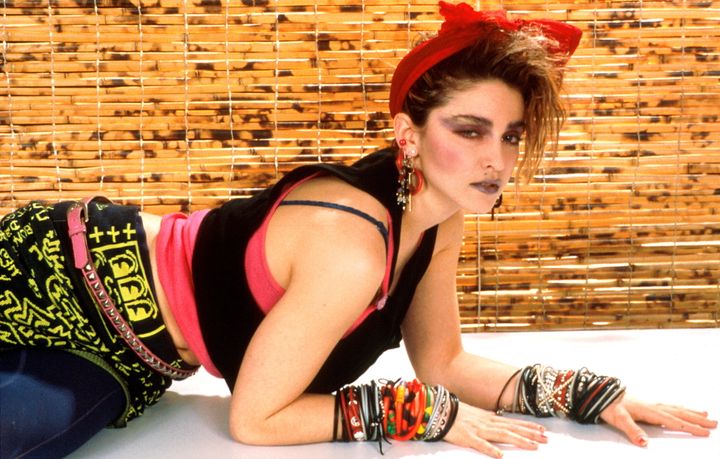
“I’m 57 years young now. But when I was in high school, Madonna was huge! We all wanted to be her with our neon pink lace skirts and ripped sweatshirts that fell off our shoulders. And we all wanted to have hair just like her, including my girlfriend and I. So, what did two idiot teenagers do? We grabbed a pair of scissors and cut each other’s hair in an asymmetrical shape. Then we found some hair bleach, took a chunk of our bangs, and bleached them. For reference, my natural hair color is dark brown. Well, we both ended up with orange bangs … not Madonna!

“My mom freaked out and brought me to get it fixed and I ended up with a pixie cut and almost jet-black hair because the bleach did so much damage. My Madonna dream hair ended that day!” ― Michele Baratta-Detwiler, a 57-year-old fashion and DIY content creator

Sadly, the Madonna look really only worked on Madonna.

Michael Putland via Getty Images

Sadly, the Madonna look really only worked on Madonna.

5. Cake-like makeup

“I also haven’t seen super matte setting powder in a while. Solid cake setting powder used to be in fashion. Now I look for a balance, you have to keep a little glow and glisten when you age, at the same time you don’t want to look like the tin man… so all of these very luminous products have to be used sparingly and in strategic spots rather than everywhere as we age gracefully.” ― Carla Rockmore, a designer and style influencer

6. Helmet head hair

“The days of Aqua Net and perfectly coiffed hair are thankfully gone, especially because I have never wanted to take too much time primping. Anything too obviously done does not read modern to me. I prefer a polished yet ‘je ne sais quoi’ to my look.” ― Lovett

Helmet hair, pictured here in a stock photo, was definitely a thing.

Jena Ardell via Getty Images

Helmet hair, pictured here in a stock photo, was definitely a thing.

7. Using milk of magnesia on oily skin

“The one beauty trend that made me grit my teeth was using MOM (milk of magnesia) on the face to control oil. This one really got under my skin because my skin is oily. In my beginning stages of wearing makeup I struggled with learning how to control the oil while wearing makeup. I tried everything, including this so-called hack. But after learning the potential risk to the skin and seeing actual makeup clients of mine suffer from the side effects, I emptied that bottle in the toilet. Now I’m an advocate for not following every trend without due diligence. I’ve recently seen younger women using Calamine lotion for the same reason. I hope this one fades as well.” ―Dorciah Sloane, a 53-year-old makeup artist and style influencer

8. Outrageous eyeshadow shades

The ’80s was the period for the most outrageous colors in eyeshadow and one simply could not get enough glitter! The brightest blues, yellow, orange, fuchsia donned our eyelids and at times all the colors of the rainbow balanced precariously on our eyelids. At the time, I worked as a makeup consultant and spent hours on applying my makeup that was so bright you could see it from the moon! In the 80s, eyeshadow and lipstick stayed on for days, it was so long lasting it was hard to remove ― probably due to the carcinogenic ingredients that went into the products.

“These days, I am happy with a more natural look with eyeshadow that enhances not takes over your face! I prefer mineral-based makeup and treatment ― makeup that cares for your skin.” ― Jayne Dalton, a 61-year-old style influencer

Did you really live in the '80s if you didn't have eyeshadow in every shade of the rainbow?

Rebecca Handler via Getty Images

Did you really live in the ’80s if you didn’t have eyeshadow in every shade of the rainbow?

9. Curled bangs

“You know what was awful? The ’80s curled bangs split horizontally with one half curled down toward your face and the other flowing back towards your crown made frozen by Aqua Net! As junior class president and vice president in high school, my twin sister and I were in charge of decorating the gym into a prom paradise! The night before our senior pictures we spent all night decorating and got about two hours of sleep in order to wake up at 5:30 a.m., dry our permed hair, and get our bangs just right! With tired eyes we got to school and stood in line to take pictures. The assistant to the photographer grabbed a comb and some Aqua Net and told us our hair would look better on camera if she fixed it. In a daze we agreed and took the shots! Later on between bells, we went into the bathroom and gazed in horror at the mall bangs she gave us. Granted, we did curl ours down, but never backwards, and now we sported that look in our senior pictures. To this day, we avoid bangs.” ― Tegan Higgins, a 51-year-old influencer who runs @tandttwintalk on Instagram and TikTok with her twin sister

10. Thinking makeup is a must

“I am glad that we’re starting to go more natural with our makeup trends, so we don’t see so much heavy contouring anymore. Pamela Anderson has set an example by showing up all nude. I like that. We should celebrate more natural looks and features as the new normal.” ― Mette Sørrig Andersen, a 53-year-old content creator

Share Button

Bullying ‘normal occurrence’ at Newcastle NHS trust, say CQC

Newcastle Hospitals NHS Foundation Trust’s CQC rating is downgraded to “requires improvement”.

Share Button

Footballer Michael Owen on son’s sight loss: ‘I’d swap eyes with him if I could’

The father and son on getting to grips with a degenerative eye condition.

Share Button