Modern living may be contributing to an epidemic of nearsighted vision and related blindness. By 2050, it is estimated that half the world’s population will suffer from low vision due to myopia, a condition where the eye grows too large and can no longer focus on objects in the distance. Human eyes, honed by evolution to survive in the wild, are ill-adapted to city living, contributing to increased cases of myopia, among other factors.
For decades, researcher Sally McFadden from the University of Newcastle has investigated eyes and eyesight in humans and animals. She will present her work and the importance of acoustical imaging Dec. 5 at 10:40 a.m. Australian Eastern Daylight Time, as part of Acoustics 2023 Sydney, running Dec. 4-8 at the International Convention Centre Sydney.
As humans age, our eyes adjust based on how we use them, growing or shortening to focus where needed. We now know that blurred input to the eye while the eye is growing causes myopia. It is so specific that the eye grows exactly to compensate for the amount and the direction of blur. For example, if you put the focus behind the retina, the eye grows longer, while if you put the focus in front of the retina, the eye slows its growth and becomes shorter. If the eye grows too long, it becomes myopic or nearsighted. In extreme cases, high myopia is associated with glaucoma, and can increase the risk of retinal detachment and abnormal pathologies around the optic nerve which lead to profound blindness.
“Babies are generally born longsighted, and the changes in the optics of the eye have to coordinate with the eye growth to get to the perfect length for focused vision,” said McFadden. “The problem is that the human eye evolved to suit a hunter-gatherer lifestyle and is not adapted for modern living.”
McFadden and her team built a high-frequency ultrasonography system to measure eye size and how quickly eyes grow to better understand myopia and its contributing factors.
“Education level (amount of study) and the type of light stimulation to the eye all correlate with the amount of myopia you develop,” McFadden said. “Time spent outdoors is protective. Myopia is greater in cities than in rural populations, and even correlates with those that live in small homes.”
Currently, vision-correcting gear like glasses and contacts are the only solution for myopia. However, eyedrops for children with myopia are in development and could halt the vision from worsening. Teams from around the world are collaborating to develop treatments for high myopia to preserve our vision.
Global carbon emissions from fossil fuels have risen again in 2023 — reaching record levels, according to new research from the Global Carbon Project science team.
The annual Global Carbon Budget projects fossil carbon dioxide (CO2 emissions of 36.8 billion tonnes in 2023, up 1.1% from 2022.
Fossil CO2 emissions are falling in some regions, including Europe and the USA, but rising overall — and the scientists say global action to cut fossil fuels is not happening fast enough to prevent dangerous climate change.
Emissions from land-use change (such as deforestation) are projected to decrease slightly but are still too high to be offset by current levels of reforestation and afforestation (new forests).
The report projects that total global CO2 emissions (fossil + land-use change) will be 40.9 billion tonnes in 2023.
This is about the same as 2022 levels, and part of a 10-year “plateau” — far from the steep reduction in emissions that is urgently needed to meet global climate targets.
The research team included the University of Exeter, the University of East Anglia (UEA), CICERO Center for International Climate Research, Ludwig-Maximilian-University Munich and 90 other institutions around the world.
“The impacts of climate change are evident all around us, but action to reduce carbon emissions from fossil fuels remains painfully slow,” said Professor Pierre Friedlingstein, of Exeter’s Global Systems Institute, who led the study.
“It now looks inevitable we will overshoot the 1.5°C target of the Paris Agreement, and leaders meeting at COP28 will have to agree rapid cuts in fossil fuel emissions even to keep the 2°C target alive.”
Professor Corinne Le Quéré, Royal Society Research Professor at UEA’s School of Environmental Sciences said: “The latest CO2 data shows that current efforts are not profound or widespread enough to put global emissions on a downward trajectory towards Net Zero, but some trends in emissions are beginning to budge, showing climate policies can be effective.
“Global emissions at today’s level are rapidly increasing the CO2 concentration in our atmosphere, causing additional climate change and increasingly serious and growing impacts.”
“All countries need to decarbonise their economies faster than they are at present to avoid the worse impacts of climate change.”
How long until we cross 1.5°C of global warming?
This study also estimates the remaining carbon budget before the 1.5°C target is breached consistently over multiple years, not just for a single year.
At the current emissions level, the Global Carbon Budget team estimates a 50% chance global warming will exceed 1.5°C consistently in about seven years.
This estimate is subject to large uncertainties, primarily due to the uncertainty on the additional warming coming from non-CO2 agents, especially for the 1.5°C targets which is getting close to the current warming level.
However, it’s clear that the remaining carbon budget — and therefore the time left to meet the 1.5°C target and avoid the worse impacts of climate change — is running out fast.
Other key findings from the 2023 Global Carbon Budget include:
Regional trends vary dramatically. Emissions in 2023 are projected to increase in India (8.2%) and China (4.0%), and decline in the EU (-7.4%), the USA (-3.0%) and the rest of the world (-0.4%).
Global emissions from coal (1.1%), oil (1.5%) and gas (0.5%) are all projected to increase.
Atmospheric CO2 levels are projected to average 419.3 parts per million in 2023, 51% above pre-industrial levels.
About half of all CO2 emitted continues to be absorbed by land and ocean “sinks,” with the rest remaining in the atmosphere where it causes climate change.
Global CO2 emissions from fires in 2023 have been larger than the average (based on satellite records since 2003) due to an extreme wildfire season in Canada, where emissions were six to eight times higher than average.
Current levels of technology-based Carbon Dioxide Removal (ie excluding nature-based means such as reforestation) amount to about 0.01 million tonnes CO2, more than a million times smaller than current fossil CO2 emissions.
The Global Carbon Budget report, produced by an international team of more than 120 scientists, provides an annual, peer-reviewed update, building on established methodologies in a fully transparent manner.
The 2023 edition (the 18th annual report) will be published in the journal Earth System Science Data.
Let’s challenge an assumption that needs to be debunked: the idea that plucking out one’s own gray (or white) hair will result in multiple ones growing in its stead.
“The color gray does not spread when you pull out hair,” said board-certified dermatologist Dr. Hamdan Absdullah Hamed, also a co-founder of an online platform dedicated to natural hair care solutions. “However, every time you pull it out, you’re removing the follicle as well, so I suggest leaving the white hair as it is.”
Advertisement
Although you won’t promote the growth of gray hair by plucking strands out, you really should try to stay away from the practice because it might end up damaging your follicles.
We still had questions, so we talked to the experts about gray hair health, including why it shows up and whether or not you’re better off simply embracing the look.
Can we prevent white hair from showing up to begin with?
Experts agree that the appearance of white or gray strands depends on a variety of factors, including genetics, age and diet.
“As we age, there are hormonal changes causing white hair to show up at a certain age,” explained hair surgeon Dr. Patrick Davis.
Advertisement
According to the Columbine Health Systems Center for Healthy Aging, part of Colorado State University, “by age 50, half of men and women will have at least 50% gray hair.” Those statistics clearly leave room for other factors to be at play.
The easiest way to predict when you’ll go gray is to look at your parents and grandparents. “If they had gray hair at a relatively young age, then there is a good chance that will happen to you as well,” Hamed said.
In addition to these sorts of unchangeable, steady factors, what and how we eat can actually affect the arrival of gray hair.
Specifically, studies confirm that deficiencies in vitamins B12, D3 and calcium may be associated with premature hair graying.
“Vitamin B12 in specific is involved in the production of blood cells, so it is necessary when it comes to hair growth,” Hamed explained.
Advertisement
He also noted that vitamin D3 is thought to stimulate the formation of new hair follicles, which will result in a healthier and fuller head of hair while calcium aids with the secretion of certain hormones which, in turn, can stimulate growth as well.
However, although it follows that adding these elements to one’s daily vitamin intake may prevent hair discoloration, that’s not often the case.
“Taking supplements could push things off a bit,” Hamed said. “But it really depends on a lot of things.”
In fact, he noted that, usually, gray hair caused by a lack of nutrients looks different than age-related discoloration.
“Sometimes, you will look at hair and notice the top and bottom are a different color,” he noted. “That means that we’re dealing with a lack of nutrients, so adding vitamins to your diet may help.”
Advertisement
However, that will only prevent new hair from turning gray — “you’re not reversing the damage already incurred,” he said.
Why does hair turn gray to begin with?
To put it simply, every strand of hair grows out of a follicle found on the skin of the scalp. Each follicle also features pigment cells called melanocytes that produce melanin, a chemical that colors hair and skin.
As we age, these pigment cells die off, therefore cutting down the production of melanin and, as a result, the amount of color that’s basically drenching the hair, effectively turning it gray or white.
Christopher Robbins via Getty Images
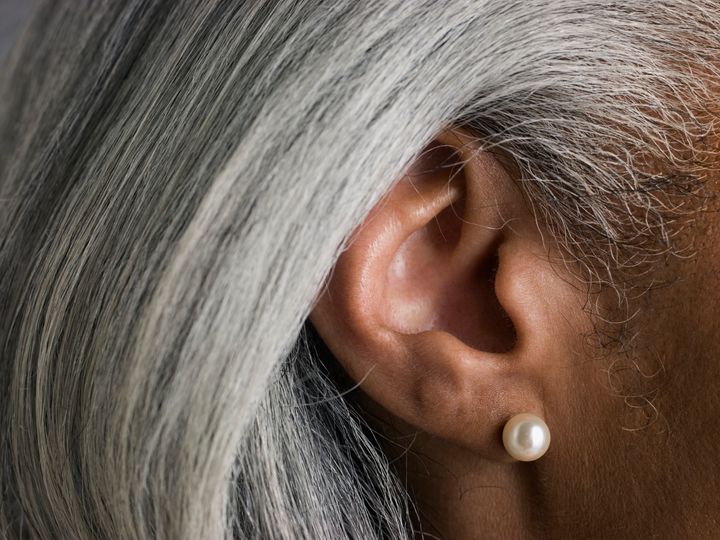
Melanin is a key determining factor in how much of and when your hair turns gray.
“People of African American descent, for example, usually have more melanin so the hair doesn’t dry out as fast and the result skews to getting white hair later,” Hamed explained.
Advertisement
Sure, adding vitamins to your diet may help prevent the graying but if your pigment cells die off, so will the amount of melanin that colors your locks, making discoloration inevitable.
Is it worth it, then, to pull out the discolored hair out considering there is not too much we can do to push off the process?
Why is it bad to pull out our own hair?
Davis explained that, even if you pluck out strands that bother you, they will come back looking exactly the same as they were before you removed them.
“The hair follicle is basically the strand’s house, filled with the characteristics of the hair that you removed,” noted the surgeon. “So it will grow back with those characteristics.”
Board-certified cosmetic dermatologist Dr. Michele Green agreed with the notion. “Once a follicle’s melanocytes die, loss of pigmentation will occur and new gray-colored hairs will grow from that follicle,” she said. ”While plucking gray hairs may lead to hair loss over time, it will not cause more gray hairs to grow, as only one hair strand can grow from a given hair follicle.”
Advertisement
Perhaps more important is the fact that forcibly removing the hair will likely damage the aimed follicle and those around it, maybe even permanently stopping hair growth in the area.
Basically, plucking out the hair is equivalent to shocking the system — the follicle, in specific — damaging it to the point of no return: forget seeing gray hair, you will stop seeing strands grow from that follicle, period.
When you’re a bit older, things get even more complicated.
“People with gray hair are usually older, so the chances of a damaged follicle even growing back are even slimmer,” said Hamed, who also warned against other potential issues. “Whenever you pull out a follicle, it makes a little well inside the skin and, over time, it can fill with oil and dandruff,” he explained. “It can get clogged, and you’ll basically have to deal with an ingrown hair.”
For what it’s worth, Davis did contend that pulling out hair in a specific direction may incur less damage.
“The hair comes out of the scalp in a specific orientation that you have to pay attention to,” he said. “If you go in the opposite angle, it’s going to cause more trauma to the follicle and scar it.”
Advertisement
That being said, he is clear on one thing: “I prefer people not plucking hair.”
Do supplements work?
When asked about the various supplements currently on the market claiming to reverse or stop the arrival of gray hair, Green acknowledges that although they may make your hair healthier, they won’t do anything about grays in specific.
“Many anti-gray supplements and serums contain vitamins such as B12, peptides and natural herbs that can supposedly prevent or reverse gray hairs,” she said. “While these ingredients may be beneficial for hair health and growth, there is currently no clinical research supporting vitamins or supplements that claim to slow or stop gray hair growth.”
Basically, if you start noticing gray hair, you have two options: You can either embrace the look (or ignore it, depending on how you look at things) or start investing in some hair dye.
After all, according to a recent survey of 2,000 Americans, two out of every five people who have gray hair have chosen to let the hue shine through. Perhaps even more telling is the fact that nearly a tenth of the survey respondents said they have intentionally dyed their hair gray as a style choice.
Support HuffPost
A No-B.S. Guide To Life
At HuffPost, we believe that everyone needs high-quality journalism, but we understand that not everyone can afford to pay for expensive news subscriptions. That is why we are committed to providing deeply reported, carefully fact-checked news that is freely accessible to everyone.
Our News, Politics and Culture teams invest time and care working on hard-hitting investigations and researched analyses, along with quick but robust daily takes. Our Life, Health and Shopping desks provide you with well-researched, expert-vetted information you need to live your best life, while HuffPost Personal, Voices and Opinion center real stories from real people.
Help keep news free for everyone by giving us as little as $1. Your contribution will go a long way.
At HuffPost, we believe that everyone needs high-quality journalism, but we understand that not everyone can afford to pay for expensive news subscriptions. That is why we are committed to providing deeply reported, carefully fact-checked news that is freely accessible to everyone.
Help keep news free for everyone by giving us as little as $1. Your contribution will go a long way.
HuffPost is your trusted source to help you lead a better life. Our reporters rely on research, expert advice and lived experiences. So when you’ve got questions, you know you can trust our answers.
We’re determined to keep HuffPost Life — and every other part of HuffPost — 100% free. Help us do that by contributing as little as $1.
HuffPost is your trusted source for stories that help you lead a better life. We’ve got you covered on all things health, wellness, food, style, parenting, relationships, work, travel and lifestyle. Our reporters rely on research, expert advice and lived experiences to address all your concerns, big and small. So when you’ve got questions, you know you can trust our answers.
We’re determined to keep HuffPost Life — and every other part of HuffPost — 100% free. Help us do that by contributing as little as $1.
At HuffPost, we believe that everyone needs high-quality journalism, but we understand that not everyone can afford to pay for expensive news subscriptions. That is why we are committed to providing deeply reported, carefully fact-checked news that is freely accessible to everyone.
Our News, Politics and Culture teams invest time and care working on hard-hitting investigations and researched analyses, along with quick but robust daily takes. Our Life, Health and Shopping desks provide you with well-researched, expert-vetted information you need to live your best life, while HuffPost Personal, Voices and Opinion center real stories from real people.
Help keep news free for everyone by giving us as little as $1. Your contribution will go a long way.
At HuffPost, we believe that everyone needs high-quality journalism, but we understand that not everyone can afford to pay for expensive news subscriptions. That is why we are committed to providing deeply reported, carefully fact-checked news that is freely accessible to everyone.
Help keep news free for everyone by giving us as little as $1. Your contribution will go a long way.
As the 2024 presidential race heats up, the very foundations of our democracy are at stake. A vibrant democracy is impossible without well-informed citizens. This is why HuffPost’s journalism is free for everyone, not just those who can afford expensive paywalls.
We cannot do this without your help. Support our newsroom by contributing as little as $1 a month.
As the 2024 presidential race heats up, the very foundations of our democracy are at stake. At HuffPost, we believe that a vibrant democracy is impossible without well-informed citizens. This is why we keep our journalism free for everyone, even as most other newsrooms have retreated behind expensive paywalls.
Our newsroom continues to bring you hard-hitting investigations, well-researched analysis and timely takes on one of the most consequential elections in recent history. Reporting on the current political climate is a responsibility we do not take lightly — and we need your help.
Support our newsroom by contributing as little as $1 a month.