New research from the Institute of Psychiatry, Psychology & Neuroscience (IoPPN) at King’s College London has established a blood-based test that could be used to predict the risk of Alzheimer’s disease up to 3.5 years before clinical diagnosis.
The study, published in the journal Brain, supports the idea that components in the human blood can modulate the formation of new brain cells, a process termed neurogenesis. Neurogenesis occurs in an important part of the brain called the hippocampus that is involved in learning and memory.
While Alzheimer’s disease affects the formation of new brain cells in the hippocampus during the early stages of the disease, previous studies have only been able to study neurogenesis in its later stages through autopsies.
To understand the early changes, researchers collected blood samples over several years from 56 individuals with Mild Cognitive Impairment (MCI), a condition where someone will begin to experience a worsening of their memory or cognitive ability. While not everyone experiencing MCI goes on to develop Alzheimer’s disease, those with the condition progress to a diagnosis at a much higher rate than the wider population. Of the 56 participants in the study, 36 went on to receive a diagnosis of Alzheimer’s disease.
Dr Aleksandra Maruszak, one of the study’s joint first authors from King’s IoPPN explains, “In our study, we treated brain cells with blood taken from people with MCI, exploring how those cells changed in response to blood as Alzheimer’s disease progressed.”
In studying how blood affected the brain cells, the researchers made several key discoveries. The blood samples collected from participants over the years who subsequently deterioratedand developed Alzheimer’s disease promoted a decrease in cell growth and division and an increase in apoptotic cell death (the process by which cells are programmed to die). However, the researchers noted that these samples also increased the conversion of immature brain cells to hippocampal neurons.
While the underlying reasons for the increased neurogenesis remain unclear, the researchers theorise that it may be an early compensating mechanism for the neurodegeneration (loss of brain cells) experienced by those developing Alzheimer’s disease.
Professor Sandrine Thuret, the study’s lead author from King’s IoPPN said, “Previous studies have shown that blood from young mice can have a rejuvenating effect on the cognition of older mice by improving hippocampal neurogenesis. This gave us the idea of modelling the process of neurogenesis in a dish using human brain cells and human blood. In our study, we aimed to use this model to understand the process of neurogenesis and to use changes in this process to predict Alzheimer’s disease and found the first evidence in humans that the body’s circulatory system can have an effect on the brain’s ability to form new cells.”
When the researchers used only the blood samples collected furthest away from when the participants were diagnosed with Alzheimer’s disease, they found that the changes in neurogenesis occurred 3.5 years prior to a clinical diagnosis.
Dr Edina Silajdži?, the study’s joint first author added, “Our findings are extremely important, potentially allowing us to predict onset of Alzheimer’s early in a non-invasive fashion. This could complement other blood-based biomarkers that reflect the classical signs of the disease, such as the accumulation of amyloid and tau (the ‘flagship’ proteins of Alzheimer’s disease).”
Dr Hyunah Lee, the study’s joint first author said, “It is now essential to validate these findings in a bigger and more diverse group of people. We are excited about the potential applications of the blood-based test we used. For example, it can help stratify individuals with memory problems for a clinical trial of disease-modifying drugs for Alzheimer’s.”
The researchers say that these findings could present an opportunity to further understand the changes the brain goes through at the earliest stages of Alzheimer’s disease.
This study was possible thanks to funding from the John and Lucille van Geest Foundation, the Medical Research Council UK, the Cohen Charitable Trust, the Galen and Hilary Weston Foundation and the Rhodes Trust.
A giant diffuse tail of stars has been discovered emanating from a large, faint dwarf galaxy. The presence of a tail indicates that the galaxy has experienced recent interaction with another galaxy. This is an important clue for understanding how so called “ultra-diffuse” galaxies are formed.
Astronomers using the Subaru Telescope and the Canada-France-Hawaii Telescope found a tail of stars stretching 200,000 light-years out away from a galaxy known as F8D1. This galaxy is a member of the M81 group located 12 million light-years away on the boundary between the constellations Ursa Major and Camelopardalis. F8D1 is one of the closest examples of an “ultra-diffuse” galaxy. The origin of these enigmatic galaxies has puzzled astronomers for several decades: are they born this diffuse or does some later event cause them to puff up in size?
The discovery of a huge tidal tail from F8D1 is compelling evidence that the galaxy has been strongly shaped by events in the past billion years. This is the first time that such a stellar stream has been discovered in a UDG. The team suggests F8D1 was disrupted by a recent close passage to the massive spiral M81, the dominant member of the group containing F8D1.
Since F8D1 lies at the edge of the survey area, only one tidal arm can be seen, extending to the northeast. The team will now search to see if there is a counterpart stream to the southwest.
A new species of microalgae was found in water from a home aquarium. While analyzing DNA samples taken from the algae, researchers from the University of Tokyo discovered Medakamo hakoo, whose DNA sequence didn’t match any on record. This new species is the smallest known freshwater green algae, with inherent qualities which enable it to be cultured stably at high density, meaning it could be effectively used to produce useful products for food and industry.
If you’ve picked up seaweed on the beach, waded through fronds in a stream or cleaned out a grimy, green fish tank, then you’ll know what algae is. These diverse aquatic organisms thrive on water, light and nutrients and come in all sorts of shapes, colors and sizes. Microalgae are an ultrasmall type of algae which are invisible to the human eye, but a vital part of the Earth’s ecosystem, forming the basis for all aquatic food chains. They have attracted particular attention from researchers and businesses for their ability to capture carbon dioxide, their use as a biofuel, as an alternative source of protein, and more. There are tens of thousands of types of microalgae, which continue to thrive in unexpected places.
“We were very surprised to discover a new species of microalgae in just a regular home aquarium,” said Professor Sachihiro Matsunaga from the Graduate School of Frontier Sciences. “Alga were taken from the water and cultured one by one. The DNA of the alga was fluorescently stained and microscopically observed to find the one with the least amount of DNA per cell. We then sequenced the DNA of that alga and compared it to the DNA of other algae. The results did not match the DNA of any previously reported algae, indicating that it was a new species, and we named it Medakamo hakoo (M. hakoo).”
Microalgae are made up of relatively few genes, and this uncomplicated form makes them useful for researchers trying to identify what roles different genes play and how they could be used. Of the tens of thousands of known microalgae, many remain uncharacterized. Thanks to this latest study, we now know that not only is this a new species, but it also has the smallest known genome of any freshwater algae, as well as other useful qualities.
“M. hakoo contains only one mitochondrion (for producing energy) and one chloroplast (which contains chlorophyll and creates food through photosynthesis), whereas normal plant cells contain multiple mitochondria and chloroplasts. This indicates that it is a green alga with an extremely simple cell structure,” explained Matsunaga. “From our research, we have also speculated that it has an unprecedented DNA structure and a new gene regulatory system. Its cell cycle is also strongly synchronized with the day and night cycle, which is key to effective, stable bioproduction. Due to these inherent qualities and extremely small size, M. hakoo can be effectively cultured at high cell density, making it possible to mass produce substances such as highly functional foods, cosmetics and bio-fuel at a low cost.”
The researchers plan to continue to explore the potential applications for M. hakoo, both in the lab and the wider world. “Aquatic green algae are the originating organisms of today’s land plants. Thanks to this research, we can better understand the minimum number of genes required for an organism to evolve and thrive in diverse environments, which we will continue to study,” said Matsunaga. “In the future, I would like to find ways to collaborate and create useful substances from the mass cultivation of M. hakoo.”
A new analysis of seismic data recorded after the massively violent eruption of the underwater volcano Hunga Tonga-Hunga Ha’apai, on January 15, 2022, has revealed new and useful information on the sequence of events. Kotaro Tarumi and Kazunori Yoshizawa at Hokkaido University discuss their methods and findings in an article in Earth and Planetary Science Letters.
“We showed that the eruption consisted of two distinct sequences of events, some of which occurred quasi-periodically in the first sequence. It will be worthwhile to investigate the mechanisms involved in such eruption cycles further,” says seismologist and geophysicist Yoshizawa.
The volcano generated seismic, tsunami and atmospheric waves that were recorded worldwide. Recent studies have estimated that it was one of the most energetic eruptions recorded by modern instruments.
“Eruption episodes are difficult to analyse fully from seismic surface waves, but we have teased out more details using what are called teleseismic-P waves,” says PhD student Tarumi. These are seismic waves that have travelled through the planet to locations distant from the eruption site. In this case, the team used seismic data collected from sites as far as at a 93-degree angle around the circumference of the planet.
The team’s “back-projection” analysis successfully detected the locations and timing of multiple explosions, even though P-waves from each eruption overlapped and were masked by other seismic signals and noises.
The back-projection technique reverses the transmission of seismic signals to reveal details of a potential source that radiated seismic waves. It was originally developed and applied for imaging the source processes of large earthquakes, but is now proving equally applicable to large scale volcanic events.
The results revealed that the sequence of eruptions occurred in two main parts. The first sequence began at 04:02 UTC on January 15, then escalated into major explosions at 04:15 UTC and 200 to 300 seconds after. The entire sequence lasted at least until 04:35 UTC. A second sequence of eruptions began about four hours later and continued from six to seven minutes, including a massive eruption at 08:31. Satellite imagery recorded the resulting dramatic ash cloud from the first eruption sequence, but until now the precise details of the underwater events have remained elusive.
One interesting finding was that significant explosive eruptions intermittently occurred at 270 to 280 second intervals, a frequency suggesting a resonance effect with the atmosphere and the Earth. “This apparent agreement of the eruption cycle and the atmospheric resonant oscillation with the Earth could be coincidental, but it certainly deserves further exploration,” Yoshizawa concludes.
Falling in love again at 47 and marrying for the second time at 52 was a miracle. And a bit frightening.
But, then again, falling in love is always phenomenal and terrifying.
We took care of each other ― little inconsequential things: me, placing a water glass on his bedside table; him, refilling my coffee as I wrote in the morning.
Advertisement
We touched each other often, like shorthand: I’m here. I’m here.
I never doubted we’d spend our later years holding hands, having better sex than ever, kissing our way around the world, then… eventually… in the distant future… the way distant future… face dying together.
But then, at 60, my husband announced he wanted to have a child with a younger woman.
Immediately my hips widened, my breasts sagged and my wrinkles deepened. Every internalized belief and vision of what it meant to be an old, unwanted, irrelevant woman became me.
A few years earlier, I’d started talking about death. I’m not obsessed ― I’m practical. Although I didn’t have a specific illness, I was aware that my life was limited — not in the sense that I could get hit by a bus tomorrow (really, how likely is that?) but in the awareness I had more past than future. I wanted to complete our wills, fill out medical proxy forms and learn his funeral preference — burial or cremation, sweetie? Did he want all lifesaving measures or not to be resuscitated? I needed to take care of these details. So if, God forbid, I did get hit by that bus tomorrow, I wouldn’t spend my last moments alive thinking, shit, I never got around to filling out those forms.
My husband didn’t want to talk about getting old and dying. He did not want to choose between burial or cremation. He did not want to even think about it. Although everyone who has ever lived on this earth has died, it felt like a personal affront to him. I got that. I even felt that. We were both doing this damn aging thing for the first time ― like learning a new sport ― and we both felt clumsy, scared and inadequate. I simply wished to take care of the paperwork and return to believing we would blissfully live the rest of our lives together.
Advertisement
There is no correct way to age. Some of us are overwhelmed with the grief of lost youth. Others try to exercise their way to eternal life. Some take risks, jumping out of airplanes or switching to jobs that once frightened them. Many fill their schedules with endless doctor’s appointments. Some are despondent with regrets.
I’d bought moisturizers, magic anti-wrinkle creams and exercise programs promising to reduce flab and fight gravity. I’d read articles suggesting clothes and hairstyles that camouflaged tell-tale signs of aging. I did brain exercises like sudoku to try to stave off forgetfulness.
My husband chose to have his first baby.
I didn’t see that coming.
Sixty was the age of leaving the house and returning for the car keys, the age of have you seen my glasses? The age of sudden, unwanted diagnoses. Who left a marriage at this point?
Turns out a lot of people.
The divorce rate for people in the U.S. 50 and older is almost double what it was in the 1990s. There is even a name for this group: silver splitters.
When I was younger, I’d agonized about how I’d age. My fears ran the gamut: growing stupid, not knowing my children’s names, having strangers clean my body, being immobilized by bad hips or knees, or never staying awake for the end of the story.
Advertisement
I questioned my friends: ”What is your plan?” Age in place? Community living? ”What is the protocol?” I heard my voice rise with an edge of panic. I did not believe I’d react well when asked to give up my car keys.
But all this planning turned out to be futile. I didn’t get to choose from my fantasy menu of aging options. Remember the old Yiddish saying: Man plans and God laughs? God was laughing, and I was suddenly trying to figure out what the rest of my life looked like without my husband.
This new phase of life required a different mindset. Now that everything had blown up and I was on a new path ― whether I wanted to be or not ― I wondered, what if I treated aging as an adventure, like traveling to a new land? Who knew which way I’d go or what I’d discover? Imagine how glittery I’d be if I filled in my cracks like the Japanese tradition of kintsugi, patching broken pottery with gold and silver. Imagine if instead of averting my eyes, I looked at my future ― however different it was now going to be ― with awe.
And with this altered perception, whole worlds opened up.
When my youngest son, from my first marriage, got engaged, he asked, “So, Mom, do you still believe in love and marriage?”
I wanted to take my time here ― he’d witnessed both my divorces. Each person we love takes a little piece of us, and then they can be careless, forget to look both ways, drink too much, climb mountain cliffs or are otherwise negligent.
Advertisement
People die. They fall out of love. They leave.
We grieve.
The only way to avoid this pain is to avoid love. But that is too hard a way to live.
“Yes,” I said. “I do.” I paused and said, “But love alone isn’t enough ― you need to be fearless.”
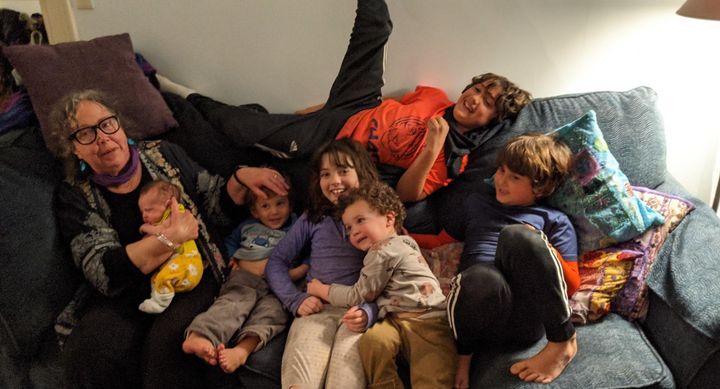
The author and almost all of her grandkids in June 2021.
Courtesy of Virginia DeLuca
Because a funny thing happened while I was grieving my husband’s departure. I discovered I really liked living alone. I found my way back to myself. Of course, it was difficult to describe being alone and happy without sounding like I was trying to convince myself that low-fat yogurt tastes as delicious as ice cream. But there could be a gratifying ending with being in alliance with myself, my desires and the people I cherish.
People around me are beginning to ask, “Are you seeing anyone?” I understood their motivation. It was some version of getting back on the horse.
A happy ending for this saga of lost love could involve me meeting another love. It wasn’t a terrible notion. I am a sucker for love. I am still the woman who watches romantic comedies. I am still a believer.
Friends and family members would relax if I fell in love again. They would stop imagining long, bleak, lonely evenings for me. Probably the only people who wouldn’t care if I am in a relationship or not are my grandchildren. I love them for it.
Advertisement
My ex-husband and I have chosen very different paths to age.
Maybe I couldn’t jump as high. Conversations from last week sometimes drew blanks. But I valued sitting and listening to a meandering story of my granddaughter’s nightmare.
I sat on the floor yesterday playing with cars and dinosaurs with my 2-year-old grandson. I said, half in jest, “I’m not sure how to get up.”
“Like this, Nonna.” He demonstrated putting his two hands on the floor and his bottom in the air and pushing.
I laughed so hard I fell over.
My body didn’t work as it once did, but I was committed to not letting embarrassment or shame get in my way. I was determined to still get on the floor and play with cars. Even if it meant I must put my ass in the air to get up.
I am strengthening my skills for this new land. I am learning to ask for help and be more gracious in accepting it. I am learning to disclose what I don’t know or when I’m unsure. I attempt to admit when I’m wrong and to apologize. (Of course, I should have tried that one earlier, but better late than never.) I’ve committed to taking care of myself: resting when tired, being outside more and not creating daily to-do lists that actually require three days to complete.
Advertisement
I’m working on accepting that I cannot create happiness for anyone else. I can share joy and wonder, crack jokes and join in the laughter, but I cannot develop a sense of serenity in another person. Despite my many years as a therapist and a parent, I know I cannot prevent suffering. I can sit with my children, grandchildren, friends and patients. I can hold their hands and offer a shoulder to cry on, encourage and cheer them on ― I can soothe hurt and troubled feelings. I can advocate for them and help them find resources. But finding a sense of well-being is their own work to do. That is an inside job.
And, of course, that also applies to me.
I have let go of the idea that I will make a big splash and solve the world’s problems. I recycle, protest and donate, but I really have no idea how to protect endangered species or get the world to pay attention to climate change. Or end poverty. Or child abuse. Or war. Or racism. And still, I want to learn. I want to do what I can, even in my own little way.
I savor small pleasures. Daffodils. Growing beans we can eat. I pull my novel out of the drawer and dust it off. At work, I asked for a raise and got it. I focus on the birdsong in the pre-dawn light.
Despite the visible reminders of old age, strangers say hi and smile at me. I believe, Ha! They are admiring an energetic, engaged old woman.
I still carry a self-image of a graceful, pretty woman, so I’m shocked when I see a lumbering gray-haired me in a photo. I tell myself that I’ve always photographed poorly.
Advertisement
I choose to live with these two delusions: I photograph terribly, and strangers admire me. There are worse ones. I could choose to believe I control the world ― or should ― and always be upset when things don’t go the way I’d planned. I could choose to live with the delusion that by 70, the world owes me something and be pissed when it doesn’t come my way. I could choose to live with the delusion that aging and dying are not in my cards and be horrified at the process. I could choose to live with all sorts of delusions that would cause me to be resentful and scared.
Instead, I choose to feel graceful and love ― in whatever ways I can ― and believe that strangers on the street are wishing me well.
Virginia DeLuca lives in Boston, Massachusetts, and works as a psychotherapist. She’s the author of the novel, “As If Women Mattered” and her essays have appeared in the Iowa Review, The Writer, and others. She is the graduate of the GrubStreet Memoir Incubator program and has completed her memoir, “If You Must Go, I Wish You Triplets.”
Do you have a compelling personal story you’d like to see published on HuffPost? Find out what we’re looking for here and send us a pitch.