
This is how highly resistant strains of fungi emerge

An international research team has deciphered the mechanism by which the fungus Cryptococcus neoformans is resistant to fungus-specific drugs. It is a yeast-like fungus that can infect humans. Specific drugs, named antifungals, are available for treatment, but they don’t always work — a phenomenon similar to antibiotic resistance. A team from Duke University in the USA and Ruhr-Universität Bochum (RUB) has used genetic, bioinformatic and microbiological techniques to decipher the mechanism underlying this resistance. They describe it in the journal Nature Microbiology, published online on 2 August 2022.

“The results are highly relevant for combating fungal infections in clinical practice, veterinary medicine and agriculture,” says Professor Ulrich Kück, Senior Professor in General and Molecular Botany at RUB. He cooperated for the project with the Bochum researcher Dr. Tim Dahlmann and the team headed by Professor Dr. Joe Heitman, who is currently based at Duke University in North Carolina and has been a visiting professor at RUB on several occasions.

Number of fungal infections on the rise

“In the western hemisphere, the number of people with a lowered immune defence is increasing, because life expectancies are rising rapidly and treatment with immunosuppressants after organ transplants is becoming more common,” explains Ulrich Kück. “This is associated with an increase in fungal infections.” Cryptococcus neoformans is one of the most significant human pathogenic fungi responsible for so-called cryptococcosis. It triggers acute infections in immunocompromised patients; and the mortality rate may be as high as 70 per cent. This is because fungal strains that are resistant to the drugs often evolve in hospitals, which makes treatment more difficult. So far, it was unclear which cellular and genetic mechanisms lead to this resistance.

So-called transposons, however, were known to play a role in the resistances. Transposons are jumping genes, i.e. DNA segments that can change their position in the genome and thus affect the function of genes. If a transposon jumps into a gene that’s critical for susceptibility to a drug, it’s possible for resistance to emerge. The mobility of the transposons is controlled by regulatory RNAs, so-called small interfering RNA, or siRNA for short.

RNA mechanism causes resistance

In their current study, the researchers discovered gene mutations in resistant isolates that led to siRNA control being switched off. By introducing an intact copy of the gene, it was possible to restore siRNA control; as a result, the researchers were able to prevent the transposons from jumping and shed light on the cause of resistance. Due to their small size, the gene segments that code for siRNAs are not easy to find in the genome. Tim Dahlmann managed to locate them with special bioinformatic analyses. By identifying the resistance mechanisms, it will be possible to use them for the treatment of mycoses in humans in the future.

Story Source:

Materials provided by Ruhr-University Bochum. Original written by Julia Weiler. Note: Content may be edited for style and length.


Share Button

Mechanism of bacterial toxins in deadly attacks

Only one thousandth of a milligram of the bacterial botulinum toxin is necessary to kill a living organism. The toxin unfolds its lethal effect by preventing the release of neurotransmitters at the point where nerve cells attach to muscles, thereby paralyzing them. As simple as it may seem, this process is in fact a sophisticated and multi-staged procedure. No less complex and in fact very effective is the intoxication process of toxin complexes (Tc), virulence factors of many bacteria, including insect and human pathogens.

A bacterial syringe delivers a deadly enzyme

The mechanism of action of Tc toxins has only recently been uncovered to a greater extent by the work of Stefan Raunser’s team in structural biology at the MPI Dortmund. “Unraveling the structure of the Tc toxin subunits and their assembly by cryo electron microscopy (cryo-EM) enabled us to understand the key steps of toxin activation and membrane penetration,” says Raunser. The scientists showed that the subunits of the Tc toxin complex work together like a syringe: once the subunits are assembled, structural changes in the complex trigger the opening of a cocoon which contains a toxic enzyme, which is then secreted in a unique injection mechanism via a channel into the host cell. There, it unfolds its deadly effect by disturbing the regulation of the cell’s cytoskeleton, which consists of a network of polymerized actin (F-actin) filaments involved in many essential cellular processes.

Setting up the opponent by reducing the striking distance

“For a long time, we struggled with obtaining a complete picture of the intoxication process, since we lacked the structural data of the secreted enzymes, one of which is TccC3,” reflects Raunser. Until recently, it was only known that TccC3 transfers an ADP-ribose group to actin promoting its aberrant polymerization, which leads to actin filament clumping. “TccC3 is what we call a “difficult” system for structural investigations due to its size and high flexibility,” says Hartmut Oschkinat. “Only by applying solution NMR, could we overcome this challenge and visualize the protein’s 3D structure for the first time.” By fusing two further cryo-EM snapshots of TccC3 bound to F-actin and of the modified F-actin alone, the scientists have uncovered the enzyme’s unique mechanism of action. “TccC3 acts like a boxer who sets up his opponent to make him vulnerable to the attack” says Stefan Raunser. In the first step, the enzyme binds to a region between two consecutive actin subunits of F-actin. TccC3 then opens a gate, which brings the molecule NAD+ that contains the ADP-ribose group within striking distance to a reactive site on actin. Once the bulky ADP-ribose group is transferred to F-actin, it is no longer accessible for its depolymerizing factors, whereby F-actin can no longer be broken down and thus clumps.

In addition to this discovery, the scientists’ findings have helped formulate an explanation for the strikingly high efficiency of the enzyme. When the enzyme detaches from F-actin, its gate mechanism prevents a futile rebinding to the already modified actin as preparation for the next attack. “It is amazing how all these mechanisms evolved to increase the toxins potency to the max. And nature did quite a good job since botulinum toxins, ricin and other biotoxins are still considered the most toxic substances known,” Raunser concludes.

Story Source:

Materials provided by Max Planck Institute of Molecular Physiology. Note: Content may be edited for style and length.

Share Button

Stickers and a smartphone for easy nitrite detection on foods

Nitrates and nitrites give processed meats their characteristic pink color and robust flavor. Although many consumers want to limit consumption of these preservatives because the substances can form potentially cancer-causing compounds, knowing how much is in a food has been difficult to determine. Now, researchers reporting in ACS Applied Materials & Interfaces have developed a color-changing film that consumers can stick onto foods and easily analyze nitrite levels by snapping a picture with a smartphone.

Cured and processed meats, such as salami and bacon, are often treated with nitrite or nitrate salts to keep them looking and tasting fresh. Though nitrate is relatively stable, it can be converted to the more reactive nitrite ion in the body. When in the acidic environment of the stomach or under the high heat of a frying pan, nitrite can undergo a reaction to form nitrosamines, which have been linked to the development of various cancers. Some methods to determine nitrite levels in foods already exist, but they are not very consumer-friendly and often require expensive and laborious techniques and instruments. To help consumers make more informed decisions, Saúl Vallejos, José M. García and colleagues wanted to develop an easy-to-use nitrite quantification system.

To accomplish this, the researchers developed a film they called “POLYSEN,” which stands for “polymeric sensor,” made of four monomers and hydrochloric acid. Disks punched from the material were placed on meat samples for 15 minutes, allowing the monomer units and acid in the film to react with nitrite in a four-step azo coupling reaction. The disks were then removed and dipped in a sodium hydroxide solution for one minute to develop the color. When nitrite was present, the film’s yellowish hue deepened with higher nitrite levels in the food. To quantitate the color change, the researchers created a smartphone app that self-calibrates when a chart of reference disks is photographed in the same image as the sample disks.

The team tested the film on meats they prepared and treated with nitrite, in addition to store-bought meats, and found that the POLYSEN-based method produced results similar to those obtained with a traditional and more complex nitrite detection method. In addition, POLYSEN complied with a European regulation for migration of substances from the film to the food. The researchers say the new approach could be a user-friendly and inexpensive way for consumers to determine nitrite levels in foods.

The authors acknowledge funding from La Caixa Foundation and the Spanish Agencia Estatal de Investigación. They also acknowledge the support and collaboration of the company Inforapps.

Story Source:

Materials provided by American Chemical Society. Note: Content may be edited for style and length.
Share Button

Archie Battersbee: Parents take case to European Court of Human Rights

The 12-year-old’s life support was due to be withdrawn on Wednesday morning.

Share Button

Drug deaths: Record number of fatalities in Wales

A record number of drug misuse deaths are reported in Wales for 2021, with a 41% rise.

Share Button

More Men Are Getting Botox Than Ever. Here’s How ‘Brotox’ Is Different.

First introduced to the general public in the late 1980s, Botox has now become a billion-dollar industry that has challenged our relationship with beauty, wellness, plastic surgery, ageism and even gender ― it’s not just women who are getting the procedure.

According to the 2020 plastic surgery statistics report by the American Society of Plastic Surgeons, in 2020, women received about 4 million Botox-type treatments while men underwent just over 250,000 procedures of the kind.

Although there’s still a large difference in number of treatments between the two genders, experts are quick to note that, in the past few years, there has been a sharp increase in desire for the muscle-freezing, wrinkle-reducing injection among a range of people.

“While Botox is and has traditionally been more popular among women, various sources have demonstrated that it has been growing in popularity among men, as well,” said Dr. Samuel Lin, a board-certified plastic surgeon and associate professor of surgery at Harvard Medical School.

Facial plastic surgeon Dr. Jacob D. Steiger has also noticed the trend. “We are seeing the proportion of men versus women increasing,” he noted, “meaning the male segment is increasing at a higher rate. This is jokingly referred to as ‘brotox.’”

According to the American Society of Plastic Surgeons, “brotox” is the No. 1 cosmetic procedure requested by men, with a 400% increase in treatments administered since 2000.

Overall, men and women seem to concentrate on the same area of the face when undergoing treatment: the forehead.

In the past, “people preferred a more total effect to the point that they looked expressionless,” explained Dr. Bruce Hermann, a board-certified plastic surgeon. “Today, I find that the majority of women prefer the maximal effect possible without having a frozen forehead. For men, I find that in general they prefer an effect similar to women but a bit more subtle on the forehead.”

Male vs. Female Botox

Although men and women tend to seek Botox treatments on similar areas of the face, experts note that the procedures differ based the gender one was assigned at birth. As a general statement, given their larger muscle mass in the facial musculature, men need more Botox than women do to obtain similar effects.

“For example, in the glabellar area [the skin between your eyebrows], for a similar effect, I start women with about 15 units of Botox and go up as needed to achieve the desired result,” Hermann shared. “For men, I would normally recommend starting with 20 units and adjusting from there.”

The expert is quick to note that the approach gets more complex when dealing with patients’ foreheads. “Men commonly prefer a more subtle effect in the area,” he said. “So I’ll use a higher dosage per area in men but inject a smaller surface area.”

As long as the dosage is adjusted, the frequency of injection is the same for men and women, Steiger said. For most patients, results last about four months.

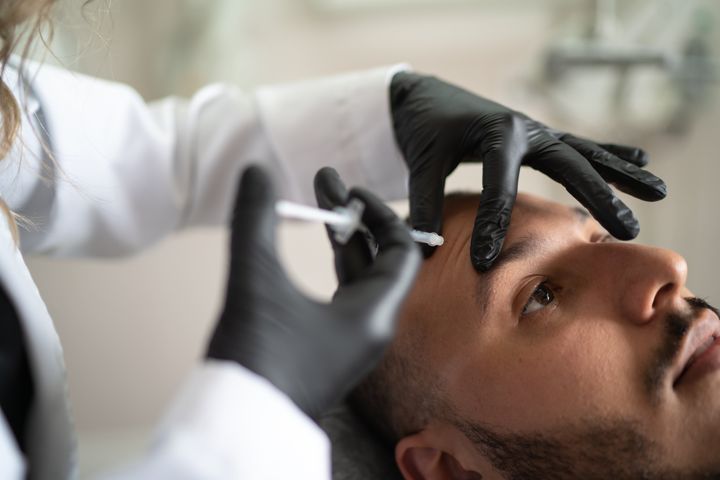
In general, given their larger muscle mass in the facial musculature, men need more Botox than women do to obtain similar effects.

FG Trade via Getty Images

In general, given their larger muscle mass in the facial musculature, men need more Botox than women do to obtain similar effects.

Anatomical variations in skin composition can also potentially lead to gender-specific differences in terms of reactions and complications. “Men typically have thicker skin with higher collagen composition compared to women,” Lin explained. “Male skin also tends to be more vascular, which carries a higher complication rate of bleeding and bruising when injecting Botox.”

Although based on anecdotal evidence, some physicians also believe that Botox wears off faster in men given their metabolism. However, Lin explained that this should be discussed directly between a patient and doctor, because it’s not easy to generalize “given broad differences in human metabolism.”

In short: Men and women look to address similar facial issues when getting Botox, but the dosages needed to reach similar results can vary.

The Future Of Botox

Experts, including Hermann, believe the overall trends will stay the same in the future: Men and women will continue seeking to tackle similar facial issues through the treatment. Although more women than men are likely to undergo the procedure, “the percentage of men getting Botox will increase slightly each year,” Hermann predicted.

The surgeon specifically calls out ageism in the workforce. Although ageism was once an issue commonly mentioned by women in the workforce, it affects men as well.

Case in point: In 2019, Google settled an age discrimination lawsuit concerning its hiring practices. As a result, over 200 job seekers over the age of 40 who had applied for positions at the company received a settlement of $11 million.

COVID-19 also changed things. “The ‘Zoom effect’ is a phenomenon brought on by the pandemic whereby people working from home saw themselves more frequently on camera and started to notice things that made them look more aged,” Hermann said. “A study by the American Society of Plastic Surgeons in 2020 showed an increase in interest in plastic surgery or non-surgical procedures like Botox to look younger in 11-35% of women surveyed that were using Zoom or similar platforms.”

If you’re ever considering a Botox treatment, here’s how to find a reputable provider.

Share Button

Over 100,000 monkeypox vaccines procured, government says

The majority of the nearly 2,500 confirmed monkeypox cases in England are in London.

Share Button

Call for body-image warnings on retouched photos

The impact of body image on mental and physical health needs to be taken more seriously, MPs say.

Share Button

Bioscientists use mixed-reality headset, custom software to measure vegetation in the field

Ecologists won’t always need expensive and bulky equipment to measure vegetation in the wild. Rice University scientists have discovered a modern heads-up display works pretty well.

Rice researchers set up aMicrosoft HoloLens as a mixed-reality sensor to feed VegSense, their application to measure understory vegetation, plant life that grows between the forest canopy and floor.

A proof-of-concept study by graduate student Daniel Gorczynski and bioscientistLydia Beaudrot shows VegSense could be a suitable alternative to traditional classical field measurements at a low cost.

Their study in Methods in Ecology and Evolution shows the hardware-software combination excels at quantifying relatively mature trees in the wild, which is one measure of a forest’s overall health.

Gorczynski came up with the idea to try HoloLens, commonly marketed as a productivity tool for manufacturing, health care and education. He developed the open-source software for the device and noted that while the combination is less effective at picking up saplings and small branches, there’s ample room for improvement.

Gorczynski said he was introduced to mixed-reality sensing while an undergraduate at Vanderbilt University and recognized its potential for biological studies. “It seemed sort of like a natural fit,” he said. Gorczynski brought the idea to Beaudrot in 2019 shortly after his arrival at Rice.

The combination of stock hardware and custom software cost far less than systems based onlidar (for “light detection and ranging”) most often used in three-dimensional field studies, said Gorczynski, who developed VegSense on a platform geared more toward 3D games and interactive experiences than hard science.

Field tests at Houston’s Memorial Park showed that at least for mature trees, the smaller solution is just as good. In their case study, VegSense easily detected 48 of 50 such trees in the target area, a circle about 30 feet in diameter that Gorczynski walked, looking up, down and around to build the 3D database. (“Imagine an asterisk with a circle around it,” he said, describing the data-capture pattern.)

“For this study, we wanted to be really deliberate in trying to replicate more traditional understory vegetation structure measurements,” Gorczynski said. “We tried to get that level of detail.”

What he sees as he scans the environment is a holograph-like grid pattern that tracks the surfaces of vegetation. “What’s really cool about that is you can see what the scanner is picking up, but also the spots you missed,” Gorczynski said. “The idea is to get the mesh to cover as much of the vegetation as possible because that’s what gets you the best scan.”

“The results were so nice that Dan quickly wrote it up for publication,” Beaudrot said, noting that Gorczynski expanded his validation of the gear during a subsequent field trip to Tanzania, the focus of one of 15 tropical forests in a recent rainforest study by the Rice group.

“This device can facilitate a lot of great ecological research, particularly because it’s so cost-effective,” she said. “Collecting vegetation information on the forest floor right now is really hard to do without a lot of manual labor, or a really expensive lidar system.”

“So this is a groundbreaking, cost-effective device,” Beaudrot said. “It’s not going to give you the same resolution data that lidar will, but this is just the first application. We hope making VegSense open-source to the ecological research community will spur all the potential ways it can be developed.”

Northrop Grumman, Conservation International and Rice supported the research.

Video: https://youtu.be/dBHfxvhMChU

Story Source:

Materials provided by Rice University. Original written by Mike Williams. Note: Content may be edited for style and length.

Share Button

Signaling ‘stressed-out’ plants

A plant scientist from the University of Missouri has discovered a new way of measuring stress in plants, which comes at a time when plants are experiencing multiple stressors from heat, drought and flooding because of extreme weather events.

The discovery involves a once maligned collection of molecules called reactive oxygen species (ROS), which are produced by anything that uses oxygen, like animals, people and plants. But Ron Mittler at MU has uncovered a redeeming quality of ROS — their role as a communication signal that can indicate whether plants are stressed out.

“When stressors from heat and drought are added together, plants don’t have ground water to draw from, so they close the stomata [leaf pores], and this makes the leaves become really hot,” said Mittler, whose appointment is in the College of Agriculture, Food and Natural Resources. “This is why the combination of drought and heat is really dangerous, because the leaf temperature is much higher than with a plant subjected to just heat. The change can be anywhere between two and four degrees, and that can make the difference between life and death.”

Plant stress is also tied to crop loss, but existing analytical research on the subject has typically focused on how crops react to just one stressor. However, Mittler said a plant’s survival rate will dramatically decrease as the number of stressors continues to increase to three to six different stressors. The key, he said, is to keep ROS levels in check. Either too much or too little can be damaging, but an optimum level of ROS can be considered safe for life.

Hooked on science

Born and raised in Israel, Mittler wanted to be a veterinarian while growing up. But, after enrolling at the Hebrew University of Jerusalem, he recalls spending a summer in the late 1980s as an undergraduate student working in an agriculture lab, where he got “hooked” on science — particularly the role of ROS in plants. Mittler has been studying ROS ever since.

“At the time, we were trying to identify why certain cell lines were more resistant to salinity than others,” he said. “That was my first-ever scientific research problem. But then I started to work on desert plants, and from there on reactive oxygen species and blue green algae.”

“Reactive oxygen species signaling in plant stress responses,” was published in Nature Reviews Molecular Cell Biology, a journal of Nature. Other authors include Sara Zandalinas and Yosef Fichman at MU; and Frank Van Breusegem at Ghent University in Belgium.

This study was supported by funding from the National Science Foundation (IOS-2110017, IOS-1353886, MCB-1936590 and IOS-1932639), the National Institutes of Health, the University of Missouri Interdisciplinary Plant Group, University of Missouri, Research Foundation — Founders (project G0D7914N) and the Excellence of Science Research (project 30829584). The content is solely the responsibility of the authors and does not necessarily represent the official views of the funding agencies.

Story Source:

Materials provided by University of Missouri-Columbia. Note: Content may be edited for style and length.

Share Button