The woman, named locally as Jody Keenan, 39, had been out with friends in Newry when she collapsed.


The woman, named locally as Jody Keenan, 39, had been out with friends in Newry when she collapsed.
The drug found in magic mushrooms could treat depression in a unique way, researchers say.
The monarch speaks about her experience with the virus during a virtual hospital visit.

New research published in Diabetologia (the journal of the European Association for the Study of Diabetes [EASD]) finds that the consumption of healthy plant-based foods, including fruits, vegetables, nuts, coffee, and legumes, is associated with a lower risk of developing type 2 diabetes (T2D) in generally healthy people and support their role in diabetes prevention.
The study was conducted by Professor Frank Hu and colleagues at the Department of Nutrition, Harvard T.H. Chan School of Public Health, Boston, MA, USA, and aimed to identify the metabolite profiles related to different plant-based diets and investigate possible associations between those profiles and the risk of developing T2D.
A metabolite is a substance used or produced by the chemical processes in a living organism and includes the vast number of compounds found in different foods as well as the complex variety of molecules created as those compounds are broken down and transformed for use by the body. Differences in the chemical makeup of foods means that an individual’s diet should be reflected in their metabolite profile. Recent technological advances in the field of high-throughput metabolomics profiling have ushered in a new era of nutritional research. Metabolomics is defined as the comprehensive analysis and identification of all the different metabolites present within a biological sample.
Over 90% of diabetes cases are the type 2 form, and the condition poses a major threat to health around the world. Global prevalence of the disease in adults has more than tripled in less than two decades, with cases increasing from around 150 million in 2000 to over 450 million in 2019 and projected to rise to around 700 million in 2045.
The global health burden of T2D is further increased by the numerous complications arising from the disease, both macrovascular, such as cardiovascular disease, and microvascular, which damage the kidneys, the eyes, and the nervous system. The diabetes epidemic is primarily caused by unhealthy diets, having overweight or obesity, genetic predisposition, and other lifestyle factors such as a lack of exercise. Plant-based diets, especially healthy ones rich in high quality foods such as whole grains, fruits, and vegetables, have been associated with a lower risk of developing T2D but the underlying mechanisms involved are not fully understood.
The team conducted an analysis of blood plasma samples and dietary intake of 10,684 participants from three prospective cohorts (Nurses’ Health Study, Nurses’ Health Study II and Health Professionals Follow-up Study). Participants were predominantly white, middle-aged (mean age 54 years), and with a mean body mass index (BMI) of 25.6kg/m2.
Study participants completed food frequency questionnaires (FFQs) which were scored according to their adherence to three plant-based diets: an overall Plant-based Diet Index (PDI), a healthy Plant-based Diet Index (hPDI), and an Unhealthy Plant-Based Diet Index (uPDI). Diet indices were based on that individual’s intake of 18 food groups: healthy plant foods (whole grains, fruits, vegetables, nuts, legumes, vegetable oils, and tea/coffee); unhealthy plant foods (refined grains, fruit juices, potatoes, sugar-sweetened beverages, and sweets/desserts); and animal foods (animal fats, dairy, eggs, fish/seafood, meat, and miscellaneous animal-based foods). The team distinguished between healthy and unhealthy plant foods according to their association with T2D, cardiovascular disease, certain cancers, and other conditions, including obesity and high blood pressure.
The researchers tested blood samples taken back in late 1980s and 1990s in the early phase of the three studies mentioned above to create metabolite profile scores for the participants, and any cases of incident T2D during the follow-up period of the study were recorded. Analyses of these data together with the diet index scores enabled the team to find any correlations between metabolite profile, diet index, and T2D risk.
The study found that compared with participants who did not develop T2D, those who were diagnosed with the disease during follow-up had a lower intake of healthy plant-based foods, as well as lower scores for PDI and hPDI. In addition, they had a higher average BMI, and were more likely to have high blood pressure and cholesterol levels, use blood pressure and cholesterol drugs, have a family history of diabetes, and be less physically active.
The metabolomics data revealed that plant-based diets were associated with unique multi-metabolite profiles, and that these patterns differed significantly between the healthy and unhealthy plant-based diets. In addition, metabolite profile scores for both the overall plant-based diet and the healthy plant-based diet were inversely associated with incident T2D in a generally healthy population, independent of BMI, and other diabetes risk factors, while no association was observed for the unhealthy plant-based diet. As a result, higher metabolite profile scores for PDI and hPDI indicated both closer adherence to those diets and having a lower risk of developing T2D.
Further analysis revealed that after adjusting for levels of trigonelline, hippurate, isoleucine, a small set of triacyglycerols (TAGs), and several other intermediate metabolites, the association between plant-based diets and T2D largely disappeared, suggesting that they might play a key role in linking those diets to incident diabetes. Trigonelline, for example, is found in coffee and has demonstrated beneficial effects on insulin resistance in animal studies, while higher levels of hippurate are associated with better glycaemic control, enhanced insulin secretion and lower risk of T2D. The team suggest that these metabolites could be investigated further and may provide mechanistic explanations of how plant-based diets can have a beneficial effect on T2D risk.
Professor Hu explains: “While it is difficult to tease out the contributions of individual foods because they were analysed together as a pattern, individual metabolites from consumption of polyphenol-rich plant foods like fruits, vegetables, coffee, and legumes are all closely linked to healthy plant-based diet and lower risk of diabetes.”
The authors conclude: “Our findings support the beneficial role of healthy plant-based diets in diabetes prevention and provide new insights for future investigation…our findings regarding the intermediate metabolites are at the moment intriguing but further studies are needed to confirm their causal role in the associations of plant-based diets and the risk of developing type 2 diabetes.”
Since they only collected blood samples at one point in time, the authors also believe that long-term repeated metabolomics data are needed to understand how dietary changes relate to changes in metabolome, thereby influencing T2D risk.
Lately there’s been this recurring TV commercial that my husband, Chris, and I find particularly distressing. It’s for a diabetes drug. The ad begins with a son coming home for a visit after leaving for college. He observes the way his father has turned his focus to old hobbies and is developing some new, healthier habits, implying that using this drug opens space in your life for other things besides managing your Type 2 diabetes.
The 60-second spot cycles through scenes of the father — a somewhat hefty, gray-haired man — working out, preparing salads (while his wife flashes their son an approving look), tinkering with his car’s engine and fishing on a scenic lake. The wife, a woman with a nondescript, practical haircut (also fully gray) and mom jeans (definitively not the trendy ones that my 19-year-old daughter wears), hovers on the periphery.
Advertisement
Our distress is rooted in the implication that this man and this woman supposedly represent people at our stage of life: parents with a child who has just left for college (our daughter began this fall), adjusting to the empty nest, rediscovering old pastimes and trying out new ones. Every time we see it — and if we happen to be watching the nightly news or one of the early morning shows, we see it a lot — one of us inevitably has to ask, “Do I really seem that old?”
“No way,” the other reassures. “There’s no way that couple is our age.” An unsure silence usually follows. It’s weighted with all the denials that want to confidently claim our hold on youth and vitality but are struggling to take shape and leave our mouths. Even if the actors in the ad are miscast age-wise (and I really want to believe they are), a nagging feeling tugs at the edge of my consciousness and leaves me doubting. Maybe that commercial is more about us than we care to admit.
This week, I turn 50.
I’d like to say that I am embracing this milestone birthday with boundless grace and gratitude. But honestly? I’m dragging my heels more than a little bit as the looming finish line of my 40s approaches and I teeter on the brink of becoming officially “middle-aged” (which statistically actually happened when I turned 40, since the average life expectancy for women in the U.S. is 81).
Advertisement

Courtesy of Melanie Brooks
“You are only as old as you feel, right?” a friend (still living blissfully in her mid-40s) quipped recently in an effort to reassure me that turning 50 is no big deal. It didn’t work. “If that’s true,” I responded, “I’m in big trouble.”
Because here’s the thing: I do feel old. In. So. Many. Ways.
Take, for example, my left foot. It hurts. Regularly. Especially when I wake up in the middle of the night to pee (don’t even get me started on this epic betrayal by my bladder). The first step out of bed genuinely feels like the floor is made of spikes. I move through the darkness to the bathroom in an off-balance hobble reminiscent of a drunken sailor. It’s not pretty. A recent trip to the podiatrist revealed that the plantar fasciitis I had surgery for in my 30s has returned along with a half-inch heel spur. It might eventually mean more surgical intervention, but for the time being it means consistent use of a bulky stretching boot, Advil and sensible (translate that to ugly) shoes.
My foot issue wouldn’t be overly concerning if it weren’t for the fact that I’m supposed to be training for a half-marathon at the end of May — an ill-conceived venture instigated by my oldest brother (who might also be pushing back against the realities of his age; he’s 53, FYI) that I grudgingly agreed to because of my lifelong FOMO and not being able to stand the thought of my three brothers accomplishing it without me.
Advertisement
My foot, coupled with the gathering aches in my joints, the extra pounds assembling at my waistline (and other places I didn’t even know you could gain weight) that are more determined to stay than I am to fight them off, and an expectation (based on empirical data from the last few years of trying to regain my exercise momentum that includes two broken kneecaps and a stress fracture in my hip) that at any moment something is inevitably going to break down, have me strongly doubting the possibility of running that race, let alone making it up the stairs.
So, this very-soon-to-be-50 body — with its taunting night sweats forecasting menopause, mysteriously appearing spots and wrinkles, and obnoxious sagging flesh — is making me feel old. But it’s not just the physical. There’s also the fact that my firstborn (the culprit in the creation of that sagging flesh) is about to turn 22. How is it possible that I have a 22-year-old? Chris and I got married when we were 22. There’s no way that this kid of mine, who I still partly see as the 4-pound premature baby I could hold in the palm of my hand, is possibly ready for anything so grown up. And yet, whether that’s true or not, he does have a serious girlfriend and is about to apply to graduate school.

Courtesy of Melanie Brooks
Despite my sincere efforts to stay relevant and keep up with the interests and outlooks of my own Gen Z kids and the college students I teach, some recent interactions have exposed the grim reality that I have not. Here’s a sampling:
I made a “Schitt’s Creek” reference in my class the other day, and my students offered me their best blank stares. “Nobody has watched ‘Schitt’s Creek’? Come on! ‘Ew, David’? ‘Best wishes, Warmest regards’?” I exclaimed. One guy dutifully raised his hand. “My mom loves that show,” he said.
Aware of its cult-like following, I convinced my 19-year-old daughter (who’d binged the series) to watch the first episode of HBO’s “Euphoria” with me while she was home for spring break. It was a mistake. She’d prepared me for the sexual content and substance abuse. But as I watched the teenage characters face one traumatic experience after another, I couldn’t stop myself from repeating, “Where are their parents?” and felt a burgeoning anxiety for the well-being of all teenagers the world over. “I can’t do it,” I told Lily, peeling my fingers away from my eyes, when she asked if I wanted to watch the second episode. We turned on “Grey’s Anatomy” instead.
I once saw a T-shirt that said, “You know you are getting old when you open your mouth and your mother comes out.” Well, last week, when I spent 10 minutes engaged in a sanctimonious conversation on a walk with a friend about Rhianna’s sheer black maternity dress over a lacy bra and panties and nothing else! that she wore to the Dior Show during Paris Fashion Week, I heard myself say, “I mean, really, can that even be called a dress?” and there my mother was.
Today I experienced a disproportionate surge of excitement when I managed to guess the day’s Wordle on my second try (and I came precariously close to posting it on Facebook).
When I turned 40, I didn’t feel old. There wasn’t time. I was teaching a full load of classes, and I’d started a master’s program in creative writing with lofty literary goals keeping me focused. My children were 12 and 9, and I was looking ahead to the business of middle school and high school. My work and the kids’ activities and year-round sports — baseball, soccer, gymnastics, basketball, track and field, lacrosse — were the guardrails that kept my schedule full, productive and moving in a defined direction.
Now, 10 years later, my kids are both in college and where all that scheduled activity used to live is wide-open space. Unlike Drug Commercial Man who has apparently pounced on the chance to re-create himself as he’s entered his new stage of life, I feel stalled. I’m approaching this sixth decade without a map, and a languishing sense of uncertainty has latched on and won’t let go.

Courtesy of Melanie Brooks
It doesn’t help that I’m turning 50 at a time when the whole world seems to be experiencing an existential crisis. There are layers of collective and individual trauma that have emerged from the ongoing effects of the COVID-19 pandemic, the war in Ukraine and the sobering forecasts from global climate researchers that have us all feeling a generalized sense of unease. But as I try to wrap my head around the mounting dread accompanying my birthday and what comes next, I recognize there is more to it than that.
My dad died when he was 53. He’d lived with an incurable illness for close to 10 years, and though reaching his 50th birthday was an achievement none of us had allowed ourselves to envision after his diagnosis, it felt less of a celebration and more of a step closer to the end (which, as it turned out, it was). My mom was 52 when he died. She and my father had dated since she was 14 years old. The grief of losing him derailed her natural transition to midlife, and she spent a good part of the next two decades trying in various ways to reinvent herself and fill the void. Now 78, she’s reached a graceful and settled rhythm, one definitely worth striving for when I reach that age. But in terms of role models for how to lean into my current moment or portraits of “flourishing 50s,” neither my father’s nor mother’s trajectories offered much guidance.
The truth is, I’m scared. I’m scared that I’m 50 and I haven’t done enough. I’m scared that I’m 50 and I don’t know what to do now. And I’m scared that before I can unravel these fears and grab onto a tangible thread of direction, time is going to run out.
Positive thinking, and oftentimes my therapist, tell me to wrap my arms around my fears, pull them close and listen to their wise whispers. My thinking, on the other hand, tells me to grab a handful of chocolate chips, hide under a weighted blanket and ignore my fears for as long as I can.
Advertisement
My immediate challenge, since there’s only so much fulfillment I can garner from the chocolate chips before self-loathing about the chocolate chips sets in, is to find some sort of middle ground. Maybe I don’t have to go as far as fully embracing the things that scare me, but I can at least acknowledge them, give them a little space inside all of this new wide-open space I have and stop trying to run from them (which, currently, doesn’t have the outlook of being all that successful anyway — see previous commentary on my left foot).
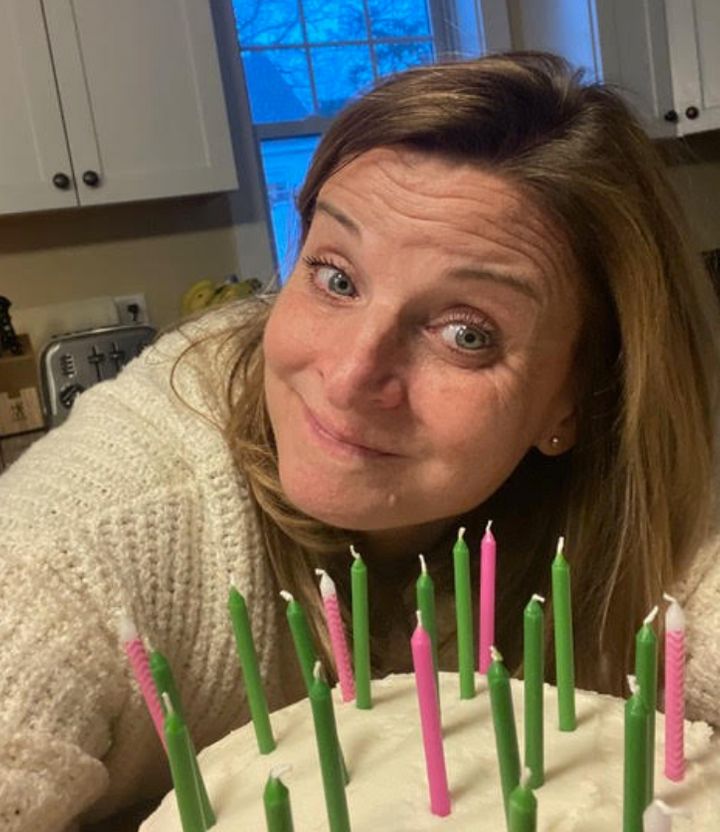
Courtesy of Melanie Brooks
Maybe it’s not so much about suddenly re-creating myself in a way that’ll make my kids feel compelled to do voice-over narration about their new and improved mother when they come home from college, but instead it’s about taking the pressure off, easing my way in and reminding myself who I already am. And even though I’m clearly not all that secure about her, there’s one thing I do know about 50-year-old me for certain: She’s not yet surrendering to the exterior cues prescribing mom jeans and a practical haircut for women her age, no matter what portrait that drug commercial paints of who I’m supposed to be.
Melanie Brooks is the author of “Writing Hard Stories: Celebrated Memoirists Who Shaped Art From Trauma” (Beacon Press, 2017). She teaches professional writing at Northeastern University and narrative medicine in the MFA program at Bay Path University in Massachusetts and creative writing at Nashua Community College in New Hampshire. She is completing a memoir called “A Hard Silence” about the lasting effect of living with the 10-year secret of her father’s HIV before his death in 1995. She lives in New Hampshire with her husband, two children (when they are home from college) and two Labs.
Do you have a compelling personal story you’d like to see published on HuffPost? Find out what we’re looking for here and send us a pitch!

Chelsea, from Nottingham, experienced low mood, anxiety and self-harm.
Vaccines and treatments have helped many in the UK but Isabel, 11, is among those still at risk.

What happens below the cellular level when the heart contracts and relaxes has long been unexplored. Thanks to new ultra-high-resolution electron microscopy techniques, scientists can now watch the heart beating — almost at a molecular level. Researchers at the Medical Faculty of the University of Freiburg summarise the most important developments in cardiac electron microscopy and their significance for research in a recent publication, published in Nature Reviews Cardiology. Insight at the nanometre scale is of great importance for the development of new therapies, for example for heart attacks or cardiac arrhythmias.
“With the high-resolution microscopy techniques developed by us and others worldwide, we gain fascinating insights into the dynamic ultrastructure of the heart,” says the study’s lead author Dr Eva Rog-Zielinska. She heads the 4D Imaging Section at the Institute of Experimental Cardiovascular Medicine (IEKM) of the University Heart Centre at the University Medical Centre Freiburg. “We can use this insight to analyse the three-dimensional structure of heart cells with unprecedented precision. Our images are made up of cubes — so-called voxels — with an edge length of one nanometre or less. For illustration: one nanometre is the distance a fingernail grows in one second,” Rog-Zielinska explains.
Watching the heart beat in super slow motion
A challenge is to link ultra-high resolution mapping of the heart to a moving target. “Thanks to recent advances in imaging, we now have a much better understanding of how muscle and connective tissue cells behave in the beating heart,” says co-author Prof Peter Kohl, Director of the IEKM, who is also the spokesperson of the German Collaborative Research Centre 1425 dedicated to exploring cardiac scarring.
Electron microscopy itself, but crucially also newly developed methods for the preparation and post-processing of corresponding samples, play a central role in the generation of molecular insight. “It is particularly exciting that we can record muscle cells like individual frames in a film — thanks to millisecond-precise high-pressure freezing. This allows us to watch the heart’s molecular structures beating in super slow motion, as it were,” says Kohl.
Experiments, simulations and artificial intelligence intertwine
The microscopic images are evaluated at IEKM with the help of artificial intelligence, assisted by computer simulations to depict heart function and pathological changes as realistically as possible. “Newly gained insight allows us to gain a completely new understanding of cardiac activity and, based on this, to develop new therapeutic concepts. We are looking forward to a very exciting time in heart research,” says Kohl.
Story Source:
Materials provided by University of Freiburg. Note: Content may be edited for style and length.

Most simulations of our climate’s future may be overly sensitive to Arctic ice melt as a cause of abrupt changes in ocean circulation, according to new research led by scientists at the University of Wisconsin-Madison.
Climate scientists count the Atlantic Meridional Overturning Circulation (or AMOC) among the biggest tipping points on the way to a planetary climate disaster. The Atlantic Ocean current acts like a conveyor belt carrying warm tropical surface water north and cooler, heavier deeper water south.
“We’ve been taught to picture it like a conveyor belt — even in middle school and high school now, it’s taught this way — that shuts down when freshwater comes in from ice melt,” says Feng He, an associate scientist at UW-Madison’s Center for Climatic Research.
However, building upon previous work, He says researchers are revising their understanding of the relationship between AMOC and freshwater from melting polar ice.
In the past, a stalled AMOC has accompanied abrupt climate events like the Bølling-Allerød warming, a 14,500-year-old, sharp global temperature hike. He successfully reproduced that event using a climate model he conducted in 2009 while a UW-Madison graduate student.
“That was a success, reproducing the abrupt warming about 14,700 years ago that is seen in the paleoclimate record,” says He, now. “But our accuracy didn’t continue past that abrupt change period.”
Instead, while Earth’s temperatures cooled after this abrupt warming before rising again to plateau at new highs for the last 10,000 years, the 2009 model couldn’t keep pace. The simulated warming over the northern regions of the planet didn’t match the increase in temperatures seen in geological archives of climate, like ice cores.
In a study published this week in the journal Nature Climate Change, He and Oregon State University paleoclimatologist Peter Clark describe a new model simulation that matches the warmth of the last 10,000 years. And they did it by doing away with the trigger most scientists believe stalls or shuts down the AMOC.
Warming temperatures on Earth’s surface cause sea ice in the Arctic Ocean and the Greenland Ice Sheet to melt, releasing fresh water into the ocean. Scientists widely believed that the freshwater influx disrupts the density differences in the North Atlantic that make the AMOC’s north-bound water sink and turn back south.
“The problem,” says He, “is with the geological climate data.”
Though the climate record shows an abundance of freshwater that came from the final melting of the ice sheets over North America and Europe, the AMOC barely changed. So, He removed the assumption of a freshwater deluge from his model.
“Without the freshwater coming in making the AMOC slow down in the model, we get a simulation with much better, lasting agreement with the temperature data from the climate record,” He says. “The important result is that the AMOC appears to be less sensitive to freshwater forcing than has long been thought, according to both the data and model.”
This is particularly important to climate models that evaluate how the AMOC will respond to future increases of freshwater from ice melt.
“It’s built into many models,” He says. “Future global warming from increasing carbon dioxide in the atmosphere melts sea ice, and the freshwater from the melting ice is believed to cause the AMOC to weaken.”
The widespread consequences of a drastic weakening of the AMOC include rapid sea-level rise on the eastern coast of North America, cooling over Europe that could disrupt agriculture, a parched Amazon rainforest and disruption of Asian monsoons. The new modeling study anticipates a much smaller reduction in AMOC strength, but that doesn’t rule out abrupt change.
“We suggest until this challenge is solved, any simulated AMOC changes from freshwater forcing should be viewed with caution,” He says. “We can’t be certain why the AMOC shut down in the past. but we are certain it did change. And it can change again.”

Ammonia is commonly used in fertilizer because it has the highest nitrogen content of commercial fertilizers, making it essential for crop production. However, two carbon dioxide molecules are made for every molecule of ammonia produced, contributing to excess carbon dioxide in the atmosphere.
A team from the Artie McFerrin Department of Chemical Engineering at Texas A&M University consisting of Dr. Abdoulaye Djire, assistant professor, and graduate student Denis Johnson, has furthered a method to produce ammonia through electrochemical processes, helping to reduce carbon emissions. This research aims to replace the Haber-Bosch thermochemical process with an electrochemical process that is more sustainable and safer for the environment.
The researchers recently published their findings in Nature Scientific Reports.
Since the early 1900s, the Haber-Bosch process has been used to produce ammonia. This process works by reacting atmospheric nitrogen with hydrogen gas. A downside of the Haber-Bosch process is that it requires high pressure and high temperature, leaving a large energy footprint. The method also requires hydrogen feedstock, which is derived from nonrenewable resources. It is not sustainable and has negative implications on the environment, expediting the need for new and environmentally friendly processes.
The researchers have proposed using the electrochemical nitrogen reduction reaction (NRR) to produce ammonia from atmospheric nitrogen and water. The benefits of using an electrochemical method include using water to provide protons and the ability to produce ammonia at ambient temperature and pressure. This process would potentially require lower amounts of energy and would be less costly and more environmentally friendly than the Haber-Bosch process.
The NRR works by using an electrocatalyst. For this process to succeed, nitrogen must bond to the surface and break apart to produce ammonia. In this study, the researchers used MXene, a titanium nitride, as the electrocatalyst. What differentiates this catalyst from others is that nitrogen is already in its structure, allowing for more efficient ammonia formulation.
“It’s easier for ammonia to form because the protons can attach to the nitrogen in the structure, form the ammonia and then the ammonia will leave out of the structure,” said Johnson. “A hole is made in the structure that can pull the nitrogen gas in and separate the triple bond.”
The researchers found that using titanium nitride induces a Mars-van Krevelen mechanism, a popular mechanism for hydrocarbon oxidation. This mechanism follows a lower energy pathway that would allow for higher ammonia production rates and selectivity because of the nitrogen from the titanium nitride catalyst.
Without modifications to the materials, the researchers reached a selectivity of 20%, which is the ratio of the desired product formed compared to the undesired product formed. Their method could potentially reach a higher selectivity percentage with modifications, forging a new pathway to ammonia production through electrochemical processes.
“The Department of Energy has set a goal of a selectivity of 60%, which is a challenging number to reach,” said Johnson. “We were able to reach 20% using our material, showcasing a method that we might be able to take advantage of moving forward. If we upgrade our material, can we reach 60% soon? That is the question we will continue to work to answer.”
This research could potentially reduce the carbon footprint and global energy usage on a larger scale.
“In the future, this could be a major scientific reform,” said Djire. “About 2% of the world’s total energy is used for ammonia production. Reducing that huge number would drastically reduce our carbon footprint and energy consumption.”
This study was funded by the Startup Research Fund. Other contributors to the publication are Eric Kelley from the chemical engineering department at Texas A&M, Brock Hunter from Auburn University, and Jevaun Christie and Cullan King from Prairie View A&M University.
Story Source:
Materials provided by Texas A&M University. Original written by Michelle Revels. Note: Content may be edited for style and length.
