Health24.com | Dangerous ‘drunkorexia’ hits college campuses

  • Researchers have found that many students diet, exercise or purge to offset calories from drinking
  • This behaviour was observed among female Australian students and is called ‘drunkorexia’
  • Drunkorexia appears to be motivated by two key social norms: consuming alcohol and thinness

College students are known to drink too much and eat a poor diet.

So it may not be surprising that new research has revealed that these two unhealthy behaviours often collide on campus.

When students diet, exercise or purge to purposely offset calories they consume from alcohol, experts sometimes call this “drunkorexia”.

The new study, published online recently in the journal Australian Psychologist, discovered that drunkorexia is incredibly common among female college students, and certain psychological thought patterns may be partially to blame.

Early ‘maladaptive schemas’

Based on a survey of nearly 500 female university students in Australia, researchers found that eight in 10 had engaged in drunkorexic behaviours – skipping meals, drinking low-calorie or sugar-free alcoholic beverages, and purging or exercising after drinking – over a three-month period.

Close to three in 10 reported engaging in these behaviours to offset the calories they took in from alcohol. They did not otherwise show signs of an eating disorder.

The study also found that those who engaged in drunkorexic behaviours were likely to share particular thought patterns – called early maladaptive schemas – or deeply held beliefs about oneself that often develop in childhood.

The researchers identified insufficient self-control, emotional deprivation and social isolation as the three particular schemas associated with drunkorexia.

“Drunkorexia behaviour appears to be motivated by two key social norms for young adults – consuming alcohol and thinness,” said study author Alycia Powell-Jones, a clinical psychologist at the University of South Australia.

More intense intoxication

“However, our research indicates that this behaviour can be a coping strategy potentially to manage social anxieties, through becoming accepted and fitting in,” she added.

Prior research has confirmed that excessive drinking and disordered eating often go hand-in-hand, but this study was the first to identify potential underlying causes.

The prevalence of drunkorexia should be cause for concern, according to two experts, as the combination of these two behaviours comes with consequences.

One concern is that restricting food while drinking alcohol increases the intensity of intoxication.

“Having food in your stomach prior to drinking helps to slow down how quickly alcohol enters your bloodstream,” explained Lisa Fucito, an associate professor of psychiatry at Yale University School of Medicine in New Haven, Connecticut.

Relatively common behaviours

And alcohol is not a replacement for food – it is just empty calories, added Fucito.

“Individuals who engage in these patterns may actually put on weight and have nutritional deficits,” she noted.

Besides the well-established dangers inherent to eating disorders and excessive alcohol consumption, the combination heightens the risk that one will progress towards more severe forms of the two conditions.

According to Simon Sherry, a professor of psychology and neuroscience at Dalhousie University in Halifax, Nova Scotia, “Individuals who engage in these relatively common behaviours will be at risk to develop the full-blown version of an eating disorder or the full-blown version of a substance use disorder.”

Sherry said, “One of the riskiest things here is that you could move further down a continuum of having a mental illness.”

But he emphasised that there are well-established interventions to treat eating disorders, and he believes that these techniques could manage drunkorexia.

Deeply ingrained psychological factors

“We have roughly three decades of research that suggests cognitive behavioural therapy is an effective intervention for disordered eating, and I think that intervention could easily and flexibly take into account this pattern of behaviour whereby alcohol gets woven into a pattern of disordered eating,” Sherry said.

“I’d be quite optimistic about helping someone who was suffering from this particular collision between food and alcohol problem,” he said.

As this study revealed, there may be deeply ingrained psychological factors that contribute to the development of drunkorexia, and Fucito said that effective intervention would need to address them.

“An effective intervention needs to address both risks – the pressures to be thin and to drink heavily,” Fucito explained.

Image credit: Shutterstock

Share Button

Health24.com | Enjoy a nap, but know the pros and cons

  • According to a number of studies, napping is a double-edged sword
  • Short naps appear to be good for cardiovascular health, whereas long naps don’t
  • Napping too long during the day can disrupt overall sleep patterns, and it’s best to ‘maximise sleep at night’

You could read this story now. Or you could take a nap first, and perhaps tackle it feeling more alert and refreshed.

Health-wise, is that a good idea?

Under the right conditions, for the right reasons, probably – if you’re awake to the possible pitfalls.

“A power nap, between 15 and 45 minutes, can improve memory and reduce fatigue for the rest of the day,” said Dr Michael Grandner, director of the Sleep and Health Research Program at the University of Arizona in Tucson. “If you’re otherwise well-rested, that kind of nap can actually boost performance pretty well.”

Long-term effects inconclusive

Some studies even compare the benefits of a midday nap to a cup of coffee, while some companies – including Google and NASA – let workers pencil naptime into their daily schedule.

But the long-term effects of naps are less conclusive.

For example, a 2019 study in the British medical journal Heart tracked the napping habits of nearly 3 500 people over five years and found those who napped once or twice a week were 48% less likely to have a cardiovascular event than those who didn’t. Conversely, a meta-analysis of 11 studies published in the journal Sleep in 2015 showed people who nap for an hour or more a day had 1.82 times the rate of cardiovascular disease than people who didn’t nap.

“We do not know enough about the association of naps with either optimal health or disease risk, especially cardiovascular disease,” said Dr Clete Kushida, a neurologist and professor of psychiatry and behavioural sciences at the Stanford University Medical Center in California. “More research needs to be conducted.”

The more urgent health question, both experts say, is why you’re taking that nap.

Sleep evaluation urged

“If you’re napping because it helps you get through the day, that’s probably a good thing,” Grandner said. “But if you’re napping because you just can’t stay awake, that’s a sign that there’s some underlying health issue. You’re either not getting enough sleep at night or your sleep quality could be very poor.”

The Centers for Disease Control and Prevention estimates one-third of US adults don’t get enough sleep – at least seven hours per night is the standard recommendation – and warns that the risks include heart disease, diabetes, obesity and depression. Even the weary who appear to have slept long enough may have sleep apnoea, a common sleep disorder where breathing is frequently interrupted.

“If an individual has significant daytime sleepiness leading to inadvertent or spontaneous naps, it usually indicates sleep quantity or sleep quality issues,” Kushida said. If the sleep time seems adequate, he urges an evaluation “for sleep disorders and/or medical diseases”.

The ideal nap, Kushida and Grandner agree, shouldn’t last too long.

“You don’t want to get into a deep stage of sleep,” Grandner said. “If you’ve ever woken up from a nap that was too long, you know it because you feel miserable and groggy.”

Napping too long during the day, Kushida added, can disrupt overall sleep patterns. “It’s generally recommended to maximise sleep at night,” he said.

A foundational part of our biology

Grandner said the exception might be if someone occasionally doesn’t sleep enough at night and needs to recoup during the day.

“I call that the sleep replacement nap,” he said. “College students do it a lot. They stay up at night, but then they nap a few hours during the day. That’s not an ideal solution, but it’s not terrible, either.”

Lying down for a nap or laying your head on the desk might be a good time to reflect on the importance of sleep.

“We live in a culture that doesn’t necessarily value sleep,” Grandner said. “We need to stop talking about it as unproductive time, and to stop admiring people who brag about how little sleep they think they need.

“The scientific evidence is there,” he said. “Sleep is a foundational part of our biology, like diet and physical activity. We need to take care of it.”

Image credit: Unsplashed

Share Button

Health24.com | Could vegetables be the fountain of youth?

  • Plant protein has been proven to have a positive effect on longevity
  • Diets high in animal protein, on the other hand, are linked to numerous health problems
  • Benefits of plant proteins include lower blood pressure, cholesterol and blood sugar levels

If you want to live longer, you should choose beans over beef for your protein, a new analysis suggests.

“These findings have important public health implications as intake of plant protein can be increased relatively easily by replacing animal protein and could have a large effect on longevity,” the researchers reported.

Diets high in protein from plants– such as legumes (peas, beans and lentils), whole grains and nuts – have been linked to a lower risk of diabetes, heart disease and stroke, while diets high in animal protein have been linked with a number of health problems.

However, there have been conflicting findings on the association between different types of proteins and the risk of early death, so a group of researchers analysed 32 studies that examined the risk of death from heart disease, cancer and any cause in adults aged 19 and older.

Lower risk of lifestyle diseases

During a follow-up of up to 32 years, just over 113 000 deaths occurred among more than 715 000 participants in the studies. A high intake of total protein was associated with a lower risk of all-cause death.

Consumption of plant protein was associated with an 8% lower risk of death from any cause and a 12% lower risk of death from heart disease. Consumption of animal protein was not significantly associated with risk of death from heart disease or cancer.

Data from 31 of the studies also showed that an additional 3% of energy from plant proteins a day was associated with a 5% lower risk of death from any cause, according to the findings published n 22 July in the BMJ.

Possible reasons for the beneficial effects of plant proteins include lower blood pressure, cholesterol and blood sugar levels, which might help reduce the risk of conditions such as heart disease and type 2 diabetes, said Ahmad Esmaillzadeh, a professor of nutrition at Tehran University of Medical Sciences in Iran, and colleagues.

Further research is required, but the study results “strongly support the existing dietary recommendations to increase consumption of plant proteins in the general population”, the researchers said in a journal news release.

Image credit: iStock

NEXT ON HEALTH24X

Share Button

Coronavirus: Safety fears over lack of translated virus advice

Covid-19 advice is in a limited range of languages and takes too long to be updated, campaigners say.

Share Button

Obesity: Have 20 years of policies had any effect?

There’s been two decades of efforts to tackle obesity. Has anything worked?

Share Button

Randomness theory could hold key to internet security

The question has been central to cryptography for thousands of years, and lies at the heart of efforts to secure private information on the internet. In a new paper, Cornell Tech researchers identified a problem that holds the key to whether all encryption can be broken — as well as a surprising connection to a mathematical concept that aims to define and measure randomness.

“Our result not only shows that cryptography has a natural ‘mother’ problem, it also shows a deep connection between two quite separate areas of mathematics and computer science — cryptography and algorithmic information theory,” said Rafael Pass, professor of computer science at Cornell Tech.

Pass is co-author of “On One-Way Functions and Kolmogorov Complexity,” which will be presented at the IEEE Symposium on Foundations of Computer Science, to be held Nov. 16-19 in Durham, North Carolina.

“The result,” he said, “is that a natural computational problem introduced in the 1960s in the Soviet Union characterizes the feasibility of basic cryptography — private-key encryption, digital signatures and authentication, for example.”

For millennia, cryptography was considered a cycle: Someone invented a code, the code was effective until someone eventually broke it, and the code became ineffective. In the 1970s, researchers seeking a better theory of cryptography introduced the concept of the one-way function — an easy task or problem in one direction that is impossible in the other.

For example, it’s easy to light a match, but impossible to return a burning match to its unlit state without rearranging its atoms — an immensely difficult task.

“The idea was, if we have such a one-way function, maybe that’s a very good starting point for understanding cryptography,” Pass said. “Encrypting the message is very easy. And if you have the key, you can also decrypt it. But someone who doesn’t know the key should have to do the same thing as restoring a lit match.”

But researchers have not been able to prove the existence of a one-way function. The most well-known candidate — which is also the basis of the most commonly used encryption schemes on the internet — relies on integer factorization. It’s easy to multiply two random prime numbers — for instance, 23 and 47 — but significantly harder to find those two factors if only given their product, 1,081.

It is believed that no efficient factoring algorithm exists for large numbers, Pass said, though researchers may not have found the right algorithms yet.

“The central question we’re addressing is: Does it exist? Is there some natural problem that characterizes the existence of one-way functions?” he said. “If it does, that’s the mother of all problems, and if you have a way to solve that problem, you can break all purported one-way functions. And if you don’t know how to solve that problem, you can actually get secure cryptography.”

Meanwhile, mathematicians in the 1960s identified what’s known as Kolmogorov Complexity, which refers to quantifying the amount of randomness or pattern of a string of numbers. The Kolmogorov Complexity of a string of numbers is defined as the length of the shortest computer program that can generate the string; for some strings, such as 121212121212121212121212121212, there is a short program that generates it — alternate 1s and 2s. But for more complicated and apparently random strings of numbers, such as 37539017332840393452954329, there may not exist a program that is shorter than the length of the string itself.

The problem has long interested mathematicians and computer scientists, including Juris Hartmanis, professor emeritus of computer science and engineering. Because the computer program attempting to generate the number could take millions or even billions of years, researchers in the Soviet Union in the 1960s, as well as Hartmanis and others in the 1980s, developed the time-bounded Kolmogorov Complexity — the length of the shortest program that can output a string of numbers in a certain amount of time.

In the paper, Pass and doctoral student Yanyi Liu showed that if computing time-bounded Kolmogorov Complexity is hard, then one-way functions exist.

Although their finding is theoretical, it has potential implications across cryptography, including internet security.

“If you can come up with an algorithm to solve the time-bounded Kolmogorov complexity problem, then you can break all crypto, all encryption schemes, all digital signatures,” Pass said. “However, if no efficient algorithm exists to solve this problem, you can get a one-way function, and therefore you can get secure encryption and digital signatures and so forth.”

The research was funded in part by the National Science Foundation and the Air Force Office of Scientific Research, and was based on research funded by the Intelligence Advanced Research Projects Activity in the Office of the Director of National Intelligence.

Share Button

How airway cells work together in regeneration and aging

Researchers at the Eli and Edythe Broad Center of Regenerative Medicine and Stem Cell Research at UCLA have identified the process by which stem cells in the airways of the lungs switch between two distinct phases — creating more of themselves and producing mature airway cells — to regenerate lung tissue after an injury.

The study, published in Cell Stem Cell, also sheds light on how aging can cause lung regeneration to go awry, which can lead to lung cancer and other diseases.

“There currently are few therapies that target the biology of lung diseases,” said Dr. Brigitte Gomperts, a professor and vice chair of research in pediatric hematology-oncology at the UCLA Children’s Discovery and Innovation Institute and the paper’s senior author. “These findings will inform our efforts to develop a targeted therapy to improve airway health.”

The airways, which carry the air that is breathed in from the nose and mouth to the lungs, are the body’s first line of defense against airborne particles — like germs and pollution — that can cause illness.

Two types of airway cells play a vital role in this process: mucus cells, which secrete mucus to trap harmful particles, and ciliated cells, which use their finger-like projections to sweep the mucus-engulfed particles up to the back of the throat, where they can be cleared out of the lungs.

The infectious or toxic particles that people breathe in every day can injure the airways and when that happens, airway basal stem cells — which are capable of self-renewing and producing the mucus and ciliated cells that line the airways — activate to repair the damage.

To keep the right balance of each cell type, airway basal stem cells must transition from the proliferative phase, during which they produce more of themselves, to the differentiation phase, during which they give rise to mature airway cells.

“These stem cells have to maintain a really delicate equilibrium,” said Gomperts, who is also co-director of the cancer and stem cell biology program at the UCLA Jonsson Comprehensive Cancer Center. “They have to produce just the right amount of mucus and ciliated cells to keep harmful particles out of the lungs, but they also have to self-replicate to ensure there will be enough stem cells to respond to the next injury.”

In the new study, the researchers examined mice with lung injuries, analyzing how the different types of cells found in the niche — the supportive environment that surrounds airway basal stem cells — work together to orchestrate the repair response.

They found that a group of molecules known as the Wnt/beta-catenin signaling pathway activates to stimulate the airway basal stem cells to respond to injury. The researchers were surprised to discover that this group of molecules originates in one cell type to initiate proliferation and another cell type to initiate differentiation.

In the proliferation phase of repair, a connective tissue cell called a fibroblast secretes the Wnt molecule, which signals to the stem cells that it’s time to self-renew. In the differentiation phase of repair, the Wnt molecule is secreted by an epithelial cell, which make up the lining of tissues and organs, to signal to the stem cells that it’s time to produce mature airway cells.

Understanding how regeneration occurs in healthy lungs is a critical first step to understanding how disease can arise when the process goes wrong. Seeking insights into what role this process and the cells that activate it might play in disease, the scientists studied its activity in older mice.

“We were surprised to find that in the aging airways, the Wnt/beta-catenin signaling pathway is active in the stem cells even when there is no injury, in contrast to the young airways where it is only activated when necessary,” said Cody Aros, the paper’s first author, a UCLA medical student who recently completed his doctoral research. “When this pathway is active, it stimulates the stem cells to produce more of themselves and more airway cells — even if they’re not needed.”

Previous research by Gomperts’ lab has established a link between a more active Wnt/beta-catenin pathway and lung cancer.

“The more a cell divides, the more likely it is that a proofreading error or mutation can occur and lead to cancer,” Gomperts said.

The new paper builds on that work by establishing not just what goes wrong but precisely when it goes wrong in otherwise healthy people as part of the aging process.

“These findings give us insight into which cell types are important, which pathway is important and when we might want to think about intervening with therapies to prevent the formation of cancer,” Aros said.

Share Button

Scientists record rapid carbon loss from warming peatlands

Scientists at the Department of Energy’s Oak Ridge National Laboratory have demonstrated a direct relationship between climate warming and carbon loss in a peatland ecosystem. Their study published in AGU Advances provides a glimpse of potential futures where significant stores of carbon in peat bogs could be released into the atmosphere as greenhouse gases.

Peatlands currently cover around 3% of Earth’s landmass and hold at least a third of global soil carbon — more carbon than is stored in the world’s forests.

Peat bogs are particularly good at locking away carbon because of the cold, wet, acidic conditions that preserve meters-deep layers of ancient plant matter. Scientists have taken a keen interest in these enormous carbon reserves, questioning how much and how quickly the hotter, drier conditions in a peatland bog can trigger microbial processes that release carbon in the form of carbon dioxide and methane into the air, furthering the warming cycle as the gases trap heat in the atmosphere.

Enter DOE’s Spruce and Peatland Responses Under Changing Environments, or SPRUCE project, a unique whole ecosystem manipulation experiment in the forests of northern Minnesota. SPRUCE uses a series of enclosures to expose large peatland plots to five different temperatures, with the hottest of the chambers experiencing an increase of about 16 degrees Fahrenheit above and deep belowground. Half the enclosures also received elevated levels of carbon dioxide.

This futuristic experiment allows scientists to measure the effects of conditions this ecosystem has never experienced before, providing a glimpse of potential future climates.

“Because of DOE’s investment in a large-scale experiment, we’ve been able to study whole ecosystem warming across a range of temperatures that can’t be extrapolated from historical data,” said Paul Hanson, ORNL ecosystem scientist and SPRUCE project coordinator. “In doing so, we have evidence that carbon losses will be anticipated for rapidly changing peatland systems in the future.”

Hanson and his colleagues examined three years of SPRUCE data, tracking changes in plant growth, water and peat levels, microbial activity, fine root growth and other factors that control the movement of carbon into and out of the ecosystem. Together, these intakes and outputs make up what’s known as the carbon budget.

The study found that in just three years, all warmed bog plots turned from carbon accumulators into carbon emitters — marking the first time whole-ecosystem plots have been used to document such changes. This fundamental shift in the nature of the bog occurred even at the most modest level of warming (about 4 degrees F above ambient temperature), and showed carbon loss rates five to nearly 20 times faster than historical rates of accumulation.

Warmer temperatures directly translated into greater carbon emissions, with the warmest of the experimentally heated plots emitting the most carbon dioxide and methane. The scientists were surprised to find such a linear relationship between heat and carbon loss.

“This is a very tight relationship for biological data,” Hanson said. “These results were within the range of hypotheses that we allowed ourselves to think about, but the sensitivity of carbon loss to temperature was a bit of a surprise.”

The decline of sphagnum moss, a key species in this ecosystem, contributed notably to the net carbon loss. A previous study by ORNL colleague Richard Norby detailed sphagnum’s role in accumulating carbon in peat and its potentially irreversible decay as warming dries out bogs.

The SPRUCE data will inform a new wetland model for potential use in DOE’s Energy Exascale Earth System Model project, which uses high-performance computing to simulate and predict environmental changes important to the energy sector. The wetland model accurately predicted the temperature effects but overestimated the impact of elevated carbon dioxide compared with the SPRUCE data, which showed no significant ecosystem-level effects after three years of treatment.

Story Source:

Materials provided by DOE/Oak Ridge National Laboratory. Note: Content may be edited for style and length.

Share Button

Coronavirus ‘most severe health emergency’ WHO has faced

The World Health Organization warns of a long road ahead despite huge efforts made to curb the virus.

Share Button

Your Weekly Priority Card

When you have a lot of quarterly goals, it can be tricky to keep them prioritized, especially since priorities can shift as you go through the quarter. So it’s good to have a reliable practice to refocus your attention on your top priorities.

One simple practice I’ve been using lately is to create a priority card at the start of each week. It’s just an index card with my top priorities for the week listed on it. I keep it near my desk and normally review it to begin each workday, along with reviewing my other quarterly goals. This helps me see the week’s priorities in the context of bigger goals, which makes me feel more committed to progress.

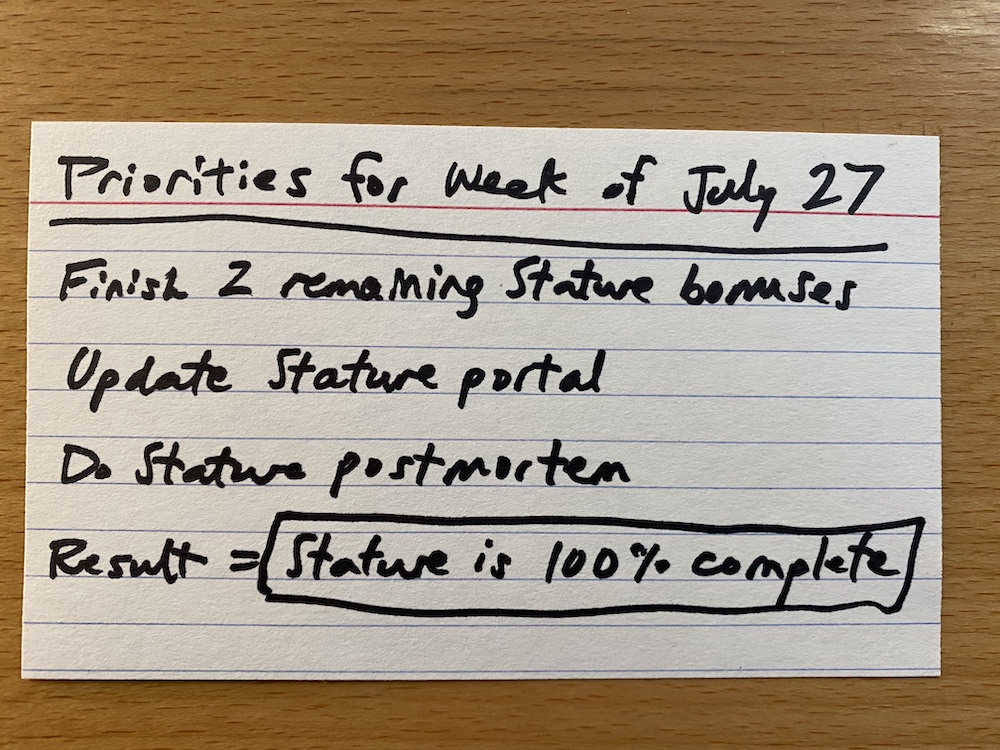
Here’s what my priority card for this week looks like:

It only takes seconds to fill out one of these cards, so it’s very straightforward. This week my #1 priority is to finish and publish the two remaining bonuses for the Stature course. One bonus is a short text document – basically a character design sheet – which is almost done. I expect to have that one done and published today or tomorrow. The final bonus is a collection of audios (Stature builders) that will likely take me a few days to finish.

My other priorities include making some improvements to the Stature portal and doing a postmortem for the Stature project.

I expect to do these in the order listed. I’ll have the Stature project 100% done when these items are completed, which will be a nice result. It feels good to bring a long project to full completion.

Do I know I can complete these items in a week? I know I can work on them a decent amount this week, but since they involve some creative work that’s tricky to predict time-wise, I may need more than a week to finish. That’s okay. I can continue working on them next week if necessary. But the priority for this week is to move these projects forward towards completion.

These projects have detailed action steps listed in Nozbe, so the priority card items refer to known projects that have already been mapped out. I know what needs to be done, so the main decision is to flow through these particular action steps this week.

There are dozens of other projects that I won’t touch this week – eventually they’ll get their turns as well, but I can only fit so much into a single week. While I could jump around and make progress on lots of different projects in a week, this week I’d like to maintain more of a mono-focus and move this one project forward, especially since it’s so close to the finish line.

I can still maintain habit-based activities such as daily blogging and other pre-scheduled commitments each week. The priority card helps me make good use of my discretionary work time – i.e. those blocks of time that aren’t already spoken for.

Setting priorities also helps to clarify posteriorities. Anything not listed on my priority card for a given week isn’t a priority for that week. I may still be able to work it in, but I’d rather make progress on the priorities first. This doesn’t mean that other items aren’t important, but it does mean that I’ve decided they aren’t as important for me to attend to in the current week.

To make meaningful progress on interesting projects, something else has to wait. If you don’t decide in advance what has to wait, your focus is more likely to become scattered or chaotic throughout the week. You’ll still have to make those prioritization decisions at some point, but your decisions may be ad hoc and inconsistent if you don’t maintain a reliable process for weighing options and deciding.

Filling out a weekly priority card after reviewing my quarterly goals works well for me. I’m basically breaking off a chunk of my quarterly goals to set priorities for the upcoming week.

I encourage you to make your own priority card for this week. Test this idea to see if it helps you focus better and improve your results. Grab and index card and a marker or pen right now, and make it so.

After you fill out your priority card, keep it somewhere convenient, so you’ll review it each day. I recommend that you use one of your devices to set a daily reminder to review it at a certain time, so you’ll have a convenient trigger for the review action.

As I noted earlier, it’s best to set priorities for the week after reviewing your quarterly goals. If you don’t have quarterly goals intelligently defined, you can still apply this idea without them, but it’s best to set weekly priorities based on long-term goals. Also consider joining us in Conscious Growth Club next year, and we’ll walk you through a 5-step process to define and update your goals at the start of every calendar quarter. It does take some practice to get into the rhythm of doing this, but it makes a world of difference in the progress you can make. A delightful benefit of this kind of investment is being able to set and achieve meaningful goals and advancing them week by week and quarter by quarter.

Update (several hours later): As expected I got one of the remaining Stature bonuses completed and published today. So that’s a very nice start to the week!

Share Button