Health24.com | All that Twitter and Snapchat may not be bad for teens

Teens spend countless hours glued to their phones and tablets, continually posting on social media, but British researchers report that it might not be as terrible as many parents may think.

It appears that teens who are less satisfied with their lives do tend to spend more time on Snapchat, Instagram and the like, but the link between life satisfaction and time spent on social media was “trivial”, the research found.

New modelling methods

“The previous literature was based almost entirely on correlations with no means to dissociate whether social media use leads to changes in life satisfaction or changes in life satisfaction influence social media use,” explained researcher Amy Orben, a lecturer in psychology at the University of Oxford.

But by applying new modelling methods to an eight-year survey of households in the United Kingdom, the researchers were able to tease out data that gave them a better understanding of the effect of social media.

The survey looked at how much time teens spent on social media during a normal school day and compared this with their life satisfaction ratings.

The researchers did find lower life satisfaction increased the time spent on social media, while less time on social media was tied to higher life satisfaction.

This finding was stronger among girls than boys, but even so, the connection was tenuous, they noted.

More and better data needed

Co-lead author Andrew Przybylski, director of research at Oxford Internet Institute, said this finding is an important step in understanding the effects of social media.

“Given the rapid pace of technological advancement in recent years, the question of how our increasing use of technology to interact with each other affects our well-being has become increasingly important,” Przybylski said in an Oxford news release.

“With most of the current debate is based on lacklustre evidence, this study represents an important step towards mapping the effects of technology on adolescent well-being”, he said.

These findings hint at what the effect of social media might be on teens, but more and better data are needed to really understand the impact of social media, the researchers added.

“Applying transparent and innovative statistical approaches, we show that social media effects are not a one-way street, they are nuanced, reciprocal, possibly contingent on gender, and arguably trivial in size,” the researchers concluded.

The study was published in the Proceedings of the National Academy of Sciences.

Image credit: iStock

Share Button

Health24.com | Toddler with ball-shaped foot has ‘astounding enthusiasm’, mom says

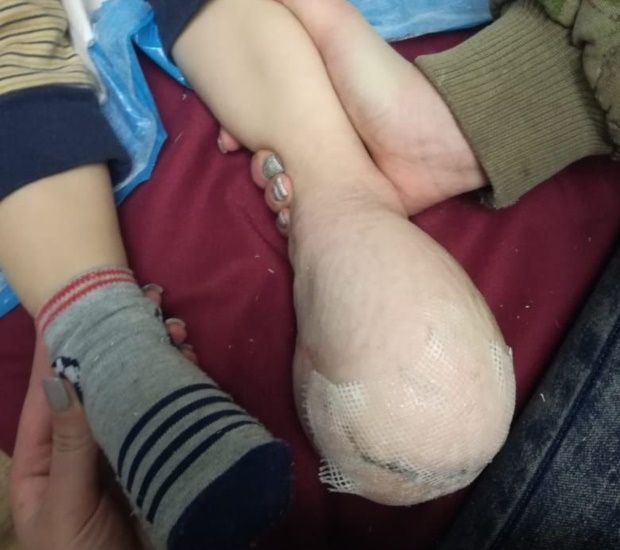
Little Nathan Ungerer (3) has already undergone four operations after being incorrectly diagnosed with a hereditary disease in his left foot.

The energetic toddler, who lives with his mother in Middelburg, has never been able to wear shoes.

But this might change after his fifth – and hopefully final – surgery in coming months which is aimed at reducing the size of his left foot.

Nathan was mistakenly diagnosed at birth with hereditary Milroy disease, or lymphedema. An MRI scan later revealed the problem was due to lipoma – a harmless fatty lump between the skin and underlying muscle tissue.

“So far the operations have been successful and his left foot is now much smaller. It did grow twice as fast as the right foot – which happens in Milroy disease – but we’re relieved it’s not hereditary and won’t grow any bigger,” said Nathan’s grandmother, Selona van Wyngaard, who’s from Roodepoort, Gauteng.

YOU visited the family in August 2017 before Nathan’s new diagnosis, when the series of operations to systematically remove the fatty tumour in his foot had already started.

Selona says Nathan and his mom, Soné van Aswegan have since moved to Middelburg, Mpumalanga, and travel to Johannesburg for his treatment at a West Rand hospital.

Selona beams when she talks about her daughter and grandson. “Soné looks after him so well . . . they stay on a farm and she’s met a wonderful man who’s good to them,” she says. Her daughter fell pregnant with Nathan in her teens.

This week a proud Soné sent a photo of Nathan horse-riding for the first time to her mother and all their supporters.

Nathan's foot after several operations.

“Nathan is always laughing, and keeps getting cuter,” Sone wrote.

“His foot will stay round, even after the final operation, but it doesn’t seem to bother him. I recently saw slippers that might fit him and wanted to buy them. But he’s never been bothered with shoes – I’m astounded by his enthusiasm each day.”

Image credit: Supplied

Share Button

Mental health cut-off: Why sling me out of CAMHS at 18?

Kirsty was being treated by Child and Adolescent Mental Health Services (CAMHS) – but then she turned 18.

Share Button

NHS staff shortage: How many doctors and nurses come from abroad?

Could the NHS endanger health services in poorer countries by recruiting overseas?

Share Button

Body image concerns ‘making people suicidal’

Mental health experts say the issue is too often overlooked but is causing people real distress.

Share Button

Health24.com | WATCH: What if our brains were half the size?

The human brain is packed with 100 billion neurons. It’s responsible for everything we do, think and feel. It dictates our emotions, intelligence and overall mental health. But, what if our brains were 50% smaller?

Image credit: iStock

NEXT ON HEALTH24X

Share Button

Health24.com | WATCH: What if you were swallowed alive?

12 May 2019

WATCH: What if you were swallowed alive?

Whether you’re in the jaws of a shark or crocodile, forced through the digestive system of a reticulated python, or helplessly trapped inside a whale… It’s a terrible situation to be in.

Getting swallowed alive is a worst nightmare scenario. Whether you’re in the jaws of a shark or crocodile, forced through the digestive system of a reticulated python, or helplessly trapped inside a whale… It’s a terrible situation to be in.

Image credit: iStock

Share Button

Health24.com | FEATURE DOCUMENTARY: Could a cheaper Bug Mac ever replace the Big Mac?

12 May 2019

FEATURE DOCUMENTARY: Could a cheaper Bug Mac ever replace the Big Mac?

Can eating insects save the world?

As we search for alternative food sources, it begs the question: Can eating insects save the world?

Image credit: iStock

NEXT ON HEALTH24X

Live healthier

Share Button

Ramadan bootcamp: Getting fit for the fast

A gym class for Muslim women in Leicestershire has been preparing them for the holy month.

Share Button

Cancer screening rates decline when patients see doctors later in day

Compared to patients who see their primary care doctor earlier in the day, cancer screening rates decline significantly as the day goes on, according to a new study from researchers in the Perelman School of Medicine and the Wharton School both of the University of Pennsylvania. The researchers, whose findings were published today in JAMA Network Open, believe these rates of decline may be in part due to “decision fatigue” — which results from the cumulative burden of screening discussions earlier in the day — and doctors falling behind in their busy schedules.

“Our findings suggest that future interventions targeting improvements in cancer screening might focus on time of day as an important factor in influencing behaviors,” said the study’s lead author, Esther Hsiang, a Wharton Business School student and researcher with the Penn Medicine Nudge Unit. “We believe that the downward trend of ordering may be the result of ‘decision fatigue,’ where people may be less inclined to consider a new decision after they’ve been making them all day. It may also stem from overloaded clinicians getting behind as the day progresses.”

The researchers found that, among eligible patients, primary care doctors ordered breast cancer screening more often for patients seen in the 8 a.m. hour (64 percent) as compared to those with appointments at 5 p.m. (48 percent). Similarly, for colon cancer screening, tests were also ordered more frequently for 8 a.m. patients (37 percent) compared to those coming in later in the day (23 percent).

Examining data from 2014 through 2016 across 33 Pennsylvania and New Jersey primary care practices, the researchers found that ordering rates had far-reaching effects. When looking at the entire population eligible for screenings at these practices (roughly 19,000 for breast cancer and 33,000 for colorectal cancer), the researchers tracked whether the patients completed a screening within a year of their appointment. The data showed that the downward trend associated with the timing of the appointments carried over.

Breast cancer screening — which included mammograms — stood at a 33 percent one-year completion rate for the entire eligible population who had their appointment in the 8 a.m. hour. But for those who had clinic visits at 5 p.m. or later, just 18 percent completed screenings. For colorectal cancer, screenings such as colonoscopies, sigmoidoscopies, and fecal occult blood tests were completed by 28 percent of the patients with appointments in the 8 a.m. hour. That number dropped to 18 percent for patients who saw the doctor at 5 p.m. or later.

The one-year completion results cast long shadows. While doctors may simply be deferring discussions about screening to future appointments, it assumes that the decision will be made the next time. Additionally, these types of cancer screenings also require coordination with a different department and another visit on the part of the patient, which provide several opportunities for further lapses in screening.

Researchers also observed that although order rates fell as the day progressed, there was a brief spike in screening orders for breast and colon cancers when patients saw their clinician around noon. For example, breast cancer screening orders dropped to 48.7 percent at 11 a.m. but increased to 56.2 percent around noon, before gradually falling off again. This trend held true for one-year completion rates, as well. The study team suggest that this may be due to lunch breaks that give clinicians and opportunity to catch up and start fresh.

A downward trend in outcomes by hour was noted in a study in 2018 examining the rates of flu vaccinations by the time of day when patients saw a clinician. In that study, a “nudge” was built into the system that prompted doctors to accept or decline an influenza vaccine order, which helped spur an increase of vaccinations by nearly 20 percent, as compared to patients with doctors who weren’t nudged.

“Our new study adds to the growing evidence that time of day and decision fatigue impacts patient care,” said Mitesh Patel, MD, MBA, director of the Penn Medicine Nudge Unit and an assistant professor of Medicine. “In past work, we’ve found that nudges in the electronic health record can be used to address these types of gaps in care, which we suspect will be the case here. Future research could evaluate how nudges may be implemented in order to improve cancer screening.”

Other Penn authors on this study included Shivan Mehta, Dylan Small, Charles Rareshide, Christopher Snider and Susan Day.

Share Button