A giant wave is rippling through the Milky Way, and scientists don’t know why

Our Milky Way is constantly in motion: it spins, it tilts, and, as new observations reveal, it ripples. Data collected by the European Space Agency’s Gaia space telescope show that our galaxy is not only rotating and wobbling but also sending out a vast wave that travels outward from its center.

For about a century, astronomers have known that the Milky Way’s stars orbit its core, and Gaia has precisely tracked their speeds and trajectories. Since the 1950s, scientists have also recognized that the galactic disc is not flat but warped. Then in 2020, Gaia uncovered that this warped disc slowly oscillates over time, similar to the motion of a spinning top.

Now, researchers have identified an enormous wave that moves through the Milky Way, influencing stars tens of thousands of light-years from the Sun. The phenomenon is like a rock dropped into a pond, where the resulting ripples spread outward — only here, the “ripples” are made of stars, stretching across the galaxy’s outer regions.

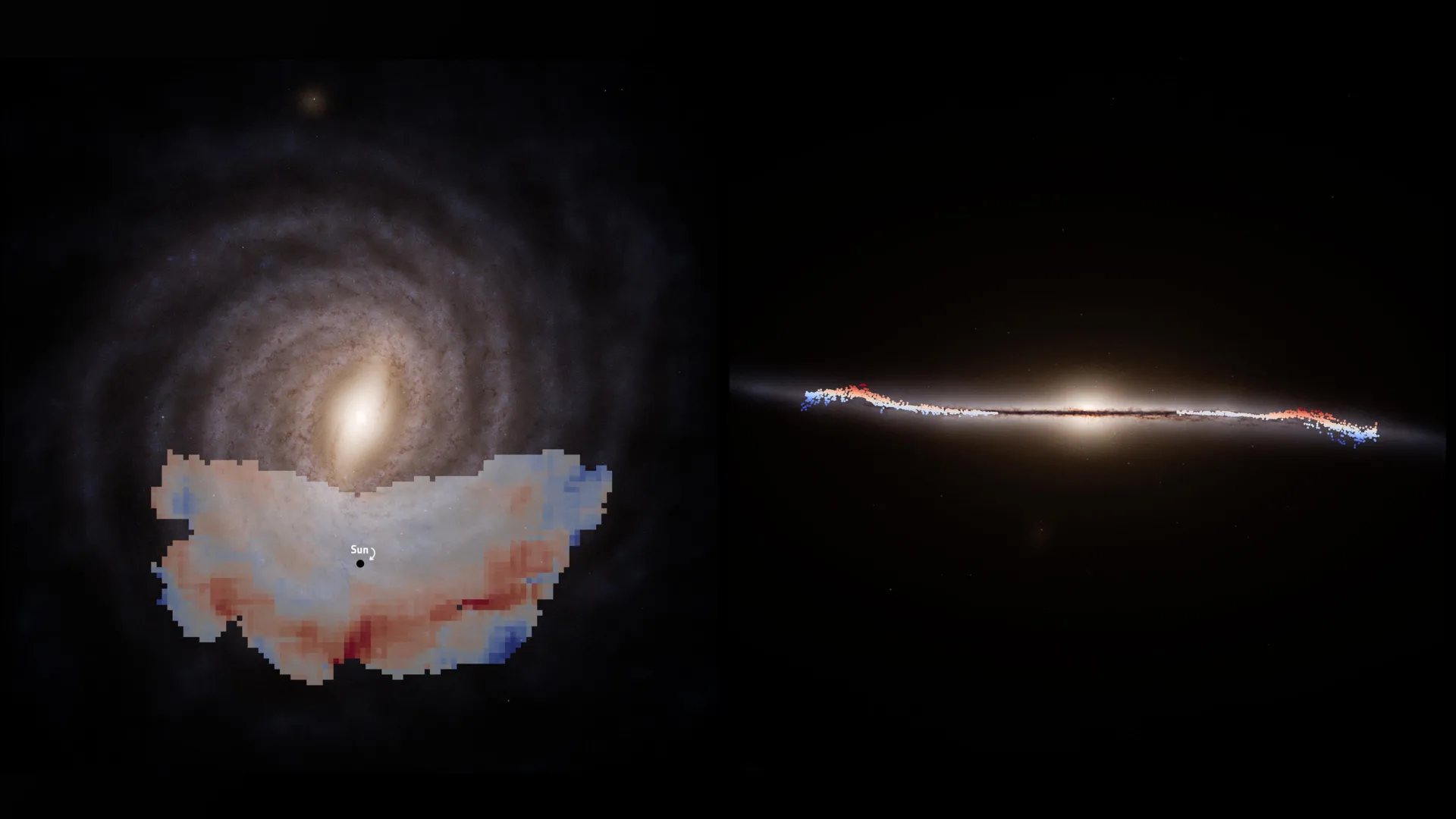
The newly revealed wave is illustrated in the figure above. Thousands of bright stars, shown in red and blue, are overlaid on Gaia’s detailed map of the Milky Way.

In the image on the left, we see our galaxy from a top-down perspective. The right panel shows a side view, cutting vertically through the galactic plane. From this angle, the left portion of the galaxy curves upward while the right side bends downward (this is the warp of the disc). The red and blue regions mark the newly discovered wave: red areas indicate stars located above the warped plane, while blue areas show stars lying below it.

Although no spacecraft can venture beyond the galaxy, Gaia’s remarkably precise measurements — covering all three spatial dimensions (3D) and three components of motion (toward and away from us, and across the sky) — allow scientists to construct these top-down and edge-on views of the Milky Way.

These maps reveal that the wave extends over a vast section of the disc, affecting stars located about 30,000 to 65,000 light-years from the galactic center (the Milky Way itself measures about 100,000 light-years across).

“What makes this even more compelling is our ability, thanks to Gaia, to also measure the motions of stars within the galactic disc,” says Eloisa Poggio who is an astronomer at the Istituto Nazionale di Astrofisica (INAF) in Italy, and led the team of scientists that discovered the wave.

“The intriguing part is not only the visual appearance of the wave structure in 3D space, but also its wave-like behavior when we analyze the motions of the stars within it.”

In the edge-on view of the Milky Way linked below (“The Milky Way’s great wave in motion”), white arrows show how the stars move. The vertical motion of the stars (represented by these arrows) is slightly shifted sideways compared to the pattern of their positions (shown by the red and blue colors).

“This observed behavior is consistent with what we would expect from a wave,” Eloisa explains.

She compares the phenomenon to a stadium crowd performing a wave. If we could freeze that moment in time, some people would be standing upright, others would just have sat down (after the wave passed), and some would be about to stand (as the wave approaches). Galactic timescales are far longer, but the principle is similar.

In this comparison, the people standing upright correspond to the red regions in Gaia’s maps, while those about to rise — moving upward with the greatest vertical speed — are represented by the longest white arrows pointing up, just ahead of the wave’s crest.

Eloisa and her team detected this remarkable motion by carefully studying young giant stars and Cepheid stars, both of which vary in brightness in predictable ways that make them easy for Gaia to observe across large distances.

Because these stars seem to move with the wave, the researchers suspect that gas in the galactic disc may also participate in this large-scale motion. Newly formed stars could retain information from the gas they were born from, preserving a kind of “memory” of the wave.

The cause of the galaxy’s vast oscillations is still uncertain. One possibility is that the Milky Way experienced a past encounter or collision with a smaller, dwarf galaxy, but further analysis is needed to confirm this.

This newly found “great wave” might also have some link to a smaller undulating structure known as the Radcliffe Wave, which lies roughly 500 light-years from the Sun and extends about 9,000 light-years across.

“However, the Radcliffe Wave is a much smaller filament, and located in a different portion of the galaxy’s disc compared to the wave studied in our work (much closer to the Sun than the great wave). The two waves may or may not be related. That’s why we would like to do more research,” Eloisa adds.

“The upcoming fourth data release from Gaia will include even better positions and motions for Milky Way stars, including variable stars like Cepheids. This will help scientists to make even better maps, and thereby advance our understanding of these characteristic features in our home galaxy,” says Johannes Sahlmann, ESA’s Gaia Project Scientist.


Share Button

Effects of antidepressants on physical health ranked for first time

Find out which to avoid if you are concerned about weight gain.

Share Button

Atlantic dolphins are dying much younger. Scientists sound the alarm

Common dolphins, among the most abundant marine mammals on Earth, are living significantly shorter lives in the North Atlantic. A new study published on October 10 in Conservation Letters reports that their lifespan has dropped sharply in recent decades.

Researchers from the University of Colorado Boulder found that female common dolphins are living an average of seven years less than they did in 1997. The team warns that this decline threatens not just the species but also the ocean ecosystems they help sustain.

“There is an urgent need to manage the population better,” said Etienne Rouby, a postdoctoral researcher at the Institute of Arctic and Alpine Research (INSTAAR). “Otherwise, there is a risk for decline and, ultimately, extinction.”

Dolphins of the Bay of Biscay

Roughly 6 million common dolphins inhabit tropical and temperate waters worldwide, making them the most numerous members of the cetacean family, which includes whales and porpoises. One of their key winter gathering spots is the Bay of Biscay, off the coast of France, where nutrient-rich waters attract anchovies, sardines, and other small fish that serve as food for the dolphins.

However, this same region is also one of Europe’s busiest fishing zones. While dolphins are not the intended catch, many become accidental victims of fishing operations. Known as “bycatch,” this phenomenon causes thousands of dolphin deaths each year. In 2021 alone, bycatch was estimated to have killed about 6,900 dolphins out of the bay’s winter population of 180,000.

Despite such figures, past surveys suggested that dolphin numbers in the area were stable.

A New Way to Measure Decline

Traditional monitoring methods rely on counting dolphins spotted from ships or aircraft. Because the animals are constantly moving, these surveys can overlook population changes until they become severe. For species like dolphins, which reproduce slowly and live for decades, that delay can make recovery extremely difficult once the decline becomes visible, Rouby explained.

To better track survival trends, the research team took a different approach by examining stranded dolphins that had washed ashore along the Bay of Biscay. Dolphins usually beach themselves when sick, injured, or disoriented, and most do not survive. Although stranded animals represent only about 10% of total deaths, their condition over time can reveal important patterns in population health.

The researchers analyzed 759 stranded common dolphins collected between 1997 and 2019.

“We wanted to capture changes in the population’s survival and fertility rates. These are more sensitive indicators of population health, and they enable us to identify the problems before they become irreversible,” Rouby said.

Evidence in the Teeth

By studying the growth layers in dolphin teeth, the scientists determined the ages at which the animals died. Their findings showed that the average lifespan of female dolphins in the Bay of Biscay fell from 24 years in the late 1990s to only 17 years by 2019. This decrease has also resulted in fewer calves being born, signaling a broader reproductive decline.

The study found that population growth has slowed by 2.4% since 1997. Under ideal conditions, common dolphin numbers can increase by about 4% per year, meaning that growth in 2019 was likely only around 1.6%.

“The numbers are likely to be lower in reality,” Rouby said. He warned that if this trend continues, growth could eventually turn negative, marking the beginning of an overall population decline.

Policy Changes and Future Action

Since 2024, the French government has implemented a one-month annual fishing ban in the Bay of Biscay each January to protect dolphins. Although initial reports show the measure may be helping, Rouby suggested that adjusting the ban’s timing based on dolphin migration patterns could make it more effective. Because dolphins do not always arrive at the same time each year, matching the closure to their movements would offer better protection.

Other North Atlantic cetaceans, including harbor porpoises and bottlenose dolphins, may be facing similar pressures. Understanding these patterns could help strengthen marine protection policies such as the US Marine Mammal Protection Act and the European Marine Strategy Framework Directive.

Why Dolphins Matter

“Dolphins are the top predators in the Bay of Biscay, and they play a very important role in the ecosystem,” Rouby explained. “Without these predators, fish populations could become out of control, and they would in turn consume too much plankton and vegetation until the system collapses.”

He emphasized the need for swift, informed action. “As humans, we should make conscious decisions to protect the living and non-living things around us. Facing evidence of viability loss, we need to act before it is too late.”

Share Button

Eight countries added to methanol poisoning warning list

Japan, Mexico and Peru are among the nations included in the updated Foreign Office guidance.

Share Button

Scientists discover how a high-fat keto diet could keep your brain young

Protecting your brain’s energy and keeping your mind sharp might start with what’s on your plate. Foods such as fish and seafood, meat, non-starchy vegetables, berries, nuts, seeds, eggs, and even full-fat dairy may play a key role in maintaining cognitive health.

Exploring the Power of the Ketogenic Diet

At the University of Missouri, researchers are exploring how these foods influence brain function. Their work focuses on a high-fat, low-carbohydrate eating plan known as the ketogenic diet. Early results suggest that this approach could not only support long-term brain health but also slow or even prevent cognitive decline, especially among individuals who face a higher genetic risk of developing Alzheimer’s disease.

Inside the Roy Blunt NextGen Precision Health building, Ai-Ling Lin, a professor in the School of Medicine, and doctoral student Kira Ivanich are examining how the ketogenic diet may benefit people with the APOE4 gene, which is the strongest known genetic risk factor for late-onset Alzheimer’s disease.

In their recent study using mice, Lin and Ivanich found that females with the APOE4 gene developed healthier gut bacteria and showed higher brain energy levels when following a ketogenic diet compared to those on a high-carbohydrate diet. Males did not show the same improvement, suggesting that gender may influence who benefits most from this dietary approach.

How the Brain Uses Fuel

The key lies in how the brain produces its energy.

“When we eat carbs, our brains convert the glucose into fuel for our brains, but those with the APOE4 gene — particularly females — struggle to convert the glucose into brain energy, and this can lead to cognitive decline down the road,” Ivanich said. “By switching to a keto diet, ketones are produced and used as an alternative fuel source. This may decrease the chance of developing Alzheimer’s by preserving the health of brain cells.”

These findings highlight the potential of “precision nutrition,” an approach that adapts diets and interventions to fit a person’s unique biology.

“Instead of expecting one solution to work for everyone, it might be better to consider a variety of factors, including someone’s genotype, gut microbiome, gender and age,” Lin said. “Since the symptoms of Alzheimer’s — which tend to be irreversible once they start — usually appear after age 65, the time to be thinking about preserving brain health is well before then, so hopefully our research can offer hope to many people through early interventions.”

Advancing Research Through Collaboration

Lin joined Mizzou in part for its collaborative environment and advanced imaging facilities located in the NextGen Precision Health building and at the University of Missouri Research Reactor.

“We can do a lot of things in-house here that at other places we would have to outsource,” Lin said. “This is team science. The impact we make will be much better when we work together than by ourselves.”

With cutting-edge imaging equipment and both research and clinical spaces under the same roof, the NextGen Precision Health building allows Mizzou to move quickly from preclinical models to human trials.

For Ivanich, that real-world impact is personal.

“When my grandmother got Alzheimer’s, that sparked my interest in this topic, so being able to make an impact to help people preserve their brain health is very rewarding,” she said. “With Mizzou being a leading research university and having a tight-knit community feel, I know I’m at the right place.”

“Ketogenic diet modulates gut microbiota-brain metabolite axis in a sex-and genotype-specific manner in APOE4 mice” was published in the Journal of Neurochemistry.

Share Button

Boris Johnson left Inquiry in a hurry – he’ll be pleased not to come back

School closures seemed the only option but lockdowns probably went “too far” , former PM tells Covid Inquiry.

Share Button

Reaching 100: ‘I never thought I’d make it to this age’

The number of people reaching 100 years old is at an all-time, according to data by the ONS.

Share Button

Children paid ‘huge price’ in Covid pandemic, Johnson tells inquiry

The former PM says lockdown rules “probably did go too far” and says children could have been exempted.

Share Button

‘Delighted’ woman played clarinet in brain surgery

Denise Bacon says she is experiencing improvements in her ability to walk.

Share Button

This simple neck measurement might reveal hidden heart risks

For decades, doctors have depended on indicators such as body mass index (BMI) and waist-to-hip ratio to gauge a person’s risk for chronic disease. But researchers are now turning their attention to a different, often-overlooked measurement: neck circumference.

While a thick neck may suggest physical power, like that of athletes in contact sports, research indicates it could also be a marker of hidden health risks.

Why Neck Size Matters

BMI calculates body fat by comparing weight to height, but it doesn’t always paint an accurate picture. A muscular athlete may register a high BMI without carrying excess fat. This is where measuring neck size can offer additional clues about what’s happening inside the body.

Studies have found that individuals with larger necks relative to their body size are more likely to develop serious health issues. The reason lies in fat distribution — particularly in the upper body.

Fat stored around the upper torso releases fatty acids into the bloodstream, which can interfere with how the body regulates cholesterol, blood sugar, and heart rhythm. In effect, neck circumference acts as a visible indicator of visceral fat, the harmful kind that accumulates around internal organs.

The Link to Heart Disease and Other Conditions

Evidence connecting neck size to health outcomes is compelling. People with thicker necks show higher rates of cardiovascular diseases, including hypertension, atrial fibrillation, and heart failure.

Atrial fibrillation is of particular concern because it causes irregular heartbeats and erratic blood flow, raising the risk of blood clots and stroke. Over time, this irregular rhythm can strain the heart and lead to failure.

Neck circumference is also tied to coronary heart disease, where narrowed arteries reduce the flow of oxygen-rich blood to the heart.

More Than Just Heart Health

The risks don’t stop at cardiovascular problems. Larger neck size is associated with a greater likelihood of developing type 2 diabetes and gestational diabetes, both of which can lead to long-term complications such as nerve damage, vision loss, and limb amputation.

Sleep disorders are another major concern. A thicker neck is a known risk factor for obstructive sleep apnea, a condition in which breathing repeatedly stops and starts during sleep. This not only leads to severe daytime fatigue but also places additional stress on the heart and blood vessels. People with sleep apnea are also more prone to accidents caused by exhaustion.

When Neck Size Becomes a Warning

So, how big is too big? Research suggests that men with a neck circumference of 17 inches (43 cm) or more, and women with 14 inches (35.5 cm) or more, face elevated health risks.

Perhaps most surprising, these dangers are not limited to people who are overweight. Even individuals with a normal BMI may be at risk if their neck measurements exceed these thresholds. For every additional centimeter beyond that range, the likelihood of hospitalization and early death increases.

Taking Action

If your neck measurement falls above these levels, there’s no reason for alarm, but it’s worth noting. Neck size represents only one piece of your overall health profile, yet it can reveal important information that other metrics might overlook.

The positive news is that neck circumference can change with lifestyle improvements. Regular cardiovascular exercise, strength training, and sufficient sleep all contribute to better metabolic health. Eating a diet rich in vegetables, fruits, and pulses supports weight management and reduces unhealthy fat storage.

How to Measure Your Neck

Checking your neck size is simple. Use a flexible tape measure and wrap it around the narrowest part of your neck, keeping the tape snug but not tight. The process takes only a few seconds.

A Simple Measurement With Big Meaning

This quick check can highlight potential risks that traditional metrics might miss. While neck circumference shouldn’t replace established health assessments, it provides a valuable, easy-to-use tool for understanding cardiovascular and metabolic health.

In our search for better ways to predict and prevent disease, it turns out some of the most revealing clues are right in front of us. Your neck may be quietly reflecting more about your health than you think — and it’s worth paying attention.

The Conversation

Share Button