Artificial intelligence meets materials science

A Texas A&M engineering research team is harnessing the power of machine learning, data science and the domain knowledge of experts to autonomously discover new materials.

The team developed and demonstrated an autonomous and efficient framework capable of optimally exploring a materials design space (the materials design space is an abstraction of the concrete world. It is the space of all the possible materials under study, characterized by fundamental material features).

An autonomous system — or artificial intelligence (AI) agent — is defined as any system capable of building an internal representation, or model, of the problem of interest, and that then uses the model to make decisions and take actions independent of human involvement.

The authors of this interdisciplinary work are Dr. Anjana Talapatra and Dr. Raymundo Arroyave from the Department of Materials Science and Engineering, and Shahin Boluki, Dr. Xiaoning Qian and Dr. Edward Dougherty from the Department Electrical and Computer Engineering.

Their autonomous framework is capable of adaptively picking the best machine learning models to find the optimal material to fit any given criteria. Their research, funded by the National Science Foundation and the Air Force Office of Scientific Research, will reduce the time and cost spent going from lab to market by ensuring the greatest possible efficiency in the search for the right material.

The underlying mathematical theory has many applications, including affecting the field of biomedicine. For example, with their Bayesian learning and experiment design framework, a disease can be modeled to uncover critical risk factors to develop effective therapeutics for specific patients and reduce the cost of human clinical trials.

“Advanced materials are essential to economic security and human well-being, with applications in industries aimed at addressing challenges in clean energy, national security and human welfare, yet it can take 20 or more years to move a material after initial discovery to the market.” — Materials Genome Initiative

The team wanted to test the framework exhaustively, so they carried out the demonstration in a closed-loop computational platform, using quantum mechanics to predict properties of MAX-phases, which are promising materials for high-temperature applications, including novel oxidation resistant coatings for jet engine turbine blades. The Texas A&M group is also applying the framework to the discovery of high-temperature shape memory alloys that can be used to build aerospace vehicles with morphing wings, for example.

Autonomous innovation

Significant research on efficient experiment design techniques has been done before. However, this team is the first to use a Bayesian based technique (meaning they take stock of all that is known about a material/material class and leverage that knowledge to find the best material) and employ it in an autonomous fashion, continuously searching not only for the next best computation/experiment to run but also for the best model to represent the acquired data.

“The accelerated exploration of the materials space to identify configurations with optimal properties is an ongoing challenge,” said Talapatra, who works as a computational scientist in Arroyave’s Computational Materials laboratory. “Current paradigms are centered around the idea of performing this exploration through high-throughput experimentation and/or computation. Those approaches do not account for the constraints in resources available. We have addressed this problem by framing materials discovery as an optimal experiment design.”

The methods presented in this research are flexible and adaptable to different research situations. Significantly, Talapatra and Boluki’s algorithm can work with very little initial data, making it ideal for new materials research.

The algorithm represents a smarter step forward compared to previous work in the field. Other algorithms force one to start with a predefined model, which introduces a constraint into the experiment and can skew the results. “Our algorithm can automatically and autonomously decide which model is the best model out of n models, at any given time, depending on the acquired data,” said Talapatra. The autonomous computer program reduces the number of steps and limits the use of limited resources. Since it can start with as few as two experiments as initial data points, the algorithm is ideal for optimizing initial experiments and discerning the best path forward.

It can be used as a one-step tool by experimentalists to simply decide on the next material to explore, or as a purely computational tool to replace expensive computational models and reduce computational costs. It can also be used in a combined experimental and computational setup. At the very least, this framework provides a very efficient means of building the initial data set since it may be used to guide experiments or calculations by focusing on gathering data in those sections of the materials design space which will result in the most efficient path to achieving the optimal material.

“Typically, materials research occurs in a very ad-hoc way and serendipity tends to be the rule, rather than the exception,” said Talapatra. “The problem is you often don’t know the fundamental physics behind why a material is or is not working. Our models are not precise enough. When you start a materials discovery journey, you start with the very basic physical knowledge, such as the number of electrons and what happens when the elements join together. You have to find the similarities between the features and the properties.”

“We included as much science as possible in the (artificial intelligence) models,” said Boluki, a doctoral student who will defend his thesis next fall. Boluki and Talapatra worked as implementers in the project and coded it in python together.

The paper on the algorithm has been peer reviewed, presented at several conferences and given good feedback from the materials science and engineering community. Engineers and scientists at Texas A&M are already using the program.

From cell pathology to materials science: The mathematical underpinning

In 2011, Qian and Dougherty began collaborating on enhancing experiment design in biomedical research. They utilized mathematical models to see when cells are going to the tumor stage.

That same year, federal policymakers announced the Materials Genome Initiative, which aims to accelerate the discovery of new advanced materials by combining the use of computational and experimental tools along with digital data. Over the last eight years, nationwide, much time, money and resources have been invested in this effort.

Qian and Dougherty turned their focus to materials science problems in 2013. The team started working on optimal design problems two years ago, initially collaborating with Drs. Turab Lookman and Prasanna Balachandran from Los Alamos National Laboratory. Current paradigms are typically centered around the idea of exploring the materials space through experimentation or computation and their approach showed that there are more efficient ways of discovering materials.

“While other people were focusing on the generation and analysis of huge amounts of data, we realized that the best way forward was to focus on experiment design — how to explore the vast domain of possible materials and increase our chances of success by choosing materials with a goal, target property, or response in mind,” said Talapatra.

Share Button

Greener days ahead for carbon fuels?

For decades, scientists have searched for effective ways to remove excess carbon dioxide emissions from the air, and recycle them into products such as renewable fuels. But the process of converting carbon dioxide into useful chemicals is tedious, expensive, and wasteful and thus not economically or environmentally viable.

Now a discovery by researchers at the U.S. Department of Energy’s Lawrence Berkeley National Laboratory (Berkeley Lab) and Joint Center for Artificial Photosynthesis (JCAP) shows that recycling carbon dioxide into valuable chemicals and fuels can be economical and efficient — all through a single copper catalyst.

The work appears in the Dec. 17 edition of the journal Nature Catalysis.

Going where the action is: product-specific active sites

When you take a piece of copper metal, it may feel smooth to the touch, but at the microscopic level, the surface is actually bumpy — and these bumps are what scientists call “active sites,” said Joel Ager, a researcher at JCAP who led the study. Ager is a staff scientist in Berkeley Lab’s Materials Sciences Division and an adjunct professor in the Department of Materials Science and Engineering at UC Berkeley.

These active sites are where the magic of electrocatalysis takes place: electrons from the copper surface interact with carbon dioxide and water in a sequence of steps that transforms them into products like ethanol fuel; ethylene, the precursor to plastic bags; and propanol, an alcohol commonly used in the pharmaceutical industry.

Ever since the 1980s, when copper’s talent for converting carbon into various useful products was discovered, it was always assumed that its active sites weren’t product-specific — in other words, you could use copper as a catalyst for making ethanol, ethylene, propanol, or some other carbon-based chemical, but you would have to go through a lot of steps to separate unwanted, residual chemicals formed during the intermediate stages of a chemical reaction before arriving at your final destination — the chemical end-product.

“The goal of ‘green’ or sustainable chemistry is getting the product that you want during chemical synthesis,” said Ager. “You don’t want to separate things you don’t want from the desirable products, because that’s expensive and environmentally undesirable. And that expense and waste reduces the economic viability of carbon-based solar fuels.”

So when Ager and co-author Yanwei Lum, who was a UC Berkeley Ph.D. student in Ager’s lab at the time of the study, were investigating copper’s catalytic properties for a solar fuels project, they wondered, “What if, like photosynthesis in nature, we could use electrons from solar cells to drive specific active sites of a copper catalyst to make a pure product stream of a carbon-based fuel or chemical?” Ager said.

Tracing a chemical’s origins through its ‘passport’

Previous studies had shown that “oxidized” or rusted copper is an excellent catalyst for making ethanol, ethylene, and propanol. The researchers theorized that if active sites in copper were actually product-specific, they could trace the chemicals’ origins through carbon isotopes, “much like a passport with stamps telling us what countries they visited,” Ager said.

“When we thought of the experiment, we thought that this is such an inobvious idea, that it would be crazy to try it,” Ager said. “But we couldn’t let it go, because we also thought it would work, as our previous research with isotopes had enabled us to discover new reaction pathways.”

So for the next few months, Lum and Ager ran a series of experiments using two isotopes of carbon, carbon-12 and carbon-13, as “passport stamps.” Carbon dioxide was labeled with carbon-12, and carbon monoxide — a key intermediate in the formation of carbon-carbon bonds — was labeled with carbon-13. According to their methodology, the researchers reasoned that the ratio of carbon-13 versus carbon-12 found in a product would determine from which active sites the chemical product originated.

After Lum ran dozens of experiments and used state-of-the-art mass spectrometry and NMR (nuclear magnetic resonance) spectroscopy at JCAP to analyze the results, they found that three of the products — ethylene, ethanol, and propanol — had different isotopic signatures showing that they came from different sites on the catalyst. “This discovery motivates future work to isolate and identify these different sites,” Lum said. “Putting these product-specific sites into a single catalyst could one day result in a very efficient and selective generation of chemical products,” Lum said.

Greener days ahead for chemical manufacturing

The researchers’ new methodology — what Ager describes as “straightforward chemistry with an environmental and economic twist” — is the beginning of what they hope could be a new beginning for green chemical manufacturing, where a solar cell could feed electrons to specific active sites within a copper catalyst to optimize the production of ethanol fuels.

“Perhaps one day this technology could make it possible to have something like an oil refinery, but powered by the sun, taking carbon dioxide out of the atmosphere and creating a stream of useful products,” he said.

Share Button

Banning sweets at supermarket checkouts ‘works’

Removing the temptation stops unhealthy impulse buying, a large UK study suggests.

Share Button

Facebook banned mastectomy nipple tattoo pictures

Gemma Winstanley’s nipple tattoos for mastectomy patients were deemed “sexual content” by Facebook.

Share Button

Health24.com | 6 things we learnt about testicular cancer with Cancercare’s Dr Greg hart

Movember has come and gone, but the month gave us many take-home lessons when it came to a host of men’s issues. We sat down with Dr Greg Hart, an oncologist for leading cancer treatment facility, Cancercare. Dr Hart, who is based at the Rondebosch Oncology Centre at The Christiaan Barnard Memorial Hospital, talked to us about testicular cancer. This is what we learnt.

1. It’s the most common cancer in young men

As a whole, testicular cancer makes up a small percentage of the total amount of cancers in men, says the oncologist. But the problem lies in men aged between 15 to 40 years old.

“It only makes up about 1% in the cancers in men. But in young men it’s a different story,” says Dr Hart. “It makes up about 13% of cancers in young men. So, it’s the most common cancer in men between the ages of 15 and 40. At that time in your life, you’re not expecting to have to deal with a malignancy.”

In your lifetime, however, men only have a 0.4% chance (one in 250) of getting the disease.

Read more: 9 reasons to pick up the December issue

2. It’s very treatable

“The other very important thing about testicular cancer is that it’s very treatable and almost always curable,” says Dr Hart. “But your chances are better the earlier the cancer is picked up. That is the case with all cancers, but particularly with testicular cancer.”

There are two types of testicular cancers: Seminoma and non-seminoma. “Seminomas have an excellent prognosis,” says Dr Hart. With all the other testicular tumours (the non-seminomas) also having an excellent prognosis, “but slightly less excellent than with the seminomas.”

Seminoma or non-seminoma, there is a high chance of survival, even if your cancer is picked up at a later stage. “You would expect, even in patients with advanced disease, with cancers that have spread to other parts of the body, you would expect to be able to cure them with chemotherapy drugs that we have at our disposals.”

Read more: I thought men didn’t get breast cancer, until I did

3. Awareness is key

The most important thing is to be aware of testicular cancer, its occurrence in young men, and to be aware of the symptoms. Dr Hart notes that awareness is the most important factor when it comes to picking up the cancer early.

“It’s not like other types of cancers like prostate cancers in men, or cervical cancers in women, where you need to go for regular check-ups and blood tests to pick the cancer up. The easiest way to pick it up is just to keep an eye on yourself. Young men need to familiarise themselves with their testicles and examine them on a regular basis.”

And that’s why initiatives like Movember cannot go unheard. Especially with testicular cancer’s high occurrence in young men. But there’s also other great initiatives out there, too — all year round. “The guys at Love Your Nuts are very active,” says Dr Hart. “It’s a local NGO that was started by testicular cancer survivors, and it’s there to raise awareness and put you in touch with the right people [if you have testicular cancer].”

Read more: Guys, why aren’t you checking your balls for testicular cancer?

4. Checking for symptoms is easy

When it comes to testicular cancer, men don’t have to visit the doctor for regular check-ups and blood tests. They just have to go into the shower, jokes the doctor. “Often the only symptom that a young man will have is a lump or an area of firmness in the testicle,” says Dr Hart.

“There is a misconception that a lump has to be painful in order to be cancerous. Often the majority of testicular lumps are painless or associated with slight pain. According to Dr Hart, “regular examination of one’s testicles needs to be done. Look in particular for any lumps, but any unexplained testicular discomfort should also be followed up on.”

5. Our public and private healthcare system is well equipped for treatment

When it comes to cancer, one of the challenges in South Africa is the under-reporting of testicular cancer. Hence, stats are hard to find. But Dr Hart says that as a whole, the country is well-equipped to treat and cure cancer, both publicly and privately.

“I work in the private healthcare system, where there is generally a higher awareness among patients, so many patients will present with earlier disease,” Dr Hart says on the challenges faced. “Unfortunately, in the public sector, because of patient education and a patient’s access to public healthcare, they often present with disease that’s more advanced and is spread elsewhere in the body. They then require more intense treatment.

“The drugs that we use that are likely to cure prostate cancers are drugs that have been around for a long time,” Dr Hart adds. “So they’re not expensive and are available throughout the country in the private and public sector. So the prognosis is still good in the public sector, although those patients present [the disease] much later.”

Read more: I had penile cancer: Here’s what I want all men to know

6. When you need to see an oncologist

“Because I’m an oncologist, we are less involved on the diagnostic side of cancers — that side is filled by our urology colleagues,” says Dr Hart. Rather, testicular cancer is picked up by a general practitioner, then you’re referred to a urologist, where the testicle will be removed and diagnosed with cancer. “It’s really there where oncologists like myself and the Cancercare team would get involved,” says Dr Hart.

“Often, in a lot of patients, surgery is all that’s needed, and my job is to supervise their surveillance with regular scans and regular examinations to make sure the cancer doesn’t come back.”

Read more: This is the most important health check you can do at home

About Cancercare

“We at Cancercare are experts in the administration of chemotherapy, but we provide a holistic approach to our patient’s support,” says Dr Hart. “So we have in-house counsellors and social workers who are able to help our patients, and their families, manage the psychological and emotional trauma that comes with a diagnosis of cancer, and who supports them through the treatment process as well.”

This article was originally published on www.mh.co.za

Image credit: iStock 

Share Button

Skin creams can lead to fire deaths

Products for conditions such as eczema can leave people at risk of setting themselves ablaze, experts warn.

Share Button

Health Feedback: Take Our Latest Health Magazine Poll

take-our-poll

Want to have your voice heard and help our editors out? Take our most recent health surveys.

Health Confessions: Have You Ever Done This?
Embarrassing moments happen all the time, especially with health and body issues. We also do things (like taking medicine that wasn't prescribed for us) that we might not readily confess. What past experiences do you least like to admit? Take the survey!

Is Your Sex Life Fizzling Out or Sizzling?
Hows your sex life holding up in these crazy times? Has your passion sunk right along with the economy—or are you fending off stress with a lot more bedroom action? Engaged in any Facebook-flirting lately? Wonder how well Barack and Michelle are keeping the fire alive? Take the survey!

Share Button

The Health Hangover Handbook

'Tis the season to overdo it, from eating to talking to whooping it up. So how do you survive the morning after? Try our sneaky little tricks.

Theres more than one way to overindulge during the holiday season. You can carol until you get a sore throat, or scarf too many cookies at the office party. You can stress over the perfect prime rib, or try to work off 5 pounds in a day so you can fit into that slinky cocktail dress that night. Sometimes you go too far, and then comes the morning after. But dont despair: Weve come up with easy cures for almost every imaginable holiday hangover. Before you know it, youll feel ready to deck the halls all over again.


You ate the whole thing
Potato pancakes, penne quattro formaggio, double-fudge macaroons. It was your neighbors holiday shindig, and you didnt want to insult her by not trying everything, at least once. Now you feel bloated, nauseated, and disgusting. “Its the ultimate yuck feeling,” says Cindy Yoshida, MD, a gastroenterologist in Charlottesville, Virginia, and author of No More Digestive Problems. “Higher-fat foods empty a lot more slowly from the stomach,” she says, which means part of last nights meal might still be with you the next day.

Our get-better-fast plan
Give your tummy a break. Dont eat until youre hungry. “And then have smaller meals that are relatively low in calories and fat and high in fiber for the rest of the day,” Yoshida says. That will stimulate your gastrointestinal tract and get things moving.

Rehydrate early and often. Not only will fluids help re-balance your bodys salt-to-water ratio, which fights bloating, but “they also empty from the stomach better than solids do,” Yoshida explains.

Mellow out with mint. A peppermint lozenge or pepper-mint tea can increase gastric emptying, which will relieve pain, Yoshida says. (If you have heartburn, skip peppermint, which can aggravate it. Try an antacid like Pepcid Complete instead.)


Youre stressed to the max
Your least-favorite relative insisted on a holiday visit this year. As usual, she showers the kids with love and loot and drives you insane with subtle cut-downs. After 24 hours youve turned into a snapping turtle, youre exhausted, and you can almost feel the steam coming out of your ears. Yes, you have a stress hangover. Stress hormones sweeping through your body can make you restless, wound-up, and unable to sleep, says Amy Flowers, PhD, a psychologist in private practice in Macon, Georgia.

Our get-better-fast plan
Take a walk. Exercise can help the stress hormones beat a hasty retreat, Flowers says.

Distract yourself. Do something you enjoy. Even 30 minutes of cooking, painting, or reading can lighten your mood and help you cope.

Let it out. Jot down your feelings in a journal or talk to a trusted friend about what youre going through.


You talked too much
Maybe you led the caroling at the office bash, or stayed up all night gabbing with your sisters the one time a year you get together. But today? You are hoarse, and even a whisper is painful. Thats your vocal cords, red, irritated, and swollen, telling you theyre overused, says C. Richard Stasney, MD, director of the Texas Voice Center and a clin-ical associate professor of otolaryngology at the Baylor College of Medicine in Houston.

Our get-better-fast plan
Shh. Ideally, rest your voice for a day or two. But even a few hours will help, Stasney says.

Drink up. If people were smoking at the party and you were downing wine, youre probably dehydrated, and your vocal cords may be irritated. Consume 2 quarts of water during the day to rehydrate your body and lubricate your pipes.

Soothe the soreness. A steaming bowl of chicken soup will pamper your poor cords. Or, gently gargle for 2 minutes with a solution of 6 ounces of warm, distilled water mixed with 1/2 teaspoon of salt, 1/2 teaspoon of baking soda, and 1/2 teaspoon of light corn syrup; this strange-but-potent combo may help stimulate mucous flow in your dry throat. Or try Entertainers Secret ($15 for two bottles; 800-308-7452), a throat spray with aloe vera.


You went a little wild
Who has time for bedroom gymnastics when youve got a gazillion gifts to buy? Certainly not you … until last night, that is, when you and hubby caught Julia Roberts and Jude Law in Closer on cable. By the flicks end, you were so charged up you had the best sex of your life. Youre not too sorry, except its uncomfortable even to sit down this morning. Just one night of passion can cause tiny tears in the entrance to your vagina, says David E. Soper, MD, a professor of obstetrics and gynecology at the Medical University of South Carolina in Charleston. And if youre running to the bathroom every 30 seconds and it burns when you pee, you have typical symptoms of “honeymoon cystitis.”

Our get-better-fast plan
Baby your bottom. A warm bath or cool compresses can be soothing; afterward, pat the area dry. Also, wear loose cotton clothes to avoid friction.

Call for help. If youve got a peeing problem, phone your doctor and describe your symptoms. Shell probably prescribe a 3-day course of antibiotics and perhaps an oral painkiller (such as Pyridium) that relieves urinary tract pain, Soper says.

Avoid irritants. Dont put creams or even strong soap on your vagina, Soper says. Theyll dry you out, which can make tiny cracks in the skin worse.


You hoisted a few too many
A glass of your favorite pinot noir seemed like the perfect way to celebrate the season. But that second bottle probably wasnt such a good idea. Now you have a classic hangover: headache, nausea, fatigue, and shakiness. Otherwise known as veisalgia, these symptoms are the result of dehydration (because alcohol impairs the kidneys ability to hold onto fluids), poor sleep (because alcohol alters levels of certain neuro-transmitters, causing brain cells to be hyperexcitable), and inflammation (because the impurities in most alcoholic drinks lead to an inflammatory response that produces flulike symptoms like achy muscles), says hangover researcher Jeffrey Wiese, MD, an associate professor of medicine at the Tulane University Health Sciences Center in New Orleans.

Our get-better-fast plan
Sleep in or take a nap. “It may help to try to get a couple of extra hours of sleep in the morning,” Wiese says. “Every additional hour you can get will help you recover.”

Sip right. Replenishing fluids is important. Sports drinks, which contain essential nutrients, are best, followed by juices, and then water, Wiese says. “The more you can drink, the better, since it will help the hangover go away faster.” Start before you go to sleep.

Take vitamins. Popping 50 to 100 milligrams of thiamine, or B1, and 10 milligrams of B6 per day may make up for deficits and ease hangover symptoms, says Bankole Johnson, MD, PhD, chairman of the department of psychiatric medicine at the University of Virginia in Charlottesville. Keep taking them for a couple of days to restore the losses caused by overindulging.

Relieve pain. Its fine to take ibuprofen to reduce aches and underlying inflammation, Wiese says. You can even take it at bedtime. But “stay away from acetaminophen,” he adds, “because it wont help with inflammation and can damage the liver if used with alcohol.”


You ODd on caffeine
The boss wont fault you for gulping down extra-strength venti lattes so you can finish all your projects before the holidays. But your body probably will. You might feel restless and nervous, and your thoughts may race at breakneck speed. “Caffeine in high doses can feel like a panic or anxiety attack,” says Jim Lane, PhD, a professor of medical psychology at Duke University Medical Center in Durham, North Carolina. So when the boss has a few questions about those projects, you may overreact. “Caffeine also triggers the release of adrenaline, which seems to magnify the stress response,” Lane explains.

Our get-better-fast plan
Know the signs. The kick typically starts within 20 to 30 minutes, and it takes about 4 hours for half of the caffeine in your blood to be eliminated, Lane says. You cant hasten its exit, but it might help to acknowledge why you feel jumpy and realize the feeling will go away.

De-stress. Soothing music may help while youre waiting for the buzz to wear off. “Silver Bells,” anyone?


Youre running on empty
A wee-hours Web-shopping blitz is sure to cheat you out of major shut-eye. That means youll wake up feeling foggy, groggy, and totally unprepared to tackle a to-do list. “If you sleep only 4 hours a night, youll perform as well as if you were legally drunk,” says Joyce Walsleben, RN, PhD, a sleep expert at the New York University School of Medicine and co-author of A Womans Guide to Sleep. A lack of sleep can also curb your ability to fight off infections.

Our get-better-fast plan
Lighten up. The morning after, sit near a sun-drenched window or take a walk in the sun for 20 minutes; the light promotes alertness by turning off your bodys production of melatonin, which makes you sleepy.

Take a nap. “A 10- to 20-minute nap helps you collect sleep and revive your performance level, especially before you drive,” Walsleben says.

Caffeinate. Have a cup about 20 minutes before you want your performance to kick into high gear. Eat lightly. Stick with small meals of complex carbohydrates (vegetables, fruits, whole grains) and lean pro-tein. Avoid turkey, dairy, fish, and peanuts; they have an amino acid (tryptophan) that makes you sleepy.


You hit the gym … and it hit you back
A kickboxing class plus your usual routine seemed like a perfect way to work off holiday bloat. But supersizing your workout can lead to delayed onset muscle soreness, or DOMS, when it hurts to get out of bed. “You may actually have caused some microscopic tears to the muscle tissues and the tendon attachments,” explains Cedric Bryant, PhD, chief science officer for the American Council on Exercise. “While your body tries to repair itself, inflammation impinges on the nerves surrounding the muscles, producing pain.” DOMS usually goes away in 48 to 72 hours.

Our get-better-fast plan
Hop back on the horse. Whole-body exercise (swimming, for instance, or riding a stationary bike with movable handlebars) at a gentle intensity will restore range of motion to your muscles, Bryant says.

Stretch carefully. Target the sore areas and do some gentle stretching.

Treat yourself. Get a massage. The kneading of sore muscles can boost blood flow to the tissues, which can speed the healing process. Ask your doctor or a friend to recommend a good massage therapist.


Share Button

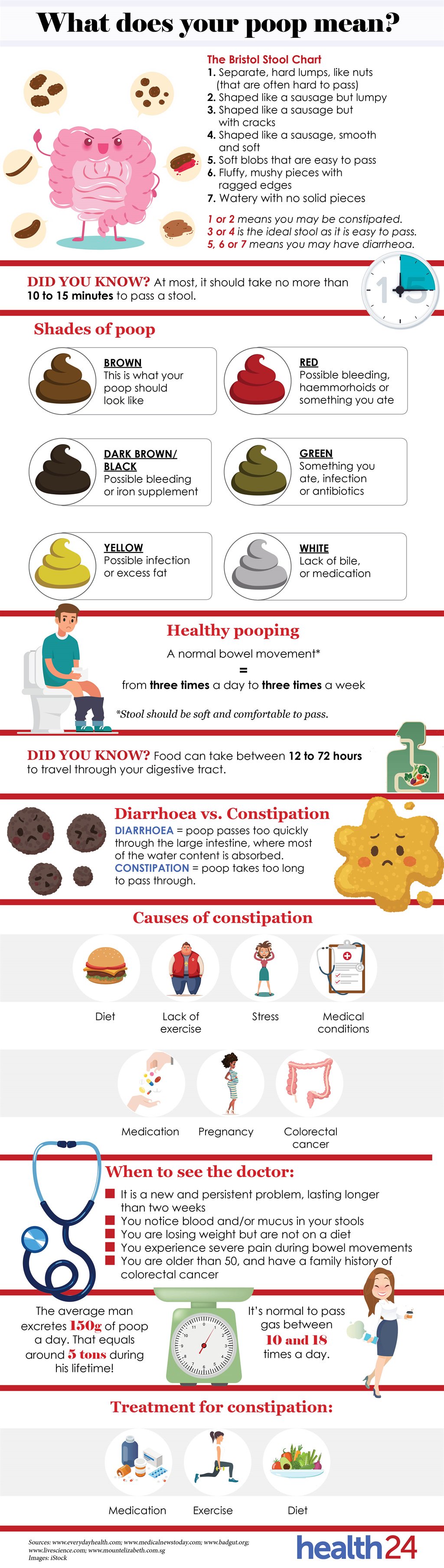
Health24.com | What’s your poop telling you?

The information on Health24 is for educational purposes only, and is not intended as medical advice, diagnosis or treatment. If you are experiencing symptoms or need health advice, please consult a healthcare professional. See additional information.

Share Button

Gently stroking babies ‘provides pain relief’

A study monitored the brain activity of babies when they had a blood test while being stroked.

Share Button