Rape Crisis Scotland argues Dr Andrew McFarlane has distressed his son’s victim and may cause harm to other rape survivors.


Rape Crisis Scotland argues Dr Andrew McFarlane has distressed his son’s victim and may cause harm to other rape survivors.
Let’s talk about sweat… From contestants on The Celebrity Traitors and scores of celebrities openly discussing it, to the trend of professionals using saunas for business meetings
The Dignified Death bill was passed in the senate, with 20 out of 31 legislators voting in favour.
The Dignified Death bill was passed in the senate, with 20 out of 31 legislators voting in favour.
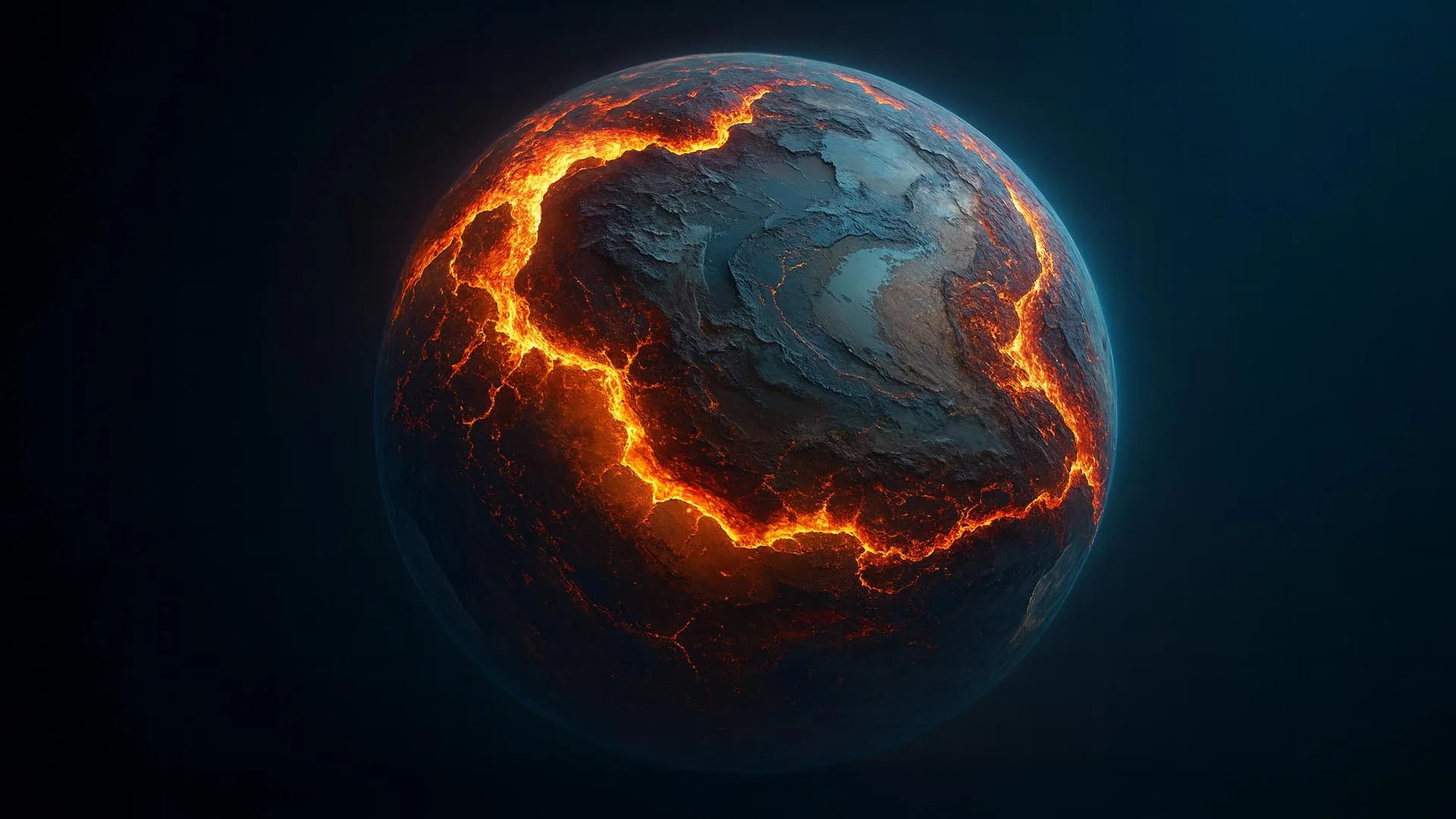
For billions of years, Earth’s continents have remained remarkably steady, providing the groundwork for mountains, ecosystems, and human civilization. Yet the reason behind their long-term stability has puzzled scientists for more than a century. Now, researchers from Penn State and Columbia University have uncovered strong evidence explaining how the continents formed and maintained their endurance, and the crucial factor behind it is heat.
In a new study published in Nature Geoscience, the team found that creating long-lasting continental crust required extreme temperatures — over 900 degrees Celsius — in the planet’s lower crust. These intense conditions allowed radioactive elements such as uranium and thorium to move upward. As these elements decayed, they produced heat, and by migrating from the deep crust to higher levels, they carried heat away. This process helped the lower crust cool and solidify, ultimately strengthening it.
According to the researchers, the findings extend beyond understanding Earth’s geology. They could also aid modern efforts to locate valuable critical minerals, which are essential for technologies like smartphones, electric vehicles, and renewable energy systems, as well as guide the search for potentially habitable planets elsewhere.
The same processes that stabilized Earth’s crust also redistributed rare earth elements such as lithium, tin, and tungsten, revealing new clues about where these minerals may be found today. Similar heat-driven mechanisms could occur on other rocky planets, offering planetary scientists additional signs to identify worlds capable of supporting life.
“Stable continents are a prerequisite for habitability, but in order for them to gain that stability, they have to cool down,” said Andrew Smye, associate professor of geosciences at Penn State and lead author on the paper. “In order to cool down, they have to move all these elements that produce heat — uranium, thorium and potassium — towards the surface, because if these elements stay deep, they create heat and melt the crust.”
Smye explained that Earth’s continental crust, as it exists today, began forming about 3 billion years ago. Before that, the planet’s crust was very different — lacking the silicon-rich composition of modern continents. Scientists had long suspected that the melting of older crust played an important role in forming stable continental plates, but this study shows that the process required far higher temperatures than previously realized.
“We basically found a new recipe for how to make continents: they need to get much hotter than was previously thought, 200 degrees or so hotter,” Smye said.
He compared the process to forging steel.
“The metal is heated up until it becomes just soft enough so that it can be shaped mechanically by hammer blows,” Smye said. “This process of deforming the metal under extreme temperatures realigns the structure of the metal and removes impurities — both of which strengthen the metal, culminating in the material toughness that defines forged steel. In the same way, tectonic forces applied during the creation of mountain belts forge the continents. We showed that this forging of the crust requires a furnace capable of ultra-high temperatures.”
To reach their conclusions, the researchers analyzed rock samples from the Alps in Europe and the southwestern United States, along with data from previous scientific studies. They examined chemical information from hundreds of samples of metasedimentary and metaigneous rocks, which form much of the lower crust, and organized them based on their peak metamorphic temperatures — the highest temperatures reached while the rocks remained mostly solid but underwent physical and chemical changes.
The team compared rocks formed under high-temperature (HT) and ultrahigh-temperature (UHT) conditions. Smye and his co-author, Peter Kelemen, professor of earth and environmental sciences at Columbia University, discovered that rocks that had melted at temperatures above 900 °C consistently contained much lower amounts of uranium and thorium than those formed at cooler conditions.
“It’s rare to see a consistent signal in rocks from so many different places,” he said. “It’s one of those eureka moments that you think ‘nature is trying to tell us something here.'”
He explained that melting in most rock types occurs when the temperature gets above 650 °C or a little over six times as hot as boiling water. Typically, the further into the crust you go, the temperature increases by about 20 °C for every kilometer of depth. Since the base of most stable continental plates is about 30 to 40 kilometers thick, temperatures of 900 °C are not typical and required them to rethink the temperature structure.
Smye explained that earlier in Earth’s history, the amount of heat produced from the radioactive elements that made up the crust — uranium, thorium and potassium — was about double what it is today.
“There was more heat available in the system,” he said. “Today, we wouldn’t expect as much stable crust to be produced because there’s less heat available to forge it.”
He added that understanding how these ultra-high temperature reactions can mobilize elements in the Earth’s crust has wider implications for understanding the distribution and concentration of critical minerals, a highly sought-after group of metals that have proved challenging to mine and locate. If scientists can understand the reactions that first redistributed the valuable elements, theoretically they could better locate new deposits of the materials today.
“If you destabilize the minerals that host uranium, thorium and potassium, you’re also releasing a lot of rare earth elements,” he said.
The U.S. National Science Foundation funded this research.
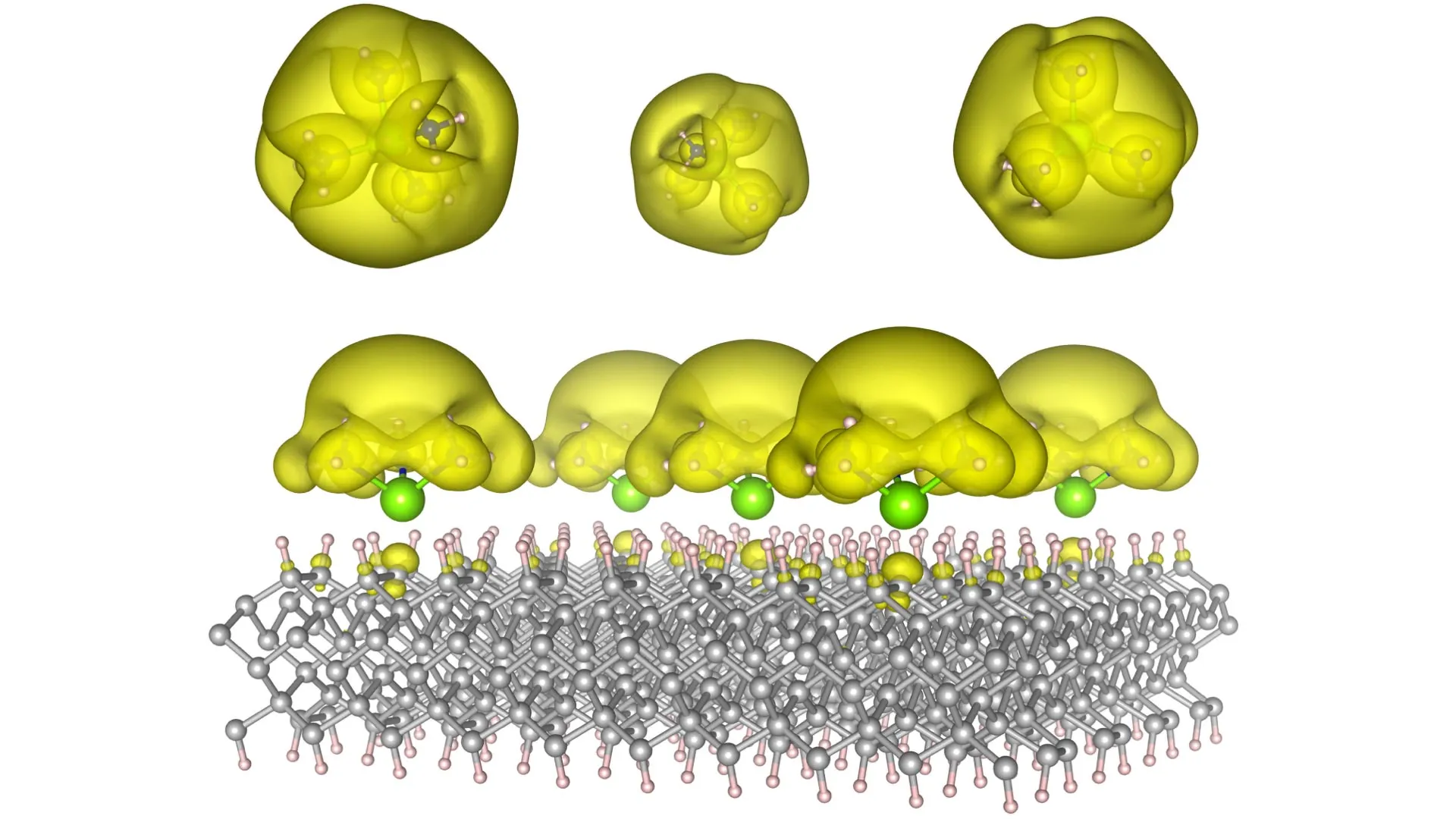
Picture a future where factories can create materials and chemical compounds more quickly, at lower cost, and with fewer production steps. Imagine your laptop processing complex data in seconds or a supercomputer learning and adapting as efficiently as the human brain. These possibilities depend on one fundamental factor: how electrons behave inside materials. Researchers at Auburn University have now developed a groundbreaking type of material that allows scientists to precisely control these tiny charged particles. Their findings, published in ACS Materials Letters, describe how the team achieved adjustable coupling between isolated-metal molecular complexes, called solvated electron precursors, where electrons are not tied to specific atoms but instead move freely within open spaces.
Electrons are central to nearly every chemical and technological process. They drive energy transfer, bonding, and electrical conductivity, serving as the foundation for both chemical synthesis and modern electronics. In chemical reactions, electrons enable redox processes, bond formation, and catalytic activity. In technology, managing how electrons move and interact underpins everything from electronic circuits and AI systems to solar cells and quantum computers. Typically, electrons are confined to atoms, which restricts their potential uses. However, in materials known as electrides, electrons move independently, opening the door to remarkable new capabilities.
“By learning how to control these free electrons, we can design materials that do things nature never intended,” explains Dr. Evangelos Miliordos, Associate Professor of Chemistry at Auburn and senior author of the study, which was based on advanced computational modeling.
To achieve this, the Auburn team created innovative material structures called Surface Immobilized Electrides by attaching solvated electron precursors to stable surfaces such as diamond and silicon carbide. This configuration makes the electronic characteristics of the electrides both durable and tunable. By changing how the molecules are arranged, electrons can either cluster into isolated “islands” that behave like quantum bits for advanced computing or spread into extended “seas” that promote complex chemical reactions.
This versatility is what gives the discovery its transformative potential. One version could lead to the development of powerful quantum computers capable of solving problems beyond the reach of today’s technology. Another could provide the basis for cutting-edge catalysts that speed up essential chemical reactions, potentially revolutionizing how fuels, pharmaceuticals, and industrial materials are produced.
“As our society pushes the limits of current technology, the demand for new kinds of materials is exploding,” says Dr. Marcelo Kuroda, Associate Professor of Physics at Auburn. “Our work shows a new path to materials that offer both opportunities for fundamental investigations on interactions in matter as well as practical applications.”
Earlier versions of electrides were unstable and difficult to scale. By depositing them directly on solid surfaces, the Auburn team has overcome these barriers, proposing a family of materials structures that could move from theoretical models to real-world devices. “This is fundamental science, but it has very real implications,” says Dr. Konstantin Klyukin, Assistant Professor of Materials Engineering at Auburn. “We’re talking about technologies that could change the way we compute and the way we manufacture.”
The theoretical study was led by faculty across chemistry, physics, and materials engineering at Auburn University. “This is just the beginning,” Miliordos adds. “By learning how to tame free electrons, we can imagine a future with faster computers, smarter machines, and new technologies we haven’t even dreamed of yet.”
The study, “Electrides with Tunable Electron Delocalization for Applications in Quantum Computing and Catalysis,” was also coauthored by graduate students Andrei Evdokimov and Valentina Nesterova. It was supported by the U.S. National Science Foundation and Auburn University computing resources.
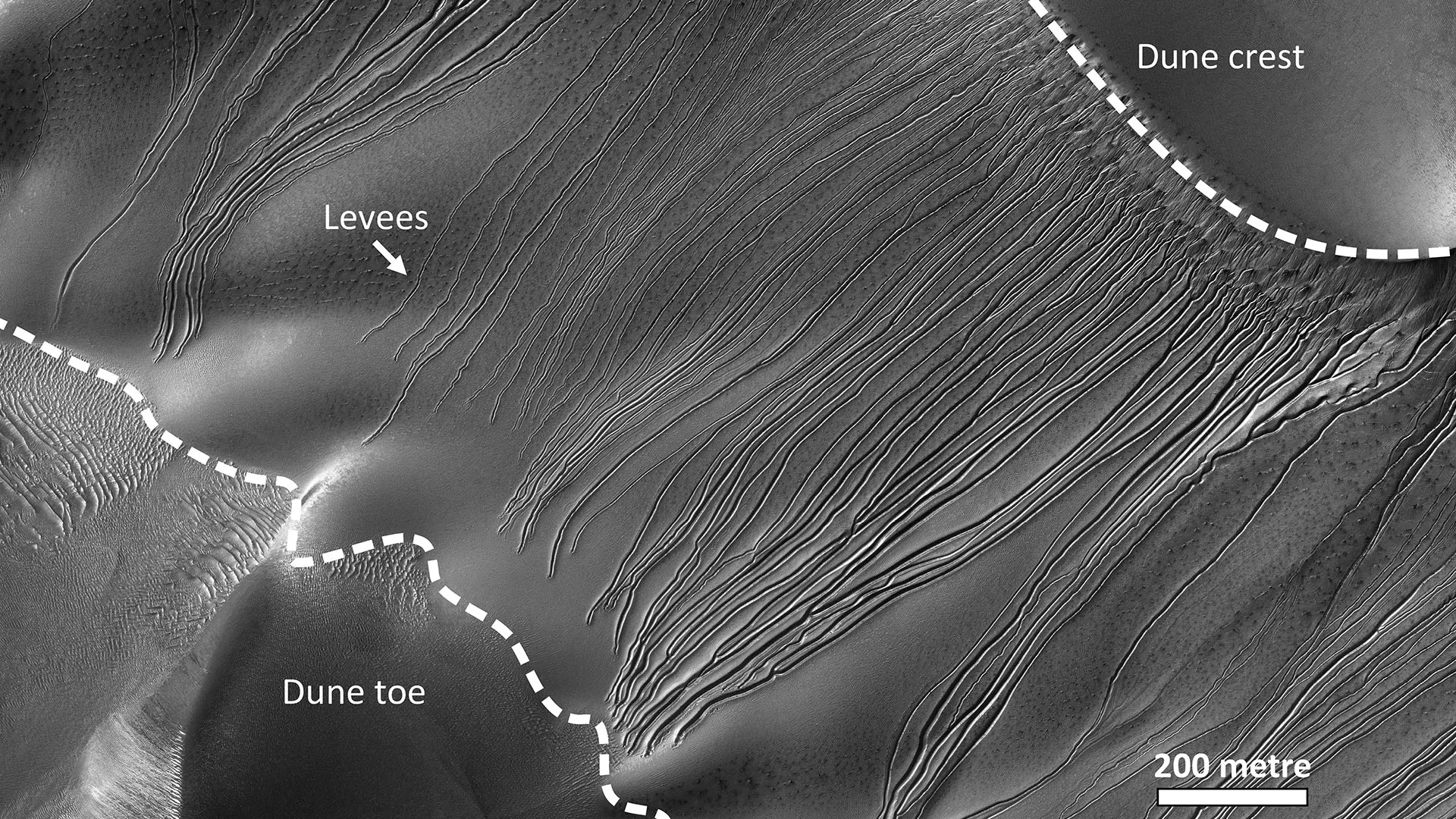
Could Mars have once supported life? Scientists still don’t have proof. Yet some of the planet’s strange surface features might seem to hint at it. Earth scientist Dr. Lonneke Roelofs of Utrecht University set out to study the origin of mysterious gullies carved into Martian dunes. In her laboratory experiments, she discovered that blocks of frozen carbon dioxide (CO2 ice) can actually dig these channels on their own. “It felt like I was watching the sandworms in the film Dune,” she said. Her research appears in Geophysical Research Letters.
For years, scientists suspected CO2 ice might be responsible for the odd formations, but no one had been able to show it directly. Roelofs succeeded by creating gullies in the lab using CO2 ice blocks, replicating a natural process that doesn’t occur on Earth and had never before been seen in action.
Sublimation
During the Martian winter, when temperatures plunge to around minus 120 degrees Celsius, ice accumulates on the dunes. As spring approaches, the sun warms the slopes and large ice blocks — sometimes a meter long — break loose. Because Mars has a thin atmosphere and a sharp temperature difference between warm sand and the ice, the underside of these blocks instantly turns to gas in a process known as sublimation. Since gas takes up far more space than solid ice, the pressure builds rapidly, making the ice appear to “explode.”
“In our simulation, I saw how this high gas pressure blasts away the sand around the block in all directions,” says Roelofs. As a result, the block digs itself into the slope and becomes trapped in a hollow surrounded by small ridges of settled sand. “However, the sublimation process continues, and so the sand keeps on being blasted in all directions.” As the ice keeps vaporizing, it gradually slides downhill, carving a long, deep trench with ridges on either side. These artificial gullies match the ones seen on Mars almost exactly.
Landscape formation
Roelofs studies the geological forces that sculpt Mars’ surface. In earlier work, she showed that sublimating CO2 ice can trigger debris flows that cut deep channels along crater walls. “But the gullies from this research looked different,” she explains. “Therefore, a different process was behind this, but which? That is what I set out to discover.”
Mars chamber
Together with master student Simone Visschers, she traveled to the English city of Milton Keynes to solve the mystery behind these unusual sand gullies. The Open University has a ‘Mars chamber’: a facility for simulating Martian conditions. Financial support from the British Society of Geomorphology made the visit possible. “We tried out various things by simulating a dune slope at different angles of steepness. We let a block of CO2 ice fall from the top of the slope and observed what happened,” states the researcher. “After finding the right slope, we finally saw results. The CO2 ice block began to dig into the slope and move downwards just like a burrowing mole or the sandworms from Dune. It looked very strange!”
From ice to gullies
But how exactly do these blocks of ice form? “The CO2 ice blocks form on the desert dunes halfway down the southern hemisphere of Mars. During the winter, a layer of CO2 ice forms over the entire surface of the dune field, sometimes up to a thickness of 70 cm! In spring, this ice begins to warm up and sublimate. The last remnants of this ice are located on the shaded side of the dune tops, and that is where the blocks break off from once the temperature is high enough. Once the blocks reach the bottom of the slope and stop moving, the ice continues to sublimate until all the CO2 has evaporated. What remains is a hollow in the sand at the bottom of the dune.”
Why Mars?
Why does this planet fascinate people so much? “Mars is our nearest neighbour. It is the only rocky planet close to the ‘green zone’ of our solar system. This zone lies exactly far enough from the Sun to make the presence of liquid water possible, which is a prerequisite for life. Questions about the origin of life, and possible extra-terrestrial life, could therefore be solved here,” says Roelofs. “Also, conducting research into the formation of landscape structures of other planets is a way of stepping outside the frameworks used to think about the Earth. This allows you to pose slightly different questions, which in turn can deliver new insights for processes here on our planet.”
Mike Nesbitt said a plan has been developed, but not yet been finalised, and will be published on Thursday.
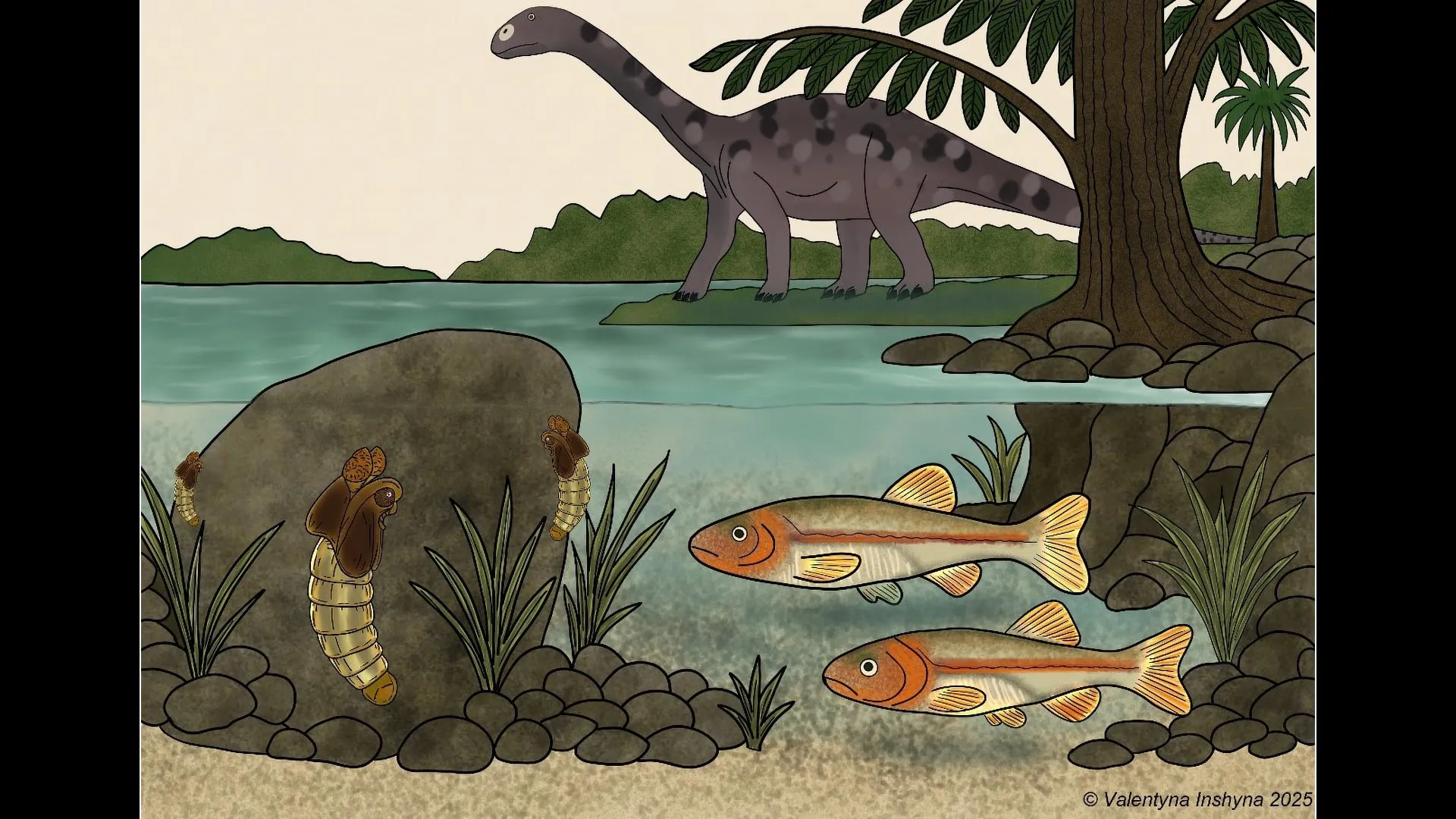
An international group of researchers led by the Doñana Biological Station (EBD-CSIC) has identified a previously unknown species of fossilized insect from the Jurassic period in Australia, estimated to be about 151 million years old. This discovery marks the oldest known member of the Chironomidae family found in the Southern Hemisphere. These non-biting midges typically live in freshwater environments. The fossil reveals a remarkable evolutionary feature: a structure that likely helped the insect attach securely to rocks. Until now, such an anchoring mechanism had only been documented in marine organisms.
The fossil was uncovered in the Talbragar fish beds in New South Wales. The study, published in the journal Gondwana Research, involved experts from the Australian Museum Research Institute, the University of New South Wales, the University of Munich, and Massey University in New Zealand.
The fly from the stagnant waters
“This fossil, which is the oldest registered find in the Southern Hemisphere, indicates that this group of freshwater animals might have originated on the southern supercontinent of Gondwana,” explains Viktor Baranov, a researcher at the Doñana Biological Station and first author of the study.
The newly identified species was named Telmatomyia talbragarica, meaning “fly from the stagnant waters,” a nod to the lake-like setting of the Talbragar region.
Researchers examined six fossilized specimens, including pupae and emerging adults, all showing the presence of a terminal disc. This structure, known to function in environments affected by tides, was once believed to be limited to marine species. However, sediment and fossil evidence from Talbragar indicate that the area was once a freshwater habitat, demonstrating the surprising adaptability (phenotypic plasticity) of chironomids.
Rethinking the origins of the family
The Podonominae group has long served as a valuable model for studying how species are distributed across the planet and how biodiversity arises over time.
Earlier theories suggested that Podonominae originated in northern Gondwana before spreading northward into Laurasia, the ancient landmass that included today’s Northern Hemisphere continents. Their fossil record, however, is limited, partly because of preservation challenges and a lack of studies focusing on Southern Hemisphere specimens. Later discoveries of older fossils in Eurasia, dating back to the Jurassic, prompted some scientists to propose a Laurasian origin instead.
The new findings challenge that view, offering strong evidence that the Podonominae subfamily most likely began in the Southern Hemisphere and later expanded worldwide.
Today, Podonominae species are found mostly in the Southern Hemisphere. Their scattered distribution across South America, Australia, South Africa, and New Zealand is a classic case of vicariance — a process in which natural barriers such as mountains or rivers divide a population, forcing each group to evolve independently and form new species. Swedish entomologist Lars Brundin first proposed in 1966 that the breakup of the ancient supercontinent Gondwana triggered this evolutionary separation.
Limitations due to the scarcity of fossils in the Southern Hemisphere
While this discovery addresses a significant gap in the lineage’s fossil record, a comprehensive understanding of this group’s evolutionary history is still limited by the lack of Southern Hemisphere fossils. The majority of known Podonominae fossils originate from the Northern Hemisphere, with only two prior exceptions documented from the Southern Hemisphere: an Eocene specimen from Australia and a Paleocene record from India.
There is a strong bias towards finding and studying fossils in the Northern Hemisphere. Because of this we end up making incorrect assumptions about where groups originated,” explains Matthew McCurry, palaeontologist from the Australian Museum and The University of New South Wales.
Professor in Massey University Steve Trewick claims, “there are long-standing questions about the way Southern Hemisphere biotas formed and changed through geological time. Fossils species of tiny, delicate freshwater insects like the Talbragar fly are rare and help us interpret the history of life on our planet.”
The analysis of the fossilized specimens, combined with genomics, will help determine whether the dispersal of these insects after the breakup of Gondwana was primarily passive or active. The resulting data will certainly be of value for comprehending and conserving modern-day biodiversity.
Failings in Colin Flatt’s care in the final months of his life are laid bare in a new report.
