A survey in England suggests nearly 9 in 10 have at least one unhealthy trait such as smoking or drinking.


A survey in England suggests nearly 9 in 10 have at least one unhealthy trait such as smoking or drinking.
The work will help identify the latest types of flu and ensure new vaccines can fight off the virus.

Q: Why do I crave chocolate like crazy right before my period?
A: Honestly? We have no clue. (We don't know why many PMS symptoms happen!) Lots of theories exist, and the best ones point to hormones. The good news is we do know how to keep these cravings from ruling your life. Though your body may be crying out for a bite (or three!) from a chocolate bar, you're better off resisting the sweet stuff.
Too many sugary treats cause your blood sugar to spike, then plummet. As soon as it crashes, you'll be reaching for another sweet. This cycle can lead to both low energy and weight gain. Instead, choose complex carbs like fruits, vegetables, nuts, and whole grains to keep your blood sugar at a somewhat-even level all day long. That will prevent you from feeling cranky, and craving more candy.

Nearly two million American jobs have been lost in the past year, and hundred of thousands of people will likely be laid off or have their hours scaled back in 2009. If you think you might be one of them, know this: You're almost certain to lose your employer-sponsored benefits with your full-time job. That's why you need an action plan, stat. Make sure you know your health-insurance rights and options, because once you get that pink slip you have no time to lose. Here's what you need to do within…
…One hour
Youre stressed and scared, and not in any mental state to make decisions. Take a few minutes to collect yourself and relax as much as possible. Take slow, deep breaths. In the coming days and weeks youll have to make a slew of decisions regarding your health care and personal finances, and youll need to stay calm.
…One day
Whether security is waiting to walk you out the door or you have time to clean out your desk, grab the paperwork related to your employer-issued benefits. Carefully read over the fine print on your contract and the terms of your health-insurance plan. Then ask someone from human resources:
Dont leave without asking for a certificate of creditable coverage. This document includes the dates that your health insurance began and ended, and proves that you were covered during that time. Youll need this to apply to other health-insurance plans.
…One week
If your health benefits havent expired yet, make doctors and dentists appointments for you and your family if you're due. Refill prescriptions. Try to squeeze in as much essential health care as you can before the expiration date, because it will almost certainly be more expensive once you lose your employer-provided insurance. If your doc is booked, explain your situation and ask to be notified about cancellations. (Dont overdo it, however. If you get too many unnecessary tests and checkups in a short period of time, your premiums will likely be higher if you decide to buy health insurance on the open market. And if a checkup turns up a serious health problem, you may even be denied coverage altogether.)
Plan to spend down your flexible spending account (FSA), if you have one, on new glasses, cold medicine, acupunctureon whatever you can, so your former employer doesn't get to keep your hard-earned savings. Unlike health savings accounts (HSAs), which are portable from job to job and roll over, FSAs are always administered by your employer and must be spent by the end of the companys “plan year” (plus a 2 ½-month grace period).
One month
Enroll in your spouses employer-sponsored plan, if you can. Under the Health Insurance Portability and Accountability Act (HIPAA), you and your dependents can do this ASAP, without waiting until the next enrollment period. Here's the catch: You must request this so-called special enrollment within 30 days of losing your previous health benefits.
…Two months
If you're single or cant get covered by your spouse, sign up for a COBRA extension. Under the Consolidated Omnibus Budget Reconciliation Act, you and your family have the right to extend your current health plan for up to 18 months after you are laid off. (If your former employer has fewer than 20 employees, you may not be eligible for a COBRA plan.) You will have to pay for 100% of the coverage rather than sharing the cost with your employer, but it is still usually cheaper than buying an equivalent policy on your own.
Keep an eye on the mail. After your employer notifies the insurer that youve been terminated, the insurer must inform you of your COBRA rights in writing within 14 days. Once this notice is sent by your insurernot once you receive itthe clock starts ticking: You have 60 days to enroll in the plan. (If your existing coverage expires after the notice is sent, you have 60 days from the expiration date.)
…62 days
And we really mean 62 days. Under HIPAA, if you go without health insurance for 63 days or more, you will be subject to a preexisting-condition exclusion. When you enroll in a new health plan, the insurer can exclude from coverage any health conditioncancer, heart disease, diabetesfor which you received treatment in the six months leading up to your enrollment. This exclusion period can last for up to 12 months (or 18 months if you join the health plan late), but you can offset it by producing your certificate of creditable coverage, which you remembered to ask for on day 1. If you can prove that youve had continuous health insurance for more than 12 months without a gap of 63 days or more, the new health plan will not be able to impose a preexisting-condition exclusion.
You probably know by now that sitting for long periods is a big health no-no. Not only can sitting make you fat, but in 2012, Australian researchers found that people who sit for more than 11 hours a day have a 40% increased risk of death from any cause, according to a study in the Archives of Internal Medicine.
More recently, a study in the Journal of the National Cancer Institute found that people who spent most of the day on their butts had a 24% greater colon cancer risk—and that number shot up to 54% for people who clocked the most hours sitting in front of the TV. And the risks remained even for so-called “active couch potatoes”—people who work out but still spend most of their day off their feet. The study authors said this suggests that regular exercise can’t offset the risks of too much sitting.
So if sitting is so bad, why don't we just stand all the time? While it's important to get up and moving when you can, standing for an entire day isn't good for you either.
That's what writer Dan Kois learned, according to a recent story for New York magazine. Kois tried standing 95% of the time for 30 days straight, and had cramps in his calves at bedtime and pain in his hips, heels, and legs—even after using cushioned insoles and standing on an anti-fatigue mat at work. The take-home message? The goal isn't to make a complete switch from one to the other. As one University of Pittsburgh professor told Kois, jobs that require a lot of standing (like nursing or retail) are linked to their own set of health problems including varicose veins, lower-back pain, and increased risk of stroke.
When it comes down to it, you really need both to stay healthy. There are easy ways to incorporate standing into your daily routine for better health—you just need to take it one step at a time.
Here are some tips to break out of a mostly sedentary lifestyle:
It seems silly, but you literally need to remind yourself to get up. Setting your phone alarm or using an app like BreakTime for Mac devices are simple ways to encourage more movement throughout the day. Even the scientists that Kois talked to for his article used this strategy to stand up for 10 minutes every hour. Plus, you won't be able to ignore that loud ping on your smartphone or computer when the time comes.
One activity you can certainly do while standing: talking on the phone. This is especially great for office dwellers who constantly get bogged down by calls or people who have lots of phone dates with friends and family. At work, you just need a long phone-to-ear cord or quality headset to ensure you get more mobile. Even taking a call standing will help your legs shift more naturally.
You'd be surprised how many ways you can sneak walking into your daily routine. A quick walk after a meal can be a relaxing way to get your feet moving. After eating, the fat levels in your bloodstream are at their peak, so simply moving around post meal increases the activity of lipoprotein lipase, a gene that boosts your metabolism.
If you drive to work, park your car a few blocks away from the building, suggests Roshini Raj, M.D., Health's contributing medical editor. That way you can get your legs working before you even get through the door. Same goes for you train and subway riders. Get off a stop or two early, or take the stairs instead of the elevator or escalator to add some extra steps to your day. Dr. Raj also recommends walking to get your lunch instead of ordering in. It's that simple!
The next time you go out for food or drinks, skip the table and try sitting at the bar. Seating yourself on the front third of a bar stool can help you maintain the S-shape in your spine and distribute your weight more evenly (that is, more weight supported by your feet and less by your butt). To mimic this position, called "perching," spread your feet just wider than hip distance and gently roll your hips forward, arching your back slightly.
Summer is definitely the time for concerts, tailgates, and lazy days at the park. Next time, don't haul a chair with you. Leaving your folding chairs at home will force you to get up more often while outdoors. Just have a blanket on hand to rest every so often, but don't be afraid to stand the whole time either–better yet, go for a short walk while you're up.
Sometimes the best way to ask a question is face to face. Yes, it's super easy to email, call, or IM someone at work. But does walking to your coworker's desk really take that long? You may even get a faster response to a simple question this way. When it comes time to hash out a project, opt to chat with your colleague in person or even suggest taking a walk to the coffee machine. Both are great ways to get you two moving and working at the same time.
The idea here is to give your body the chance to rotate between different positions throughout the day. Start by creating an area at your desk where you can stand and work. A box or milk crate covered with fabric can be a great resting place for your laptop, or you can leave memos to read on a shelf at standing height. If you're daring enough, you could even try a standing desk.
Here's to happy standing!
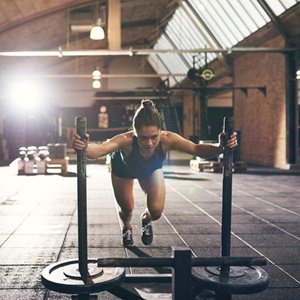
Running, swimming, cycling and other types of endurance exercise can slow cellular aging, but strength training may not, a new study suggests.
Researchers looked at how different types of exercise affected telomeres in 124 inactive, young, healthy adults.
Telomeres are protective caps on the ends of chromosomes. As you age, telomeres shorten and result in cell ageing. However, an enzyme called telomerase can counteract the shortening process and even add length to the telomeres.
The study participants were randomly assigned to six months of either: endurance training (long sessions of running); high-intensity interval training (high-intensity running alternating with slower running); resistance (weight) training; or no changes in activity (the control group).
Telomerase activity
The participants’ telomere length and telomerase activity were assessed at the start of the study, and two to seven days after the final exercise session, according to the authors. The study was published in the European Heart Journal.
“Our main finding is that compared to the start of the study and the control group, in volunteers who did endurance and high-intensity training, telomerase activity and telomere length increased, which are both important for cellular ageing, regenerative capacity and thus, healthy ageing,” said study leader Ulrich Laufs, a professor at Leipzig University in Germany. “Interestingly, resistance training did not exert these effects.”
Compared to the resistance and control groups, telomerase activity increased two to threefold and telomere length increased significantly in the endurance and high-intensity training groups.
“The study identifies a mechanism by which endurance training – but not resistance training – improves healthy ageing. It may help to design future studies on this important topic by using telomere length as indicator of ‘biological age’ in future intervention studies,” Laufs said in a journal news release.
Endurance and high-intensity training could increase telomere length and telomerase activity by affecting levels of nitric oxide in blood vessels, which produces changes in cells, the researchers theorised.
“From an evolutionary perspective, endurance and high-intensity training may mimic the advantageous traveling and fight-or-flight behaviour of our ancestors better than strength training,” said study co-author Dr Christian Werner, from Saarland University in Germany.
Image credit: iStock

Whether you’re attending an office party, cooking for family and friends, or dining out, the warmer weather can increase your risk of catching a foodborne illness.
According to a previous Health24 article, food poisoning is usually caused by consuming food contaminated by bacteria, parasites or viruses. The most common symptoms include nausea, vomiting, diarrhoea and abdominal cramps.
Hot summer weather provides the perfect conditions for harmful organisms to breed. Here are some tips to avoid getting sick:
1. Wash your hands
Wash your hands properly with soap and water before and after handling food, especially raw meat, eggs and fresh produce. This will not only reduce your risk of getting food poisoning or cross-contaminating foods with harmful bacteria, but will also reduce your risk of catching the norovirus (a stomach bug).

2. Use separate chopping boards
Avoid cross-contamination by using separate chopping boards for raw meat, raw produce and ready-to-eat foods. Wash cutting boards immediately after using them.

3. Keep your kitchen clean
This seems like obvious advice, but things get busy over the festive season and we don’t pay enough attention to wiping working surfaces or washing dish towels. Kitchen counters and dish towels are notorious for harbouring nasty bacteria. Give the kitchen a quick, yet thorough daily clean to prevent bacteria from gaining a foothold.

4. Plan your shopping carefully
When doing your shopping, do your grocery shopping last to avoid raw meat and fresh produce going off. Keep a cooler bag in the car to ensure that perishable items stay cool.

5. Take care when camping or picnicking
The outdoors can be idyllic but risky when it comes to preparing food. Keep raw meat, fresh produce and dairy products as cool as possible and out of direct sunlight. Make sure that all meat you braai is cooked through, especially chicken and pork. The following temperatures are recommended to ensure that harmful bacteria are killed: 63°C for beef, lamb and pork and 74°C for poultry. If you have no access to fridges, go for non-perishable foods or keep meat frozen until it is cooked.

6. Store leftovers properly
It’s great to look forward to tasty leftovers, but ensure that you store food properly and consume it within four days. Reheat food at a high temperature, make sure it’s heated throughout, and don’t reheat leftovers more than once, as fluctuations in temperature can cause bacteria to grow.

7. Organise your fridge properly
When you buy a larger amount of groceries than usual during the festive season, you might be tempted to simply stash everything in the fridge as you find space. But you need to keep raw meat well away from fresh fruits and vegetables and other cold items such as ready-made salads, as juices from raw meat can drip onto other food and cause cross-contamination. Store raw meat on the bottom shelf of the fridge to avoid dripping or spillage. Never overfill your fridge as this can affect the temperature.
Worried about load shedding or an unplanned power outage in your area? Keep plastic ice blocks in your refrigerator to help keep produce colder for longer and don’t open and close the refrigerator door more than necessary. Make sure the seals on the doors are in good condition, as broken seals can allow cold air to escape. A freezer in good working condition should be able to hold its temperature for around 48 hours.

Image credit: iStock


Experts advising government say there is not enough evidence to warrant a ban on sale to children.
A woman told she was breaking the law by doing teeth whitening says she is angry she now has a criminal conviction.
If you’ve been to your neighborhood farmers market or seen a small “local” section pop up in your grocery store, you may have noticed a trend: People want to know where their food is coming from, and the agricultural industry is responding. The number of farmers markets in the U.S. has skyrocketed in recent years, but with an aging population of farmers, who’s supporting this growth?
Enter the new American farmer. It’s a term used by Andrew Flachs, an environmental anthropologist at Purdue University, to describe a movement of younger people new to agricultural work who do it for different reasons than the conventional farmer. They may be motivated through higher education, personal politics, disenchantment with urban life or in search of an authentic rural identity, he says.
In a new paper in the journal Rural Sociology, Flachs identifies several hot spots where this movement is really taking shape: the West Coast, central Texas and Oklahoma, central Florida and the Great Lakes region.
“We’re seeing these hot spots pop up in the peripheries of hip cities,” Flachs said. “Some of these places might seem obvious, like the West Coast and the northern Midwest around Madison, the Twin Cities and Chicago. But we also see some things that aren’t totally expected.”
Among the unexpected trends he found, east Texas and the southern Midwest are becoming increasingly important for this kind of agriculture. Appalachia, which has historically been a hub, essentially disappeared from the map.
In collaboration with Matthew Abel, an anthropologist at Washington University in St. Louis, Flachs built a model that counts how many traits associated with new American agrarianism appear in each county. With data from the USDA agricultural censuses from 1997 to 2012, they considered factors such as average sales per farm, number of certified organic farms, owners under age 34, number of farms selling directly to individuals, proximity to farmers markets and more.
The findings show that newer farmers appear to thrive on the outskirts of cities that provide high demand and purchasing power, a large population and healthy number of farmers markets.
The price of real estate is another important factor in determining where these markets can flourish. Rural developers have steadily increased farm real estate over the last few decades, which could deter newer farmers from settling down there. Concentrations of urban wealth drive up real estate costs in the city while simultaneously creating new niche markets, making space for younger farmers to exist between urban and rural landscapes.
Identifying where new and small farmers live and work will pave the way for further research on what’s motivating this budding sector of the agricultural economy. New American farmers occupy an important intersection of niche marketing strategies, environmental politics and rural demographic change that could have a significant impact on food production and social life in agrarian landscapes, according to the paper.
Flachs points out that many new American farmers approach agriculture with hopes to embody a nostalgic past where food and environments were healthier, but others may be simply trying to make a living as farmers amid dissatisfaction with conventional agribusiness. Although it’s easy to stereotype, it’s unlikely that all new American farmers fit this description.
“Sometimes when we think about these farmers, we picture young people with liberal arts degrees looking for some kind of connection to the earth or wanting to work with their hands,” Flachs said. “What we found is that that’s probably not the most representative view of who these people actually are. I’m glad to have my stereotype broken up by the data.”
Story Source:
Materials provided by Purdue University. Note: Content may be edited for style and length.

