Up to half of patients coming to some pharmacies are being turned away because they are not eligible.


Up to half of patients coming to some pharmacies are being turned away because they are not eligible.
British Medical Association say 30,000 medics were chasing 10,000 jobs this year.

The sun-drenched paradise of Thailand’s Phi Phi islands isn’t the usual starting point for a PhD. But for Sarah Sajedi, those soft, sandy beaches – or rather, what she found under them -inspired her pivot from a business career to an academic one.
“I was standing there looking out at this gorgeous view of the Andaman Sea, and then I looked down and beneath my feet were all these pieces of plastic, most of them water bottles,” she says.
“I’ve always had a passion for waste reduction, but I realized that this was a problem with consumption.”
Sajedi, BSc ’91, decided to return to Concordia to pursue a PhD with a focus on plastic waste. As the co-founder of ERA Environmental Management Solutions, a leading provider of environmental, health and safety software, she brought decades of experience to complement her studies.
Her latest paper, published in the Journal of Hazardous Materials, looks at the science around the health risks posed by single-use plastic water bottles. They are serious, she says, and seriously understudied.
Tiny threats, little known
In her review of over 140 scientific articles, Sajedi writes that individuals on average ingest between 39,000 and 52,000 microplastic particles per year, and bottled water users consume 90,000 more particles than tap water consumers.
The particles are usually invisible to the naked eye. A microplastic particle can range between one micron — a thousandth of a millimeter — to five millimeters; nanoplastics are smaller than one micron.
They emerge as bottles are made, stored, transported and broken down over their lifespans. Because they are often made from low-quality plastic, they shed tiny pieces every time they are manipulated and exposed to sunlight and temperature fluctuations. And unlike other types of plastic particles, which enter human bodies through the food chain, these are ingested directly from the source.
As Sajedi notes, the health consequences can be severe. Once inside the body, these small plastics can cross biological boundaries, enter the bloodstream and reach vital organs. This can lead to chronic inflammation, oxidative stress on cells, hormonal disruption, impaired reproduction, neurological damage and various kinds of cancer. However, the long-term effects remain poorly understood due to a lack of widespread testing and standardized methods of measurement and detection.
Sajedi identifies multiple methods researchers have used to measure nano- and microplastics, each with their own strengths and weaknesses. Some, for instance, can detect very small particles but cannot identify their chemical composition. Others can provide details about their makeup but miss the smallest plastics. And the best, most advanced and most reliable tools are often extremely costly and not always available.
Education is the best prevention
Sajedi is encouraged by the legislative action that has been adopted by governments around the world aimed at limiting plastic waste. However, she notes that the most common targets are single-use plastic bags, straws and packaging. Very few address the pressing issue of single-use water bottles.
“Education is the most important action we can take,” she says. “Drinking water from plastic bottles is fine in an emergency but it is not something that should be used in daily life. People need to understand that the issue is not acute toxicity — it is chronic toxicity.”
Chunjiang An, associate professor, and Zhi Chen, professor, in the Department of Building, Civil and Environmental Engineering at the Gina Cody School of Engineering and Computer Science contributed to this paper.
This research was supported by the Natural Sciences and Engineering Research Council of Canada and Concordia University.
More than 100 million people, including at least 15 million children, use e-cigarettes, fuelling a new wave of nicotine addiction, say experts.
The prize-winning discovery explains how the immune system attacks hostile infections, but not the body’s own cells.
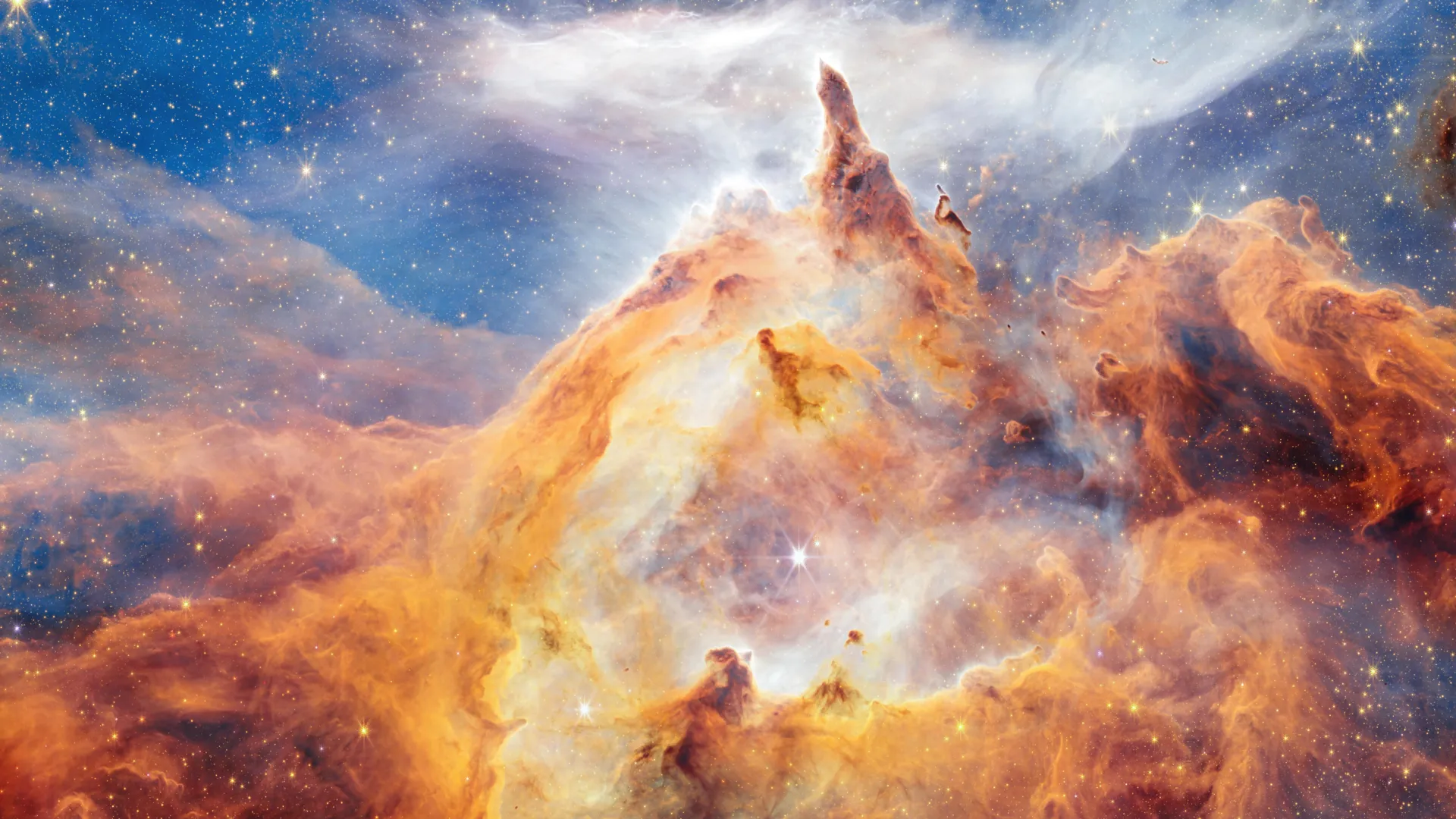
This is a sparkling scene of star birth captured by NASA’s James Webb Space Telescope. What appears to be a craggy, starlit mountaintop kissed by wispy clouds is actually a cosmic dust-scape being eaten away by the blistering winds and radiation of nearby, massive, infant stars.
Called Pismis 24, this young star cluster resides in the core of the nearby Lobster Nebula, approximately 5,500 light-years from Earth in the constellation Scorpius. Home to a vibrant stellar nursery and one of the closest sites of massive star birth, Pismis 24 provides rare insight into large and massive stars. Its proximity makes this region one of the best places to explore the properties of hot young stars and how they evolve.
At the heart of this glittering cluster is the brilliant Pismis 24-1. It is at the center of a clump of stars above the jagged orange peaks, and the tallest spire is pointing directly toward it. Pismis 24-1 appears as a gigantic single star, and it was once thought to be the most massive known star. Scientists have since learned that it is composed of at least two stars, though they cannot be resolved in this image. At 74 and 66 solar masses, respectively, the two known stars are still among the most massive and luminous stars ever seen.
Captured in infrared light by Webb’s NIRCam (Near-Infrared Camera), this image reveals thousands of jewel-like stars of varying sizes and colors. The largest and most brilliant ones with the six-point diffraction spikes are the most massive stars in the cluster. Hundreds to thousands of smaller members of the cluster appear as white, yellow, and red, depending on their stellar type and the amount of dust enshrouding them. Webb also shows us tens of thousands of stars behind the cluster that are part of the Milky Way galaxy.
Super-hot, infant stars -some almost 8 times the temperature of the Sun – blast out scorching radiation and punishing winds that are sculpting a cavity into the wall of the star-forming nebula. That nebula extends far beyond NIRCam’s field of view. Only small portions of it are visible at the bottom and top right of the image. Streamers of hot, ionized gas flow off the ridges of the nebula, and wispy veils of gas and dust, illuminated by starlight, float around its towering peaks.
Dramatic spires jut from the glowing wall of gas, resisting the relentless radiation and winds. They are like fingers pointing toward the hot, young stars that have sculpted them. The fierce forces shaping and compressing these spires cause new stars to form within them. The tallest spire spans about 5.4 light-years from its tip to the bottom of the image. More than 200 of our solar systems out to Neptune’s orbit could fit into the width its tip, which is 0.14 lightyears.
In this image, the color cyan indicates hot or ionized hydrogen gas being heated up by the massive young stars. Dust molecules similar to smoke here on Earth are represented in orange. Red signifies cooler, denser molecular hydrogen. The darker the red, the denser the gas. Black denotes the densest gas, which is not emitting light. The wispy white features are dust and gas that are scattering starlight.
The James Webb Space Telescope is the world’s premier space science observatory. Webb is solving mysteries in our solar system, looking beyond to distant worlds around other stars, and probing the mysterious structures and origins of our universe and our place in it. Webb is an international program led by NASA with its partners, ESA (European Space Agency) and CSA (Canadian Space Agency).
Former England captain Lewis Moody says in an exclusive BBC interview he has “a reluctance to look the future in the face”.
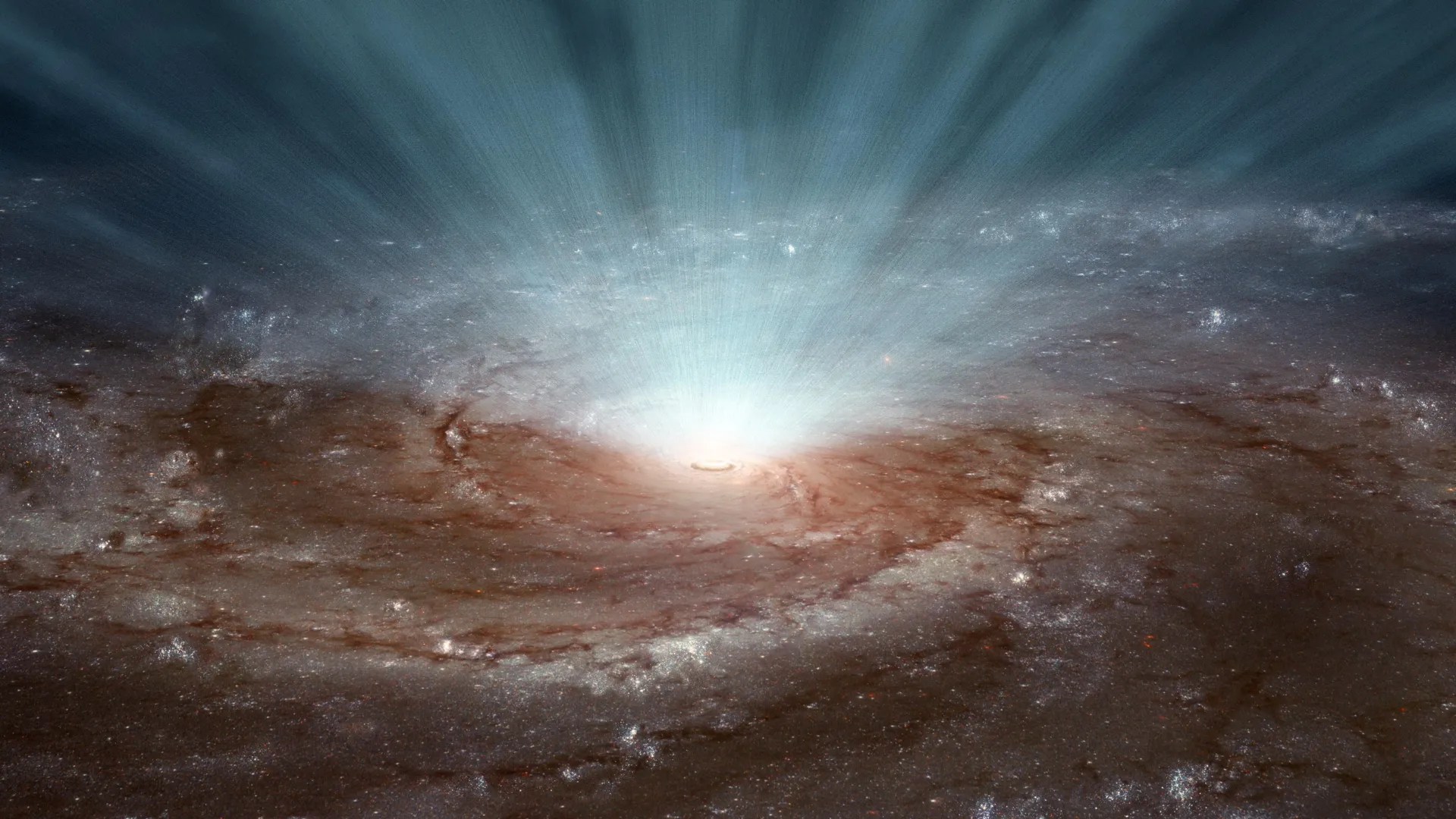
The universe is full of different types of radiation and particles that can be observed here on Earth. This includes photons across the entire range of the electromagnetic spectrum, from the lowest radio frequencies all the way to the highest-energy gamma rays. It also includes other particles such as neutrinos and cosmic rays, which race through the universe at close to the speed of light.
Curiously, “cosmic rays” are not actually rays – this name has historical reasons – but small particles, mostly atomic nuclei, which are accelerated to enormous energies somewhere in the universe. Although their sources are not yet fully understood, they are most likely associated with some of the most extreme environments in the universe, such as black holes, supernovae, or rotating neutron stars (a type of dead star).
But occasionally cosmic rays have much higher energy than usual. We’ve known about this since 1962, but we still have no idea why.
We also don’t know where this ultra-high-energy cosmic radiation comes from.
Now, research from the Norwegian University of Science and Technology (NTNU) may have found the answer to this big unanswered question in physics.
Supermassive black holes may be the cause
Foteini Oikonomou, an associate professor at NTNU’s Department of Physics, is working on the case. In a recent article, she and her colleagues present a completely new and plausible explanation for this ultra-high-energy radiation.
The lead author is PhD research fellow Domenik Ehlert from the same department. The team also includes postdoctoral fellow Enrico Peretti from the Université Paris Cité. Their work focuses on astroparticle physics, which studies the relationship between the smallest particles in the universe and the universe’s largest phenomena.
“We suspect that this high-energy radiation is created by winds from supermassive black holes,” said Oikonomou.
But what on earth does that mean?
Active black holes create winds
The Milky Way is the neighborhood in the universe where you and I live. Our Sun and solar system are part of this galaxy, along with at least 100 billion other stars.
“There is a black hole called Sagittarius-A* located right in the centre of the Milky Way. This black hole is currently in a quiet phase where it isn’t consuming any stars, as there is not enough matter in the vicinity,” Peretti said.
This contrasts with growing, supermassive, active black holes that consume up to several times the mass of our own Sun each year.
“A tiny portion of the material can be pushed away by the force of the black hole before it is pulled in. As a result, around half of these supermassive black holes create winds that move through the universe at up to half the speed of light,” Peretti said.
We have known about these gigantic winds for approximately ten years. The winds from these black holes can affect galaxies. By blowing away gases, they can prevent new stars from forming, for example. This is dramatic enough in itself, but Oikonomou and her colleagues looked at something else, much smaller, that these winds could be the cause of.”
It is possible that these powerful winds accelerate the particles that create the ultra-high-energy radiation,” said Ehlert.
To understand this, we also need to explain a little bit about atoms.
Atoms and enormous amounts of energy
Atoms consist of a nucleus, which is made up of protons and neutrons. These particles are made up of quarks, but we don’t need to go into that right now.
One or more electrons can be found around this nucleus in the so-called cloud.
“The ultra-high-energy radiation consists of protons or atomic nuclei with energy up to 1020 electron volts,” explained Oikonomou.
If that number doesn’t mean anything to you, you should know that in this context, it is an absolutely enormous amount of energy.
“A particle like this, which is smaller than an atom, contains about as much energy as a tennis ball when Serena Williams serves it at 200 kilometers per hour,” said Oikonomou.
It corresponds to approximately a billion times more energy than the particles created by researchers in the Large Hadron Collider in Switzerland and France.
Fortunately, these cosmic rays are destroyed by the Earth’s atmosphere. When they reach ground level, they are as harmless as all the other cosmic radiation that reaches us at the Earth’s surface.
“But for astronauts, cosmic radiation is a very serious problem,” Oikonomou said.
Airline crews don’t need to worry about this because they don’t fly high enough.
“The main concern for astronauts is cosmic low-energy radiation produced by our own Sun, because it is much more common. The rays we study are infrequent enough that it is extremely unlikely they would pass through an astronaut,” she said.
Other suspects
Previously, researchers have looked into whether these high-energy particles come from gamma-ray bursts, from galaxies that are creating new stars at an extremely high rate, or from plasma outflows from supermassive black holes.
However, Oikonomou and her colleagues have another hypothesis.
“All the other hypotheses are very good guesses – they are all sources that contain a lot of energy. But no one has provided evidence that any of them are the source. That is why we decided to investigate the winds from the supermassive black holes,” said Ehlert.
Guilty? Maybe
So what do we actually know? Is it the winds that create the high-energy particles in the cosmic radiation?
“Our answer is more of a cautious ‘maybe’,” said Oikonomou.
That doesn’t sound particularly dramatic. However, when researchers ask questions like this, they often feel a sense of excitement and think “YES, that might just be the case!,” but that doesn’t mean it is the case in this instance.
“We find that the conditions related to these winds align particularly well with particle acceleration. But we are still unable to prove that it is specifically these winds that accelerate the particles behind the high-energy cosmic radiation,” Oikonomou said.
However, the model the researchers are using can explain one specific aspect of these particles that we still don’t understand. Within a certain energy range, the particles have a chemical composition that other models cannot explain in any meaningful way.
“We can also test the model using neutrino experiments,” said Oikonomou.
That, however, is something for a completely different article.
“In the years to come, we hope to collaborate with neutrino astronomers to test our hypothesis,” Oikonomou said. Perhaps they will then find more evidence, one way or the other.
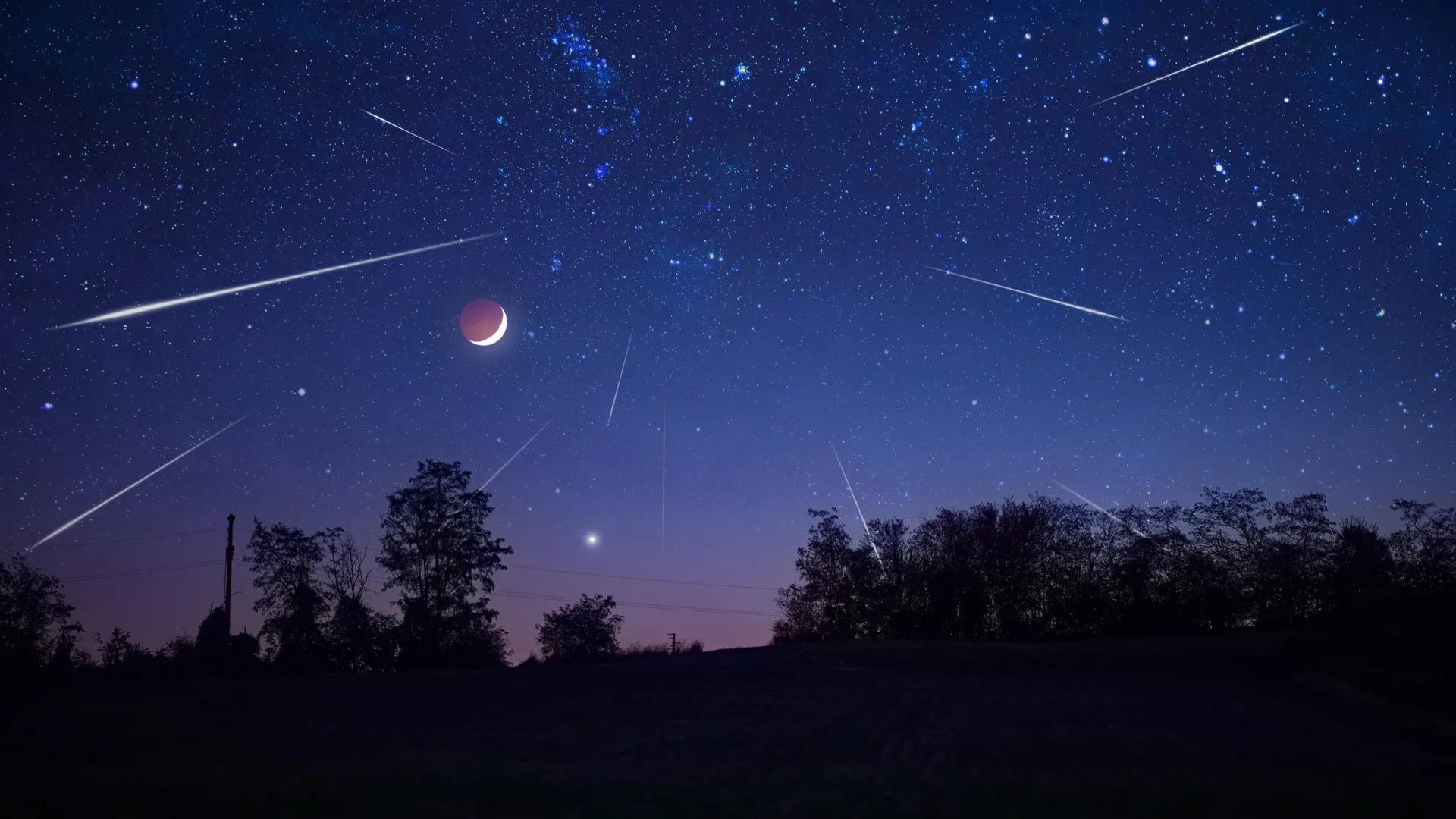
A supermoon takes over the sky, the Draconid meteor shower peeks through, and the Orionid meteor shower shines bright.
Skywatching Highlights
<See video link at the bottom.>
Transcript
What’s Up for October? A Supermoon takes over, the Draconid meteor shower peeks through, and the Orionid meteors sparkle across the night sky.
The evening of October 6, look up and be amazed as the full moon is bigger and brighter because — it’s a supermoon!
This evening, the moon could appear to be about 30% brighter and up to 14% larger than a typical full moon. But why?
Supermoons happen when a new moon or a full moon coincides with “perigee,” which is when the moon is at its closest to Earth all month.
So this is an exceptionally close full moon! Which explains its spectacular appearance.
And what timing — while the supermoon appears on October 6th, just a couple of days before on October 4th is “International Observe the Moon Night”!
It’s an annual, worldwide event when Moon enthusiasts come together to enjoy our natural satellite.You can attend or host a moon-viewing party, or simply observe the Moon from wherever you are.
So look up, and celebrate the moon along with people all around the world!
The supermoon will light up the sky on October 6th, but if you luck into some dark sky between October 6th and 10th, you might witness the first of two October meteor showers — the Draconids!
The Draconid meteor shower comes from debris trailing the comet 21P Giacobini-Zinner burning up in Earth’s atmosphere
These meteors originate from nearby the head of the constellation Draco the dragon in the northern sky and the shower can produce up to 10 meteors per hour!
The Draconids peak around October 8th, but if you don’t see any, you can always blame the bright supermoon and wait a few weeks until the next meteor shower — the Orionids!
The Orionid meteor shower, peaking October 21, is set to put on a spectacular show, shooting about 20 meteors per hour across the night sky.
This meteor shower happens when Earth travels through the debris trailing behind Halley’s Comet and it burns up in our atmosphere.
The full duration of the meteor shower stretches from September 26 to November 22, but your best bet to see meteors is on October 21 before midnight until around 2 am.
This is because, not only is this night the shower’s peak, it is also the October new moon, meaning the moon will be between the Earth and the Sun, making it dark and invisible to us.
With a moonless sky, you’re much more likely to catch a fireball careening through the night.
So find a dark location after the sun has set, look to the southeast sky (if you’re in the northern hemisphere) and the northeast (if you’re in the southern hemisphere) and enjoy!
Orionid meteors appear to come from the direction of the Orion constellation but you might catch them all across the sky.
Here are the phases of the Moon for October.
The soap actor meets families fighting for their children’s education for BBC Panorama.
