New water simulation captures small details even in large scenes

When designers select a method for simulating water and waves, they have to choose either fast computation or realistic effects; state-of-the-art methods are only able to optimize one or the other. Now, a method developed by researchers at the Institute of Science and Technology Austria (IST Austria) and NVIDIA bridges this gap. Their simulation method can reproduce complex interactions with the environment and tiny details over huge areas — all in real time. Moreover, the basic construction of the method allows graphics designers to easily create artistic effects. The authors will present their work at the annual top conference for computer graphics: SIGGRAPH 2018, where IST Austria researchers are presenting a total of five different projects.

Current water wave simulations are based on one of two available methods. “Fourier-based” methods are efficient but cannot model complicated interactions, such as water hitting shore of an island. “Numerical” methods, on the other hand, can simulate a wide range of such effects, but are much more expensive computationally. As a result, “scenes with details at the level of tiny waves and with environmental interactions at the level of kilometer-long islands were either impossible or completely impractical,” says Chris Wojtan, professor at IST Austria. “Our method makes that breadth of scale and range possible, in real time.” The team behind the new method comprises Tomáš Sk?ivan of IST Austria, as well as Stefan Jeschke, Matthias Müller-Fischer, Nuttapong Chentanez, and Miles Macklin of NVIDIA, in addition to Wojtan.

Achieving all of this required ingenuity, as well as a deep understanding of the basic physics involved. “We encoded the waves with different physical parameters than people previously used,” explains Wojtan. “Essentially, this gave us values that changed much more slowly, which is what allowed us to simulate small details at very large resolution.” These details make possible a variety of effects that were previously unattainable or extremely expensive computationally, such as objects landing realistically in water (or even thousands of objects landing simultaneously!), or water reflecting off the sides of a moving boat.

Jeschke, first author and former IST Austria postdoc, emphasizes the possible applications in creating detailed and artistic simulations, for instance for games, films, or virtual reality programs. “The combination of range, detail, and computational speed represents a big step forward for the industry,” he says. “Plus, because of how we encode our simulation, it is easy to manipulate it and model water flow in varying environments like rivers or oceans. Our method allows artists to easily ‘overwrite’ nature, and create scenes faster than ever before.” The team has already designed one such tool: the “wave-painter” works like the paintbrush in a drawing program, increasing the height of the waves as the artist “draws” on a particular area. The wave-painter can also be adapted to create waves flowing in a particular direction as seen in rivers, for example.

Story Source:

Materials provided by Institute of Science and Technology Austria. Note: Content may be edited for style and length.

Share Button

Bowel cancer screening to start earlier at age 50 in England

This will lower the starting age by 10 years in some areas and bring England in line with Scotland.

Share Button

Health24.com | Celeb suicides: How should the media cover them?

Suicide contagion. That’s the term experts have given a phenomenon showing that people who are exposed to suicide – either through someone they know or the media – are more likely to commit suicide themselves.

TIME reported on a new paper, published in the Canadian Medical Association Journal, on 30 July 2018 that says, “Some specific journalistic practices – such as including lots of details about a death by suicide, or glamorising these incidents – may make suicide contagion worse.”

However, Dr Ayal Schaffer, a psychiatry professor at the University of Toronto and a co-author of the new study, said, “We’re not saying reporting on suicide is bad. Our goal is not to blame journalists; it’s not to tell journalists how to do their jobs. But it is to provide a pretty strong research base to support specific guidelines about how reporting on suicide should be done.”

The study results

Researchers analysed articles about suicide that appeared in 13 major publications in the Toronto media market. The study also included media coverage from the New York Times, which has a high circulation rate in Toronto.

Almost 17 000 articles mentioned suicide; 6 367 articles had a strong focus on suicide and were published between 2011 and 2014. During that time, about 950 people in Toronto committed suicide. The study found that “exposure to media reporting on suicide can lead to suicide contagion and, in some circumstances, may also lead to help-seeking behaviour. There is limited evidence for which specific characteristics of media reports mediate these phenomena.”

The researchers “used multivariable logistic regression to determine whether specific article characteristics were associated with increases or decreases in suicide deaths in the seven days after publication, compared with a control window.” 

What they found was shocking. TIME reported that “stories about celebrity suicides, headlines that included information about how a suicide was completed and statements that made suicide seem inevitable were all correlated with suicide contagion”.

Other research supports this theory – four months after Robin Williams committed suicide in 2014, a study, published in PLOS ONE, revealed a 10% increase in suicides across the US.

Responsible reporting

Andrew Seaman says he has seen improvements in the way these types of stories are covered. He told TIME, “This points to an evolving understanding that, while a journalist’s first responsibility is reporting the facts, certain issues, such as suicide and school shootings, require more nuanced news judgment than others, particularly given the body of research supporting theories like suicide contagion.” Seaman is the ethics committee chair at the Society of Professional Journalists (SPJ) and a former health reporter.

Seaman believes that suicide reporting should always be based on one of SPJ’s guiding principles: To minimise harm. 

pull quote, suicide, mental health, health

“You really have to think of the story and say, ‘What are my responsibilities here, and where do they end?’” he said. “Do I really need to include the method? Do I need to go into detail here? In most cases, I don’t think you have to.”

Dr Schaffer agrees. He says that journalists should leave out details about how a death occurred and avoid speculation on the causes. Unfortunately, the more vivid and detailed an account of death is, particularly suicide, the more it contributes towards the suicide contagion phenomenon, he says.

“The more someone is able, in a very specific way, to get connected to this story – and if they can see themselves in that person or wanting to be that person or admiring that person – that story becomes a very powerful driver to their behaviour,” said Dr Schaffer. 

Adding ‘messages of hope’

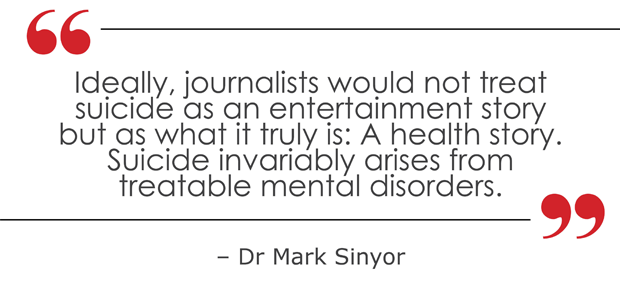
The framing of a story is just as important, Dr Mark Sinyor, the new study’s lead investigator and a psychiatrist at Sunnybrook Health Sciences Centre, told TIME in an email. He said, “Ideally, journalists would not treat suicide as an entertainment story but as what it truly is: A health story. Suicide invariably arises from treatable mental disorders. Most people who experience suicidal crises find paths to resilience, and there is no reason anyone has to die by suicide.”

Dr David Brent, who is a professor of psychiatry and the Endowed Chair in Suicide Studies at the University of Pittsburgh and not affiliated with the research, echoes this. He told Reuters, “Stories can have a positive effect if they shed light on the role of mental health issues. And certainly you can say something about the devastating effect the suicide has on people.”

Dr Schaffer says it’s important to add “messages of hope” to articles about mental health, as this can potentially help prevent suicide. He suggests referring to people who have survived a suicide attempt.

“Part of the message of hope is, at a macro level, the sense that we can actually do something, because we need to fight against this sense that there’s hopelessness and helplessness associated with suicide. We know that there are lots of things we can do that can actually reduce the rates of suicide – not to zero, but to much less than it is.”

Suicide warning signs

Suicide warning signs can be either subtle or obvious. Here are some of the signs you should take note of:

  • Talking about suicide, dying or self-harm
  • Being preoccupied with death, for example, writing poems or stories about death
  • Having no hope for the future, feeling trapped and hopeless
  • Feelings of worthlessness, self-hatred, guilt, shame or saying they feel like a burden
  • Getting their affairs in order by drawing up a will or giving away valued possessions
  • Withdrawing from friends and family; no longer socialising because they prefer to be alone
  • Making unexpected visits or calls to friends and family, and saying goodbye
  • If a person has a sudden sense of calm and happiness after going through an extremely bad depressive episode, it could mean they have decided to attempt suicide.

Do you need help?

For a suicidal emergency call the South African Depression and Anxiety Group on 0800 567 567. Their 24-hour helpline is 0800 12 13 14. 

Image credit: iStock

Share Button

How smallpox claimed its final victim

How did British medical worker Janet Parker become the world’s last victim of smallpox?

Share Button

Pairs of small colliding galaxies may seed future stars

A pair of dwarf galaxies closely circling the Milky Way, the Large and Small Magellanic Clouds, were in the throes of merging into one when they fell into our galaxy. The duo is thought to hold enough gas to replenish half of the Milky Way’s supply of star-making fuel, and now, a study in the Monthly Notices of the Royal Astronomical Society offers new insights into how galaxies like ours are able to capture this gas so easily.

“You have this enormous reserve of star formation fuel sitting there ready to be stripped by another system,” says study coauthor Mary Putman, an astronomer at Columbia University.

Home to millions of stars, dwarf galaxies are outshined by bigger galaxies like the Milky Way with hundreds to thousands of times more stars. But what dwarf galaxies lack in brightness, they make up for in their sheer abundance of star-making fuel. The hydrogen gas swirling through the Large and Small Magellanic Clouds and dwarf galaxies like them are thought to play a key role in birthing new stars and other small galaxies.

To explore the star-making potential of dwarf galaxy pairs, a research team led by then-Columbia graduate student Sarah Pearson turned to a remote pair — NGC 4490 and NGC 4485 — 23 million light years away. Similar to the Large Magellanic Cloud, NGC 4490 is several times larger than its companion galaxy. But its isolated location allowed the researchers to simulate its eventual merger with NGC 4485 without interference from the Milky Way’s gravitational pull.

In their simulations, they watched the bigger galaxy, NGC 4490, peel off gas from its smaller sibling, a gravitational effect due to their lopsided difference in size. As the pair circled ever closer to each other, the smaller galaxy’s tail of gas was swept farther and farther away, a finding that supports a study earlier this year that fingerprinted the gas streaming from the Magellanic Clouds into the Milky Way as belonging to the Small Magellanic Cloud.

Long after NGC 4490 collided with its smaller companion and merged into one in the researchers’ simulation, their gas footprint continue to expand, the researchers found. In five billion years, they found, the pair’s gas tails would extend over a distance of 1 million light years, nearly twice its current length. “After 5 billion years, 10 percent of the gas envelope still resides more than 260,000 light years from the merged remnant, suggesting it takes a very long time before all the gas falls back to the merged remnant, ” says Pearson, who is now a fellow at the Flatiron Institute’s Center for Computational Astrophysics.

When the researchers compared their results to real-world observations of NGC 4490/4485 made by telescope, the results matched, indicating their model was accurate.

Their findings are also consistent with what astronomers know about the recycling of gas in the universe. As gas clouds grow more extended, the looser the gas becomes, thus making it easier for a bigger galaxy to come along and gobble it up. The simulation suggests that this dispersal process has helped the Milky Way efficiently strip gas from the Small Magellanic Cloud, and that this sort of gas-transfer may be fairly common elsewhere in the universe.

“Our study suggests that similar dwarf pairs exist out there,” says Pearson. “Because their gas is so extended, if they fall into something like the Milky Way, their gas is easily shed.”

The study further suggests that declining gas density on the outskirts of colliding dwarf galaxies makes it hard for new stars to form, a conclusion matched by observations. The researchers plan to continue studying other pairs of dwarf galaxy collisions to refine their model.

The other authors of the study are George Privon, University of Florida; Gurtina Besla, University of Arizona; David Martinez-Delgado, Astronomical Calculation Institute; Kathryn Johnston, Columbia; R. Jay Gabany, Black Bird II Observatory; David Patton, Trent University; and Nitya Kallivayalil, University of Virginia.

Story Source:

Materials provided by Columbia University. Original written by Kim Martineau. Note: Content may be edited for style and length.

Share Button

Ultrahot planets have starlike atmospheres

Recent observations by NASA’s Hubble and Spitzer space telescopes of ultrahot Jupiter-like planets have perplexed theorists. The spectra of these planets have suggested they have exotic — and improbable — compositions.

However, a new study just published by a research team that includes Arizona State University astrophysicist Michael Line, an assistant professor in ASU’s School of Earth and Space Exploration, proposes an explanation — that these gas-rich planets have compositions that are basically normal, going by what is known about planet formation. What’s different about them is that the atmospheres on their daysides look more like the atmosphere of a star than a planet.

“Interpreting the spectra of the hottest of these Jupiter-like planets has posed a thorny puzzle for researchers for years,” Line said.

The biggest puzzle is why water vapor appears to be missing from these worlds’ atmospheres, when it is abundant in similar but slightly cooler planets.

According to the new study, ultrahot Jupiters do in fact possess the ingredients for water (hydrogen and oxygen atoms). But due to the strong radiation on the planet’s daysides, temperatures there go high enough that water molecules are completely torn apart.

With ultrahot Jupiters orbiting extremely close to their stars, one side of the planet faces the star perpetually, while the nightside is gripped by endless darkness.

Dayside temperatures reach between 3,600 to 5,400 degrees Fahrenheit (2,000 to 3,000 degrees Celsius), ranking ultrahot Jupiters among the hottest exoplanets known. And nightside temperatures are around 1,800 degrees Fahrenheit cooler.

Star-planet hybrids

Among the growing catalogue of planets outside our solar system — known as exoplanets — ultrahot Jupiters have stood out as a distinct class for about a decade.

“The daysides of these worlds are furnaces that look more like a stellar atmosphere than a planetary atmosphere,” said Vivien Parmentier, an astrophysicist at Aix Marseille University in France and lead author of the new study published in Astronomy and Astrophysics. “In this way, ultrahot Jupiters stretch out what we think planets should look like.”

While telescopes like Spitzer and Hubble can gather some information about the daysides of ultrahot Jupiters, their nightsides are difficult for current instruments to probe.

The new paper proposes a model for what might be happening on both the illuminated and dark sides of these planets. The model is based largely on observations and analysis from three recently published studies, coauthored by Parmentier, Line, and others, that focus on three ultrahot Jupiters, WASP-103b, WASP-18b, and HAT-P-7b.

The new study suggests that fierce winds driven by heating may blow the torn-apart water molecules into the planets’ cooler nightside hemispheres. There the atoms can recombine into molecules and condense into clouds, all before drifting back into the dayside to be ripped apart again.

Family resemblance?

Hot Jupiters were the first widely discovered kind of exoplanet, starting back in the mid-1990s. These are cooler cousins to ultrahot Jupiters, with dayside temperatures below 3,600 degrees Fahrenheit (2,000 Celsius).

Water has proven to be common in their atmospheres, and thus when ultrahot Jupiters began to be found, astronomers expected them to show water in their atmospheres as well. But water turned out to be missing on their easily observed daysides, which got theorists looking at alternative, even exotic, compositions.

One hypothesis for why water appeared absent in ultrahot Jupiters has been that these planets must have formed with very high levels of carbon instead of oxygen. Yet this idea could not explain the traces of water sometimes detected at the dayside-nightside boundary.

To break the logjam, the research team took a cue from well-established physical models of stellar atmospheres, as well as “failed stars,” known as brown dwarfs, whose properties overlap somewhat with hot and ultrahot Jupiters.

“Unsatisfied with exteme compositions, we thought harder about the problem,” Line said. “Then we realized that many earlier interpretations were missing some key physics and chemistry that happens at these ultrahot temperatures.”

The team adapted a brown dwarf model developed by Mark Marley, one of the paper’s co-authors and a research scientist at NASA’s Ames Research Center in Silicon Valley, California, to the case of ultrahot Jupiters. Treating the atmospheres of ultrahot Jupiters more like blazing stars than conventionally colder planets offered a way to make sense of the Spitzer and Hubble observations.

“With these studies, we are bringing some of the century-old knowledge gained from studying the astrophysics of stars, to the new field of investigating exoplanetary atmospheres,” Parmentier said.

“Our role in this research has been to take the observed spectra of these planets and model their physics carefully,” Line said. “This showed us how to produce the observed spectra using gases that are more likely to be present under the extreme conditions. These planets don’t need exotic compositions or unusual pathways to make them.”

Share Button

Marine mammals lack functional gene to defend against popular pesticide

As marine mammals evolved to make water their primary habitat, they lost the ability to make a protein that defends humans and other land-dwelling mammals from the neurotoxic effects of a popular human-made pesticide, according to new research from the University of Pittsburgh School of Medicine.

The implications of this discovery, announced today in Science, led researchers to call for monitoring our waterways to learn more about the impact of pesticides and agricultural run-off on marine mammals, such as dolphins, manatees, seals and whales. The research also may shed further light on the function of the gene encoding this protein in humans.

“We need to determine if marine mammals are, indeed, at an elevated risk of serious neurological damage from these pesticides because they biologically lack the ability to break them down, or if they’ve somehow adapted to avoid such damage in an as-yet undiscovered way,” said senior author Nathan L. Clark, Ph.D., associate professor in Pitt’s Department of Computational and Systems Biology, and the Pittsburgh Center for Evolutionary Biology and Medicine. “Either way, this is the kind of serendipitous finding that results from curiosity-driven scientific research. It is helping us to understand what our genes are doing and the impact the environment can have on them.”

Clark and lead author Wynn K. Meyer, Ph.D., a postdoctoral associate in his laboratory, knew from previous research by other scientists that some genes behind smelling and tasting lost their function during the evolution of marine mammals. They set out to see what other genes conserved in land-dwelling mammals had lost function in marine mammals.

By analyzing DNA sequences from five species of marine mammals and 53 species of terrestrial mammals, the team found that Paraoxonase 1 (PON1), was the gene that best matched the pattern of losing function in marine mammals while retaining function in all terrestrial mammals. PON1 even beat out several genes responsible for smell and taste, senses that marine mammals don’t rely on much.

In humans and other terrestrial mammals, PON1 reduces cellular damage caused by unstable oxygen atoms. It also protects us from organophosphates, some of which are pesticides that kill insects — which lack PON1 — by disrupting their neurological systems.

Clark and Meyer worked with Joseph Gaspard, Ph.D., director of science and conservation at the Pittsburgh Zoo & PPG Aquarium, and Robert K. Bonde, Ph.D., now a scientist emeritus at the U.S. Geological Survey’s Wetland and Aquatic Research Center, to obtain marine mammal blood samples from U.S. and international scientists and conservation biologists. Collaborators at the University of Washington reacted blood samples from several marine mammals with an organophosphate byproduct and observed what happened. The blood did not break down the organophosphate byproduct the way it does in land mammals, indicating that, unless a different biological mechanism is protecting the marine mammals, they would be susceptible to “organophosphate poisoning,” a form of poisoning that results from the buildup of chemical signals in the body, especially the brain.

In an attempt to learn why marine mammals lost PON1 function, the researchers traced back when the function was lost in three different groups of marine mammals. Whales and dolphins lost it soon after they split from their common ancestor with hippopotamuses 53 million years ago; manatees lost it after their split from their common ancestor with elephants 64 million years ago. But some seals likely lost PON1 function more recently, at most 21 million years ago and possibly in very recent times.

“The big question is, why did they lose function at PON1 in the first place?” said Meyer. “It’s hard to tell whether it was no longer necessary or whether it was preventing them from adapting to a marine environment. We know that ancient marine environments didn’t have organophosphate pesticides, so we think the loss might instead be related to PON1’s role in responding to the extreme oxidative stress generated by long periods of diving and rapid resurfacing. If we can figure out why these species don’t have functional PON1, we might learn more about the function of PON1 in human health, while also uncovering potential clues to help protect marine mammals most at risk.”

As an example of the potential real-world consequences of losing function at PON1, the researchers explain in their scientific manuscript that in Florida, “agricultural use of organophosphate pesticides is common and runoff can drain into manatee habitats. In Brevard County, where 70 percent of Atlantic Coast manatees are estimated to migrate or seasonally reside, agricultural lands frequently abut manatee protection zones and waterways.”

The scientists believe the next step is to launch a study that directly observes marine mammals during and shortly after periods of excess agricultural organophosphate run-off. Such a project would require increased monitoring of marine mammal habitats, as well as testing of tissues from deceased marine mammals for evidence of organophosphate exposure. The most recent estimate the research team could find of organophosphate levels in manatee habitats in Florida is a decade old, Clark said.

“Marine mammals, such as manatees or bottlenose dolphins, are sentinel species — the canary in the coal mine,” said Clark. “If you follow their health, it will tell you a lot about potential environmental issues that could eventually affect humans.”

Additional authors on this research include Jerrica Jamison, Raghavendran Partha, M.Tech., Amanda Kowalczyk, B.S., Charles Kronk, B.S., and Maria Chikina, Ph.D., all of Pitt; Rebecca Richter, B.S., Judit Marsillach, Ph.D., and Clement E. Furlong, Ph.D., all of the University of Washington; Stacy E. Woods, Ph.D., M.P.H., of Johns Hopkins University; Daniel E. Crocker, Ph.D., of Sonoma State University; and Janet M. Lanyon, Ph.D., of the University of Queensland.

This study was supported by National Institutes of Health grants R01HG009299, U54 HG008540 and T32 EB009403. Collaborators were supported by funds from the Biotechnology Research Gift Fund, University of Washington, Division of Medical Genetics, and by grant 16SDG30300009 from the American Heart Association. Marine mammal samples were collected with funds from the Winifred Violet Scott Charitable Trust, the Sea World Research and Rescue Foundation, and the U.S. Geological Survey.

Share Button

Gel and acrylic nails allergy warning

When applied at home or by untrained nail technicians, reactions can occur, skin experts say.

Share Button

The unpleasant reason men navigate better than women

Scientists show innate ability is not the explanation for men navigating better than women.

Share Button

Heatwave blamed for record A&E attendances in England

A&E attendances in England in July were at the highest level since records began in 2010.

Share Button