Piping plovers want people to get off their lawn

A new study in The Condor: Ornithological Applications presents negative associations between anthropogenic disturbance (human recreational use of beaches, coastal modifications) and Piping Plovers on their non-breeding grounds. Shorebirds are one of the most threatened bird families in the world. Numerous studies have shown the negative impacts of humans on these birds, whether it be large-scale (e.g., habitat loss, climate change) or small-scale (e.g., ATV use, running with pets, flying kites). This research indicates that there are direct consequences of disturbance. Most Piping Plover research has focused on the breeding season in an attempt to directly influence population numbers, however this study argues that efforts are required throughout the year in all locations to assist Piping Plover conservation.

Virginia Polytechnic Institute and State University’s Dan Gibson and colleagues monitored Piping Plovers year-round to determine the health and behavior of individuals. Body condition, survival, and site fidelity were of most interest. Plovers in disturbed areas proved to be significantly lighter in mass, due to the birds not procuring enough food. Given poorer body condition, it should be no surprise that birds in these disturbed areas also had lower survival rates. Piping plovers have strong site fidelity on the breeding grounds and this study supports that fidelity continues on the non-breeding grounds. While physically capable of changing location, it was not common for individuals to do so even if there was a high level of disturbance. The lack of movement by disturbed individuals suggests that aspects of the species’ life history (i.e. fidelity) constrained individuals to make seemingly adaptive habitat-use decisions. Some of the strategies used on the breeding grounds (reduced human recreation, roped-off areas, no dogs on beaches) may be beneficial to also do on the non-breeding grounds to ensure year-round conservation and oversight on this threatened shorebird species.

Lead author Dan Gibson comments, “We have a lot of of opportunity to engage with the public in what exactly our research is about. We often try to stress that the impact an individual recreationist has on a shorebird is practically non-existent. However, if every person who uses a beach in a given day influences how these shorebirds feed or rest, those minute impacts can begin to add up over the course of a season that can manifest itself as reductions in individual body condition and ultimately their ability to withstand bad weather conditions or successfully migrate and find a mate. We try to stress that small changes in how we use a beach (e.g., keep dogs on leash, avoid running through groups of birds) can really add up to substantial improvements in the overall quality of coastal habitat for shorebirds.”

“This study availed itself of a unique resource that range-wide banding efforts have provided for the study of the demographics of the endangered piping plover,” adds College of Environmental Science and Forestry Associate Professor Jonathan Cohen, a shorebird expert who was not involved with the research, “and successfully attempted the difficult task of teasing out the sometimes subtle effect of disturbance in nonbreeding areas on annual vital rates. The finding that this endangered species may not readily abandon habitat that is detrimental for fitness was surprising, and warrants immediate attention from the conservation community.”

Story Source:

Materials provided by American Ornithological Society Publications Office. Note: Content may be edited for style and length.

Share Button

The Gaia Sausage: The major collision that changed the Milky Way galaxy

An international team of astronomers has discovered an ancient and dramatic head-on collision between the Milky Way and a smaller object, dubbed the “Sausage” galaxy. The cosmic crash was a defining event in the early history of the Milky Way and reshaped the structure of our galaxy, fashioning both its inner bulge and its outer halo, the astronomers report in a series of new papers.

The astronomers propose that around 8 billion to 10 billion years ago, an unknown dwarf galaxy smashed into our own Milky Way. The dwarf did not survive the impact: It quickly fell apart, and the wreckage is now all around us.

“The collision ripped the dwarf to shreds, leaving its stars moving in very radial orbits” that are long and narrow like needles, said Vasily Belokurov of the University of Cambridge and the Center for Computational Astrophysics at the Flatiron Institute in New York City. The stars’ paths take them “very close to the centre of our galaxy. This is a telltale sign that the dwarf galaxy came in on a really eccentric orbit and its fate was sealed.”

The new papers in the Monthly Notices of the Royal Astronomical Society, The Astrophysical Journal Letters and arXiv.org outline the salient features of this extraordinary event. Several of the papers were led by Cambridge graduate student GyuChul Myeong. He and colleagues used data from the European Space Agency’s Gaia satellite. This spacecraft has been mapping the stellar content of our galaxy, recording the journeys of stars as they travel through the Milky Way. Thanks to Gaia, astronomers now know the positions and trajectories of our celestial neighbours with unprecedented accuracy.

The paths of the stars from the galactic merger earned them the moniker “the Gaia Sausage,” explained Wyn Evans of Cambridge. “We plotted the velocities of the stars, and the sausage shape just jumped out at us. As the smaller galaxy broke up, its stars were thrown onto very radial orbits. These Sausage stars are what’s left of the last major merger of the Milky Way.”

The Milky Way continues to collide with other galaxies, such as the puny Sagittarius dwarf galaxy. However, the Sausage galaxy was much more massive. Its total mass in gas, stars and dark matter was more than 10 billion times the mass of our sun. When the Sausage crashed into the young Milky Way, its piercing trajectory caused a lot of mayhem. The Milky Way’s disk was probably puffed up or even fractured following the impact and would have needed to regrow. And Sausage debris was scattered all around the inner parts of the Milky Way, creating the ‘bulge’ at the galaxy’s centre and the surrounding ‘stellar halo.’

Numerical simulations of the galactic mashup can reproduce these features, said Denis Erkal of the University of Surrey. In simulations run by Erkal and colleagues, stars from the Sausage galaxy enter stretched-out orbits. The orbits are further elongated by the growing Milky Way disk, which swells and becomes thicker following the collision.

Evidence of this galactic remodelling is seen in the paths of stars inherited from the dwarf galaxy, said Alis Deason of Durham University. “The Sausage stars are all turning around at about the same distance from the centre of the galaxy.” These U-turns cause the density in the Milky Way’s stellar halo to decrease dramatically where the stars flip directions. This discovery was especially pleasing for Deason, who predicted this orbital pileup almost five years ago. The new work explains how the stars fell into such narrow orbits in the first place.

The new research also identified at least eight large, spherical clumps of stars called globular clusters that were brought into the Milky Way by the Sausage galaxy. Small galaxies generally do not have globular clusters of their own, so the Sausage galaxy must have been big enough to host a collection of clusters.

“While there have been many dwarf satellites falling onto the Milky Way over its life, this was the largest of them all,” said Sergey Koposov of Carnegie Mellon University, who has studied the kinematics of the Sausage stars and globular clusters in detail.

Story Source:

Materials provided by Simons Foundation. Note: Content may be edited for style and length.

Share Button

Nurse Lucy Letby arrested over Chester Hospital baby deaths

Detectives are searching the house of Lucy Letby after the deaths of eight babies at a hospital.

Share Button

Health24.com | 10 best low-sugar fruits that won’t mess with your blood sugar

Look: We need sugar to survive, both physically and emotionally. But even with fruits, you can inadvertently have too much of a good thing.

That said, you shouldn’t just cut out fruits altogether when trying to limit sugar intake. Fruits contain important nutrients like vitamin C, fibre and antioxidants – and increasing your intake of fruits and vegetables has been shown to reduce your cancer and mortality risk.

Instead, reach for fruits that are lower in sugar per serving. While registered dietititian Sarah Hortman says there aren’t any official guidelines as to what constitutes a “low-sugar” fruit, she says that “fruits containing higher fibre and water content dilute the amount of sugar or carbohydrate in a fruit.”

Without further (avoca)ado, these low-sugar fruits will allow you to get your sugar fix minus the dreaded energy crash.

Avocado

Yes, the reason millennials can’t afford to buy property is also a solid source of heart-healthy monounsaturated fats and fibre. Avocados are so tasty and low in sugar that they make the perfect dessert substitute, says Hortman. Just swap your typical sweetener for some puréed avocado in your favourite milkshake, mousse, and cake recipes.

Per 1/3 fruit: 334kJ, 7g fat (1g sat), 4g carbs, 0.3g sugar, 4mg sodium, 3g fibre, 1g protein

Read more: Which is better for weight loss: fruits or veggies?

Watermelon

Watermelon might be your next favourite workout recovery snack. In a small study from the Journal of Agricultural Food Chemistry, researchers found that the amino acids in the fruit juice helped athletes recover faster (and feel less sore) after working out. Watermelon is also high in the antioxidant lycopene.

Per one-cup serving: 192kJ, 0g fat (0g sat), 12g carbs, 10g sugar, 2mg sodium, 1g fibre, 1g protein

wedges of watermelon on blue background

Apples

Apples are the perfect mid-day snack because of their high soluble fibre content, which “absorbs water to become thick like the viscous texture of cooked oatmeal,” says Hortman. They’ve also been shown to lower your “bad” LDL cholesterol levels.

Per small apple: 322kJ, 0g fat (0g sat), 21g carbs, 15g sugar, 0mg sodium, 4g fibre, 0g protein

Read more: The 4 best fruits to eat if you’re trying to lose weight

Strawberries

The fruit (which, despite its name, isn’t technically a berry!) is packed with vitamin C and other antioxidants, has a decent amount of fibre, and can help reduce inflammation.

Per one-cup serving: 205kJ, 0g fat (0g sat), 12g carbs, 7g sugar, 2mg sodium, 3g fibre, 1g protein

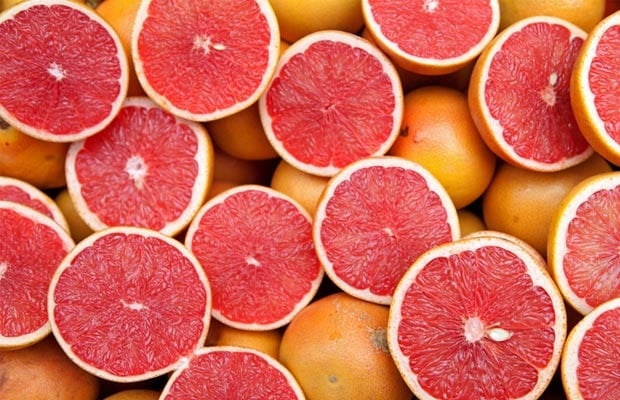
Grapefruit

This citrus fruit ranks low on the sugar scale, with a bitter tartness to match. You also get half of your daily recommended value of vitamin C by eating just half of a fruit. But talk to your doctor if you’re taking meds – the FDA warns that grapefruit (and grapefruit juice) can have bad interactions with several types of drugs, including statins for cholesterol and even some types of antihistamines.

Per 1/2 medium grapefruit: 171kJ, 0.2g fat (0g sat), 10g carbs, 9g sugar, 0mg sodium, 1g fibre, 0.8g protein

close up of grapefruits

Read more: 5 low-carb fruits that are super good for you

Limes

Limes are another great low-sugar fruit: only 1g of sugar in the entire fruit. You’ll also get nearly a third of your daily vitamin C dose per fruit. So don’t be afraid to use it to flavour salad dressings and fish tacos, or garnish your seltzer water when you’re feeling fancy.

Per medium lime: 83kJ, 0g fat (0g sat), 7g carbs, 1g sugar, 1mg sodium, 2g fibre, 0.5g protein

Olives

The Mediterranean diet has long been touted as the pathway to longevity, and thankfully, olives (which yes, are a fruit) are a staple. A small study from the American Journal of Hypertension found that polyphenol-rich olive oil is linked to decreased blood pressure in women who have high blood pressure or hypertension. While low in sugar, olives are often sold in cans and jars high in sodium, so keep an eye on portion sizes.

Per two tablespoon serving: 83kJ 2g fat (0.5g sat), 1g carbs, 0g sugar, 124mg sodium, 0g fibre, 0g protein

Read more: Here’s exactly how much fruit it’s safe to eat per week

Cucumbers

As a green-juice ingredient, we typically think of cucumbers as spa-friendly veggies. Surprise: They’re actually a fruit. Hortman says you can safely eat up to three and a half cups of cucumbers as a serving (since they’re basically all water), making them great for mindless munching.

Per 1/2-cup serving: 33kJ, 0g fat (0 g sat), 2g carbs, 1g sugar, 1mg sodium, 0g fibre, 0g protein

Chopped fresh cucumber

Tomatoes

Tomatoes are a rich source of the carotenoid lycopene, which can help protect the skin against ultraviolet rays (but nope, it can’t replace SPF), strengthen bones and even prevent asthma. And the low-sugar fruit is low in carbohydrates, too.

Per one-cup serving: 133kJ, 0g fat (0g sat), 7g carbs, 5g sugar, 9mg sodium, 2g fibre, 2g protein

Squash

While most squash varieties have a rep for being starchy, they offer way more benefits than other starchy carbs like bread and potatoes. Technically a fruit, according to Hortman, their fibre can help stabilise blood sugar levels while slowing down digestion – keeping the intestinal tract healthy and keeping you full for longer.

Per one-cup serving: 263kJ, 0g fat (0g sat), 16g carbs, 3g sugar, 6mg sodium, 3g fibre, 1.5g protein

This article was originally published on www.womenshealthmag.com

Image credit: iStock 

NEXT ON HEALTH24X

Share Button

Health24.com | 3 times women self-diagnosed via Google – and got it scarily wrong

Your hiccups just won’t quit. Seriously, it’s been two days. You could head to your GP. But, groan. So inconvenient. And Dr Google is faster and free. It takes you mere seconds to type your symptoms into a search engine and just a few more to learn that those persistent throat spasms could be a sign of a pulmonary embolism. Or a stroke. Or, cancer.

One in 20 of the 100 billion monthly Google searches relates to health and medical info. Psychologists have given this tech-enabled obsessing over real or imagined symptoms a name: Cyberchondria.

“Everybody googles their symptoms, diagnoses and treatments – and that’s enabled people to be a lot more knowledgeable,” says neurologist Dr Lyle Dennis. “But the flip side is that people are getting scared.” Why?

Millions of medical sites, blogs and Wiki pages can, intentionally or not, spew out a bunch of overwhelming, confusing or panic-inducing info. The good news: Google is overhauling how it displays health-related search queries, partnering with the Mayo Clinic to ensure more credible information is the most accessible.

But is shopping for a diagnosis online scary or smart? Read these three real-life scenarios below, then decide for yourself…

Read more: 7 lies you really need to stop telling your doctor

Case study 1

Amanda had been tired for weeks. A web search for “fatigue” brought up site after site describing her exact symptoms and pointing to a likely diagnosis: Systemic exertion intolerance disease (aka chronic fatigue). She ordered scores of supplements that promised relief. When they didn’t deliver – several months and a lot of money later – a blood test at her GP revealed the real, easily treatable culprit: Anaemia.

What the experts say

“Anxiety often motivates us to find answers,” explains clinical psychologist Dr Thomas Fergus. It’s human nature to identify any and all perceived threats, which makes online health hunting a loaded endeavour. Research from Microsoft US shows around 40% of people who type in medical terms start calmly, then quickly escalate (read: cramps becoming anxiety-induced ulcers).

“Based on web searches, I’ve had patients with common headaches come in thinking they have brain tumours,” says internal medicine specialist Dr Sandra Fryhofer. But many don’t even make it that far.

“Some women are convinced they have an illness and decide to treat it themselves,” says obstetrician and gynaecologist Dr Michele Curtis. “Others become paralysed by denial and don’t want to hear an official diagnosis.” Either way, some cyberchondriacs delay care, which can lead to serious consequences. (For example, if sudden vaginal bleeding does turn out to be cervical cancer, early treatment can be lifesaving. But, for real, you probably don’t have cervical cancer!)

Case study 2

Erin was scrolling through Facebook when she saw a friend had been diagnosed with multiple sclerosis.  A link sent Erin through to a message board full of patients’ descriptions of early symptoms, including tingling in the hands and feet. Erin had felt that before! She dialled her doctor, demanding a battery of expensive and invasive tests (hello, spinal tap). Everything came back negative. Oh.

What the experts say

Doctors know they shouldn’t order tests sans red flags, but many cave in anyway. “Some women are so convinced they have a certain ailment that it’s hard to dissuade them, even with proof,” says Dr Curtis. Turns out, reading real-life stories can also be a catalyst for a “what if?” frenzy that leads to “me too!”

Without context or professional know-how, social media-shared stories can seem almost too relatable. “It’s the narrative that matters to people, often more than the facts,” says Dr Curtis.

Case study 3

Sarah had a dull ache in her right side. A quick Google search suggested it was indigestion or a pulled muscle. She kept clicking and saw appendicitis mentioned. Alarmed, Sarah ferreted out more info on the condition and eventually found a self-test: Press and release on the area to see if that hurts. Ouch! Sarah called her doctor, who sent her to emergency right before her appendix burst.

What the experts say

Few medical conditions can snowball as fast as an online health investigation, but in some cases, a little cyberchondria can steer you in the right direction. In fact, a survey by Pew Research Center found that 41% of those who digitally diagnose said a professional confirmed their suspicion.

Taking an active role in your health is linked to better outcomes, says WH health expert Dr Ginni Mansberg. “My patients have more time to research than me and really think about their symptoms. I only often get 15-20 minutes with someone, so it can be a godsend to have a patient come in presenting what they think they have.”

This article was originally published on www.womenshealthsa.co.za

Image credit: iStock

Share Button

Sperm quality improved by adding nuts to diet, study says

Men who ate about two handfuls of nuts a day improved sperm count and vitality, a study finds.

Share Button

Give your bones a workout, public told

We should all be doing strengthening exercises as well as aerobic activity, a report says.

Share Button

Illegal levels of air pollution linked to child’s death

Air pollution is linked to the asthma death of a nine-year-old girl who lived near to a busy London road.

Share Button

Health24.com | Thailand caves: How long can you survive without food or water?

On 23 June 2018, 12 boys and their football coach went missing in Tham Luang cave, one of Thailand’s longest caves. News24 reported that it’s one of the hardest to navigate as the corridors are winding and narrow.

They were exploring the cave when heavy rains hit the area, flooding the entrance and trapping them deep underground.

Nine days later, two British Navy Seal divers reached them. They are alive and mostly well, but now the real challenge begins as they try to get them out safely.

But this begs the question – how long can a person survive without any food or water? Hint: It’s probably longer than you think, but definitely not something you should try.

Living without food

Michael Peel, a senior medical examiner at the Medical Foundation for the Care of Victims of Torture, reviewed available literature regarding human starvation in a 1997 article in the British Medical Journal. According to this information, people can survive without food for between 30 and 40 days, but they need to remain hydrated. 

Severe symptoms of starvation (apathy, withdrawal, listlessness and extreme weight loss, for example) will display around day 35 to 40, while death can occur at between 45 to 61 days, according to literature describing the hunger strikers of the Belfast Maze Prison in the ‘80s.

There are, however, a number of factors that can influence how long a person can survive without food – these include age, weight, general health and how the body’s metabolism slows to help conserve energy.

Dr Mike Stroud, a senior lecturer of Medicine and Nutrition at Southampton University, told the BBC he believes it is possible to survive for 60 days without food. “That is about the time hunger strikers in prisons tend to die,” said Dr Stroud. “But they are normally in warmer conditions.”  

He continued, “The average resting human body, doing absolutely nothing, produces about 100 watts of body heat, which could function a light bulb. The body needs more than just [kilojoules] – it will start to shut down its organs one by one. But it could still take up to 60 days for that to happen.”  

Dr Claude Piantadosi at Duke University in North Carolina says going without food for six weeks is about the limit for an average person. He told NBC News, “If somebody’s really huge, really fat, they could live longer than six weeks.”

What happens to your body?

If you stop eating for six hours, your body breaks down glycogen (stores energy in your body) into glucose. About 25% of this energy is used by your brain.

Your body goes into ketosis after six to 72 hours without food, where it is forced to use an alternative source of energy when the glucose is depleted. Your brain breaks down the body’s protein, which releases amino acids that can convert into glucose. Your body is using its muscle mass to produce energy and survive.   

After one to two weeks your body becomes depleted of minerals and vitamins, which can lead to a weakened immune system. Death can be a result of illness or a heart attack due to the severe degradation of the muscles in the heart, diaphragm and body.

Dehydration is deadly

Without drinking water your survival time is lot shorter. Experts estimate you can live for about one week without water depending on the weather conditions. However, if it’s hot and dry, the estimation drops to just a few days. 

“I have sort of a 100-hour rule,” said Dr Piantadosi. “Depending on the temperature you are exposed to, you can go 100 hours [4.2 days] without drinking at an average temperature outdoors. If it’s cooler, you can go a little longer. If you are exposed to direct sunlight, it’s less,” he said.

According to Randall Packer, an expert on the body’s water balance at George Washington University, “The more energy you expend the more likely you are to lose water. You lose a little bit of water every time you exhale. You lose water when you sweat. You do make a little water when you metabolise food … but the balance is such that you always need some sort of water intake.”

How dehydration can kill you

“Under extreme conditions an adult can lose 1 to 1.5l of sweat per hour. If that loss is not replaced by drinking, the total volume of body fluid can fall quickly and, most dangerously, blood volume drops,” said Packer.

When you lose more than 7% of your body weight, your body struggles to maintain blood pressure. As this happens, blood flow to non-vital organs, such as your kidneys and gut, begins to slow. If your kidneys are unable to filter blood, cellular waste begins to build up, which can cause kidney failure and death.

Image credit: iStock 

Share Button

Countess of Chester Hospital: Woman held in baby deaths probe

A healthcare professional is being held over the deaths of eight babies at a Cheshire hospital.

Share Button