Administering hormones affects DNA

The public debate on endocrine disrupting chemicals (EDCs) — exogenous substances that have the same or similar effects as endogenous hormones — has been going on for some time. Chemicals such as bisphenol A or phthalates, the latter of which are used to soften plastics, may be connected to rising infertility rates among men and women.

In an experiment with pigs, researchers from ETH Zurich and the Technical University of Munich have demonstrated for the first time that the administration of even extremely low doses of an endocrine disruptor — in this case, an endogenous estrogen — leads to epigenetic changes in a pregnant sow’s DNA. Moreover, these changes were also observed in the sows’ embryos, and similar changes were even evident after the offspring had reached adulthood. The study was recently published in the journal Scientific Reports.

A time window of increased sensitivity

“EDCs, especially estrogens, are highly effective even at very low doses,” says Susanne Ulbrich, Full Professor of Animal Physiology at ETH Zurich. Whether endo- or exogenous chemicals have an effect, and how strong that effect is, also depends on the point in time during which the exposure occurs. “For example,” Ulbrich explains, “the body is particularly susceptible to external disruptive hormonal influences during the embryonic phase of early pregnancy.”

Ulbrich and her colleagues examined exactly such a time window in their study with pigs: to simulate the intake of EDCs via drinking water or food, they exposed pregnant sows to varying doses of estradiol-17β, a natural estrogen, via their daily feed either over the course of the whole gestation period or only during the first ten days after fertilisation.

The lowest dose corresponded to the acceptable daily intake for humans (0.05 micrograms per kilogram body weight). In the same experiment, the scientists administered two other dosages: one close to the “no observed effect” level (10 micrograms per kilogram body weight daily) as well as a higher dosage (1,000 micrograms per kilogram daily) — the latter to simulate the accidental taking of the contraceptive pill in early pregnancy. The experiment included a control group of pigs that received no estradiol.

The scientists tested the gene expression and the epigenetic changes in various tissues of the pregnant sows as well as in their offspring, both in the ten-day-old embryos (blastocysts) and in one-year-old mature females.

Changes in gene expression

Their efforts bore fruit: of the 57 estrogen-related genes, estradiol affected the tissue-specific expression of about two dozen of the genes tested, according to dosage. Most of these genes regulate the cell cycle or suppress the growth of tumours. The changes were most pronounced in the pregnant sows’ corpora lutea, endometria, hearts and skeletal muscle.

In addition, the researchers observed epigenetic changes in a few selected genes in the sows’ liver. Similar changes to these genes also appeared in the embryos and in the adult offspring: even in the one-year-old female offspring, the researchers were able to determine that the epigenetic pattern of these genes had been altered.

Epigenetic changes occur for example through the addition or removal of small chemical groups, such as methyl groups, at certain points in the DNA. This can alter the expression of the affected gene, and in turn change the cell’s function.

Lasting changes

“We didn’t find any serious impact on the health of the adult offspring; we saw only slight changes, such as in bone density and the ratio of fat to muscle mass,” Ulbrich explains. However, it remains unclear what long-term effects the epigenetic changes might have, and whether the interaction of the many EDCs humans are exposed to on a daily basis render the situation more acute.

“There is an urgent need to observe this phenomenon over several generations in a long-term study,” says the ETH professor. “Epigenetic changes can emerge within just one generation, but in certain circumstances they will continue to be transmitted to succeeding generations. We can already clearly demonstrate that hormones, even after a brief exposure period and in very small amounts, can have a measurable effect,” she concludes.

Based on these results, Ulbrich, an expert in reproductive physiology, is calling for a re-assessment of the acceptable daily intake value and the “no observed effect level” dosage. She notes that pigs’ hormonal changes during pregnancy closely resemble those in humans, so the results of the study are highly applicable to humans; they may even be more appropriate than findings from a study of, say, mice.

“At the moment, recommended threshold levels are probably too high,” Ulbrich says. No matter how tiny the estrogen dosage, the epigenetic changes she and her team observed clearly evidenced that the test subjects had been exposed to an EDC. She continues: “How exactly that resulted in the changes and what impact these changes will have in the long run requires closer study. The sensitivity of embryos in the early days of pregnancy should under no circumstances be underestimated.”

Share Button

Simple logic for nanofluidic computing simulated

Invigorating the idea of computers based on fluids instead of silicon, researchers at the National Institute of Standards and Technology (NIST) have shown how computational logic operations could be performed in a liquid medium by simulating the trapping of ions (charged atoms) in graphene (a sheet of carbon atoms) floating in saline solution. The scheme might also be used in applications such as water filtration, energy storage or sensor technology.

The idea of using a liquid medium for computing has been around for decades, and various approaches have been proposed. Among its potential advantages, this approach would require very little material and its soft components could conform to custom shapes in, for example, the human body.

NIST’s ion-based transistor and logic operations are simpler in concept than earlier proposals. The new simulations show that a special film immersed in liquid can act like a solid silicon-based semiconductor. For example, the material can act like a transistor, the switch that carries out digital logic operations in a computer. The film can be switched on and off by tuning voltage levels like those induced by salt concentrations in biological systems.

“Previous devices were much more elaborate and complex,” NIST theorist Alex Smolyanitsky said. “What this ion-trapping approach achieves is conceptual simplicity. In addition, the same exact device can act as both a transistor and a memory device — all you have to do is switch the input and output. This is a feature that comes directly from ion trapping.”

The NIST molecular dynamics simulations focused on a graphene sheet 5.5 by 6.4 nanometers (nm) in size and with one or more small holes lined with oxygen atoms. These pores resemble crown ethers — electrically neutral circular molecules known to trap metal ions. Graphene is a sheet of carbon atoms arranged in hexagons, similar in shape to chicken wire, that conducts electricity and might be used to build circuits. This hexagonal design would seem to lend itself to pores, and in fact, other researchers have recently created crown-like holes in graphene in the laboratory.

In the NIST simulations, the graphene was suspended in water containing potassium chloride, a salt that splits into potassium and sodium ions. The crown ether pores were designed to trap potassium ions, which have a positive charge. Simulations show that trapping a single potassium ion in each pore prevents any penetration of additional loose ions through the graphene, and that trapping and penetration activity can be tuned by applying different voltage levels across the membrane, creating logic operations with 0s and 1s (see text box below).

Ions trapped in the pores not only block additional ion penetration but also create an electrical barrier around the membrane. Just 1 nm away from the membrane, this electric field boosts the barrier, or energy needed for an ion to pass through, by 30 millivolts (mV) above that of the membrane itself.

Applying voltages of less than 150 mV across the membrane turns “off” any penetration. Essentially, at low voltages, the membrane is blocked by the trapped ions, while the process of loose ions knocking out the trapped ions is likely suppressed by the electrical barrier. Membrane penetration is switched on at voltages of 300 mV or more. As the voltage increases, the probability of losing trapped ions grows and knockout events become more common, encouraged by the weakening electrical barrier. In this way, the membrane acts like a semiconductor in transporting potassium ions.

To make actual devices, crown ether pores would need to be fabricated reliably in physical samples of graphene or other materials that are just a few atoms thick and conduct electricity. Other materials may offer attractive structures and functions. For example, transition metal dichalcogenides (a type of semiconductor) might be used because they are amenable to a range of pore structures and abilities to repel water.

Making A Logic Operation in Liquid

NIST simulations showed that ion trapping depends on the voltage across the porous graphene membrane, suggesting the possibility of performing simple ion-based logic operations. At sufficiently low salt concentration, the membrane’s highly conductive (on) regime coincides with low trapped ion occupancy, and vice versa. Direct electrical measurement of the membrane’s voltage, which might be used in an electrical circuit, is what’s known as a “read” operation.

If a low voltage, denoted 0, is applied across the membrane with appropriate salt concentration, the membrane is nearly nonconductive (off) and its pores are fully occupied by the trapped ions. Therefore, the charge in the graphene circuit, measured at the membrane, is relatively high, denoted as 1. Conversely, when high voltage (more than 300 mV), denoted 1, is applied, the membrane is highly conductive (on), fewer ions are trapped, and thus a low (0) state of energy in the membrane itself is measured.

The input-output relationship can be viewed as a NOT logic gate or operation, in which input and output values are reversed. If 0 goes in, then 1 comes out, and vice versa. With two graphene sheets an OR (XOR) logic operation would be possible. In this case, the output value, or the difference between the two membrane states, is 1 only when either of the two sheets is highly conductive. Stated another way, the output is 1 if the inputs are different but 0 if the two inputs are identical.

Even a small variation in applied voltage results in a relatively large change in potential membrane charge or current, suggesting that sensitive switching may be possible. Thus, voltage-tunable ion trapping in crown pores might be used to store information, and simple, yet sensitive ionic transistors might be used to perform sophisticated logic operations in nanofluidic computing devices.

The research is funded by the Materials Genome Initiative.

Share Button

The culprit of some GaN defects could be nitrogen

As silicon-based semiconductors reach their performance limits, gallium nitride (GaN) is becoming the next go-to material to advance light-emitting diode (LED) technologies, high-frequency transistors and photovoltaic devices. Holding GaN back, however, is its high numbers of defects.

This material degradation is due to dislocations — when atoms become displaced in the crystal lattice structure. When multiple dislocations simultaneously move from shear force, bonds along the lattice planes stretch and eventually break. As the atoms rearrange themselves to reform their bonds, some planes stay intact while others become permanently deformed, with only half planes in place. If the shear force is great enough, the dislocation will end up along the edge of the material.

Layering GaN on substrates of different materials makes the problem that much worse because the lattice structures typically don’t align. This is why expanding our understanding of how GaN defects form at the atomic level could improve the performance of the devices made using this material.

A team of researchers has taken a significant step toward this goal by examining and determining six core configurations of the GaN lattice. They presented their findings in the Journal of Applied Physics, from AIP Publishing.

“The goal is to identify, process and characterize these dislocations to fully understand the impact of defects in GaN so we can find specific ways to optimize this material,” said Joseph Kioseoglou, a researcher at the Aristotle University of Thessaloniki and an author of the paper.

There are also problems that are intrinsic to the properties of GaN that result in unwanted effects like color shifts in the emission of GaN-based LEDs. According to Kioseoglou, this could potentially could be addressed by exploiting different growth orientations.

The researchers used computational analysis via molecular dynamics and density functional theory simulations to determine the structural and electronic properties of a-type basal edge dislocations along the <1-100> direction in GaN. Dislocations along this direction are common in semipolar growth orientations.

The study was based on three models with different core configurations. The first consisted of three nitrogen (N) atoms and one gallium (Ga) atom for the Ga polarity; the second had four N atoms and two Ga atoms; the third contained two N atoms and two Ga core-associated atoms. Molecular dynamic calculations were performed using approximately 15,000 atoms for each configuration.

The researchers found that the N polarity configurations exhibited significantly more states in the bandgap compared to the Ga polarity ones, with the N polar configurations presenting smaller bandgap values.

“There is a connection between the smaller bandgap values and the great number of states inside them,” said Kioseoglou. “These findings potentially demonstrate the role of nitrogen as a major contributor to dislocation-related effects in GaN-based devices.”

Story Source:

Materials provided by American Institute of Physics. Note: Content may be edited for style and length.

Share Button

Sintering atomically thin materials with ceramics now possible

For the first time, researchers have created a nanocomposite of ceramics and a two-dimensional material, opening the door for new designs of nanocomposites with such applications as solid-state batteries, thermoelectrics, varistors, catalysts, chemical sensors and much more.

Sintering uses high heat to compact powder materials into a solid form. Widely used in industry, ceramic powders are typically compacted at temperatures of 1472 degrees Fahrenheit or higher. Many low-dimensional materials cannot survive at those temperatures.

But a sintering process developed by a team of researchers at Penn State, called the cold sintering process (CSP), can sinter ceramics at much lower temperatures, less than 572 degrees F, saving energy and enabling a new form of material with high commercial potential.

“We have industry people who are already very interested in this work,” said Jing Guo, a post-doctoral scholar working in the group of Clive Randall, professor of materials science and engineering, Penn State. “They are interested in developing some new material applications with this system and, in general, using CSP to sinter nanocomposites.” Guo is first coauthor on the paper appearing online in Advanced Materials.

The idea of trying to develop a ceramic-2D composite system was the result of a National Science Foundation workshop on the future of ceramics, organized by Lynnette Madsen, that drew 50 of the top ceramic scientists in the U.S. Yury Gogotsi, a Charles T. and Ruth M. Bach Distinguished University Professor and director of the A.J. Drexel Nanomaterials Institute, at Drexel University, heard Randall’s presentation on cold sintering and proposed a collaboration to develop a ceramic composite using a new class of two-dimensional materials, called MXenes, discovered by Gogotsi and his collaborators at Drexel. MXenes are carbide and nitride sheets a few atoms thin that possess extreme strength. Many of them are excellent metallic conductors.

While it has been known that mixing even a very small amount of 2D materials, such as graphene, into a ceramic can dramatically change its properties, MXene has never been used in ceramic composites. In this work, Guo and Benjamin Legum, Gogotsi’s doctoral student, mixed 0.5 to 5.0 percent MXene into a well-known ceramic system called zinc oxide. The metallic MXene coated the ceramic powder and formed continuous two-dimensional grain boundaries, which prevented grain growth, increased the conductivity by two orders of magnitude, transforming semiconducting zinc oxide into a metallic ceramic, and doubled hardness of the final product. The addition of MXene also improved the ability of zinc oxide to transform heat to electricity.

“Ben came here quite frequently to work with Jing, and over time they overcame all of the problems involved with dispersing the 2D MXenes into the zinc oxide and then sintering it,” said Randall. “This opens a whole new world incorporating 2D materials into ceramics.”

Gogotsi added, “This is the first ceramic composite containing MXene. Taking into account that about thirty MXenes with diverse properties are already available, we are opening a new chapter in research on ceramic matrix composites, with potential applications ranging from electronics to batteries and thermoelectrics.”

Story Source:

Materials provided by Penn State. Note: Content may be edited for style and length.

Share Button

Novel hybrid catalyst to split water discovered

Researchers from the University of Houston and the California Institute of Technology have reported an inexpensive hybrid catalyst capable of splitting water to produce hydrogen, suitable for large-scale commercialization.

Most systems to split water into its components — hydrogen and oxygen — require two catalysts, one to spur a reaction to separate the hydrogen and a second to produce oxygen. The new catalyst, made of iron and dinickel phosphides on commercially available nickel foam, performs both functions.

Researchers said it has the potential to dramatically lower the amount of energy required to produce hydrogen from water while generating a high current density, a measure of hydrogen production. Lower energy requirements means the hydrogen could be produced at a lower cost.

“It puts us closer to commercialization,” said Zhifeng Ren, M.D. Anderson Chair Professor of physics at UH and lead author of a paper describing the new catalyst published Friday in Nature Communications.

Hydrogen is considered a desirable source of clean energy, in the form of fuel cells to power electric motors or burned in internal combustion engines, along with a number of industrial uses. Because it can be compressed or converted to liquid, it is more easily stored than some other forms of energy, said Ren, who also is a researcher at the Texas Center for Superconductivity at UH.

But finding a practical, inexpensive and environmentally friendly way to produce large amounts of hydrogen gas — especially by splitting water into its component parts — has been a challenge.

Most hydrogen is currently produced through steam methane reforming and coal gasification; those methods raise the fuel’s carbon footprint despite the fact that it burns cleanly.

And while traditional catalysts can produce hydrogen from water, co-author Shuo Chen, assistant professor of physics at UH, said they generally rely on expensive platinum group elements. That raises the cost, making large-scale water splitting impractical.

“In contrast, our materials are based on earth abundant elements and exhibit comparable performance with those of platinum group materials,” she said. “It can be potentially scaled-up at low cost, which makes it very attractive and promising for the commercialization of water splitting.”

Researchers said the catalyst remained stable and effective through more than 40 hours of testing.

The new catalyst, they wrote, “proves to be an outstanding bifunctional catalyst for overall water splitting, exhibiting both extremely high OER (oxygen evolution reaction) and HER (hydrogen evolution reaction) activities in the same alkaline electrolyte. Indeed, it sets a new record in alkaline water electrolyzers (1.42 V to afford 10 mA cm-2), while at the commercially practical current density of 500 mA cm-2.”

Previous catalysts have used different materials to spur a reaction to produce the hydrogen than those that are used to produce the oxygen. Ren said the interaction between the iron phosphide particles and the dinickel phosphide particles boosted both reactions. “Somehow a joint effort of the two materials is better than any individual material,” he said.

In addition to Ren and Chen, other authors on the paper include Fang Yu, Haiqing Zhou and Jingying Sun, all with the UH Department of Physics; Fan Qin and Jiming Bao, with the Department of Electrical and Computer Engineering at UH; and Yufeng Huang and William A. Goddard III of the Materials and Process Simulation Center at the California Institute of Technology.

Story Source:

Materials provided by University of Houston. Original written by Jeannie Kever. Note: Content may be edited for style and length.

Share Button

Health24.com | 6 times your period blood looks different – and what it means about your health

Seriously, what’s up with those weird periods we sometimes get? Well, your period blood can actually tell you a lot about your health. While most of these changes are perfectly normal, some are a sign that you should see a doctor.

According to Kotex health expert and midwife, Sister Burgie Ireland, when your period changes – whether it’s a difference in colour or texture, or both – this is what’s going on with your body…

1. Rusty brown, brick or dark red

Women who eat lots of red meat and green leafy vegetables will have more iron in their blood, explains Ireland. When this iron mixes with air, it can make period blood look darker. This blood is normal, so don’t stress.

Read more: Can you really get pregnant while on your period?

2. Brown with mucus

Experiencing this type of blood is normal. For some girls or women, this is a sign you’re your period will start in the next 24 hours, or it may happen on the last day of your period.

3. Raspberry/light pink

A girl’s first and early periods can be lighter in colour. Women playing extreme sports, and those who are dieting seriously or are underweight, can have lighter, scantier periods. This can also be a once-off implantation bleed at the start of a pregnancy, which is perfectly normal.

Read more: Menstrual cups are having a moment – here’s what it’s like to wear one

4. Pink with mucus

Many girls may experience pink mucous blood. Again, this is totally normal. This only means that your period is about to end.

5. Dark crimson with big clots

When this happens for every period, it can be a sign of an undiagnosed connective tissue disease e.g. lupus or a blood disorder. It’s also associated with endometriosis, approaching menopause or a sign of an oestrogen hormonal imbalance. You may want to visit a doctor.

Read more: Here’s why you should always masturbate on your period

6. Bright red with clots

This is a sign of fresh bleeding and can be caused by fibroids, polyps, cysts, some STIs (like chlamydia) or a pelvic infection. It could also happen with a miscarriage or ectopic pregnancy. You may also want to visit a doctor if you experience this type of bleeding.

And if your period blood smells?

According to Ireland, period blood has its own smell. This is not a bad small, but it’s different. To prevent body odour while on your period change your pad, tampon and panty liner at least every four hours; wash every day; wear clean undies every day; and wear comfortable (rather than body-hugging) jeans.

This article was originally published onwww.womenshealthsa.co.za

Image credit: iStock

Share Button

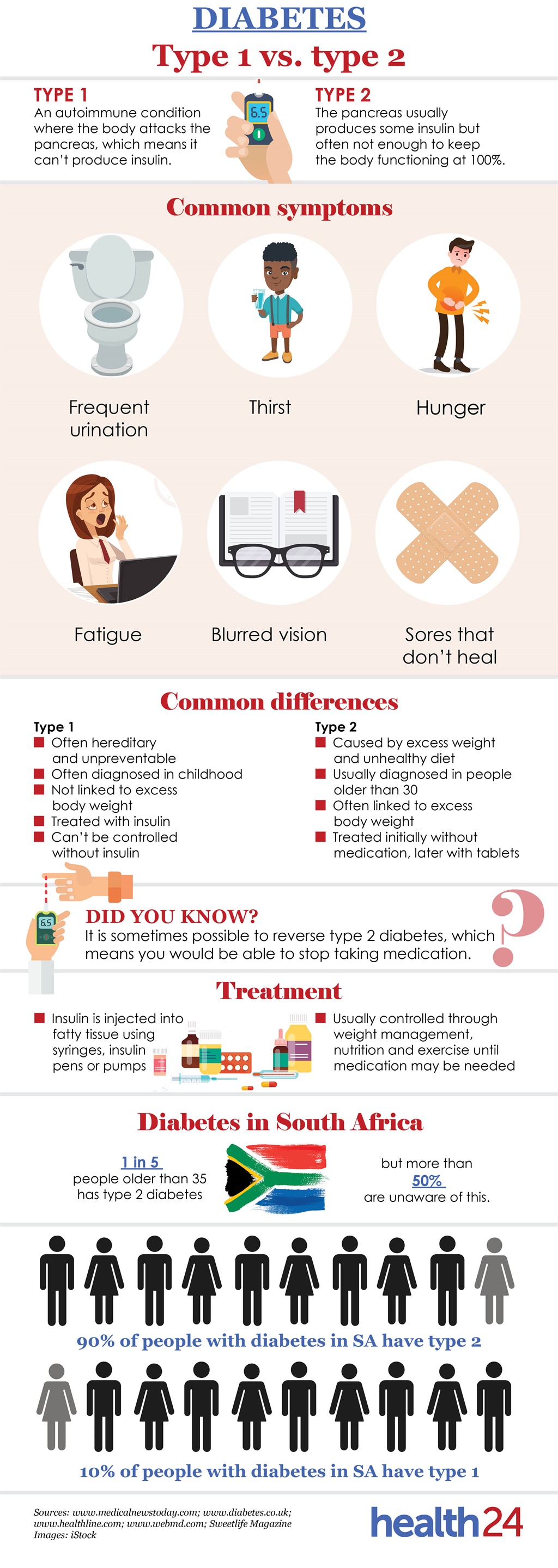
Health24.com | SEE: How to tell the difference between type 1 and 2 diabetes

Diabetes expert

Dr. May currently works as a fulltime endocrinologist and has been in private practice since 2004. He has a variety of interests, predominantly obesity and diabetes, but also sees patients with osteoporosis, thyroid disorders, men’s health disorders, pituitary and adrenal disorders, polycystic ovaries, and disorders of growth. He is a leading member of several obesity and diabetes societies and runs a trial centre for new drugs.

Share Button

Health24.com | Antibiotic use in farm animals may add to superbug threat

There’s a lot of concern about growth hormones and the fact that certain farmers supplement their livestock’s diet with these substances in order for them to grow bigger at a faster rate.

But what about antibiotics?

It is believed that, apart from killing pathogens, supplementing farm animals’ diet with antibiotics also leads to faster growth. The downside, however, is that it may add to a massive global problem – antimicrobial resistance.

Antimicrobial resistance in humans has been increasing at a rapid pace over the last few decades. Abuse and misuse of medication, like antibiotics, is a major contributor.

The misuse of antibiotics in humans could result in building up resistance to various medications, resulting in serious illness and subsequent death.

South African law

In South Africa, the law doesn’t specifically address administering antibiotics to farm animals to encourage rapid growth, but the Medicines and Related Substances Act (Act 101 of 1965) deals with animal healthcare professionals being allowed to prescribe medication for animals to kill off harmful bacteria or to cure disease. 

The Fertilisers, Farm Feeds, Agricultural Remedies and Stock Remedies Act (Act 36 of 1947) addresses medication for livestock being obtainable over the counter for farmers to treat common diseases that their livestock may acquire.

Growth in market and product size

While in humans antibiotics are used to kill off harmful bacteria and restore health, in animals, including birds, the use of antibiotics also expedites growth.

In India, where people generally steer clear of red meat and pork, the market for poultry is substantial and continues to grow. It’s believed that farmers are having trouble keeping up with the demand, and supplement their chicken feed with antibiotics to keep them disease-free and encourage growth.

The harm in doing this is that birds may end up carrying drug-resistant bacteria, which could be transferred to humans through contact, consumption or the environment.

The trouble with drug-resistant bacteria is that it is very difficult to kill these germs, regardless of what medication you take. This will remain a problem until doctors and scientists understand the inner workings of these organisms and how to outsmart them.

The problem is so severe that the World Health Organization (WHO) has launched a Global Action Plan to help countries around the world tackle the problem and try and minimise the damage that’s already been done.

Share Button

Women in Wales to get abortion pill at home

Supporters say it will stop women facing traumatic journeys back from clinics after taking termination tablets.

Share Button

MDMA strengths surge to ‘potentially fatal’ levels

Public Health Wales says the very high strengths caused “a number of hospitalisations”.

Share Button