Health24.com | SA first: Landmark op for urinary incontinence in men

PRETORIA – An artificial urinary sphincter has been used for the first time in South Africa. It’s used to treat severe urinary incontinence – loss of bladder control – in men.

The minimally invasive surgery involves implanting the device in the groin area, which means it’s discreet and there are no external parts. Dr Johan Venter at the Netcare Pretoria East Hospital was the team lead for the surgery and requested the technology for a patient who suffered from stress incontinence problems.

Stress incontinence problems include losing control while coughing, sneezing or performing a simple act like lifting.

Best option yet

In a statement released by the hospital, Dr Venter explained that an artificial urinary sphincter is widely considered the gold standard of treatment for urinary incontinence in men who have suffered irreparable damage to their urinary sphincter.

Dr Venter said, “We were particularly impressed by this new-generation artificial urinary sphincter option, our investigations revealing that it was the best alternative available globally for cases like this.

“Some of the advantages it offers include that it’s easy for patients to use and does not require further invasive surgeries, should it require adjustment in future.”

Discreet and compact

Dr Venter explained that the device has a pump that the patient needs to apply pressure to when he needs to urinate. It’s made of soft silicone, which makes it easy for the patient to operate and serves to deactivate the sphincter cuff for the patient to urinate normally.

“The entire device is implanted and it’s compact, limiting the size of the foreign object within the body. These cuffs should be less likely to go on to leak in the longer term, and while we have yet to have the benefit of longer term medical studies, it should offer a more sustainable solution to severe urinary incontinence in men,” said Dr Venter.

He added that there are several factors that could potentially cause damage to the urinary sphincter and pelvic floor in men, including ongoing bladder or bowel problems, constipation and heavy lifting. It can also occasionally be a complication of a prostatectomy, which is the surgical removal of the prostate gland to treat cancer.

Dr Erich Bock, director of Netcare’s North East Region, said that the new implant is an important development for urinary medicine, enabling improved outcomes for male patients who suffer severe urinary stress incontinence caused by a damaged urinary sphincter.

“This new device was only introduced to the international market late in 2016 and by all indications it will be the most sustainable and practical solution, offering appropriate patients a substantially improved quality of life,” said Dr Bock.

Image credit: iStock

Share Button

Stoke patients delaying cancer treatments for holidays

Doctors are appealing to people who are referred with potential cancer not to delay being seen.

Share Button

Health24.com | Mabuza: Youth are the key to fighting TB, SA’s deadliest disease

Deputy President David Mabuza has called on young people to become tuberculosis (TB) “champions” at the opening of the 5th South African TB Conference on Tuesday in Durban.

“While TB is preventable and curable, it remains the leading cause of death in South Africa and this cannot be acceptable to any one of us,” he said last night.

“It is worth noting that we meet during South Africa’s Youth Month. To us, this month serves as a reminder of the power of young people as agents of change.”

Undiagnosed patients

Just under 2 000 delegates are expected to attend the four-day conference which brings policy makers, academics, health workers and activists together to identify the next steps needed to effectively tackle TB.

Conference chairperson Dr Margot Uys said that one of the biggest hurdles for South Africa is that there are up to 160 000 “missing cases” – undiagnosed patients who, for various reasons, do not go to health facilities for treatment and continue to spread the disease in their communities.

“The most important thing for us is we need to find those 160 000 missing patients. And that is everyone’s responsibility,” she said.

While Mabuza agreed that “everyone” needs to “lend a hand” to “bring the TB epidemic to its end”, he said that young people especially should be called upon “to work with us to ensure that no one is left behind as we proactively go out to find people infected with TB and put them on treatment”.

Revolutionary ambassadors needed

“How can we forget that it was the determined and heroic youth of our land, who on the 16th of June 1976 faced the tyranny and might of an oppressive system?” he asked.

Mabuza said that “same determination is called for” now, and it “is again in the hands of our youth to be the new revolutionary ambassadors across society, to advance awareness about how to prevent the spread of TB and stop TB and Aids related deaths”.

He said: “It is an indictment on all of us that the TB epidemic has been allowed to prevail for too long both globally and in our country. Nobody should needlessly die, and definitely, not from TB.” – Health-e News.

Image credit: iStock

Share Button

Health24.com | SURVEY: Which of these bizarre allergies do you suffer from?

The information provided does not constitute a diagnosis of your condition. You should consult a medical practitioner or other appropriate health care professional for a physical exmanication, diagnosis and formal advice. Health24 and the expert accept no responsibility or liability for any damage or personal harm you may suffer resulting from making use of this content.

Share Button

Could your medications be making you depressed?

A US study finds many commonly-used drugs may increase the risk of the condition.

Share Button

34 Sleep Hacks for Your Most Restful Night Ever

Beat insomnia now with these science-backed sleep tips.

Share Button

Warning: Do Not Mix These Supplements

Even the most common supplements can have surprising interactions with drugs and other supplements.

Share Button

The true power of the solar wind

The planets and moons of our solar system are continuously being bombarded by particles hurled away from the sun. On Earth this has hardly any effect, apart from the fascinating northern lights, because the dense atmosphere and the magnetic field of the Earth protect us from these solar wind particles. But on the Moon or on Mercury things are different: There, the uppermost layer of rock is gradually eroded by the impact of sun particles.

New results of the TU Wien now show that previous models of this process are incomplete. The effects of solar wind bombardment are in some cases much more drastic than previously thought. These findings are important for the ESA mission BepiColombo, Europe’s first Mercury mission. The results have now been published in the planetology journal Icarus.

An Exosphere of Shattered Rock

“The solar wind consists of charged particles — mainly hydrogen and helium ions, but heavier atoms up to iron also play a role,” explains Prof. Friedrich Aumayr from the Institute of Applied Physics at TU Wien. These particles hit the surface rocks at a speed of 400 to 800 km per second and the impact can eject numerous other atoms. These particles can rise high before they fall back to the surface, creating an “exosphere” around the Moon or Mercury — an extremely thin atmosphere of atoms sputtered from the surface rocks by solar wind bombardment.

This exosphere is of great interest for space research because its composition allows scientists to deduce the chemical composition of the rock surface — and it is much easier to analyse the exosphere than to land a spacecraft on the surface. In October 2018, ESA will send the BepiColombo probe to Mercury, which is to obtain information about the geological and chemical properties of Mercury from the composition of the exosphere.

Charge matters

However, this requires a precise understanding of the effects of the solar wind on the rock surfaces, and this is precisely where decisive gaps in knowledge still exist. Therefore, the TU Wien investigated the effect of ion bombardment on wollastonite, a typical moon rock. “Up to now it was assumed that the kinetic energy of the fast particles is primarily responsible for atomization of the rock surface,” says Paul Szabo, PhD student in Friedrich Aumayr’s team and first author of the current publication. “But this is only half the truth: we were able to show that the high electrical charge of the particles plays a decisive role. It is the reason that the particles on the surface can do much more damage than previously thought.”

When the particles of the solar wind are multiply charged, i.e. when they lack several electrons, they carry a large amount of energy which is released in a flash on impact. “If this is not taken into account, the effects of the solar wind on various rocks are misjudged,” says Paul Szabo. Therefore, it is not possible to draw exact conclusions about the surface rocks with an incorrect model from the composition of the exosphere.

Protons make up by far the largest part of the solar wind, and so it was previously thought that they had the strongest influence on the rock. But as it turns out, helium actually plays the main role because, unlike protons, it can be charged twice as positively. And the contribution of heavier ions with an even greater electrical charge must not be neglected either. A cooperation of different research groups was necessary for these findings: High-precision measurements were carried out with a specifically developed microbalance at the Institute of Applied Physics. At the Vienna Scientific Cluster VSC-3 complex computer simulations with codes developed for nuclear fusion research were carried out in order to be able to interpret the results correctly. The Analytical Instrumentation Center and the Institute for Chemical Technologies and Analytics of the TU Vienna also made important contributions.

Story Source:

Materials provided by Vienna University of Technology. Note: Content may be edited for style and length.

Share Button

Citizen science: A powerful tool to combat invasive giant slugs

With the help of citizen science, researchers have unraveled the close correlation between weather conditions and the appearances of a giant slug species, enabling them to predict the slug’s activity on the following day.

The giant slug Limax maximus, an invasive species which made its way from northern Europe to Japan and other regions worldwide, is notorious for the harm it can cause to horticultural and agricultural crops. A research team led by Yuta Morii of Hokkaido University previously reported the spread of the species and its potential native predator in Japan.

In the current study published in Science of the Total Environment, Morii and his collaborators found that a certain set of weather conditions could be a reliable short-term indicator of how often giant slugs would appear on a set mountain path. The findings showed that the slugs were more likely to appear on days with higher humidity and lower windspeed and precipitation than the 20-year average. Furthermore, following days which recorded higher than average humidity and precipitation and lower than average windspeed and atmospheric pressure, the number of slug appearances tended to increase. They used the findings to make predications regarding future slug sightings.

This study was made possible by citizen science. In order to survey the number of slugs present on the path, volunteer naturalist Sanae Watanabe hiked the Mt. Maruyama route, in Sapporo, Japan, at 5:00 AM nearly every day for two years. At the same time, researchers were feeding weather data obtained from a Sapporo City meteorological station located 2 kilometers from Mt. Maruyama into a computer. They then conducted statistical analyses using a recently developed method known as Bayesian regularization, which elucidated the correlation between slug appearances and complex weather conditions.

“Citizen science is a powerful tool to combat the challenges created by invasive species. Our study emphasizes the importance of collaborations between researchers, government administration, and citizen volunteers. We hope that our prediction method can be used in the future to develop targeted eradication policies against slugs.” said Yuta Morii.

Story Source:

Materials provided by Hokkaido University. Note: Content may be edited for style and length.

Share Button

Health24.com | What to do and say when someone wants to commit suicide

A few days ago, 61-year-old celebrity chef and television host Anthony Bourdain took his own life. He hanged himself in his hotel bathroom in Kaysersberg, France, using the belt from his hotel bathrobe.

According to prosecutor Christian de Rocquigny, toxicology tests will be performed to see whether Bourdain took any medications, which may help his family understand what led him to kill himself.

He said, “There is no element that makes us suspect that someone came into the room at any moment.” 

The cold hard truth about suicide

The World Health Organization estimates that globally close to 800 000 people die from suicide every year – that’s one person every 40 seconds.

Suicide is a terrifying idea to explore – but before we go into how you can help, here are some of the worst things you can do: 

  • Don’t say anything and ignore their cry for help.
  • Mock them by saying they are just looking for attention.
  • Ask them why they want to kill themselves.
  • Turn it into a joke or encourage them to just do it.
  • Tell them they are a coward; that suicide is a cowardly act.

What to look out for

According to Dr Christine Moutier, chief medical officer at the American Foundation for Suicide Prevention, you must look for changes in pattern. “People can only keep things hidden to a certain extent. If you think about it, our behaviour patterns are in a pretty tight and narrow range. Your radar will go off if someone you know is acting differently, because you know their patterns.” 

She continues, “Even if your instincts are to avoid the person because you’re afraid you don’t know enough or that you might offend the person, you may be the only one who is noticing and who will reach out. Everyone has a role to play in preventing suicide.”

Remember, too, that someone who is contemplating suicide will not necessarily call a helpline – you may need to step in and help.

Take any suicide threat seriously 

Dr Moutier says the best thing you can do if you’re unsure whether someone is suicidal is to start an honest, caring conversation where you listen more than you talk. If you notice any signs indicating that they feel hopeless, depressed or trapped, be direct and ask them if they are having suicidal thoughts.

“That’s not going to make them worse; it’s not going to plant a seed. If you’ve created a safe environment to have this conversation, they will feel a sense of relief that they’ve been able to share this experience with someone who’s not judging them,” says Dr Moutier. 

suicide, attempt, pills, death, pain, depression,

If someone says they want to die, don’t ignore them. The National Institute of Mental Health says “suicidal thoughts or actions are a sign of extreme distress and alert that someone needs help. Any warning sign or symptom of suicide should not be ignored. All talk of suicide should be taken seriously and requires attention. Threatening to die by suicide is not a normal response to stress and shout not be taken lightly.”

It’s also important to know that almost every single person who has attempted suicide has given some kind of warning. Take note of statements such as “You’ll be sorry when I’m gone” or “I can’t see any way out” – they may indicate suicidal feelings. 
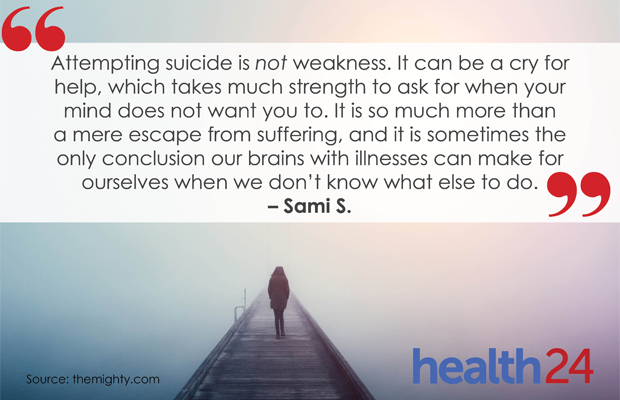
suicide, depression, mental health, pull quote, qu

How to talk about suicide

Stacey Freedenthal, a Denver psychotherapist, consultant, and associate professor at the University of Denver Graduate School of Social Work, has had extensive experience in dealing with suicide prevention. She has also compiled a useful list of things to say should you find yourself in a difficult position with a loved one who is suicidal.

1. ‘I’m glad you told me you’re thinking of suicide’

It’s natural to react with anger or disbelief when someone tells you they are thinking of suicide but that will only cause the person to regret having told you, which may push them away. When you tell them you are glad they told you what they are thinking, you are letting them know you can handle the situation, and that you encourage honesty and disclosure.

2. ‘I’m sad to hear you’re hurting’

Empathy can go a long way, particularly towards validating the person’s pain and helping soothe their loneliness. You cannot say, “It could be much worse” or “You don’t really mean that” or “But you have so much to live for.” Do not diminish the pain that they are feeling right now. 

3. ‘What’s happening to you that makes you want to die?’

Asking them to tell their story of why they want to die shows them that you really care and want to understand. Make sure you really listen to their story. Follow up with more invitations to share, such as “Tell me more.” You can show empathy or understanding by saying, “That sounds terrible” or “I can see why you’re in pain.”

4. ‘When do you think you’ll act on your suicidal thoughts?’

Freedenthal says that even if you’re not a mental health professional, “you still can ask some basic questions to help understand the person’s risk for suicide. Asking about timing will make the difference between whether you need to call someone immediately for help, for example, if the person says, ‘I have a gun in my backpack and I’m going to shoot myself during lunch’, or whether you can continue to have leisurely conversation with the person.”

5. ‘What can I do to help?’

Sharing resources that may help them is good, but you also need to make them understand that you are available to help too. “That said, there’s only so much you can do, so if you are feeling solely responsible for keeping the person alive, it’s best to involve others, too,” writes Freedenthal.

Never ignore the warning signs

Suicide warning signs can be subtle or obvious, and include:

  • Talking about suicide, dying or self-harm
  • Being preoccupied with death, for example, writing poems or stories about death
  • Having no hope for the future, feeling trapped and hopeless
  • Feelings of worthlessness, self-hatred, guilt, shame or saying they feel like a burden
  • Getting their affairs in order by drawing up a will or giving away valued possessions
  • Withdrawing from friends and family; no longer socialising because they prefer to be alone
  • Making unexpected visits or calls to friends and family, and saying goodbye

If a person has a sudden sense of calm and happiness after going through an extremely bad depressive episode, it could mean they have decided to attempt suicide.

Do you need help?

For a suicidal emergency call the South African Depression and Anxiety Group on 0800 567 567. Their 24-hour helpline is 0800 12 13 14.

Image credit: iStock

Share Button