Health24.com | ‘I was diagnosed with stage 3 bone cancer – I thought my life was ending’

She thought her life was ending after she was diagnosed with stage 3 bone cancer. “But when I started my first cycle of chemotherapy [she underwent 18], I realised there was no turning back,” says Nomsa Tshingowe.

Today, Tshingowe is a 27-year-old social worker who wants to share her cancer journey and help raise awareness. 

A life-changing diagnosis

“I think the symptoms had always been there, but I wasn’t aware that it might be something serious until I moved from Ha-Mulima to Sekhukhune, where I currently live,” she says. Her symptoms worsened over time. “My right knee was swollen – it was incredibly painful and I couldn’t walk. My symptoms seemed to be triggered by cold weather.”

This went on for a year – Tshingowe’s treatment consisted of pain medication from the local clinic. But she couldn’t continue like this. “In 2014, I demanded a referral to the hospital.”

She finally had a biopsy on 5 September 2014. “In October, at the age of 23, I was diagnosed with stage 3 osteosarcoma cancer. I thought my life was ending.”

It was a terrifying time for Tshingowe. “I was young; I had just got a permanent job. I did not understand how a young person could have cancer,” she says. “My life came to a standstill. I had to deal with chemotherapy treatment and surgery; the after effects were the worst. I remember asking the doctor to stop giving me the treatment; I just wanted him to end my suffering.”

But she didn’t give up and says her family was incredibly supportive. “They were always there by my side – seeing them beside my hospital bed gave me courage to fight even more. I had highly skilled doctors, supportive friends and colleagues.”
Nomsa Tshingowe, bone cancer, survivor, quote, pul

Losing her leg

Tshingowe endured endless blood transfusions, blood tests, scans and pain all over her body during treatment. On 27 April 2015 she had her last surgery – a total knee replacement where doctors removed her right leg and gave her a prosthesis.

“I remember coming out of theatre,” she says. “I couldn’t move, I couldn’t feel my leg and cried uncontrollably. I had to use a walking stick and other walking support devices for months.”

Offering advice

“The day you were diagnosed with cancer, that’s the day you won your first battle,” says Tshingowe. “And chemotherapy? That’s just another battle. Instead of getting angry or sad, use the energy to document your journey for other survivors –every survivor is the inspiration to the other survivor. I am here because of well documented cancer journeys of other people.

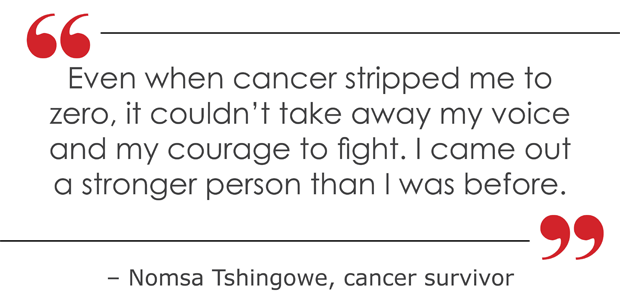
“Even when cancer stripped me to zero, it couldn’t take away my voice and my courage to fight. I came out a stronger person than I was before.”

What she’s doing today

In 2016, she decided to start creating awareness around cancer.

“I created Cancer 0 Thirty 5 Awareness when I realised there is a lack of cancer knowledge, especially in our black communities. It is aimed at promoting cancer education and awareness. The main targets are children and youth in Limpopo and the mission is to provide support to children and youth cancer survivors and their families so that they can also enjoy quality life.”

Tshingowe is currently doing her Masters in Public Health at the University of Limpopo.

Image credit: Supplied

Share Button

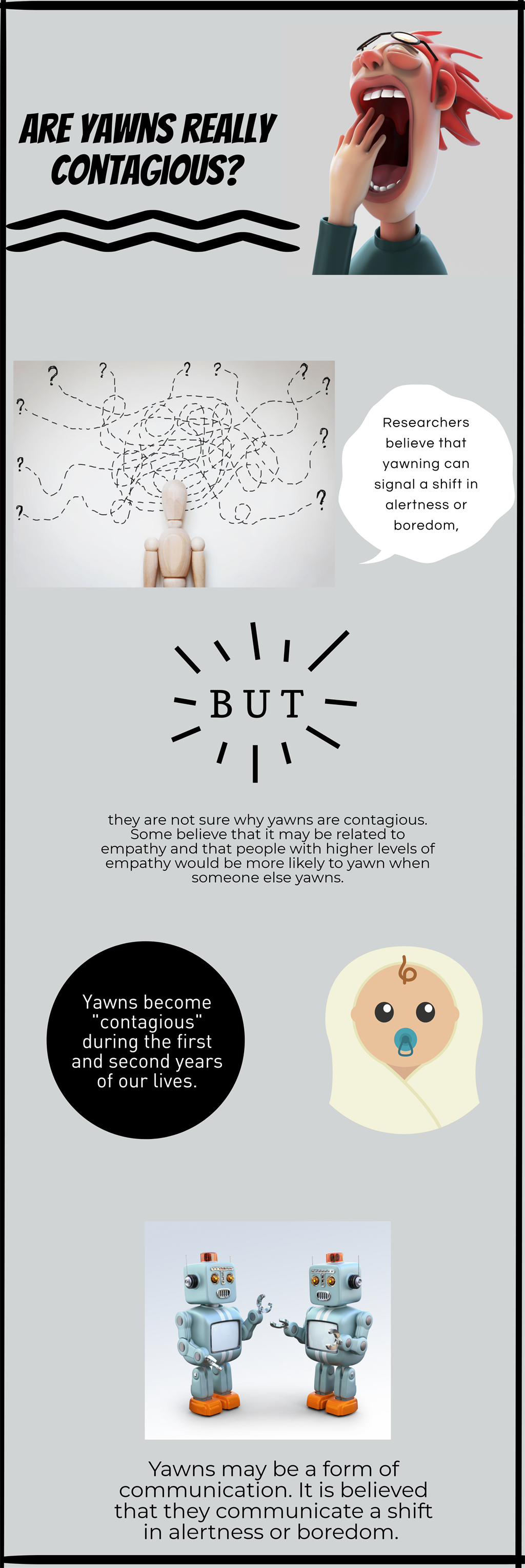
Health24.com | Are yawns really contagious?

We’ve all “caught” yawning from other people, but why that happens is unclear, according to a psychologist who has researched the behaviour.

“In short, we don’t know why yawns are contagious,” said Meredith Williamson, a clinical assistant professor at Texas A&M College of Medicine.”

Not just when you are sleepy

Researchers used to think that yawning only signals a need for sleep, but now they believe that it can also communicate a shift in alertness or boredom.

One theory is that contagious yawning is related to empathy, and that people with higher levels of empathy yawn more often when someone else yawns, compared to people with lower levels of empathy or those with a mental disorder.

“Researchers have seen that yawning may not be as contagious to people with autism or schizophrenia,” Williamson said in a university news release. “More research is being done to determine the cause of this.”

She also noted that children under the age of four and older adults are less likely to yawn in response to somebody else yawning.

Not unique to humans

Yawning may be an unspoken form of communication, but it’s not unique to people, Williamson added. Some species of primates and canines also yawn in response to each others’ yawns, and dogs will even yawn after a person yawns.

Yawning is “multifactorial. It could be partly an innate form of communication or it could be related to empathy, or a bit of both combined with other factors,” she suggested.

Image credit: iStock

NEXT ON HEALTH24X

Share Button

100 Women: The modern face of the ‘DIY abortion’

Global online searches for abortion pills have more than doubled over the last decade, BBC analysis of Google searches shows.

Share Button

Health24.com | Can the air conditioner make you sick?

We all appreciate air conditioning on scorching summer days, but during winter these very systems come under criticism as being the source of germs that cause colds and flu. Is there any truth to this?

Health24’s enviro-health expert, Olivia Rose-Innes agrees that air conditioning may possibly be harmful; however, she points out that this is hard to prove.

She explains that poorly maintained systems can harbour organic contaminants like bacteria and mould spores that may aggravate respiratory tract infections and illnesses in susceptible people.

“People in offices with air conditioning report more symptoms than those in offices with natural ventilation.

“Symptoms are varied, from headaches to respiratory-tract problems, including sinusitis, but are seldom linked to a specific cause.”

AC unlikely to spread flu

Rose-Innes says that although it is possible that infectious diseases like colds and flu may be spread by air conditioning, it’s probably rare. She says individuals are more likely to catch a cold in an indoor office with no natural ventilation or simply through contact with contaminated surfaces.

“The temperature the aircon is set at won’t make you sick – though it can certainly raise stress levels if it’s at a temperature you find uncomfortable,” Rose-Innes says. 

Allergies 

Another common misconception is that air-conditioning units can cause allergies. 

Dr Adrian Morris, Health24’s in house allergy expert, says although there might be a connection between air conditioning and one’s health, one cannot be allergic to air-conditioning systems.

“You can’t be allergic to air conditioning; it’s a machine that cools air just like your fridge.”

He says air-conditioning systems may, however, dry the nose and aggravate sinus issues.

Dr Morris notes that mould spores do thrive in air-conditioning machines, so make sure you clean the filters regularly. “Mould spores may grow in a wet conditioner, which could trigger allergies.” 

Image credit: iStock

Share Button

‘How a TV show led to my cancer diagnosis’

Maren and Margaret saw journalist Victoria Derbyshire speak about her breast cancer on The Real Full Monty.

Share Button

Why beige carbs are the ones to avoid – Dr Xand van Tulleken

Low-carb diets have been around for a while but did you know the colour of the carbs you eat also matters, says Dr Xand van Tulleken.

Share Button

A little water could make a big difference for endangered salmon

Even small amounts of running water — less than a gallon per second — could mean the difference between life or death for juvenile coho salmon in coastal California streams, according to a new study published in the journal Transactions of the American Fisheries Society.

The study, led by California Sea Grant Extension Specialist Mariska Obedzinski, shows that during dry periods, that amount of water was enough to keep pools interconnected, allowing young salmon to survive through the hot, dry summer months.

“The good news is that if we can get just a little bit of water back in these streams, we can make a really big difference,” says Obedzinski, who leads a monitoring program for endangered coho salmon and steelhead in the small streams of Sonoma County that flow into the Russian River.

Saving the Russian River coho

Russian River coho salmon were listed as threatened in 1996, but despite efforts to improve habitat, the species had hit crisis levels by the early 2000’s, and they became endangered in 2005 when scientists noted fewer than 10 fish returning to the Russian River each year to spawn. In response, local, state, and federal agencies teamed up to start a conservation hatchery program to breed and release the fish. California Sea Grant’s monitoring program was set up to track the success of the hatchery releases as well as better understand the factors that were preventing recovery of the species.

Through their monitoring, Obedzinski and her research team found that low streamflow in summer is one of the biggest bottlenecks to coho recovery. She says, “After the hatchery fish are released, we see them migrating out to the ocean and coming back as adults to spawn. We even see their offspring in creeks in the early summer, but by late summer the creeks dry out, the young salmon die, and the next generation is not surviving.”

How much is enough?

Water is a limited resource in the Mediterranean climate of central California. Population growth and development, combined with the impacts of climate change in the drought-prone region have made flow-impaired streams even less reliable.

While previous modeling studies have established water flow thresholds to support salmon in larger, snowmelt-fed streams such as those in California’s central valley, the small coastal streams where Russian River coho prefer to spawn are a different beast.

These intermittent streams may swell over their banks during wet winter months but dwindle to a trickle or even dry up in sections during the hot, dry summer. While it was clear that young salmon needed more water to survive the summer months, the question was, how much?

“We didn’t have a sense of how much water was needed,” says Obedzinski. “The existing models are based on flows in much larger streams. When you try to apply them to our tiny coastal streams, they fall apart.”

The new study provides a clearer link between salmon survival and water flow rates in Russian River tributaries, which could be useful for resource agencies and organizations working on salmon recovery, and land owners who want to help restore endangered salmon populations. The findings may also lend support for efforts that might seem small-scale in comparison to larger streamflow improvement projects in other watersheds.

John Green is a project manager for the Gold Ridge Resource Conservation District, who has already begun applying the new research to their work restoring flow in salmon streams. He says, “The big value in this research is that it has given us an idea of how much water is needed to improve fish survival. From that, we start to understand the kinds of projects we need to build and what their impacts will be.”

The researchers stress that flows allowing for minimum persistence are not high enough to support full recovery. Obedzinski says, “Keeping a pool connected is the first step in preventing local extinction by keeping at least some of the fish alive, but we want fish to be able to grow and thrive as well. In terms of meeting recovery targets, more water means more habitat for fish, and more chance of bringing back a healthy population.”

Share Button

Thousands of turtles netted off South America

Tens of thousands of sea turtles are caught each year by small-scale fishers off South America’s Pacific coast, new research shows.

Surveys at 43 harbours in Ecuador, Peru and Chile reveal that gillnet fisheries catch more than 46,000 sea turtles per year, with more than 16,000 killed in the process.

And the true numbers are likely to be higher, as not all ports in each country were surveyed.

Such accidental catching — known as bycatch — is a major threat to species including sea turtles, and the researchers say their findings highlight Ecuador and Peru as key places to tackle this.

“People worry about industrial fisheries but a real concern that people are waking up to is small-scale fisheries,” said Professor Brendan Godley, of the Centre for Ecology and Conservation on the University of Exeter’s Penryn Campus in Cornwall.

“These are small vessels but they exist in such huge numbers that they can have a massive impact on ecosystems.”

Turtles living in the study area include leatherbacks (critically endangered in the east Pacific) and hawksbills (critically endangered worldwide).

Dr Joanna Alfaro, who obtained her PhD at Exeter and is now director of ProDelphinus, a conservation organisation in Peru, said: “This work highlights the importance and the benefits of our approach of engaging with fishers.

“We are actively working with fishers in this region to develop and implement solutions to bycatch — not just to improve the situation for turtles but for the health of fisheries and fish stocks.

“Our goal is to develop fisheries that are sustainable for small-scale fishing communities and the species with which they interact.”

Dr Jeffrey Mangel, also of the University of Exeter and ProDelphinus, added: “Gathering this survey data was a massive effort across three countries, and the results give us fascinating and important insights.

“We are careful not to overstate threats to wildlife, but in this case it’s clear that tens of thousands of turtles are being caught each year.”

The southeastern Pacific sustains extensive fisheries that are important sources of food and employment for millions of people.

The study, supported by the UK government’s Darwin Initiative, was designed to fill data gaps and identify priority areas for future conservation work.

Story Source:

Materials provided by University of Exeter. Note: Content may be edited for style and length.

Share Button

Syphilis and gonorrhoea up by one-fifth

Both sexually transmitted infections have gone up by about 20% in England in 2017, figures reveal.

Share Button

Health24.com | Should you be drinking 5 cups of coffee per day?

Coffee. Cup of joe. Java. No matter what you call it, millions of people worldwide wake up and fuel their day with it. And though consumers might be jittery about the recent court battle in California over cancer warnings, experts say most of the science actually indicates coffee could have health benefits.

“The overall picture is quite clear,” said Dr Frank Hu, chair of nutrition at Harvard University’s T.H. Chan School of Public Health. “There is no long-term increased risk of major chronic disease, including diabetes, cardiovascular disease or even cancer.”

Inconclusive evidence

The java confusion stems over an eight-year court case. A Los Angeles-based judge’s preliminary decision last month requires cancer warning labels because of concerns about acrylamide, a chemical produced during the roasting process. Acrylamide also is present in some fried or roasted starchy foods, including French fries, potato chips, breakfast cereals and toast. It’s also found in cigarette smoke. The judge gave the coffee industry a few weeks to file appeals and could issue a final ruling late this month.

But there’s little evidence acrylamide levels in food cause cancer in humans. Studies have found no consistent evidence acrylamide exposure in food is associated with cancer risk, according to the US National Cancer Institute. The World Health Organization’s International Agency for Research on Cancer reviewed more than 1 000 human and animal studies and issued a statement in 2016 that “found no conclusive evidence for a carcinogenic effect of drinking coffee”.

“The California judge’s decision to label coffee as a cancer risk is really inconsistent with the scientific literature,” Hu said. “It’s very misleading and has already caused a huge amount of confusion in the general public. The health outcomes have been remarkably consistent.”

Hu was senior author of a 2015 study in the journal Circulation that concluded people who regularly drink moderate amounts of coffee daily – fewer than five cups – experienced a lower risk of death from heart and neurological diseases.

About four years ago, the US government gave coffee its OK, too. The Department of Agriculture’s dietary guidelines for all Americans, published every five years as a go-to source for nutrition advice, said three to five cups a day, which can be up to 400 milligrams a day of caffeine, can be part of a healthy diet. The American Heart Association suggests that people who have arrhythmia, an abnormal heart rhythm, talk to their health care provider about caffeine intake.

More benefit than harm

“This guidance on coffee is informed by strong and consistent evidence showing that, in healthy adults, moderate coffee consumption is not associated with an increased risk of major chronic diseases (e.g. cancer) or premature death, especially from cardiovascular disease,” the federal guidelines say. “However, individuals who do not consume caffeinated coffee or other caffeinated beverages are not encouraged to incorporate them into their eating pattern.”

More recently, a review of more than 200 studies published last autumn in the BMJ concluded three to four cups a day may be “more likely to benefit health than harm”. It found a lower risk of liver disease and some cancers in coffee drinkers, and a lower risk of dying from stroke.

All of that should be good news to the people around the world who drink more than 1.1 billion cups of coffee each day.

But it’s still easy to be confused. A quick search for coffee and health online yields hundreds, even thousands, of results.

Studies abound – some funded by the coffee industry. For example, a European Journal of Nutrition study investigated the effects of coffee and its antioxidant properties and found no effect. Researchers took blood samples of 160 volunteers who drank up to three to five cups of coffee or water each day for eight weeks.

Not a ‘magic bullet’

“Up to five cups of coffee per day had no detectable effect, either beneficial or harmful, on human health,” that study concluded. It was funded by Kraft Foods, which makes Maxwell House coffees.

Of course, “no one is talking about coffee as a magic bullet,” Hu said. He and other experts say it’s important to keep track of the bigger picture, with the focus on moderation and dietary patterns.

“You can’t pin anything on any one specific lifestyle behaviour, particularly with diet,” said Alice Lichtenstein, a senior scientist and director of the Cardiovascular Nutrition Laboratory at Tufts University in Boston.

“When we talk about diet, it should really be about the whole package, not single items. Right now, the majority of the evidence suggests there may be a health benefit from drinking coffee and there doesn’t seem to be any disadvantage. Of course, with a caveat that you don’t want to add a lot of cream and sugar, or to use it as an excuse to have a few cookies or a pastry. Then, there is a downside,” said Lichtenstein, a professor of nutrition science and policy who also was an advisor on the federal dietary guidelines.

“We have a tendency to focus on one or two specific foods or beverages, and that’s when the whole floor falls out from under us.”

Image credit: iStock

NEXT ON HEALTH24X

Share Button