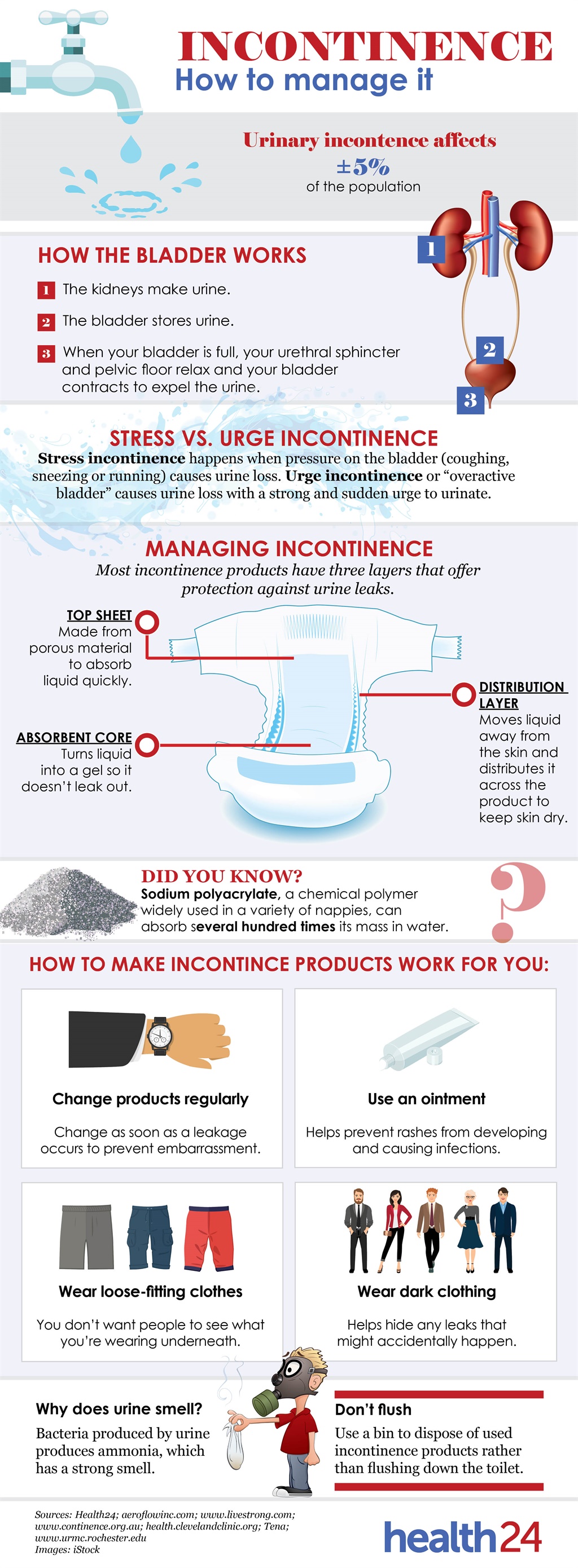
Health24.com | SEE: How an incontinence nappy works

The information provided does not constitute a diagnosis of your condition. You should consult a medical practitioner or other appropriate health care professional for a physical exmanication, diagnosis and formal advice. Health24 and the expert accept no responsibility or liability for any damage or personal harm you may suffer resulting from making use of this content.

Share Button

Health24.com | Are you suffering with ‘digital eye strain’? Here’s how you can tell

Quick question: Between your smart phone, laptop and the TV, how many hours a day do you spend glued to a screen? Just take a moment to work it out and I guarantee you it’s more than you thought.

I did a little calculation and was shocked when I figured out that I spend a good 10 hours of my day fixated on a screen (yikes!). I’ve been struggling with my eyes a lot lately. After a few hours of staring at my laptop things get a little blurry, I struggle to concentrate and it feels like there isn’t enough coffee in the world to keep my eyes from wanting to close shut. So, what gives?

Well, I decided to contact some experts and here’s the bad news in a nutshell: If you’re spending as little as two hours at a time staring at a screen, you’re actually setting yourself up for digital eye strain.

Read more: 6 most common signs you’ve damaged your eyes – and how to fix it

What is digital eye strain?

“When looking at different digital devices, we are constantly changing the reading distance, which is very stressful for our eyes,” says Andre Horn, a senior optometrist and Mellins i-Style’s managing director. It also doesn’t help that the small print and pixilated images on tablets and phones can be ridiculously tiny, leaving you squinting. Oh, and that blue light that your devices’ screen emits isn’t exactly doing your eyes any favours either.

If you’re scratching your head wondering what “blue light” is, let me break it down for you: High energy visible (HEV) or “blue light” has a very short wavelength and produces a higher amount of energy. Our eyes’ natural filters simply can’t provide sufficient protection against this type of light, which reaches all the way to the light-sensitive cells of the retina (the inner lining of the back of the eye). This is why your eyes feel tired and achy after staring at a screen for too long.

Recent studies have also found that blue light reduces the body’s melatonin levels that are needed to fall asleep naturally. All that late-night scrolling on your feeds is causing you to stay awake for longer (hello Facebook-induced insomnia, is that you?).

Read more: Could you be at risk for one of these five serious eye diseases?

Changes you should make ASAP

So how can you save your sight – you know, without giving up your devices?

Get some hi-tech lenses. If like me, you spend most of your day staring at a screen, you can get special anti-fatigue lenses (these help relax the eye muscles), or lenses with a blue light protective coating to help block HEV from entering your eye.

Apply the 20:20 rule. It’s also a good idea to take regular screen breaks. Every 20 minutes, get in the habit of looking up from the screen and finding a distant object to focus on for 20 seconds, which gets you back to a normal blinking pattern and restores moisture.

Adjust that screen. It’s such an easy tweak but can make the world of difference – adjust your computer so the screen is an arm’s length away from your eyes.

Ditch the glare. Decrease the brightness across all of your device (or download a handy app like f.lux which helps adjust your desktop settings).

And don’t forget – old-school is cool! Our eyes find it easier to focus on paper, so put that phone down and get out a good book (especially before bed).

*Note: If you have an unresolved eye condition (like astigmatism or farsightedness), it might aggravate the feeling of glare from a computer screen. Regular eye examinations are therefore important to identify potential problems.

This article was originally published on www.womenshealthsa.co.za

Image credit: iStock 

Share Button

Millions could have incorrect statin, aspirin and blood pressure prescriptions

More than 11 million Americans may have incorrect prescriptions for aspirin, statins and blood pressure medications, according to a study led by researchers at the Stanford University School of Medicine.

Their findings are based on an updated set of calculations — known as pooled cohort equations, or PCEs — that are used to determine the risk of a heart attack or stroke.

The PCEs are the foundation for cardiovascular-disease-prevention guidelines in the United States. They help physicians decide whether to prescribe aspirin, blood pressure or statin medications, or some combination of these, by estimating the risk a patient may have for a heart attack or stroke. Most physicians calculate a patient’s risk using a PCE web calculator or a smartphone app; the equations are also built into many electronic health records so that a patient’s risk is automatically calculated during an office visit.

But there has been debate over whether the PCEs are based on outdated data and therefore putting some patients at risk for over- or under-medication.

“We found that there are probably at least two major ways to improve the 2013 equations,” said Sanjay Basu, MD, PhD, assistant professor of primary care outcomes research at the School of Medicine and a core faculty member at Stanford Health Policy. “The first was well-known: that the data used to derive the equations could be updated.”

Old equations

For example, he said, one of the main data sets used to derive the original equations had information from people who were 30-62 years old in 1948, and who would therefore be 100 to 132 years old in 2018 — that is, likely dead. The older equations were often estimating people’s risk as too high, possibly by an average of 20 percent across risk groups.

“A lot has changed in terms of diets, environments and medical treatment since the 1940s,” Basu said. “So, relying on our grandparents’ data to make our treatment choices is probably not the best idea.”

Basu is the senior author of the study, which will be published June 5 in the Annals of Internal Medicine. The lead author is Steve Yadlowsky, a graduate student in electrical engineering at Stanford.

Furthermore, the researchers found that the old data may not have had a sufficient sample of African-Americans. For many African-Americans, physicians may have been estimating the risks of heart attacks or strokes as too low.

“So while many Americans were being recommended aggressive treatments that they may not have needed according to current guidelines, some Americans — particularly African-Americans — may have been given false reassurance and probably need to start treatment given our findings,” Basu said.

The researchers have updated the PCEs with newer data in an effort to substantially improve the accuracy of the cardiovascular risk estimates. The National Institutes of Health, which maintains and updates the cohort data, approved the updated equations.

Updating statistical methods

A second improvement to the equations, the authors found, was to update the statistical methods used to derive the equations.

“We found that by revising the PCEs with new data and statistical methods, we could substantially improve the accuracy of cardiovascular disease risk estimates,” the authors wrote.

The work is an example of Stanford Medicine’s focus on precision health, the goal of which is to anticipate and prevent disease in the healthy and precisely diagnose and treat disease in the ill.

Story Source:

Materials provided by Stanford Medicine. Original written by Beth Duff-Brown. Note: Content may be edited for style and length.

Share Button

World Cup fans advised to get MMR jab

A surge in measles cases in Russia means football fans should protect themselves before travelling.

Share Button

‘Remarkable’ therapy beats terminal breast cancer

Judy Perkins had been given three months to live, but two years later there is no sign of cancer in her body.

Share Button

Health24.com | Could a blood test spot lung cancer early?

Genetic blood testing is showing potential as a means of catching some early stage cancers, researchers are reporting.

For example, a panel of three different genetic tests was able to detect early stage lung cancer about half of the time in people who’d already been diagnosed with the disease.

The tests also detected late-stage lung cancers about 9 out of 10 times, the researchers said.

The findings were reported Saturday at the American Society of Clinical Oncology’s annual meeting, in Chicago.

What does the research indicate? 

“This is proof of principle that broad genome-wide sequencing has the ability to find cancer, and sometimes early stage curable cancer,” said lead study author Dr. Geoffrey Oxnard. He’s an associate professor of medicine at the Dana-Farber Cancer Institute and Harvard Medical School, both in Boston.

“That creates an opportunity for further development as a cancer detection or screening assay,” he said.

Cancer survival rates soar when tumors are detected in their earliest stages, the researchers said in background notes. Having a blood test that can detect early cancers would save countless lives.

Tumors regularly shed DNA fragments that circulate in the bloodstream. These fragments, called cell-free DNA, are already analyzed to help cancer doctors choose targeted gene-based therapies for people with advanced lung cancer, the researchers said.

Oxnard and his colleagues want to take that a step further, by developing a test that uses cell-free DNA to catch cancers as early as possible.

Their overall effort, the Circulating Cell-Free Genome Atlas (CCGA) study, has enrolled more than 12,000 of a planned 15,000 participants across the United States and Canada.

The ASCO meeting report represents some of the first results from the larger study. In it, the researchers used genetic tests to analyze the blood of 127 people who had been diagnosed with lung cancer.

The three tests looked for both cancer mutations and changes in genetic function that can indicate cancer, the researchers said.

The tests detected early stage lung cancer between 38 and 51 percent of the time, and late-stage cancers between 87 and 89 percent of the time.

The tests also had a very low rate of false positives — when a test says cancer is present when it isn’t. The researchers tested 580 blood samples from people without cancer, and found only five with genetic changes indicating cancer.

Of those five supposedly cancer-free people, two were subsequently diagnosed with stage 3 ovarian cancer and stage 2 endometrial cancer, further highlighting the potential of the tests to find early stage cancers, the researchers said.

Filtering the research process 

In addition, the researchers further refined the screening process by filtering out people with harmless white blood cell mutations, Oxnard added.

“The fact is we acquire mutations as we age. Our white cells have mutations, and these mutations pollute the DNA that’s in the blood,” Oxnard said. “You have to screen out the white cell signal to end up with the leftover signal that’s in the free DNA. In that signal is where you can find the cancer signal.”

About 54 percent of mutations detected in the blood samples were from white blood cells rather than cancers, the researchers said. These will need to be filtered out of any blood tests ultimately developed for early detection of cancer.

While this study is promising, more work needs to be done to hone the blood test’s ability to detect specific cancers, said ASCO President Dr. Bruce Johnson.

For example, one of the most common mutations related to cancer is in a gene called KRAS, Johnson said.

“If you picked up KRAS in the bloodstream, you’re not sure if it came from the lung or the pancreas or the colon,” said Johnson, chief clinical research officer at the Dana-Farber Cancer Institute.

“This is another step forward, but it’s not getting really close yet to being specific for being able to pick up an early cancer,” Johnson cautioned. “It’s another step forward, but it’s got a ways to go.”

Oxnard agreed that further research is needed before these genetic tests could be used by doctors, but he couldn’t say how long it might take to produce a clinically useful screening tool.

“I would have told you this study we’re talking about was years off a year ago. This is striking evidence of progress,” Oxnard said


Share Button

Health24.com | Could the idea of a ‘mental health day’ just make the stigma around mental health worse?

In 2017, a mental health story went viral.

Madalyn Parker, a web developer in the USA, emailed her boss to say she would not be coming into the office – she was taking a mental health day.

The world applauded her courage and gave her boss a standing ovation when he told her to take the day. “You are an example to us all, and help cut through the stigma, so we can all bring our whole selves to work,” he said.

News24’s Facebook audience was less forgiving, however, and comments ranged from “Let her take a day, i don’t want to be a working with a psycho [sic]” to “Would tell her to go work at a mental institution [sic]” and “Request admittance letter to asylum”.

But in a world where more than 300 million people suffer from depression and close to 800 000 people die by suicide every year, should we be able to take a mental health day as opposed to a sick day?

The answer might surprise you – it’s a resounding no from experts. And with good reason.

Mental issues remain health issues

Although Dr Renata Schoeman, a Cape Town psychiatrist, believes that the idea of taking a mental health day is a good move because it creates more awareness around mental health, she (and other psychiatrists) strongly believes that mental disorders should not be treated any differently from other illnesses.

“If you have to take sick leave for a mental health condition, it should be sick leave. It is still a medical disorder like any other disorder and it should not be treated separately,” says Dr Schoeman. She adds that trying to say that you must take mental health leave adds to the discrimination.

“Why should we distinguish between anxiety or depression or hypertension or diabetes?” she says. “We are concerned about calling it a mental health day because that’s almost stigmatising it more.”

The other issue is where one draws the line. “Is it just someone waking up blue in the morning?” Dr Schoeman asks. “Or is it someone who is actually depressed?

“As psychiatrists we are objecting to the idea of a mental health day. We believe there should be more compassion towards leave for any type of compassionate needs.” She says there needs to be an increased awareness of employees’ need to take care of their mental health.

But, she adds, “Part of the stigma of mental illness is that people treat it differently – it’s a biological condition.”

The dangers of extended sick leave

Dr Schoeman says we should focus on prevention and manage our mental health before we reach the point of needing sick leave for a mental illness.

People are often booked off for longer periods of time because there is no work accommodation. “Take for example if you’re going through a depressive episode – during that acute, depressive episode, your concentration may be impaired, the medication you are taking may make you feel unwell and you may not be fully functioning for the first week.”

Dr Schoeman believes that you do not necessarily have to be booked off and spend three weeks in a hospital.

“If your employer understood that maybe for the first week you needed a reduced workload or could accommodate you in terms of working half days for the first week, or give you a weekly afternoon off to see your psychologist, we would be able to reduce the need for people to be admitted to hospital for three weeks.”

She also points to alarming research that shows if you’re away from work for three to four weeks, your chances of returning to full capacity at work is only 50%.

“So the longer we book people off, the less likely they are to become fully functional [at work] again. While you’re away from the office recovering, your work just piles up and you will probably return to stressors that make the problem bigger.”

Image credit: iStock

Share Button

School meal smoothie ban in obesity fight

Fruit juices could also disappear from school lunch menus, while the amount of fruit and vegetables increase.

Share Button

Health24.com | 7 burning questions about urinary incontinence

Urinary incontinence occurs when the muscles in the bladder that control the flow of urine involuntarily relax, resulting in leakage or uncontrollable urination.

According to the World Health Organization, more than 200 million people worldwide suffer from bladder control problems.

Have you ever thought about using Botox or training your bladder to combat incontinence? 

Here are a few answers to some of your most pressing questions on the matter:

1. What causes incontinence? 

Incontinence is not a disease, but a symptom of an underlying medical condition. It varies from temporary, caused by factors such as constipation or vaginal infection, to chronic. There are a number of causes of incontinence.

Certain substances foods and drinks:

  • Caffeine
  • Alcohol 
  • Chocolate
  • Carbonated drinks 

Treatable medical conditions:

Chronic conditions: 

2. Are pregnant women prone to developing incontinence? 

Not all women have incontinence following delivery. However, pregnancy can definitely predispose you to urinary incontinence, especially in the case of vaginal delivery. Pregnancy can interfere with the normal way your urethra contracts and relaxes. Stress incontinence can happen in pregnant women as a result of hormonal changes during pregnancy, as well as pressure on the bladder. 

3. How is incontinence treated?

The treatment of incontinence differs depending on the cause and degree of the problem. 

For stress incontinence, non-medical treatment includes:

These types of treatments are for less serious cases of incontinence. They are beneficial in the short term but might not provide long-term relief. 

Medical treatment includes:

Surgical treatment: 

4. What about Botox?

In small amounts, Botox can be beneficial for the treatment of an overactive bladder. The procedure involves the injection of Botox through a small scope which is then inserted into the urethra, the tube leading to the bladder. 

5. Is incontinence a problem associated with diabetes? 

While incontinence may present in a diabetic patient, it is not necessarily an associated symptom. Diabetics tend to have decreased bladder emptying and are subsequently prone to both urge and overflow incontinence. A complete evaluation therefore needs to be done prior to treatment.

6. Can the bladder be retrained? 

Bladder training can be a very effective way to treat urinary incontinence. This happens by training your bladder to void according to a specific schedule. This entails going to the bathroom even if you do not have to and not going to the bathroom even if you need to. Wait for the scheduled time for bathroom trips. Kegel exercises can be beneficial while training your bladder. Unsure on how to effectively train your bladder? Here are some tips.

7. Are adult diapers effective? 

There is nothing wrong with wearing an adult diaper to effectively deal with incontinence; they have helped many individuals who struggle with incontinence. Since these diapers are made for adults, the padding is thicker and the lining stronger. Varieties of disposable diapers include super-absorbent, ultra-absorbent and regular. Choose a style that is suited to your condition; there are many options with various focuses. 

In a recent study, the taboos surrounding use of adult diapers are explored. According to one of the researchers, “The major challenge hampering growth is the social taboo and dignity issues around the use among adults. However, initiatives by big adult diaper brands to dignify the market and spread awareness regarding the necessity of the product through elaborate advertisements and promotion campaigns are helping the product overcome the social barrier.”

Image credit: iStock

Share Button

Novel insulators with conducting edges

Topology examines the properties of objects and solids that are protected against perturbations and deformations. Materials known so far include topological insulators, which are crystals that insulate on the inside but conduct electrical current on their surface. The conducting surfaces are topologically protected, which means that they cannot easily be brought into an insulating state.

New class of materials: Higher-order topological insulators

Theoretical physicists at the University of Zurich have now predicted a new class of topological insulators that have conducting properties on the edges of crystals rather than on their surface. The research team, made up of scientists from UZH, Princeton University, the Donostia International Physics Center and the Max Planck Institute of Microstructure Physics in Halle, dubbed the new material class “higher-order topological insulators.” The extraordinary robustness of the conducting edges makes them particularly interesting: The current of topological electrons cannot be stopped by disorder or impurities. If an imperfection gets in the way of the current, it simply flows around the impurity.

Like a highway for electrons

In addition, the crystal edges do not have to be specially prepared to conduct electrical current. If the crystal breaks, the new edges automatically also conduct current. “The most exciting aspect is that electricity can at least in theory be conducted without any dissipation,” says Titus Neupert, professor at the Department of Physics at UZH. “You could think of the crystal edges as a kind of highway for electrons. They can’t simply make a U-turn.” This property of dissipationless conductance, otherwise known from superconductors at low temperatures, is not shared with the previously known topological insulator crystals that have conducting surfaces, but is specific to the higher-order topological crystals.

Further theoretical and experimental research needed

The physicists’ study still mostly relies on theoretical aspects. They have proposed tin telluride as the first compound to show these novel properties. “More material candidates have to be identified and probed in experiments,” says Neupert. The researchers hope that in the future nanowires made of higher-order topological insulators may be used as conducting paths in electric circuits. They could be combined with magnetic and superconducting materials and used for building quantum computers.

Story Source:

Materials provided by University of Zurich. Note: Content may be edited for style and length.

Share Button