Health24.com | Can intermittent fasting actually improve your health?

Hugh Jackman swears it gets him into Wolverine shape. Silicon Valley bros think it enhances mental prowess.

And Redditors claim it can help them lose upwards of 20kg.

Intermittent fasting, which calls for not eating for anywhere between 16 hours to an entire day, is one of the buzziest diets out there, with many raving that it can help you shed kilos quickly.

Read more: Here’s how intermittent fasting stacks up compared to a normal diet

But some people are arguing that intermittent fasting has even more benefits: Multiple stories have suggested that fasting can boost your immune system, and researchers are beginning to study whether it can improve heart health and lower cancer risk, too.

But are these claims legit? And for that matter, should you even try intermittent fasting in the first place?

Let’s get one thing straight right off the bat: There’s not enough research to say for sure whether fasting has any health benefits, says Dr Liz Weinandy, a staff dietician at the Ohio State University Wexner Medical Centre.

Read more: What is the best diet for men? We weigh up 3 popular diets

“I don’t think anybody knows,” says Dr Weinandy. “This is all preliminary.”

In fact, most of the press coverage of intermittent fasting and its purported immune system benefits has focused on just one study.

In 2014, biochemist Valter Longo, the head of the anti-ageing department at USC, had both mice and human cancer patients fast for four days. During the fast, both the mice and the cancer patients discarded old blood cells; once the fast was broken, their bodies produced shiny, new cells to take the place of discarded ones, thus effectively regenerating their immune systems.

The results of Longo’s study led him to conclude that prolonged periods of fasting could reduce the harsh side effects of chemotherapy for cancer patients (in fact, some patients are already trying this on their own), or even boost immunity for healthy people.

Read more: These ridiculously easy diet changes will help you lose weight

A 2015 study from Yale Medical School went one further, finding that both dieting and fasting produce a compound that prevents the immune system from making a protein linked to inflammatory diseases like diabetes and atherosclerosis. That study also assessed both human and mice immune cells.

OK, but does intermittent fasting actually make you healthier?

While Longo’s study might sound promising, it’s important to note that the data was collected from animals and a small group of cancer patients, so it does not reflect a larger, more diverse sample of human subjects.

Further, most intermittent fasting plans recommend not eating between 16 to 24 hours – a much shorter period of time than the four-day fast in Longo’s study. For this reason, Longo says it’s unlikely that his study has any long-term implications about the health benefits of intermittent fasting.

Your body won’t eliminate old cells “until two, three or four days into the fasting,” he says. “It takes even longer for the system to start really breaking down muscle, breaking down immune cells, breaking down different tissues.”

Read more: 10 easy ways to lose weight without starving

Dr Weinandy also points out that future studies will require a broader sample size than Longo’s, so we can determine how fasting affects different groups of people – for instance, the elderly, or diabetes patients.

“There’s going to have to be a ton more research” for us to know if fasting has any long-term health benefits, she says.

So we know that intermittent fasting is not necessarily good for you. Is it even safe to begin with?

The overall consensus is that for healthy people, intermittent fasting is relatively safe and about as effective as an extremely low-carb diet in terms of encouraging weight loss.

There are, however, a few exceptions: If you have a compromised immune system or impaired liver or kidney function, you probably shouldn’t fast. If you have an active lifestyle, Dr Weinandy also cautions against exercising while fasting for a full day.

She says it could potentially drain sodium and potassium stores in the body, two important electrolytes that are essential for kidney, heart and muscle function. Nausea, weakness and muscle cramps are all signs of low electrolytes and could indicate you have a problem.

Drastically cutting kilojoules while exercising could also lower your overall metabolism.

Read more: 7 foolproof ways to ramp up your metabolism

Perhaps surprisingly, Longo also doesn’t recommend fasting for more than 12 hours. Instead, he’s devised a five-day diet plan including soups, crackers and tea, which he says is designed to trick your body into thinking it’s fasting so it can reap the benefits.

But Dr Weinandy says there’s no need to abstain from eating or buy special food to mimic fasting. She says that a balanced diet is hands-down the best way to maintain overall health.

And when it comes to the overall hype about fasting in general, she advises people to be skeptical. “You really have to look at things like this very cautiously,” she says.

This article was originally published on www.menshealth.com

Image credit: iStock 

NEXT ON HEALTH24X

Share Button

Cinema fizzy drinks contain ‘concerning’ bacteria levels

A BBC Watchdog investigation tested hygiene standards at Odeon, Vue and Cineworld chains.

Share Button

Visa clampdown ‘hits cancer patients’

Cancer patients are being put at risk by tougher rules on immigration, say specialist doctors.

Share Button

Health24.com | Most restaurants back ban on smoking sections

Not too long ago Health Minister, Dr Aaron Motsoaledi, said that he “hates” the tobacco industry and promised stricter legislation, such as abolishing the 25% smoking space in public buildings.

Should these laws be passed, one of the new laws will make it mandatory that smoking sections in restaurants and other hospitality establishments be done away with.

A University of Cape Town (UCT) study, published in the South African Medical Journal, conducted an analysis of smoking policies of restaurants, how they’ve changed over the years and what management thought of the new, proposed laws.

Health24 also spoke to two popular franchises about giving up smoking sections in their restaurants.

Attitudes have changed

Many franchised restaurants have done away with their smoking sections out of their own volition, like Wimpy restaurants.

Jacques Cronje, Marketing Executive for Wimpy, told Health24 that they support the pending legislation. “We have already voluntarily commenced in removing smoking sections as we revamp our outlets nationwide,” added Cronje.

The Harbour House Group, which has restaurants such as Tiger’s Milk, La Parada and Harbour House in their stable, also supports the shift.

Group Operations Manager, Radley Dijkers, also told Health24 that they don’t anticipate the new regulations having a major, negative impact on their business.

“As restaurant operators, we have to be very conscious of our customers’ needs and expectations. There has been a massive shift in the public’s perception on smoking tobacco due to case studies, mainstream media, social media and because of the Department of Health’s strong regulations,” said Dijkers.

‘Majority of owners support amendment’

The UCT study was put together by the director of the Economics of Tobacco Control Project (ETCP) Professor Corné van Walbeek and researcher Megan Little. The ETCP is a project of the Southern Africa Labour and Development Research Unit at the UCT School of Economics.

Over the years, we’ve seen many restaurants and hospitality establishments do away with their smoking sections of their own volition. This was also noted in the study.

In a statement issued by UCT, Little said that it seemed that over time attitudes have changed.

“There was a massive push-back from the hospitality and tobacco industries some 20 years ago when the idea of a complete ban on smoking in hospitality establishments was first floated.

“We’ve found the majority of restaurant owners and managers support the proposed amendment that would ban smoking in restaurants completely.”

In the study, more than 750 restaurants across South Africa were interviewed and varied from franchises to independently owned establishments.

restaurant owners and managers support complete ba

A shift for the better

The study also detailed a pattern between rural and urban establishments, which showed that restaurants with smoking sections inside tended to be in smaller towns and rural areas, but those without smoking sections or outside smoking sections were found predominantly in urban settings.

Prof Van Walbeek said that there has been a shift for the better in restaurants’ smoking policies in the past decade.

“Businesses all over the world respond to consumer preferences and the hospitality industry is no different. The fact that restaurants voluntarily adjusted their smoking policies in the past decade, in some cases taking a tougher stance than the law requires, is indicative of the healthier lifestyle demands of urban restaurant patrons.

“This suggests that a significant number of South Africans are ready for the ban on restaurant smoking,” said Prof Van Walbeek.

What are your thoughts about a complete ban on smoking sections in restaurants, pubs and bars, along with other hospitality establishments? Share your thoughts by emailing healthnews@health24.com and we may publish your story. Should you wish to remain anonymous, please let us know.

Image credit: iStock

NEXT ON HEALTH24X

Share Button

Health24.com | Are you using the correct treatment for your sinusitis?

You’ve probably experienced the painful, annoying symptoms of sinusitis. It occurs when the membranes of the nose become inflamed – which may be caused by a number of factors.

There are different types of sinusitis, and the more clued up you are about the type of sinusitis you have, the easier it will be to treat. 

It’s important to know that sinusitis differs from person to person and can be caused by several factors – whether it’s a viral or bacterial infection or an allergy, according to Dr Anna Bouknight from the Sinus Center of South Carolina, USA. 

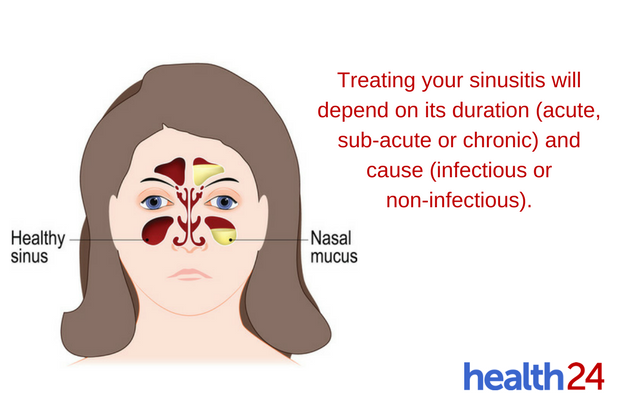
A previous Health24 article explains that the types of sinusitis are classified according to their time span, as well as the type of inflammation causing the sinusitis.

  • Acute sinusitis
  • Subacute sinusitis
  • Chronic sinusitis

Sinusitis can also be divided according to cause, i.e. whether it’s caused by infection or something else.

  • Infectious sinusitis is caused by an overgrowth of bacteria and usually occurs after a cold or flu.
  • Non-infectious sinusitis is caused by allergies (dander, pollen climate) or physical reasons such as a deviated septum, tumours or polyps in the nasal cavities.

types of sinus

Treatment

The first step towards successfully treating your sinusitis is to determine the type and cause. This should be done by your doctor, who will identify the cause of your sinusitis and treat it accordingly. 

Here are the different types of treatments recommended for different types of sinusitis:

1. Acute sinusitis

Symptoms: A stuffy nose, pressure headache, facial pain and slightly discoloured mucus.

Likely causes: Usually a viral or bacterial infection, especially if it clears up in under 10 days.

Treatment: If the symptoms don’t persist for longer than 10 days, there is no need for antibiotics. Treat symptoms with over-the-counter decongestants to relieve congestion and painkillers, such as paracetamol, to relieve pain.

2. Subacute sinusitis

Symptoms: The same as the above – the duration of the symptoms will be more than a month, but no longer than three months.

Likely causes: A more serious, longer-lasting viral or bacterial infection.

Treatment: In the case of subacute sinusitis, your doctor will prescribe a course of antibiotics and a nasal steroid to clear up the infection and congestion. 

3. Chronic sinusitis

Symptoms: The same as the above, although nasal polyps may start to develop when you have chronic sinusitis.

Likely causes: Chronic sinusitis that persists for more than three months is usually caused by allergies to dander or pollen or by physical factors such as a deviated septum or possible tumours.

Treatment: Your doctor might refer you to an ear nose and throat (ENT) specialist to investigate the cause of your sinusitis. In the case of allergies, your doctor will suggest treatments like decongestants.

According to Health24’s resident allergy expert Dr Adrian Morris, it’s a good idea to begin regular antihistamine medication a month before the pollen season starts if you are prone to seasonal allergies.

Nonsedating, long-acting antihistamines include Telfast, Zyzal and Deselex.

Image credit: iStock

Share Button

Potential new cure found for baldness

The lead researcher says the discovery could “make a real difference to people”.

Share Button

Health24.com | How to manage dermatitis associated with incontinence

People who have incontinence may experience incontinence-associated dermatitis (IAD) at some point. 

IAD occurs when moisture from urine or stool remains on the skin, causing the tissue to break down. This can be a painful and costly situation as well as difficult to identify, which increases chances of infection and chronic wounds.

Diagnosis and immediate treatment are important when dealing with IAD.

What exactly is IAD?

The condition is caused by inflammation of the skin when the area around the anus or genitals is exposed to urine or stool for long periods of time. The American Journal of Clinical Dermatology explains how elderly people – particularly those living in long-term care facilities – are at a higher risk of both incontinence and this irritating condition. 

IAD is often confused with pressure ulcers and other skin conditions, but the growing amount of research in the field is making it easier for doctors to diagnose the condition more accurately and efficiently. 

How does IAD happen? 

It was previously believed that the moisture from the urine and stool were the cause of the dermatitis occurring around the genitals and anus area. Further research, however, has proved this theory false. It has been proven that what actually causes the skin condition is what is contained in these fluids. The alkaline substances in urine, for instance, damage the tissue of your skin, making it more vulnerable to abrasion.

Symptoms of IAD include:

  • Itchy skin
  • Burning sensation 
  • Pain
  • Tender and warm skin
  • Redness and inflammation of the skin

If you are experiencing any of these symptoms, speak to your doctor as soon as possible. They should ask about your incontinence in order to diagnose your skin condition properly. Symptoms can be unclear at times; it is therefore important to rule out certain conditions that have the same symptoms as IAD:

How can it be treated? 

  • Change your absorbent pads/diapers regularly, even if they are dry, in order to maintain good hygiene. Typically people use four to six pads daily.
  • Wash the area with a cleanser that balances your skin’s pH level.
  • Properly moisturise your skin, use hydrogel or petroleum-based products to protect your skin. 
  • Your doctor may be able to recommend a product that cleanses, moisturises and protects simultaneously. 

If you’ve developed any infection as a result of IAD, your doctor may have to prescribe an antifungal or oral antibiotic medication. 

In order to manage IAD, there needs to be proper management of incontinence. Make sure you consult your doctor to discuss management strategies for both conditions. The only way to reduce your risk for IAD is to be diligent in your treatment plan. 

Image credit: iStock

Share Button

Health24.com | Does coffee cause cancer?

While scientists have not yet come up with a final verdict on whether coffee is good or bad for you, an American judge has. A Californian judge has called for coffee sellers in the state to place cancer warnings on the coffee they sell. 

The problem is the chemical produced during the roasting process, known as acrylamide, a carcinogen, has been in the middle of an eight-year legal battle between a small non-profit organisation and major coffee companies in the US.

While this battle has reached a conclusion in court, scientists are still debating whether coffee can actually cause cancer. We take a closer look.

Inconsistent results

A recent study, published in the European Journal of Cancer Prevention, did a meta-analysis and found that “coffee consumption is not associated with overall cancer risk”.

However, the results for bladder cancer were inconsistent, and a few studies analysed in the meta-analysis found that there was an increased risk of childhood leukaemia after mothers had drunk coffee during their pregnancy. 

It is also important to note that, in the same report, the International Agency for Research on Cancer (IARC) concluded that drinking hot drinks (over 65 degrees) may increase the risk of oesophageal cancer. The oesophagus is the passage that connects the mouth and stomach. 

Coffee may reduce cancer risk

According to Majorie McCullough, ScD, and Susan Gapstur, PhD, researchers from the American Cancer Society, the development of cancer in the liver, pancreas, breasts as well as the uterine endometrium is significantly reduced when one consumes coffee on a daily basis. This is due to the antioxidants found in coffee.

Although research is unclear as to how coffee affects patients with colon cancer, assistant professor and colon cancer expert Syed Kazmi has noted that patients who consume coffee tend to live longer than patients who do not. 

Coffee drinking is associated with a reduced risk of liver cancer, possible decreased risk in oral/pharyngeal cancer as well as advanced prostate cancer. 

Concerns have eased

Scientific evidence on coffee has been oscillating between benefits and risks. However, as a result of new studies finding more health benefits of coffee, concerns have eased. If you are a regular coffee drinker, the new studies indicate that you are probably not increasing your risk of cancer.

If you are not a coffee drinker, you might, however, not want to take this new evidence as a reason to start. The evidence is still uncertain, and if subsequent research does reveal a positive effect, it most likely will be small, much smaller than any benefits gained from maintaining a healthy weight or cutting down on alcohol.

Image credit: iStock 

Share Button

Health24.com | 4 numbers you need to know next time you have to see the doctor

Your life may depend on this hurry-up healthcare offensive, so it’s a good idea to know these numbers so you can hack the waiting room and your appointment.

1. The waiting room

0:20:00

According to the American Medical Association, that’s the average amount of time you spend in the germ-filled waiting room. A study in the Journal of Medical Virology reports that cold viruses can linger for 24-plus hours on hard surfaces, so bring your own pen and magazine.

And while you (should) know that touching your mouth with a contaminated hand can spread gastrointestinal viruses, head- and chest-cold viruses can enter through membranes in your eyes and nose, too. So if you touch any surface, don’t rub your eyes or scratch your nose until you’ve treated your hands with sanitiser.

Read more: 6 solutions to common problems you have with your doctor – and how to get the most out of your appointment

2. Doctor time

0:07:00

That’s the average length of time a doctor spends with each patient. Your preparation for the doctor shouldn’t be just booking the appointment – carefully record your symptoms beforehand. Once inside, monitor who’s guiding the consultation. While you’re here for expert advice, don’t let the precious minutes be dominated so you’re out the door before you’ve gotten any answers.

You can maximise that time by taking advantage of an often-underutilised ally – the nurse. “Nurses are better educated on ways to help patients understand,” says Dr Judith Hall, co-author of Doctors Talking With Patients/Patients Talking With Doctors.

Read more: Doctor’s orders: These are the 7 foods doctors prescribe for your health

3. Bonus time

0:02:00

Improve on the seven-minute appointment average by seeing a female physician. A 2004 Johns Hopkins study reports that visits with female doctors are, on average, two minutes longer than those with their male counterparts.

“Patients of female physicians also felt more comfortable disclosing medical information, which is crucial for proper care,” says study author Dr Debra Roter, a professor at Johns Hopkins school of public health.

Read more: A sleep doctor reveals the 4 fastest ways to stop snoring

4. Talk time

0:00:18

That’s how long you have to explain your symptoms before your doctor interrupts, says an Annals of Internal Medicine study. The disruption often causes patients to become flustered and forget the other reasons for the visit, says Dr Roter.

Overcome the distraction by writing a comprehensive list of your symptoms before you walk in the door. Include details such as how long you’ve had them and how often and how severe they are, as well as questions you want to ask.

This article was originally published on www.mh.co.za

Image credit: iStock

Share Button

HPV jab safe and effective, study finds

Trials show the vaccine is low risk and protects girls and young women against a virus linked to cervical cancer.

Share Button