Health24.com | Breakthrough in lung cancer treatment cuts risk of dying by 50%

Drugs designed to trigger a patient’s immune system may help boost survival for those battling lung cancer, two new studies found.

The first study found that when the immunotherapy drug Keytruda (pembrolizumab) was combined with standard chemotherapy, the chance that a patient would die within the next 11 months plummeted by more than 50%, compared with being treated with chemo alone.

An encouraging note

The combination treatment also drove down the risk that the cancer would spread by nearly as much, added the research team from NYU Langone Health in New York City.

In a similar vein, another team of researchers gave patients diagnosed with advanced lung cancer either a combination of the immunotherapy drugs Opdivo (nivolumab) and Yervoy (ipilimumab) or standard chemotherapy. Those on the two immunotherapy drugs were 42% less likely to see their disease progress after a year.

Taken together, the two findings offer an encouraging note in an effort to improve the odds against what is the leading cause of cancer-related death, experts said.

“Chemotherapy remains the standard of care for the majority of [lung cancer] patients, and is a very poor standard,” explained Dr Leena Gandhi, lead author of the NYU Langone study. In most cases, she said, chemo prolongs life by just a year or even less.

But the combination approach “resulted in a marked improvement in response, progression-free survival and overall survival in all patients,” she said.

Dr Gandhi is director of Langone’s Thoracic Medical Oncology Program at the Perlmutter Cancer Center.

Serious side effects

The studies were also published simultaneously in the New England Journal of Medicine.

The second study was led by Dr Matthew Hellmann, assistant attending at Memorial Sloan Kettering Cancer Center in New York City.

Dr Gandhi’s team enlisted more than 600 lung cancer patients from over 118 treatment centres around the world.

Of these, roughly two-thirds were randomly assigned to receive Keytruda and chemotherapy. The remaining third was treated with chemotherapy alone.

Investigators found that in both groups about two-thirds of the patients experienced serious side effects, though the combination group faced a 5% higher risk for kidney trouble.

But compared with those in the chemo-only group, those in the combination group saw their chances increase for overall survival and for halting the progression of their disease.

Combination therapy more expensive

Hellmann’s group followed 299 patients with advanced lung cancer for close to a year. One group was given the immunotherapy drugs Opdivo and Yervoy, while the other received chemo.

“Patients who received the immunotherapy combination were 42% less likely to have their disease progress,” Hellmann said in a statement.

As for costs, Gandhi said combination drug therapy (approved by the US Food and Drug Administration in 2017) is more expensive than chemo alone. But she suggested that the added expense should be weighed against “the magnitude of the benefit”.

Dr Norman Edelman, senior medical advisor for the American Lung Association, said both findings are a step forward, given that “until very recently the treatment of lung cancer has been dismal”.

“Because most lung cancer is detected after it’s already spread, we get five-year cures in less than 20% of patients using chemotherapy alone,” Edelman noted.

Substantial breakthrough

“But recently we’ve developed drugs that are tailored to the specific genetics of a patient’s tumour,” he explained. “And that was really the first breakthrough, because it extended life for a small group of people, about 10 to 15%.

“But what’s exciting about these two immune system therapies is that the researchers didn’t limit themselves to just specific genetic variations [in patients],” Edelman said.

“The first study went for all the patients, and the second study also focused on a much larger group of patients. And both found that their approaches offered a substantial improvement – in terms of prolonging life and reducing disease progression – to a much larger percentage of people,” he explained.

“And in the case of the first study, if their findings hold up, it’s really a substantial breakthrough, because they suggest this can be a first-line treatment,” Edelman added.

“In other words, you can use this instead of chemotherapy. Which is truly a big deal, because chemo is not terribly effective and has all kinds of side effects,” he said.

Image credit: iStock

Share Button

Health24.com | WATCH: Shocking video shows stark difference between a smoker and non-smoker’s lungs

Although many people know smoking isn’t good for them, it’s easy for them to keep on smoking because they don’t readily see the damage it’s causing to their lungs.

Amanda Eller, a nurse from North Carolina, recently shared a shocking video on Facebook showing what smoking really does to your lungs.

In the video a healthy set of lungs are compared with those of a person who smoked one pack of cigarettes a day, for 20 years.

The video starts off with the black, cancer-ridden lungs of a heavy smoker failing to properly inflate, then the red-coloured lungs that are shown inflating and deflating as normal.

The video has been shared more than 5 000 times.

In South Africa 17.6% of adults smoke tobacco, with men four times more likely to smoke than women.

And although smoking rates in South Africa have decreased, mostly thanks to legislation and taxation nearly eight million adults are still lighting up to 27 billion cigarettes every year, reports IOL.

Watch the video here:

Sources: Metro UK, Daily Mail, Unilad

NEXT ON HEALTH24X

Share Button

French bulldogs at risk of various health problems

French Bulldogs, predicted soon to become the most popular dog breed in the UK, are vulnerable to a number of health conditions, according to a new study published in the open access journal Canine Genetics and Epidemiology.

Researchers at The Royal Veterinary College (RVC), UK found that the most common issues in French Bulldogs over a one year period were ear infections, diarrhea and conjunctivitis (inflammation of the eye surface).

Dr. Dan O’Neill, RVC Senior Lecturer and the main author, said: “French Bulldogs are a relatively new arrival to the list of common UK breeds so there is very little current research on them in the UK. Our study — the first on this breed in the UK — is based on anonymised records gathered from hundreds of UK vet clinics. It provides owners with information on the issues that they could expect and should look out for in French Bulldogs. It may also help potential new owners to decide if a French Bulldog really is for them.”

Dr. O’Neill adds: “One of the interesting finding from our research is that male French Bulldogs appear to be less healthy than females. Males were more likely to get 8 of the 26 most common health problems while there were no issues that females were more likely to get than males.”

The authors suggest that the distinctive appearance of the French Bulldog, with their short muzzles and wide, prominent eyes, may be a key factor influencing their popularity. However, these characteristics may also increase the risk for some of the health problems seen in French Bulldogs. For example breathing issues, seen in 12.7% of the dogs in this study, are a known problem in breeds with short noses and flat faces. Skin problems overall were the most common group of health issues and the authors suggest that this may be due to the skin folds that are characteristic of the breed.

Dr. O’Neill said: “This study also documents the dramatic rise in popularity of the French Bulldog, from 0.02% of puppies born in 2003 to 1.46% of puppies born in 2013. This level of population growth in a single dog breed is unprecedented. There is a worry that increased demand for the French Bulldog is damaging to these dogs’ welfare because of the health risks associated with their extreme physical features.”

The authors analyzed data on 2,228 French Bulldogs under veterinary care during 2013 from 304 UK clinics, collected in the VetCompass™ database. The French Bulldogs had a median age of 1.3 years old compared to a median age of 4.5 years for the other dog breeds in the VetCompass™ database. This reflects the growth in popularity of French Bulldogs.

The authors caution that the study may even under-estimate the true number of dogs with health problems as the data may include more severely affected animals that require veterinary management. Additionally, as French Bulldogs have only recently become popular the data was mostly collected from young dogs and it is well recognized that health problems generally become more common with age.

Story Source:

Materials provided by BioMed Central. Note: Content may be edited for style and length.

Share Button

Bath additives for child eczema ineffective, study finds

Experts say the findings suggest the NHS could better spend the £23m each year it costs for the treatment.

Share Button

Scientists build ‘synthetic embryos’

They were made in a dish from mouse stem cells and resembled an embryo of about three days old.

Share Button

Breast screening error angers survivor and family of deceased

A man said his wife might have survived breast cancer if she had been scanned and diagnosed earlier.

Share Button

Engraved Crimean stone artifact may demonstrate Neanderthal symbolism

A flint flake from the Middle Paleolithic of Crimea was likely engraved symbolically by a skilled Neanderthal hand, according to a study published May 2, 2018 in the open-access journal PLOS ONE by Ana Majkic from the University of Bordeaux, France and colleagues. The authors developed a detailed framework for interpreting engravings on stone artifacts.

Engraved stone artifacts are important clues to the history of human culture and cognition. Incisions on the cortex (soft outer layer) of flint or chert flakes are known from Middle and Lower Paleolithic sites across Europe and the Middle East. However, it can be difficult to determine the action that created an incision: was it an accidental scrape or purposeful engraving? To address this issue, Majkic and colleagues created an interpretive framework that allows researchers to classify the structure and patterns of engraved cortexes and cross-check these attributes with a list of possible causal actions.

They tested this methodology with an engraved flake from the cave site of Kiik-Koba in Crimea. The many stone artifacts at the site are associated with Neanderthal remains and date to around 35,000 years ago. Following microscopic examination of the grooved lines on the flint cortex, the researchers concluded that the incisions represent deliberate engravings that would have required fine motor skills and attention to detail. These engravings appear to have been made with symbolic or communicative intent.

If this interpretation is correct, this engraved flake would join a growing list of signs that Neanderthals engaged in symbolic activities, along with evidence of intentional burial, personal ornaments, and other decorated objects. This has implications for the question of when and how many times this sort of cultural expression has evolved among hominin populations. The researchers hope to hone their framework further for use with artifacts of varying ages and cultural contexts.

Story Source:

Materials provided by PLOS. Note: Content may be edited for style and length.

Share Button

Newly improved glass slide turns microscopes into thermometers

The humble glass microscope slide may be primed for a makeover.

A study published online today (May 2, 2018) in the journal Nature Communications describes how an updated version of this centuries-old tool can now enable scientists to see tiny objects while also measuring their temperature.

The advancement, made possible by a new transparent coating at the forefront of optics theory, has the potential to streamline and enhance scientific research worldwide, from clandestine government biology labs to high school chemistry classes.

It may also have implications in other industries, such as computers and electronics, whose products require measurement and control of heat in highly confined spaces.

“We have instruments that magnify incredibly small objects. And we have tools that measure heat, like infrared thermometers. But we haven’t been able to combine them in a low-cost and reliable manner. This new coating takes a big step in that direction,” says the study’s co-lead author Ruogang Zhao, PhD, assistant professor in the University at Buffalo Department of Biomedical Engineering.

The department is a multidisciplinary unit formed by UB’s School of Engineering and Applied Sciences and the Jacobs School of Medicine and Biomedical Sciences at UB.

Zhao collaborated with researchers at the University of Pennsylvania, including co-lead author Liang Feng, PhD, assistant professor of materials science and engineering, and electrical and systems engineering.

For decades, researchers have tried to combine thermal imaging and microscopy. Images produced from systems that use thermocouples lack resolution and are often too coarse for modern science. Terahertz and infrared thermal mapping techniques interfere with the microscope’s lenses. Other techniques are expensive and time-consuming.

The new coating is made of a layer of acrylic glass (the same material used in most eyeglasses) that’s sandwiched between two layers of transparent gold. The gold is transparent because it’s only 20 nanometers thick; a typical sheet of paper is 100,000 nanometers thick.

Engineers fabricated the coating so that “exceptional points” — the sweet spots where unusual light behavior happens — can develop within the tri-layered structure. The coating, which significantly enhances the slide’s sensitivity to light detection, would be added to slides during the manufacturing process. Either the slide or cover slip could receive the coating.

To make use of the new coating, a laser is needed. Zhao says a common helium-neon laser, which can be seamlessly integrated with most microscopes, will do the job.

Common slides, which are often bought in bulk, typically cost around 5 cents. The new coating would likely add a few pennies to the cost, Zhao says.

The research is supported by funding from the National Science Foundation and the National Institutes of Health.

Story Source:

Materials provided by University at Buffalo. Note: Content may be edited for style and length.

Share Button

Health24.com | ‘Dagga still illegal in SA’

While the Western Cape High Court ruled on the use of medical cannabis last year, most South Africans remain confused on the issue, including some members of the South African Police Service.

The confusion has arisen because although the courts ruled that the use of cannabis by people at home is now legal, the matter was taken to the Supreme Court of Appeal where a final ruling will be made.

People still being arrested

The Western Cape High Court’s groundbreaking ruling is that people may use cannabis only at their  homes, and may grow their own cannabis at home. The ruling was met with huge excitement by Rastafarians who claimed victory for cannabis users. But months later people are still being arrested for growing and using the herb at home.

Rastafarian Mpho Kaloto from Potchefstroom says he thought the battle was won, and still doesn’t understand why he was arrested.

“I was watching on the news last year when a judge said we can grow dagga and smoke it in our homes, so I fail to understand why I was arrested after my neighbours called the cops on me. I thought what I was doing was legal,” said Jah Mpho.

The 38-year-old Rastafarian said he spent a weekend in a holding cell and was charged with drug possession, and ordered to pay a R500 fine.

“I spent a whole weekend in jail, and I was fined with R500 because of two small trees that where found at my yard. Now I have a criminal record and I’m not even a criminal. I am still confused. Right now as I feel like the law has let us down. As Rastas, dagga is a part of how we live,” he said.

Ruling not yet in effect

Judge Dennis Davis, who made the ruling, said the police can still go into a home and arrest a person for cannabis, but those arrested would be afforded the opportunity to use their right to privacy as a defence when charged. The judge also ruled that it’s not up to the courts to decide whether or not there were social problems linked to drugs, or that drug-related problems should be ignored, it was up to parliament.

Witness Phele, a lawyer who has represented people accused of cannabis possession, says that the ruling hasn’t come into effect and cannabis is still illegal in South Africa.

“The case is now before the Supreme Court of Appeal. As soon as we get an SCA Judgement the law will be applicable,” he said.

According to Phele, the law currently remains the same as it was before the judgement was passed in the Western Cape High Court.

“Nothing has changed until legislature changes the Act,” he said.

Arrested in confusion

According to Mpho, the police who arrested him were also confused after he told them about the ruling.

“I read the ruling to them, and that confused them. So the police arrested me in confusion, but I guess they thought they were doing their job.”

People suffering from severe and chronic pain related to mulitple sclerosis, cancer and HIV/Aids were expected to be the ones to have access to medical cannabis.

Marita Schalk, who has suffered from severe back pain and has experienced heart problems says cannabis oil has assisted her for the past two years.

“I was living on a lot of medication until my doctor recommended cannabis oil two years ago. It didn’t remove all of my pain, but one thing for sure is that I feel much better now. It has helped with my heart problems, and also I used to have severe back pain all the time. Things have improved very much and so I really hope it is legalised. People need something like this,” she said. – Health-e News.

Image credit: iStock

Share Button

Health24.com | ‘I have Crohn’s disease – but some people think it’s all in my head’

A chronic illness is so much more than discomfort and constantly checking into the hospital. “Socially it’s been the biggest problem,” Maddie Beale, a Crohn’s disease sufferer, says. Just over a week ago today marks a year since she was diagnosed with Crohn’s.

“You end up in the hospital and people are all gaga to come visit you for the first admission, or the second one… and then eventually it’s, ‘Ag she’s back there again! That’s so annoying.’”

Chronic illnesses are often invisible. There is constant pain that, as a friend of a sufferer, can be hard to relate to. Here is the truth about this disease, as told by Maddie.

Crohn’s disease: the diagnosis

“It took a while for me to be diagnosed, but it actually wasn’t as long as [it takes for] a lot of people,” Maddie begins. “Looking back, I realise that I’ve had symptoms for years!”

But the journey towards a diagnosis really began in October 2016. “Something just wasn’t right. My heart was racing and I was so tired; I had an upset stomach that just wasn’t going away,” Maddie says. Her GP wasn’t convinced, but sent her for blood tests. “I went straight from Pathcare to the hospital,” she says.

After a week of hospital tests, Maddie was told her intestines were inflamed. “But the doctors decided to treat it as if it’s acute and sent me home, loaded with antibiotics and steroids,” she said. It didn’t get better, and around February last year, she found herself back in the hospital.

After a CAT scan and urine samples, she was sent home yet again, having been told she was fine and was simply trying to get a day off varsity. “I couldn’t move. I was in screaming pain,” she recalls.

Read more: The truth about chronic inflammation and what it means for your health

In March, Maddie and her family decided to take things into their own hands. They made an appointment with a gastroenterologist (a doctor who specialises in conditions of the digestive tract).

“I explained my whole story and he said he could probably confidently diagnose me from just this.” After an MRE scan, which provides the doctor with detailed images of the small intestine and bowel, the expert confirmed his suspicions: Crohn’s. “It was a long process, but I know some people that took four or five years to diagnose. It could have been a lot worse…”

Dealing with Crohn’s

Finding out that you have a chronic illness is far from fun. “[But] in a way, you feel so relieved,” says Maddie. “After being told that you’re just making it up and it’s all in your head… There is a reason – that’s a relief.” But, of course, it’s also devastating. “You tell yourself that you’re fine, that you’ll get a course of antibiotics and then everything will be okay. You want people to understand that the pain is real, but you don’t want to be stuck with it forever.”

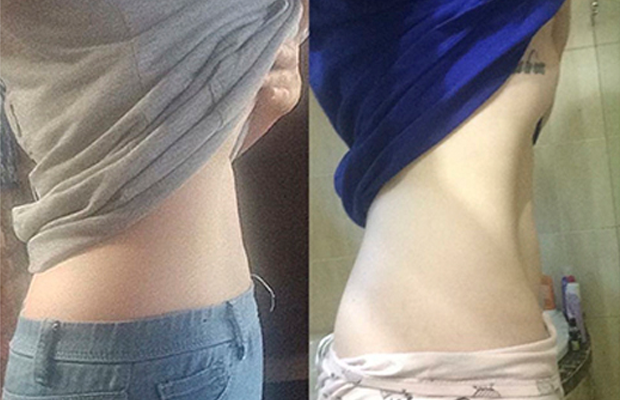
“My symptoms are much better now, but in the beginning – uncontrolled diarrhoea,” Maddie says with a laugh, “That’s why no one wants to talk about Crohn’s – because it’s ugly.” The symptoms include major blood loss through the ulcerations on your intestines. “I experienced massive weight loss. I dropped 10 kilos – like that!”

It was scary, yet Maddie still had people telling her how lucky she was to lose weight so quickly. “No, that’s not fun. What’s fun is going and working out – just having your weight fall off you is not nice.”

Maddie's dramatic weight loss

Read more: “I developed an invisible illness – here’s what it’s like”

Fatigue is another symptom. “That is probably my main struggle now,” Maddie adds. There are other things that she didn’t even think would be connected to this disease. “I had ulcers in my mouth all the time and my eye sight [was affected].”

Then there’s the pain, which includes severe joint pain because Crohn’s causes inflammation everywhere. Not to mention the lack of appetite and subsequent weight loss. “I had seven hospitalisations last year because my symptoms were just too much to handle.”

The treatment

Maddie was first put on a high dose of cortisone. “Anyone who has ever been on cortisone can tell you that it’s the worst thing ever,” she adds. “It makes you swell up and get a nice round moon face.” A side effect of cortisone is insomnia. “You’re so exhausted and feeling so sick, but you’re also buzzing.”

Maddie then went on to Imuran, a drug used to stop organ rejection after organ transplants. “It’s an auto-immune disease so the best thing is immunosuppressants – if you just wipe out the immune system…” she explains. But this made her so ill that she ended up with pancreatitis.

“I’m now on Mezavant. It’s much milder, but I’m on a high dose and it seems to be controlling things. It doesn’t damage your immune system and I’m really hoping that I can stay on it for as long as possible!”

Living with it

“Obviously my diet has changed a lot – I go through stages when I’m just on baby food,” Maddie says. There are a lot of foods she’s had to give up too: “I’m not allowed to eat anything high in fibre – the more processed, the better it is for me.” Any vegetables need to be cooked to mush. “When I explain what I can eat to people, they get a bit of a horrified look on their faces. I can eat that McDonald’s, but no salad for me!” Her favourite snack, nuts – out. “And no popcorn! How do I go to the movies now?” She jokes.

Varsity life has been a bit of a tricky adjustment. After the 45-minute drive to campus, “I’ve got a full day sitting there and I’m in pain. I don’t want to eat, but then I get low blood sugar so I’m shaky and miserable. I end up just staying home. My lecturers have been really supportive, though. I did fail a couple of subjects last year, but I’m impressed I passed what I did because I missed so much!” This year is going much better with the new meds.

Read more: What this Instagram yogi wants you to know about living with chronic pain

“Socially it’s been the biggest problem,” Maddie says. At first, friends are understanding when you say, “I can’t come out with you because I’m not doing well, or I’m too tired, or I can’t drink because I’m on medication and it will kill me if I do.” But the sympathy turns to irritation quite quickly, especially when there’s nothing you can physically see. “But you also learn who your real friends are really quickly,” she adds.

Another thing that was especially rough was the lack of independence. “I went through a stage when I couldn’t even get out the bath on my own,” Maddie says. And when it came to Christmas shopping, she did it by wheelchair. “You realise the prejudices people have – they assume that if you’re in a wheelchair, your legs don’t work. Anything else and you’re just being lazy.”

Maddie in a wheelchair

Maddie’s advice to fellow Crohnies

“The main thing, and I think this goes for anyone who has any form of chronic illness, is not to let it define you. It is a big part of your life, but don’t make your life about the illness.” It’s an easy pit to fall into and Maddie says she’s been there. “You can be so sick and just go into a ball of pity,” she adds. “But you are perfectly capable of carrying on with your life.”

Maddie has made many friends with Crohn’s or other chronic illnesses through Instagram. It’s so important to have a support system, “and just because they’re a stranger you met online doesn’t mean they won’t understand you – maybe they will [understand you] even better than those directly in your life.”

And finally, “don’t throw away your goals and dreams – adapt them! No one is ever going to look down on you for changing the way you reach your goals. Just do it.”

This article was originally published on www.womenshealthsa.co.za

Image credit: Supplied

Share Button