Health24.com | 1 in 4 SA workers suffers from depression

A recent study conducted by The South African Depression and Anxiety Group (SADAG) in partnership with Hexor, with the support of Lundbeck, indicates that depression affects one in four South African employees.

People aged between 25 and 44 are most affected by depression and take more than 18 days per annum off work because of it. The IDEA study of the London School of Economics and Political Science 2016 says this costs the South African economy more than R232 billion (or 5.7% of the country’s GDP) as a result of lost productivity, either due to absenteeism or attempting to work while feeling depressed.

Health24 previously quoted Dr Sebolelo Seape, chairperson of the Psychiatry Management Group, who said that more than 9.7% of the South African population (or 4.5 million to be exact) were suffering from depression. That means there’s a good chance the person who sits next to you has had to cope with depression at some point in their lives. 

Given the shocking statistics, what should companies be doing to handle mental illness in the workplace? 

Depression is a medical condition

Psychiatrist and leadership lecturer at the University of Stellenbosch Business School (USB), Dr Renata Schoeman, says that more than 40% of all work-related illness is due to work-related stress, major depression, burnout and anxiety disorders.

She recently presented at a Corporate Mental Health Awareness seminar at USB and said companies need to realise the significance their structure, expectations of employees and management style have on the company’s annual turnover, overall productivity and the risk of employees developing health problems that could prevent them temporarily or permanently reentering the workforce.  
stigma, depression, mental health, illness,

Fear of stigma

Non-disclosure of depression as a reason for sick leave in the workplace often arises due to the stigma that comes with the condition. Employees also fear losing their jobs.

In 2017 SADAG released stats following a survey to find out what the impact of mental illness has in the workplace. The results were shocking.

  • 61% of respondents had disclosed their mental illness to their manager, with 69% of them saying they had experienced a negative or no response when they discussed the issue with them. 
  • 44% of respondents felt uncomfortable disclosing their mental health issue to their manager. 

“Undiagnosed and untreated mental health conditions directly impact a workplace through increased absenteeism and presenteeism (attending work while unwell), reduces productivity and increases costs. Most employers tend to completely underestimate the financial impact of mental illness on their bottom line,” Dr Schoeman said.

“The cognitive symptoms of depression, such as difficulties concentrating, making decisions and remembering, are present 94% of the time during an episode of depression. Since leaders find themselves in roles of decision-making and responsibility, they are more prone to presenteeism. They would be less able to cope with the demands of their position, and as a leader their condition whilst at work would have a major impact on inter-office relationships, decision-making and their ability to manage their teams.”

She says it is imperative that companies understand the leading role they play in reducing or eradicating possible stressors at work.

“[Companies] should foster a healthy educational environment with pro-active mental health awareness programmes, stress management training, access to services which nurture help-seeking behaviour, implement a coaching or counselling programme, identify people in need of care and offer them resources to ensure they receive proper treatment,” she said.

A supportive culture is needed

Although policies and guidelines are necessary in the workplace, Dr Schoeman says that alone will not make a difference. Instead, companies need to foster a supportive culture of understanding and acceptance around mental illness.

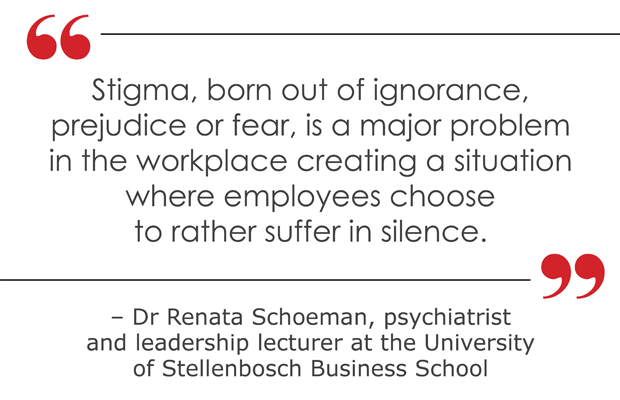
“Stigma, born out of ignorance, prejudice or fear, is a major problem in the workplace, creating a situation where employees choose to rather suffer in silence. One can understand their reluctance to seek support or report their condition, especially in the current economic climate where they might fear losing their job. As a result mental health problems often go undiagnosed and untreated, not only to the detriment of the individual’s career and health but also directly impacting the workplace’s bottom line.”

Dr Schoeman says mental health awareness in the workplace will ensure early identification and treatment of disorders, prevent recurrence and long-term complications. Implementing employee assistance programmes will help improve the quality of life for employees, while the longevity of the company will see a lesser loss to the country’s GDP and prevent disorders from becoming permanent disabilities.

How does your company handle mental illness in the workplace? Do you have an employee assistance programme at your company? Have you used it? Email mandy.freeman@24.com to share your story.

Image credit: iStock

Share Button

Report recommends NI abortion law change

A working group recommends changing NI’s laws to allow abortion in cases of fatal foetal abnormality.

Share Button

Health24.com | Reasons why your scalp is itchy – and how to fix it

An itchy scalp is admittedly gross: Is it dandruff? Eww! There are other reasons your scalp is itchy. Here, the myriad of reasons and how to nix it.

The usual suspects

Flaky, itchy dandruff, the bane of half the population, has three main causes: an oily scalp (not a dry one), a build-up of dead skin or styling products or a yeast-like fungus called malassezia.

Vigorously massaging shampoo into your scalp (not just into your hair) may lift product build-up, but if flaking persists, use shampoo containing zinc or salicylic acid, which treat fungus, build-up and oil. Still itching after a few weeks? You may need to visit your dermatologist to see if something else is going on.

Read more: Are your moles normal? Here’s exactly how to tell

Allergies

Ingredients in some hair products can prompt an allergic reaction, says Dr Maria Hordinsky. “The allergen is often fragrance or a moisturising agent called propylene glycol.”

If your whole head feels itchy, stop using these suspects for a week; if the irritation goes away, replace your old products with fragrance- or PG-free options. Scorching temps from styling tools like blow-dryers, flat-irons and curling irons can also dry out the scalp and cause itchiness, so keep heat settings on medium.

Psoriasis

When your itch is in just one spot, it could be a skin condition like psoriasis, an autoimmune disease that causes raised, scaly patches, says dermatologist Dr Joshua Zeichner. If your dermatologist determines this is the case, use a shampoo with coal tar – sounds weird, but it works. Your doctor can prescribe stronger remedies if needed.

Read more: 5 really affordable hand sanitisers that won’t harm your skin

Cancer

One itch that’s rare but not to be ignored: A crusty spot about a quarter-inch in diameter could be a precancerous lesion called actinic keratosis, the result of sun exposure over many years, says Dr Hordinsky. About 10% of these become cancerous, so see your dermatologist as soon as possible to have it checked and, if needed, removed. Ward off future damage by using a sunscreen specially formulated for the scalp – even in winter.

This article was originally published on www.womenshealthsa.co.za

Image credit: iStock

Share Button

Health24.com | These are the areas where you are most at risk of getting malaria

Today (25 April 2018) is World Malaria Day. According to the latest statistics from the World Health Organization (WHO), there were 216 million cases of malaria worldwide in 2016, resulting in 445 000 malaria-related deaths.

The National Institute of Communicable Diseases (NICD) stated that with the upcoming long weekend, many South African travellers will be visiting high-risk areas. Many people also visited such areas over the Easter weekend. 

What are the symptoms?

According to Health24, the early symptoms of malaria can easily be mistaken for flu. The incubation period varies from person to person, but is usually between two to three weeks. Initial symptoms include:

  • Intermittent mild fever 
  • Headache 
  • Muscle aches and chills 
  • General feeling of illness (malaise)

As malaria progresses, the fever may increase and you might experience severe headaches, drowsiness and often, delirium. Malaria can be deadly if not diagnosed and treated quickly.

What is the current malaria situation?

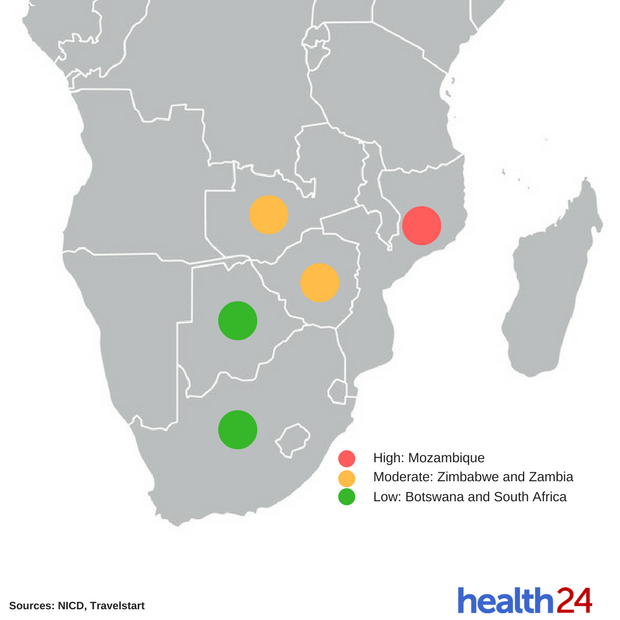
The NICD said in a press release that the total number of cases across the three malaria-endemic provinces (north-eastern Limpopo, eastern Mpumalanga and northern KwaZulu-Natal) has risen in the last three weeks, and some of these are likely to involve travellers returning from neighbouring countries, particularly Botswana and Mozambique.

The map below provides a rough estimate of malaria risk:

malaria risk map

Visiting a game reserve? Check to see whether you are at risk of malaria: 

game reserves with malaria risk

Who is at risk?

Anyone who has been in a malaria risk area in the past 10 days to three weeks and who presents with with flu-like symptoms (headache, muscle and joint pains, chills, fever and sweating; vomiting and loss of appetite in young children) should consider malaria as a possibility and seek medical attention, which should include a malaria blood test. This should be repeated if necessary.

I took precautions; should I still be worried?

According to the NICD, travellers should inform healthcare workers if they travelled to a risk area, as this information is often overlooked, delaying diagnosis.

Using anti-mosquito measures (nets, repellents, etc.) and/or prophylactic medicines does not guarantee complete protection against malaria. Many people dine or socialise outdoors in the evening during warm weather and forget to cover bare skin, especially ankles, where mosquitoes tend to bite.

Delayed malaria diagnosis often leads to more severe illness with the danger of serious complications and even death.

Are you travelling to a high-risk area this long weekend?

Discuss any upcoming travelling plans with your doctor, who will be able to prescribe a pre-exposure prophylactic drug to help prevent malaria.

No drug is 100% effective, which means that it’s important to apply other preventative measurements as well:

  • Wear clothing with long sleeves and cover your ankles – especially at dawn and dusk, when mosquitoes are most active.
  • Use long-lasting insecticide sprays inside homes and buildings.
  • Place wire or gauze screens on all doors and windows.
  • Use a fan in the room during the night – the breeze seems to discourage mosquitoes.
  • Apply mosquito repellent directly to the skin.
  • Use mosquito netting over the beds – these can be soaked in certain types of insecticide.
  • Try and spend evenings indoors rather than outdoors, where you are much less likely to get bitten.
  • Blankets treated with mosquito repellents are also useful.

Image credit: iStock

NEXT ON HEALTH24X

Share Button

Health24.com | ‘My birth control pills gave me a liver tumour’ – this is how it happened

We’re all warned that there are side effects and risks associated with taking birth-control pills, but besides wondering if your mood swings can be blamed on the pill, have you ever given it a second thought? No? Neither had Michelle Mardon. 

Hers was a rare case where a combination of birth-control pills and extremely bad luck resulted in a liver tumour (hepatic adenoma) – a ticking time bomb that could have potentially killed her.

Michelle’s story, in her own words…

“My name is Michelle Mardon, I’m 30 years old and I’m from Durban. This is my story about how 13 years on various birth control pills gave me a dangerous liver tumour that I had removed last year. I hope to educate and help other women. It’s crucial to listen to our bodies, and be brave when the outcome isn’t what we hoped for…

“In August of 2016, having been nauseous with intermittent right upper abdominal pain for two weeks (this had been happening on and off for a year or two), my mother encouraged me to see my GP. The GP thought I may have gastritis and sent me for an ultrasound scan as we have a family history of gallstones. They found a large tumour on my liver instead.

Read more: How the birth control pill can interfere with your body

“The following day, I saw a general surgeon, who booked me in for an endoscopy and CT scan. The endoscopy was clear. The scan revealed what we had feared: a hepatic adenoma. Adenomas are very dangerous when they grow past 5cm as this increases their chance of spontaneous rupture – they can burst and kill a person within 10 minutes.

“They also have malignant potential. My tumour was 5cm x 4.5cm x 4.7cm. Unfortunately, the adenoma was situated in the worst possible spot, on the porta hepatis, better described as the confluence of all the major structures of the liver. This meant surgery was high risk and the surgeon was hesitant to operate.

“The surgeon was also not 100% convinced of the adenoma diagnosis so he sent me for an MRI, the results of which confused everyone. The tumour now looked like a totally ‘safe’ lesion with no chance of turning into cancer, nor spontaneously rupturing. This is called a focal nodular hyperplasia (FNH). I was sent home with a script for pain meds.”

A second opinion… and then a third

“One month later, the pain and nausea having worsened, I sought a second opinion. The second surgeon asked me to stop taking birth control pills for six months. This would be followed up with an ultrasound scan to see if the tumour reduced in size without the presence of the pill. It didn’t and the surgeon didn’t see the need for such risky surgery to remove a benign, harmless tumour. I was sent home again, another script for pain meds in hand, and told to live with it.

“Six months later, I sought a third opinion. The pain, now a constant deep stitch feeling emanating from the right upper side of my stomach to the back of my right shoulder blade. It was no longer something I was prepared to live with.

Read more: Exactly what to do if you forget to take your birth control pill

“I flew to Joburg to see a liver transplant surgeon at the Wits Donald Gordon Medical Centre. He explained my symptoms. The tumour was strangling my gallbladder as well as partially obstructing my duodenum. This meant my food wasn’t passing through my stomach properly, nor was it being broken down thoroughly.

“’I don’t like the look of it and disagree with the diagnosis that it’s an FNH,’ he said. ‘But it’s major surgery and the decision to go ahead is up to you.’ Surgery would be five to six hours, involve a 25-30cm cut across my abdomen, three days in ICU and another 10 days in hospital. I’d need two months off work and six months to a year until full recovery.

“My final question to him: ‘Are you going to kill me Prof?’ His reply: ‘It’s not my first time at the rodeo.’ He ended up saving my life.”

‘I felt as though I were sending myself to the slaughter’

“My surgery was scheduled for 8:30am on Monday 3 July 2017. I was wheeled into theatre without pre-meds, using breathing and mind distraction techniques to calm myself down.

“The op was complete after just three hours and I had no complications. The tumour turned out to be next to the porta hepatis, rather than on it – a miracle. The lab results proved that the tumour was indeed a dangerous adenoma caused by 13 years on birth control pills. It could have ruptured and killed me at any moment, had I left it.

Read more: ‘My birth control gave me a blood clot’ – here’s what you need to know

“Recovery was much better than expected. I’ve always been a fitness enthusiast and not being able run or gym, let alone walk properly, was trying at times, but six months post-op, I was pretty much back to normal.

“I now have a large 25cm scar that I wear proudly despite the looks it gets in the gym changing room. I’ve not only been given a second chance at life, I see life through an altered lens. To think I had been so image-conscious prior to this experience. Now I have a second chance to focus on what really matters, and a pretty cool scar to go with it.”

Michelle Mardon's scar after surgery

How risky is the pill, really?

“So, what are the chances of getting a hepatic adenoma from using oral contraceptives?” This was the first thing I ask Dr Graham Stapleton, who specialises in liver and pancreatic surgery – especially the removal of tumours of the liver and pancreas.

“They are extremely rare,” he begins. “A hepatic adenoma is an uncommon solid liver lesion seen mainly in women of child-bearing age. They were rarely reported before 1960. Oral contraceptives were introduced in the 1960s, and after that the incidence of adenomas increased,” Dr Stapleton says. “[Adenomas] are more commonly seen in patients using oral contraceptives with high dosages of oestrogen and for a long duration.”

But that’s not the only cause of adenomas. “They also occur with anabolic steroids, so we’re starting to see them in bodybuilders. A small study also suggests that being overweight or obese may cause an increase in risk. A fatty liver is a factor,” Dr Stapleton warns. Hepatic adenomas are also linked to diabetes and glycogen storage disease.

“[Adenomas] develop from an interaction between gene defects and environmental changes, such as oral contraceptive pills,” he adds. However, the dosage of oestrogen in oral contraceptives nowadays is much lower than it used to be in the 1960s. 

Out of all the many patients that Dr Stapleton has treated, he has only had one patient with a hepatic adenoma and this was due to obesity. “They are extremely rare,” he reiterates. Adenomas occur in less than 0.004% of the population that are at risk.

“There is about a 4% chance of malignant transformation and a one in four chance of rapturing and bleeding into the abdominal cavity,” Dr Stapleton says. “Adenomas we do take seriously and we do take them out,” he concludes.

This article was originally published on www.womenshealthsa.co.za

Image credit: Supplied

Share Button

New prostate therapy recommended on NHS

It’s non-surgical and can treat an enlarged, non-cancerous condition called benign prostatic hyperplasia.

Share Button

Alfie Evans parents to appeal against Italy travel ban ruling

The toddler’s parents will appeal against an order stopping them from taking him to Rome for treatment.

Share Button

Billions of gallons of water saved by thinning forests

There are too many trees in Sierra Nevada forests, say scientists affiliated with the National Science Foundation (NSF) Southern Sierra Critical Zone Observatory (CZO).

That may come as a surprise to those who see dense, verdant forests as signs of a healthy environment. After all, green is good, right? Not necessarily. When it comes to the number of trees in California forests, bigger isn’t always better.

That’s in part because trees use lots of water to carry out basic biological tasks. In addition, they act as forest steam stacks, raking up water stored in the ground and expelling it as vapor into the atmosphere, where it’s accessible to humans and forest ecosystems only when it falls back to Earth as rain and snow.

That process — by which plants emit water through tiny pores in their leaves — is known as evapotranspiration. And according to researchers, excessive evapotranspiration may harm a fragile California water system, especially during prolonged, warm droughts.

New research published this week in the journal Ecohydrology shows that water loss from evapotranspiration has decreased significantly over the past three decades. That’s due in large part to wildfire-driven forest thinning — a finding with important implications for forest and water management.

A century of forest management had kept wildfires to a minimum. But without fire, Sierra forests grew very dense. In recent decades, new policies have allowed nature to take its course, with wildfires helping to thin out overgrown forests.

“Forest wildfires are often considered disasters,” said Richard Yuretich, director of NSF’s CZO program, which funded the research. “But fire is part of healthy forest ecosystems. By thinning out trees, fires can reduce water stress in forests and ease water shortages during droughts. And by reducing the water used by plants, more rainfall flows into rivers and accumulates in groundwater.”

Using data from CZO measurement towers and U.S. Geological Survey satellites, researchers found that over the period 1990 to 2008, fire-thinned forests saved 3.7 billion gallons of water annually in California’s Kings River Basin and a whopping 17 billion gallons of water annually in the American River Basin — water that would otherwise have been lost through evapotranspiration.

Forest thinning has increased in recent decades in an effort to stave off disastrous wildfires fueled by dense forests. This study shows that restoring forests through mechanical thinning or wildfire can also save California billions of gallons of water each year.

“The need for forest restoration is being driven largely by the need to lower the risk of high-intensity wildfires and restore forest health,” said University of California Merced scientist Roger Bales, director of the Southern Sierra CZO and study co-author. “Downstream users who benefit from the increased water yield are an important potential revenue stream that can help offset some of the costs of restoration.”

Forested areas needing restoration are large, Bales said, but potential changes in water availability are significant. The total effect of wildfires over a 20-year period suggests that forest thinning could increase water flow from Sierra Nevada watersheds by as much as 10 percent.

The U.S. Forest Service says that 6 to 8 of the 21-million acres it manages in California need immediate restoration. Another 58 million acres nationally also require restoration. For California alone, restoration costs are estimated at $5 to $10 billion. But, according to the study authors, the restoration might help pay for itself.

“We’ve known for some time that managed forest fires are the only way to restore the majority of overstocked western forests and reduce the risk of catastrophic fires,” said James Roche, a National Park Service hydrologist and lead author of the new study. “We can now add the potential benefit of increased water yield from these watersheds.”

Share Button

Organoids reveal how a deadly brain cancer grows

Glioblastoma multiforme (GBM) is an incredibly deadly brain cancer and presents a serious black box challenge. It’s virtually impossible to observe how these tumors operate in their natural environment and animal models don’t always provide good answers.

But now, Salk Institute researchers have taken an important step towards meeting that challenge. By editing two genes in just a few cells in human cerebral organoids, scientists in the Verma lab generated aggressive GBM tumors. This new model could be used to study tumor progression, investigate new drugs or even personalize treatments for patients. The study was published in the journal Cell Reports on April 24, 2018.

One of the problems plaguing clinical trials is, quite often, drugs that work in animals do not work in people. Researchers have tried to overcome this by using xenografts, in which patient tumor tissue is implanted in animal models, but this approach has its own issues. Sometimes, there isn’t enough human tumor tissue to study and, over time, the tumors adapt to their new home.

“As tumors grow in mice, the environment changes the tumor’s features,” says Junko Ogawa, a Salk senior research associate and first author on the paper. “We don’t know if it’s similar to the patient’s original cancer.”

The solution could be human cerebral organoids, which contain neurons and other brain cells. The Salk lab has been using stem cells to generate these small (around 4 mm) 3D structures in a dish for some time and wanted to investigate how they could be applied to study GBM.

They used the CRISPR-Cas9 tool to edit two genes closely associated with cancer, HRas and p53, in a few cells in an organoid. HRas is a cancer oncogene that drives rampant cell growth, while p53 is a tumor suppressor. In other words, they took their foot off the brake and stomped on the gas.

These organoids turned into tumor-like structures in the dish — they grew aggressively and had several biomarkers associated with GBM. Eventually, they took over the organoids, supplanting the original cells with tumor tissue. In addition, they could be serially transplanted into animal models, where they were also quite aggressive.

This approach offers a number of advantages. Editing p53 and HRas in just a few cells better replicates how GBMs actually develop in people — they don’t start as thousands of cells at once (like a xenograft) but rather as one or two aberrant cells.

The team added a fluorescent red marker, called tdTomato, to the oncogenic HRas. As those cells took over the organoids, the researchers could track their progression. In addition, when the organoid tumors were transplanted into the brains of mice, they grew rapidly and resembled tumors taken from patients, offering easier access to samples.

“You can phenocopy the properties of the tumors in a mouse,” says Ogawa, “and now we can give them drugs to see if they are effective. We can also test the tumor’s ability to invade normal brain tissue.”

These organoids could also host human tumor samples and some GBM cell lines. This model could be used to personalize care. Researchers and clinicians could transplant the cancer cells from patients to make organoid models. As a result, they could study how a tumor responds to treatment in cells that match the patient’s genome. While the organoids lack endothelial cells and an immune system (which would give them more complexity and help them better replicate actual brain tissue), this model could be quite useful in studying a variety of brain metastatic cancers, not just GBM.

This work was funded by the National Institutes of Health (R01CA095613, P30 CA014195-38, P30 014195, P30 014195 and P30 014195), the H.N. and Frances C. Berger Foundation, the Leona M. and Harry B. Helmsley Charitable Trust (grant 2017-PG-MED001), the Glenn Center for Aging Research and the Chapman Foundation.

Story Source:

Materials provided by Salk Institute. Note: Content may be edited for style and length.

Share Button

Blinded by the light: Climate change, the sun, and Lake Superior

S.J. & Jessie E. Quinney College of Natural Resources, Utah State University. “Blinded by the light: Climate change, the sun, and Lake Superior: Blinded by the light: How climate change, El Niño, and the sun led us to believe that Lake Superior was a source of CO2 to the atmosphere.” ScienceDaily. ScienceDaily, 24 April 2018. <www.sciencedaily.com/releases/2018/04/180424160239.htm>.

S.J. & Jessie E. Quinney College of Natural Resources, Utah State University. (2018, April 24). Blinded by the light: Climate change, the sun, and Lake Superior: Blinded by the light: How climate change, El Niño, and the sun led us to believe that Lake Superior was a source of CO2 to the atmosphere. ScienceDaily. Retrieved April 24, 2018 from www.sciencedaily.com/releases/2018/04/180424160239.htm

S.J. & Jessie E. Quinney College of Natural Resources, Utah State University. “Blinded by the light: Climate change, the sun, and Lake Superior: Blinded by the light: How climate change, El Niño, and the sun led us to believe that Lake Superior was a source of CO2 to the atmosphere.” ScienceDaily. www.sciencedaily.com/releases/2018/04/180424160239.htm (accessed April 24, 2018).

Share Button