This London Marathon may break the record for the hottest yet, so how do you run in the heat?


This London Marathon may break the record for the hottest yet, so how do you run in the heat?
The patient had a lucky escape say doctors, but now two more cases have been discovered.
An international team found that a protein causes brain cells to die when it is stuck in the jelly phase.
Gbadebo Olasunkanmi Alabi said “Everything on your body is perfect” to the patient.
Since the national government announced a Listeriosis outbreak in December 2017, extensive research has revealed that the total number of patients diagnosed with Listeriosis since 1 January 2017 stands at 1 011 (as of 9 April 2018).
Statistics released by the National Institute for Communicable Diseases (NICD) show that babies younger than 28 days are most affected. But recent data reveals a surprising group, second in line to contract Listeriosis: 15- to 49-year-olds.
A total of 81 deaths in neonates under 28 days old have been confirmed; 10 deaths in children aged one month to 14 years old; and close to 50 deaths in 15- to 49-year-olds. 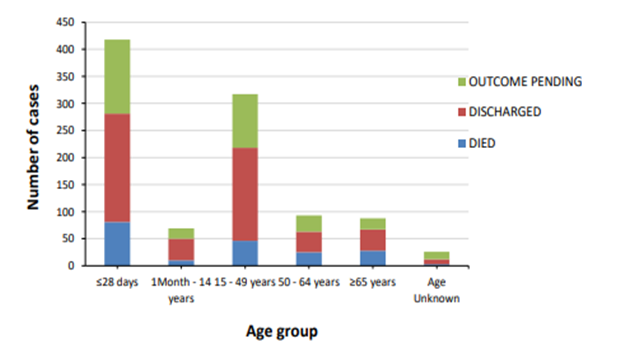
The figure above shows age distribution and outcome of laboratory-confirmed Listeriosis cases from 1 January to 9 April 2018. (n=1011)
Health24 spoke to Dr Juno Thomas, the Head of the Centre for Enteric Diseases at the NICD, about the severity of the situation. She asserted that while the death toll has risen, it is important to look at the cases as they continue to decline: from 90 cases to 40 cases a week.
She also explained that Listeria affects people with weaker immune systems, making babies and the elderly more vulnerable to the illness. According to Dr Thomas, pregnant women with Listeriosis pass the illness on to the baby through the placenta, “hence the severity in the baby”.
Regarding the second highest group, Dr Thomas attributes this to two factors. “Firstly, women in that group are of childbearing age, and secondly this age group has the highest statistics for HIV, making them a risk factor.”

The figure above shows the epidemic curve of laboratory-confirmed Listeriosis cases by epidemiological week and date of sample collection from 1 January 2017 to 9 April 2018. (n=1011)
According to the NICD, the reasons for new cases being reported are that the incubation period of Listeriosis can be up to 70 days, as well as the implicated food products having a long refrigeration shelf life. It is also possible that while there has been a recall, some products were not removed from both home and retail settings, making the possibility of cross-contamination a reality.

The figure above shows the epidemic curve of laboratory-confirmed Listeriosis cases by epidemiological date of sample collection and province from 1 January to 9 April 2018. (n=1011)
In the situational reports released by the NICD, it seems important for them to present the statistics through province distribution as well. According to Dr Thomas, this is because “we noticed that there was a distinct provincial distribution… It is important to monitor any changing trends, to see if we are missing anything. So we divided the statistics up by province to follow trends and keep track of patterns.”
Image credits: iStock, NICD
*All data supplied by the National Institute for Communicable Diseases.

NEXT ON HEALTH24X

On their first day of training, gymnasts learn the hollow-body hold. It’s a foundational position that involves bracing your abs and creating total-body tension, and it’s integral to many other movements in the sport. It’s also a seriously genius way for you to train your abs.
Yet most people have never even heard of this as a “gym” exercise. Maybe that’s because sit-ups, crunches and planks get all the press. Which is too bad, since not only will the hollow-body hold crush your core like few other exercises, it’ll pay off big in every other movement you do, too.
Read more: Take on superheros with this abs and arm routine
“The hollow-body hold allows you to properly transfer force from your upper body to your lower body without any energy leaks,” says Men’s Health fitness advisor BJ Gaddour, CSS.
“The stronger and more stable you are in this position, the more power you’ll have when squatting, throwing, pushing, pulling, jumping, hitting, kicking or sprinting.”
Read more: 3 ways to make any abs exercise more effective
In short, it gives you a huge edge. And you’ll better understand why after you experience how challenging it is. Give the hollow-body hold a try today.
It’s a simple exercise, but there are lots of small things you must do in order to nail it.
Watch the video below to see Gaddour demonstrate perfect form.
[embedded content]
Read more: Build a core that will rival a gymnast’s
This article was originally published on www.menshealth.com
Image credit: iStock

NEXT ON HEALTH24X

The information on Health24 is for educational purposes only, and is not intended as medical advice, diagnosis or treatment. If you are experiencing symptoms or need health advice, please consult a healthcare professional. See additional information.

Former Culture Secretary Baroness Tessa Jowell hopes better cancer treatments can be developed.
Researchers from the San Diego Natural History Museum (The Nat) and the non-profit organization Terra Peninsular A.C. have rediscovered the San Quintin kangaroo rat (Dipodomys gravipes) in Baja California; the Museum is partnering with the organization and local authorities on a conservation plan for the species.
The San Quintin kangaroo rat was last seen in 1986, and was listed as endangered by the Mexican government in 1994. It was held as an example of modern extinction due to agricultural conversion. In the past few decades, San Quintin, which lies 118 miles south of Ensenada, has become a major agricultural hub, converting huge areas of native habitat into fields and hot houses for tomatoes and strawberries.
Despite active searches and monitoring over the years, there had been no sign of the animal until this past summer, when Museum Mammalogist Scott Tremor and Research Associate Sula Vanderplank were in the field conducting routine monitoring of small mammal communities. Having read the field notes of the person who had seen it decades ago, they were aware of its former occurrence in the area, but were amazed to find four individuals by using traditional field techniques and live traps.
This animal is about 5 inches in length with a tufted tail. It is an herbivore that lives in arid lowlands and gets its name from its large, powerful hind feet that propel the animal in large bounds (like a kangaroo). It is larger than other kangaroo rats in the region, and is feistier than its relatives.
“Not only is this discovery a perfect example of the importance of good old-fashioned natural history field work, but we have the opportunity to develop a conservation plan based on our findings,” said Tremor. “The ability to take our research and turn it into tangible conservation efforts is thrilling. It is a commitment to preserving the uniqueness of the Baja California Peninsula.”
The discovery will be highlighted in an article by Tremor, Vanderplank, and Dr. Eric Mellink of the Center for Scientific Research and Higher Education of Ensenada, Baja California (CICESE) in the scientific journal Bulletin of the Southern California Academy of Sciences.
Since the initial discovery, the San Quinton kangaroo rat has been found to also persist inside the Valle Tranquilo Nature Reserve just south of San Quintín, which is owned and managed by the local non-profit organization Terra Peninsular A.C. This reserve is recognized as an area voluntarily destined for conservation by the National Commission of Natural Protected Areas (CONANP) and will protect the future of the species into perpetuity.
The Nat will work with Terra Peninsular and Dr. Exequiel Ezcurra, director of the University of California Institute for Mexico and the United States (UC MEXUS), on a conservation plan for the small mammal communities of the area, with an emphasis on the San Quintin kangaroo rat.
“Terra Peninsular has been monitoring the nature reserves looking for this species. You can’t imagine how happy we are to find out that after all these efforts and with the help of The Nat we can be part of this rediscovery and continue working on its protection,” said Jorge Andrade, adaptive manager coordinator at Terra Peninsular, who has also been involved in the project. “It’s very gratifying for us to think that the San Quintin kangaroo rat persists in the area to some extent, thanks to the efforts of the staff, board members, and associated researchers of our organization.”
This plan, which is made possible with critical support from The JiJi Foundation Fund at the International Community Foundation, will be developed cooperatively with a working group created by Terra Peninsular and composed of local authorities, academic institutions and staff members. It will be written in both English and Spanish, will include restoration strategies, habitat improvements, molecular analysis of population health, land protection strategies and outreach and educational materials, and will identify key concerns for the future of the species.
The Museum’s research department, the Biodiversity Research Center of the Californias, conducts field explorations and engages in collections-based research to document and conserve our region’s natural history and biodiversity. This is the third mammal that was thought to be extinct that museum staff have rediscovered in the Baja California Peninsula in the recent past: others include the high elevation California vole (Microtus californicus huperuthrus) and the round-tail ground squirrel (Xerospermophilus tereticaudus apricus).
“These rediscoveries speak to hope and resilience in a changing world,” said Vanderplank, who is also a science advisor at Terra Peninsular. “We are learning so much about this animal and its ecology, and we’re delighted to know that it is permanently protected in the Valle Tranquilo Nature Reserve.”

As Curiosity rover marches across Mars, the red planet’s watery past comes into clearer focus.
In early 2017 scientists announced the discovery of possible desiccation cracks in Gale Crater, which was filled by lakes 3.5 billion years ago. Now, a new study has confirmed that these features are indeed desiccation cracks, and reveals fresh details about Mars’ ancient climate.
“We are now confident that these are mudcracks,” explains lead author Nathaniel Stein, a geologist at the California Institute of Technology in Pasadena. Since desiccation mudcracks form only where wet sediment is exposed to air, their position closer to the center of the ancient lake bed rather than the edge also suggests that lake levels rose and fell dramatically over time.
“The mudcracks show that the lakes in Gale Crater had gone through the same type of cycles that we see on Earth,” says Stein. The study was published in Geology online ahead of print on 16 April 2018.
The researchers focused on a coffee table-sized slab of rock nicknamed “Old Soaker.” Old Soaker is crisscrossed with polygons identical in appearance to desiccation features on Earth. The team took a close physical and chemical look at those polygons using Curiosity’s Mastcam, Mars Hand Lens Imager, ChemCam Laser Induced Breakdown Spectrometer (LIBS), and Alpha-Particle X-Ray Spectrometer (APXS).
That close look proved that the polygons — confined to a single layer of rock and with sediment filling the cracks between them — formed from exposure to air, rather than other mechanisms such as thermal or hydraulic fracturing. And although scientists have known almost since the moment Curiosity landed in 2012 that Gale Crater once contained lakes, explains Stein, “the mudcracks are exciting because they add context to our understanding of this ancient lacustrine system.”
“We are capturing a moment in time,” he adds. “This research is just a chapter in a story that Curiosity has been building since the beginning of its mission.”
Story Source:
Materials provided by Geological Society of America. Note: Content may be edited for style and length.

