Male contraceptive compound stops sperm without affecting hormones: Study in monkeys

A new study published today in the journal PLOS ONE details how a compound called EP055 binds to sperm proteins to significantly slow the overall mobility of the sperm without affecting hormones, making EP055 a potential “male pill” without side effects.

“Simply put, the compound turns-off the sperm’s ability to swim, significantly limiting fertilization capabilities,” said lead investigator Michael O’Rand, PhD, retired professor of cell biology and physiology in the University of North Carolina at Chapel Hill School of Medicine, and president/CEO of Eppin Pharma, Inc. “This makes EP055 an ideal candidate for non-hormonal male contraception.”

Currently, condoms and surgical vasectomy are the only safe forms of birth control currently available for men. There are hormonal drugs in clinical trials that target the production of sperm, but these affect the natural hormones in men much like female contraceptives affect hormones in women.

During the study, thirty hours following a high-dose intravenous infusion of EP055 in male rhesus macaques, O’Rand and researchers in the Oregon National Primate Research Center at OHSU in Portland, Oregon, found no indication of normal sperm motility. Further, no physical side effects were observed.

“At 18 days post-infusion, all macaques showed signs of complete recovery, suggesting that the EP055 compound is indeed reversible,” said study co-investigator Mary Zelinski, PhD, research associate professor at the ONPRC at OHSU and associate professor of obstetrics and gynecology in the OHSU School of Medicine.

O’Rand and Zelinski indicate that more work is needed before EP055 becomes available for human use. They and their teams have begun to test a pill form of the compound and will eventually conduct a mating trial of EP055’s effectiveness against pregnancy.

Story Source:

Materials provided by University of North Carolina Health Care. Note: Content may be edited for style and length.

Share Button

Health24.com | Most SA claims are for this dread disease

Insured millennials today are facing several health challenges, notably cancer and cardiovascular conditions. This was revealed in Liberty’s Claim Statistics for 2017.

Most people filed insurance claims for cancer – both you and old. But Henk Meintjes, Head of Risk Product Development at Liberty, said that more young people than ever before are being diagnosed with illnesses like cancer and cardiovascular disease.

Starting young

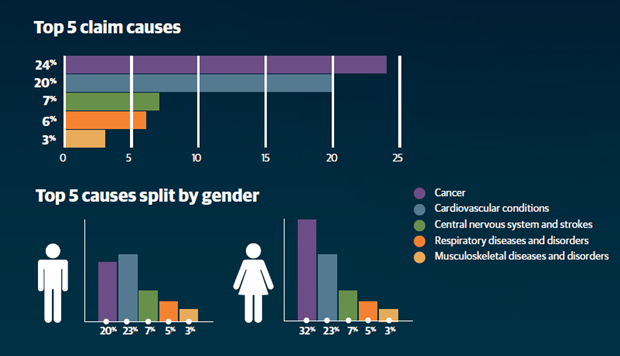
“Cancer is the top claim cause at 24.3% [of our number of claims], and cardiovascular conditions a close second at 20%. And while cancer affects people of all ages, it was 16% for young achievers – the millennials – and 21% for young parents.

“In the Western Cape, cancer claims were at 30%, and in Gauteng they were at 25%. In KwaZulu-Natal, cardiovascular conditions were more prominent at 26%, and cancer at 20%,” said Meintjes.

The other top reasons for claiming were central nervous system conditions and strokes at 7%, respiratory diseases and disorders at 6% and musculoskeletal diseases and disorders at 3%.

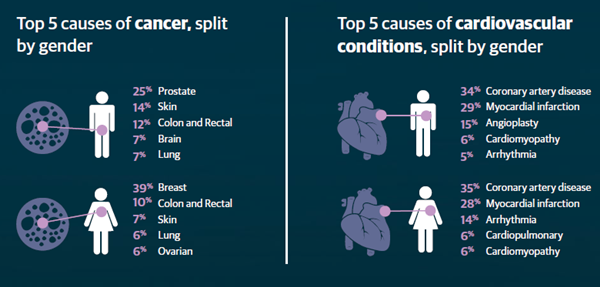
The top cancer types claimed for were breast cancer (in women), prostate cancer and colon cancer.


Early diagnoses

Meintjes added that numbers of cancer diagnoses have increased significantly. He said that in reality we all have cancer cells in our bodies, but that these diseases can be detected at an increasingly early stage.

“We are diagnosing cancer far earlier than in the past, which is great because you can get treated earlier, but from an insurance perspective, it means that we are seeing many ‘earlier’ claims.

“Some cancers, not necessarily picked up in the past, are now being diagnosed, so we see more claims taking place here as well.”

Adjustments to cut costs

“As an insurer, we realise that premiums will go up if we don’t change the way we pay out benefits. If cancer is diagnosed early enough, treatment is actually quite simple, and you don’t need the same lifestyle adjustments.

“For example, if someone needs to have a mastectomy or something similar, we need to look at adjustments to cut costs, so that premiums don’t run away to the point where clients can’t afford to be covered anymore,” said Meintjes.

In his presentation, Meintjes mentioned there were some claims which were not paid out. This was due to reasons such as non-disclosure of certain conditions, but mostly due to claims not matching the requirements specified in the policies.

Image credits: iStock, Liberty 

NEXT ON HEALTH24X

Share Button

Skin implant could help warn of cancer, scientists say

It works by detecting elevated levels of calcium in the blood linked to some cancers.

Share Button

Health24.com | Med stockout crisis cripples North West

The cash-strapped North West Health Department reports that the lives of chronically ill patients in the province are threatened. This is due to three weeks of ongoing workers’ strikes, which has heavily affected medical supplies.

Stockouts have been a crisis in South Africa for years and the government hasn’t been able to find a permanent solution. The North West Health Department, which was put under administration, has been hit by strikes after the department failed to pay suppliers, causing employees to strike, putting patients’ lives at risk.

Nationwide problem

A report in 2013 by Stop Stockouts outlined the crisis in South Africa. According to the report, one in five health facilities in South Africa is affected by stockouts, with over 400 facilities reporting a shortage of ARVs and/or TB medicines.

With over 300 health facilities across North West, it is expected that HIV and TB patients will be the hardest hit.

The collapsed delivery of chronic medication poses a danger to the management of treatment of chronically ill patients in the province and could result in loss of lives. It’s still unclear when the strike will end and which regions will be mostly affected. But all provincial health facilities are on high alert.

Stop Stockouts, an NGO that monitors medicines shortages, says it has been informed that antiretroviral drugs (ARVs), particularly second-line ARVs, which are critical, are running low in the province.

The organisation’s project manager Glenda Muzenda says they’ve also noticed a spike in the number of stockouts reported via their hotline since the industrial action.

“Patients have indicated an increasing problem across the province, and many are being turned away from clinics which have run out of medication or have been given smaller quantities. We have received over 50 reports of stockouts, which is really concerning because no patient should be sent away without medicines,” said Muzenda.

Compromising lives

In the meanwhile, Muzenda told Health-e News that the National Department of health has assured them that the situation will be rectified urgently.

“We are urging both the National and Provincial Departments of Health to act swiftly to resolve the strike, as it is now compromising the lives of people who depend on public health services in the North West,” says Muzenda. – Health-e News.

NEXT ON HEALTH24X

Share Button

Health24.com | Does alcohol cause acne?

Currently only limited research exists on the relationship between alcohol and acne. But several studies do report that alcohol may be associated with an increased prevalence of acne.

However, Dr Nerissa Moodley, a dermatology registrar at the University of KwaZulu-Natal, warns that these studies are not conclusive. 

There are several ways alcohol may exacerbate breakouts. Dr Moodley explains how:  

1. Changes in hormone levels

Alcohol consumption can increase testosterone and oestrogen levels. When hormone levels increase, your oil glands may produce more sebum which can clog pores and cause a breakout.

2. Bacteria growth

Studies show that Cutibacterium acnes (a bacterium that resides in the pilosebaceous follicles and contributes to the inflammatory response in acne vulgaris) metabolises alcohol and uses it as a fuel which may affect acne-prone skin. 

3. Inflammation

Alcohol consumption can lead to inflammation. Increased levels of cytokines (these send messages to immune cells to fight harmful substances that enter the body, such as bacteria) can predispose individuals to develop acne and play an important role in the early stages of acne formation.

How hormones affect acne

Your hormones are responsible for producing sebum through the sebaceous glands in the skin.

“The main hormone responsible for increasing sebum production is dihydrotestosterone (DHT), which is converted from testosterone in the sebaceous glands by the enzyme 5-alpha-reductase,” explains Dr Moodley. “DHT is a more potent androgen than testosterone.” 

When there is an increase in sebum production, sebum and keratinous matter collect in the follicles. This can cause a partial obstruction of the follicle, resulting in the formation of comedones, which are the primary lesions of acne.

Sebum also provides a growth medium for Cutibacterium acnes.

Diet and acne

Dr Moodley says the role of diet affecting acne is an evolving concept. “Recent studies suggest an association between dairy and acne. Dairy products contain carbohydrates and increase acne severity through diet-induced hyperinsulinaemia which stimulates increased levels of IGF-1 and thus androgens,” she says. Skim milk and whole milk have been implicated too.

“Dietary interventions using a low glycaemic load carbohydrates may have therapeutic effects in the treatment of acne because they have beneficial endocrine effects.”

She says there is no reliable evidence that eating chocolate is associated with an increase in prevalence or severity of acne.

But if you are worried that a food or alcohol is triggering your acne, Dr Moodley suggests eliminating it from your diet and monitoring the situation to see if there is a difference.

“Just remember that calcium present in milk is essential to bone growth and structure,” Dr Moodley warns.

Image credit: iStock

Share Button

Health24.com | Finally, affordable prostheses for breast cancer survivors

For women with breast cancer, having a mastectomy can be a traumatising experience. Breasts are a sexual part of a woman’s body, and having one or both lost to cancer is difficult to cope with on a number of levels.

Enter South African mechanical engineer Nneile Nkholise, who decided to use her know-how to create an affordable alternative to breast implants – using cutting-edge 3D printing tech.

She started thinking about the topic in 2013, while researching for her Masters. Now, she’s using the business she created, iMedTech Group, to help mastectomy patients.

Read more: 4 awkward boob questions you actually need answered asap

How it works

“It’s quite amazing that 3D printing has evolved over the years and now we’re having more normal desktop printers that are quite affordable to create the mould,” said Nkholise on CapeTalk’s Pippa Hudson show. The 3D printer creates a mould for the breast prostheses. 

“After creating the mould, we then cast silicone inside the mould to create the final prosthesis,” she said. They’ve got standard sizes, ranging from sizes one to three, and customised prostheses. The affected area is scanned and a mould is printed. It’s wonderfully straightforward.

Read more: 7 ways to keep your breasts happy and healthy

How much is it?

Most breast implants are hugely expensive, starting from R3 000. iMedTech’s start from just R900.

“The prices are from R900 to R1 800, depending on the size,” Nkholise told CapeTalk. Right now, her goal is to gift breast prostheses to 1 000 women who can’t afford it.

Listen to her full segment on CapeTalk below:

This article was originally published on www.womenshealthsa.co.za

Image credit: iStock

Share Button

Being a patient ‘a full-time job’

Rising numbers of people have multiple health conditions, leading to endless appointments and check-ups.

Share Button

Health24.com | Stop believing these 7 health myths

It’s often difficult to separate fact from fiction, especially when it comes to our health. Here are seven health myths you need to stop believing.

1. The myth: Green snot means you have a bacterial infection.

The truth: We produce about a litre of mucus a day so when you notice a sudden strange shade of green, it’s okay to panic for a second and assume you need antibiotics. However, the colour doesn’t necessarily mean you have a bacterial infection.

Dr Robert H. Shmerling, faculty editor at Harvard Health Publications, writes, “When the white blood cells in the mucosa encounter an irritant or infectious organism, they respond by producing enzymes to repel the invaders.”

He explains that these enzymes contain iron, which is what causes the green colour. “And if the mucus sits around (as when you’re sleeping), it becomes more concentrated and so may appear darker yellow or green. This is the natural order of things, whether the offending agent is a virus (the most common cause of sinus infection) or a bacterium.”

Girl blowing nose on tissue

2. The myth: You can get sick from a toilet seat.

The truth: Ladies, do you squat or sit on public loos? Well, it doesn’t really matter – toilet seats are pretty clean compared to door handles and bathroom floors when it comes to E. coli, norovirus and the flu virus.

Studies have shown that toilet seats may harbour dangerous strains of antibiotic-resistant staphylococcus, norovirus, E. coli  and could, in theory, also transmit Ebola. However, the microbes are excreted in faeces or vomit – and you’re more likely to choose another stall if you see any evidence of that.

Your skin also offers some protection against germs as long as you don’t have any cuts or scrapes. More good news is that you’re unlikely to pick up an STI from a toilet seat – most disease-carrying ogansims don’t survive for long outside the body.

The flu virus can live for up to 48 hours on certain surfaces, so make sure you practise good hand hygiene and cover your hand with a paper towel before opening doors.  

Public toilet

3. The myth: People who have Tourette’s syndrome all yell swear words.

The truth: Tourette’s syndrome is a chronic neurological disorder named after the doctor who first described it, and common tics include involuntary throat clearing, blinking, jerking of the head, grimacing or repeating words, making meaningless noises, snorting or laughing. These tics, often occurring in bouts and on an almost daily basis, are hard to suppress.

Only about 10% of Tourette’s sufferers shout out obscene or embarrassing comments. This is called coprolalia.

Woman with imaginary loud speaker

4. The myth: If you touch a toad, you’ll get warts.

The truth: You cannot pick up warts from frogs or toads – but touching someone who has warts is another matter.

Warts are caused by the human papillomavirus, which is unique to people. So while you can catch HPV from another person, you definitely won’t pick it up from a frog or toad.

Frog on hands

5. The myth: Sitting too close to the TV will ruin my eyesight.

The truth: Televisions have been around for many decades, and over the years technology has improved.

This claim did perhaps contain some truth before the 1950s when TVs emitted some radiation. Dr Norman Saffra, the chairman of ophthalmology at Maimonides Medical Center in Brooklyn, told the New York Times that repeated and extended exposure to this radiation could have increased the risk of eye problems. 

However, today’s TVs are built with proper shielding, so we no longer need to worry about the radiation. “It’s not an old wives’ tale; it’s an old technology tale,” Dr Saffra said. “Based on the world our grandmothers lived and grew up in, it was an appropriate recommendation.”

Someone watching tv with remote

6. The myth: You should poop at least once a day.

The truth: This one depends entirely on the person. Dr Danie Pauw previously told Health24 that it’s considered normal if you go one to three times per day, or only a few times a week. “But it should not be less than three times per week!”

He says not to worry too much about your frequency unless it changes after the age of 50.

“Certain foods can change one’s frequency, but each person is different. In general, caffeine stimulates the bowels. Those who are lactose intolerant will experience looser stools after ingestion,” says Dr Pauw. “It’s important to be aware of which foods affect your bowels. And if you ignore your body’s signals [to go], they will become weaker over time.”

Toilet paper

7. The myth: Your blood turns blue when it runs out of oxygen.

The truth: Blood gets its colour from the red blood cells that carry oxygen. However, even if it isn’t carrying oxygen it won’t turn blue – it will turn a darker shade of red instead.

If you still think it’s a bluish hue you’re seeing, remember that you’re viewing your veins through several layers of skin and tissue, which may distort the colour. 

Close up of blood on finger

Image credit: iStock

NEXT ON HEALTH24X

Share Button

Mental health patients want immediate diagnosis, says report

Research suggests patients would prefer to be told their diagnosis face-to-face.

Share Button

Thalassaemia gene therapy trial shows ‘encouraging’ results

The treatment meant some patients stopped needing blood transfusions altogether.

Share Button