Vicky Pattison talks about trying to get help for pre-menstrual dysphoric disorder.
Category Archives: Mind Building
You don’t need intense workouts to build muscle, new study reveals

If you believe getting stronger requires pushing yourself to the limit at the gym, new research suggests otherwise. Findings from Edith Cowan University (ECU) show that improving muscle size, strength, and performance does not depend on exhausting workouts or feeling sore afterward.
“The idea that exercise must be exhausting or painful is holding people back,” ECU’s Director of Exercise and Sports Science, Professor Ken Nosaka, said.
He points to a different approach that can be more effective and far easier to stick with. “Instead, we should be focusing on eccentric exercises which can deliver stronger results with far less effort than traditional exercise — and you don’t even need a gym!”
What Is Eccentric Exercise
Eccentric exercise focuses on the phase when muscles lengthen rather than shorten. This typically happens during the lowering portion of a movement, such as bringing a dumbbell down, walking downstairs, or slowly lowering yourself into a chair.
According to the study, muscles can produce greater force during these lengthening movements while using less energy than they would during lifting, pulling, or climbing actions.
More Strength With Less Effort
“You can gain strength without feeling as exhausted. So, you get more benefit for less effort. That makes eccentric exercise appealing for a wide range of people,” Professor Nosaka said.
Although these movements can sometimes lead to mild soreness, especially for beginners, discomfort is not required to see progress.
Simple Exercises You Can Do At Home
Eccentric exercises are easy to incorporate into daily routines and do not require special equipment. Examples include chair squats, heel drops, and wall push-ups. Research shows that just five minutes a day of these movements can lead to meaningful improvements in strength and overall health.
Ideal For Older Adults And Beginners
Because eccentric exercise puts less strain on the heart and lungs, it is especially well suited for older adults and people with chronic health conditions. The movements also feel familiar, which makes them easier to adopt and maintain over time.
“These movements mirror what we already do in daily life. That makes them practical, realistic and easier to stick with,” Professor Nosaka said.
“When exercise feels achievable, people keep doing it.”
This 275-million-year-old animal had a twisted jaw like nothing alive today

In a dry riverbed deep within a forest near the Amazon in Brazil, paleontologists uncovered a fossilized jawbone from a previously unknown ancient animal. As their excavation continued, the team found eight more similar jawbones, each about six inches long. However, they did not recover any additional bones that could clearly be matched to a full skeleton.
Even so, these isolated jaws revealed something remarkable. The fossils belonged to a species that lived around 275 million years ago and would have been considered a “living fossil” even in its own time. The jaws were also highly unusual, with a twisted shape. Some of the teeth pointed outward and sideways, while rows of smaller teeth lined the inner surfaces. This structure suggests the animal may have been among the earliest of its kind to grind plant material.
Naming a Strange New Species
In a study published in Proceedings of the Royal Society B, researchers formally described the species and named it Tanyka amnicola. The name Tanyka comes from the Indigenous Guaraní language and means “jaw,” while amnicola translates to “living by the river.”
“Tanyka is from an ancient lineage that we didn’t know survived to this time, and it’s also just a really strange animal. The jaw has this weird twist that drove us crazy trying to figure it out. We were scratching our heads over this for years, wondering if it was some kind of deformation,” says Jason Pardo, the study’s lead author, who worked on the project during his post-doctoral fellowship at the Field Museum in Chicago. “But at this point, we’ve got nine jaws from this animal, and they all have this twist, including the really, really well-preserved ones. So it’s not a deformation, it’s just the way the animal was made.”
An Ancient Branch of Tetrapods
Tanyka belongs to a broad group of vertebrates known as tetrapods, which includes all four-limbed animals with backbones such as reptiles, birds, mammals, and amphibians. The earliest tetrapods, called stem tetrapods, eventually split into two major branches. One group evolved to lay eggs on land, leading to reptiles, birds, and mammals. The other group continued laying eggs in water, giving rise to modern amphibians like frogs and salamanders.
Even after this split, some stem tetrapods continued to exist alongside their more recently evolved relatives. Tanyka was one of these holdovers from an older lineage.
A similar pattern can be seen in mammals. Early mammals laid eggs, while later groups evolved live birth. Most modern mammals reproduce by giving birth, but a few species, such as the platypus, still retain the older egg-laying trait.
“In the sense that Tanyka was a remaining member of the stem tetrapod lineage, even after newer, more modern tetrapods evolved, Tanyka is a little like a platypus. It was a a living fossil in its time,” says Pardo, who is now a research associate at the Field Museum while working on a postdoctoral fellowship through the University of Vilnius in Lithuania.
What Did Tanyka Look Like?
Much about Tanyka remains unknown, especially its full body shape. “We found these jaws in isolation, and they’re really weird, and they’re very distinctive. But until we find one of those jaws attached to a skull or other bones that are definitively associated with the jaw, we can’t say for sure that the other bones we find near it belong to Tanyka,” says Ken Angielczyk, a curator of paleomammalogy at the Field Museum in Chicago, who served as Pardo’s advisor during his post-doctoral fellowship there, and a co-author of the paper.
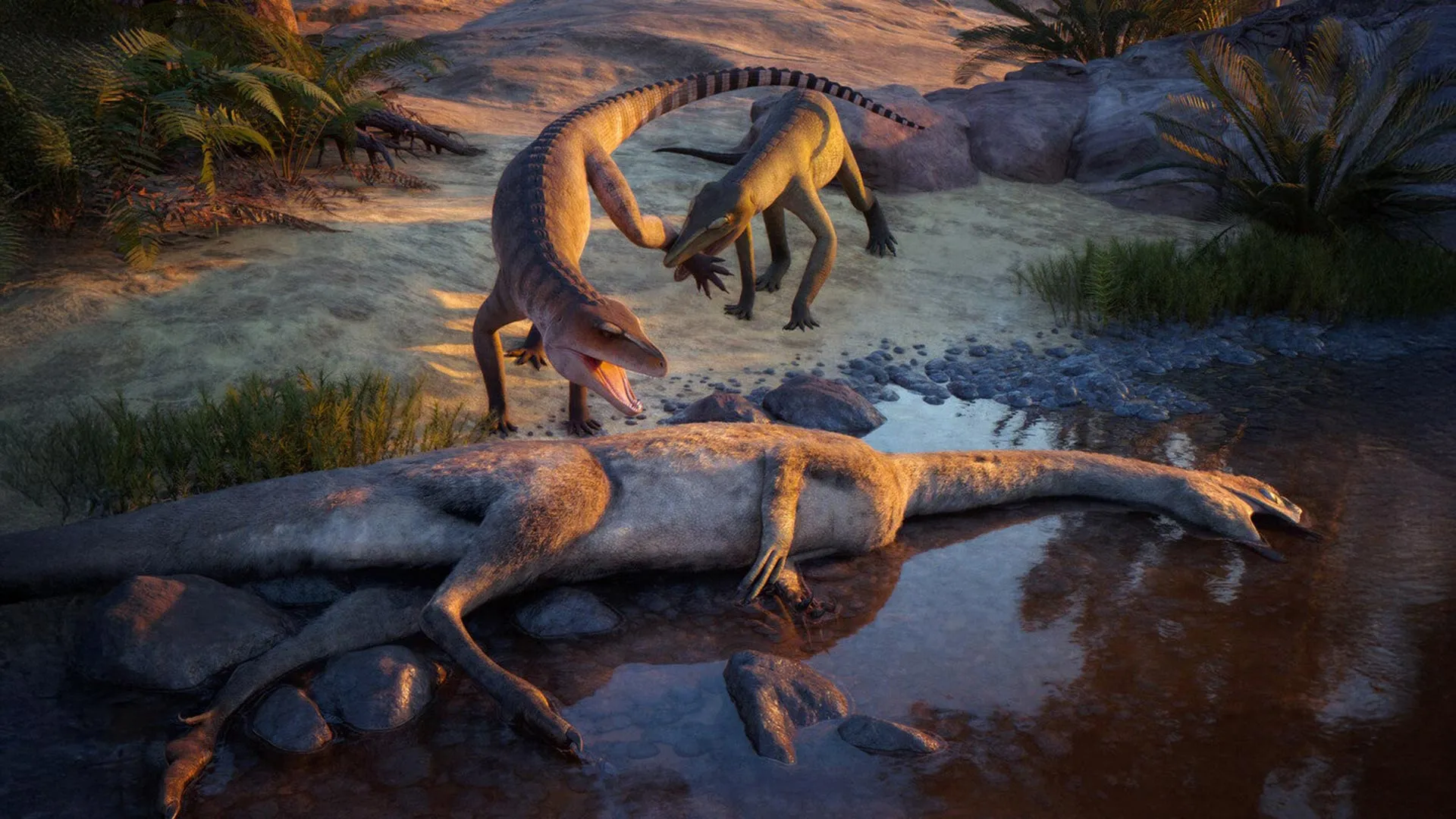
Based on comparisons with related species, researchers think Tanyka may have resembled a salamander with a slightly longer snout. Its size is uncertain, but estimates suggest it could have reached up to three feet in length. The surrounding rock indicates it likely lived in freshwater environments such as lakes.
A Jaw Built for Grinding Plants
Although the rest of its body is still a mystery, the jaw provides clear clues about how Tanyka fed.
If you run your tongue along your lower teeth, you can feel how they point upward toward the roof of your mouth. In Tanyka, this arrangement was completely different. Its lower jaw was twisted so that the teeth pointed outward to the sides instead of upward. At the same time, the inner surface of the jaw, which faces the tongue in humans, was oriented upward.
This inner surface was covered with small teeth called denticles, forming a rough grinding area similar to a cheese grater. Scientists believe the upper jaw likely had a similar structure.
“We expect the denticles on the lower jaw were rubbing up against similar teeth on the upper side of the mouth. The teeth would have been rasping against each other, in a way that’s going to create a relatively unique way of feeding,” says Pardo.
This type of tooth-to-tooth grinding is typically associated with animals that process plant material. “Based on its teeth, we think that Tanyka was a herbivore, and that it ate plants at least some of the time,” says Juan Carlos Cisneros, an author of the paper at the Federal University of Piauí (UFPI) in Brazil. Researchers note that this is surprising, since most stem tetrapods are thought to have been carnivorous.
Filling Gaps in Ancient Ecosystems
The discovery of Tanyka helps scientists better understand life during the early Permian Period. Around 275 million years ago, the region that is now Brazil was part of Gondwana, a vast supercontinent that included South America, Africa, Australia, and Antarctica. Fossils from this time and place are relatively rare compared to those from regions in the Global North.
“The Pedra de Fogo Formation in Brazil is one of the only windows we have into Gondwana’s animals during the early Permian Period of Earth history, and Tanyka is telling us about how this community actually worked, how it was structured, and who was eating what,” says Angielczyk.
The study was co-authored by Jason Pardo (Field Museum, University of Vilnius), Claudia Marsicano (Universidad de Buenos Aires, CONICET), Roger Smith (Iziko South African Museum, University of the Witwatersrand Johannesburg), Ken Angielczyk (Field Museum), Jörg Fröbisch (Museum fur Naturkunde — Leibniz-Institut fur Evolutions- und Biodiversitatsforschung), Christian Kammerer (North Carolina Museum of Natural Sciences), and Martha Richter (Natural History Museum, London).
This “Pink Floyd” spider hunts prey 6x its size and lives in walls

Researchers from several South American institutions have identified a new species of crevice weaver spider, expanding what scientists know about the Pikelinia genus. The species, named Pikelinia floydmuraria, pays tribute to the legendary band Pink Floyd while also reflecting where the spider lives. The name “muraria,” derived from the Latin word for “wall,” highlights its tendency to inhabit building walls and subtly references the band’s famous album The Wall. The findings were published in the open-access journal Zoosytematics and Evolution.
Although P. floydmuraria measures just 3 to 4 millimeters in length, it may play an important role in controlling pests in urban settings. These synanthropic (urban-dwelling) spiders were found to feed mainly on Hymenoptera (such as ants), Diptera (flies and mosquitoes), and Coleoptera (beetles), based on dietary studies of both the new species and a related Pikelinia population in Armenia, Colombia.
Scientists observed these spiders capturing ants up to six times larger than their own prosoma (body) size, demonstrating an impressive ability for such a small predator. They also consistently target common household pests, including mosquitoes (Culicidae) and houseflies (Muscidae). By placing their webs near artificial light sources, the spiders appear to take advantage of phototactic (light-attracted) insects, making their hunting more efficient and potentially helping maintain balance in urban environments.
Clues From a Related Galapagos Species
The study also shed light on a related species from the Galapagos Islands. Researchers provided the first detailed description and illustrations of the female internal genitalia of Pikelinia fasciata, a species first identified in 1902.
Strong similarities between the Galapagos spider and the newly discovered Colombian species, including nearly identical male palpal structures, point to a possible close evolutionary link. This is notable given the vast Pacific Ocean separating their habitats. Scientists are still unsure whether these shared traits come from a common ancestor or from similar environmental pressures shaping their evolution.
What Comes Next for This Newly Discovered Spider
The identification of P. floydmuraria represents only the second known species of the Pikelinia genus recorded in Colombia. Researchers emphasize the need for additional molecular and DNA-based studies to better understand its evolutionary background, trace its geographic origins, and measure its full impact as a natural controller of urban pests.
‘It’s the most normal thing in the world to feel weird’
Bryony Gordon talks about her struggles with her mental health.
The struggle to get hold of medication in England is set to get worse
People living with conditions include heart problems, stroke risks, eye infections and bipolar are unable to get hold of the drugs they rely on.
Martha’s Rule helplines get more than 1,700 calls from worried NHS staff
The scheme encourages staff and families to seek an urgent second opinion if they fear a patient’s condition is worsening.
Don’t toss cannabis leaves: Scientists found rare compounds with medical potential

Scientists at Stellenbosch University (SU) have uncovered the first evidence of a rare group of phenolic compounds known as flavoalkaloids in Cannabis leaves, adding a surprising new dimension to the plant’s chemistry.
Phenolic compounds, particularly flavonoids, are already highly valued in medicine for their antioxidant, anti-inflammatory, and anti-carcinogenic effects. This new finding suggests Cannabis may contain even more biologically important compounds than previously recognized.
Dozens of Previously Unknown Cannabis Compounds Identified
In their study, researchers analyzed three commercially grown Cannabis strains from South Africa and identified 79 phenolic compounds. Of these, 25 had never before been reported in Cannabis. Among them were 16 compounds tentatively classified as flavoalkaloids, a group that is rarely found in nature.
Interestingly, these flavoalkaloids were concentrated mainly in the leaves of just one of the strains, highlighting how much chemical variation can exist between different types of Cannabis. The findings were recently published in the Journal of Chromatography A.
Why These Compounds Are Hard To Detect
Dr. Magriet Muller, an analytical chemist in the LC-MS laboratory of the Central Analytical Facility (CAF) at Stellenbosch University and the study’s first author, explains that studying plant phenolics is especially difficult because they occur in very small amounts and have highly diverse structures.
“Most plants contain highly complex mixtures of phenolic compounds, and while flavonoids occur widely in the plant kingdom, the flavoalkaloids are very rare in nature,” she explains.
She also notes just how chemically complex Cannabis is. “We know that Cannabis is extremely complex — it contains more than 750 metabolites — but we did not expect such high variation in phenolic profiles between only three strains, nor to detect so many compounds for the first time in the species. Especially the first evidence of flavoalkaloids in Cannabis was very exciting.”
Advanced Techniques Reveal Hidden Chemistry
As part of her postgraduate work in SU’s Department of Chemistry and Polymer Science, Muller developed advanced analytical methods that combine comprehensive two-dimensional liquid chromatography with high-resolution mass spectrometry. These tools allow scientists to separate and identify compounds in extraordinary detail.
“We were looking for a new application for the methods that I developed, after successfully testing them on rooibos tea, grapes and wine. I then decided to apply the methods to Cannabis because I knew it was a complex sample, and that Cannabis phenolics have not been well characterized,” she explains.
Prof. André de Villiers, who led the study and heads the analytical chemistry research group at SU, said the results were striking. “The excellent performance of two-dimensional liquid chromatography allowed separation of the flavoalkaloids from the much more abundant flavonoids, which is why we were able to detect these rare compounds for the first time in Cannabis.”
Untapped Medical Potential in Overlooked Plant Material
According to Prof. de Villiers, the discovery underscores how much remains to be learned about Cannabis. So far, most research has focused on cannabinoids, the compounds responsible for the plant’s psychoactive effects.
“Our analysis again highlights the medicinal potential of Cannabis plant material, currently regarded as waste. Cannabis exhibits a rich and unique non-cannabinoid phenolic profile, which could be relevant from a biomedical research perspective,” he concludes.
The findings suggest that even parts of the plant often discarded, such as leaves, may hold valuable compounds with potential uses in medicine.
Surprising obesity discovery rewrites decades of fat metabolism science

Fat cells, known as adipocytes, are not just passive storage units for excess weight. They play an active role in managing how the body uses and stores energy. Inside these cells, fat is packed into structures called lipid droplets, which act as fuel reserves the body can draw on when needed, such as during fasting between meals.
To release this stored energy, the body relies on a protein called HSL. This protein works like a switch. When energy levels drop, hormones like adrenaline activate HSL, triggering the release of fat that can be used by organs throughout the body.
Why Losing HSL Does Not Lead to Weight Gain
At first glance, it might seem logical that without HSL, fat would build up since the body would struggle to access its stored energy. However, research in mice and in people with mutations in the HSL gene shows a surprising outcome. Instead of gaining fat, these individuals actually lose it.
This loss of fat leads to a condition called lipodystrophy, where the body has too little fat tissue. Rather than causing obesity, the absence of HSL disrupts normal fat storage and results in reduced fat mass.
Obesity and Lipodystrophy Share Hidden Risks
Although obesity and lipodystrophy appear to be opposite conditions, they share an important similarity. In both cases, fat cells do not function properly. This dysfunction can lead to similar health problems, including metabolic issues and increased risk of cardiovascular disease.
A Surprising Discovery Inside Fat Cells
To better understand this unexpected behavior, researchers led by Dominique Langin at the University of Toulouse within the I2MC examined where HSL operates inside fat cells. Traditionally, HSL has been known to sit on the surface of lipid droplets, where it helps break down fat.
The new study revealed something unexpected. HSL is also found inside the nucleus of adipocytes, the part of the cell that controls gene activity. “In the nucleus of adipocytes, HSL is able to associate with many other proteins and take part in a program that maintains an optimal amount of adipose tissue and keeps adipocytes ‘healthy’,” explains Jérémy Dufau, co-author of the study, who defended his doctoral thesis on this subject.
How HSL Moves Within the Cell
The researchers also discovered that the amount of HSL in the nucleus is carefully controlled. Adrenaline, which activates HSL to release fat, also signals the protein to leave the nucleus. This process occurs during fasting, when the body needs energy.
In contrast, studies in obese mice show higher levels of HSL remaining in the nucleus, suggesting that this balance may be disrupted in disease.
A New Role for a Well-Known Fat Enzyme
“HSL has been known since the 1960s as a fat-mobilizing enzyme. But we now know that it also plays an essential role in the nucleus of adipocytes, where it helps maintain healthy adipose tissue,” concludes Dominique Langin.
This newly identified function helps explain why people lacking HSL develop lipodystrophy. It also opens new avenues for understanding metabolic diseases, including obesity and its complications.
Why This Discovery Matters Now
The timing of this discovery is significant. In France, one in two adults is overweight or obese. Globally, about two and a half billion people are affected. Obesity raises the risk of serious conditions such as diabetes and heart disease and can reduce quality of life.
Advances like this highlight the need for continued research to improve prevention strategies and develop better treatments for metabolic disorders.
Mother and baby mental health unit to go ahead
Mike Nesbitt says Northern Ireland’s first regional mother and baby unit in should open within the next three years.