Ambulance service bosses have warned Worcestershire Royal that patients face “significant risk of harm”.


Ambulance service bosses have warned Worcestershire Royal that patients face “significant risk of harm”.
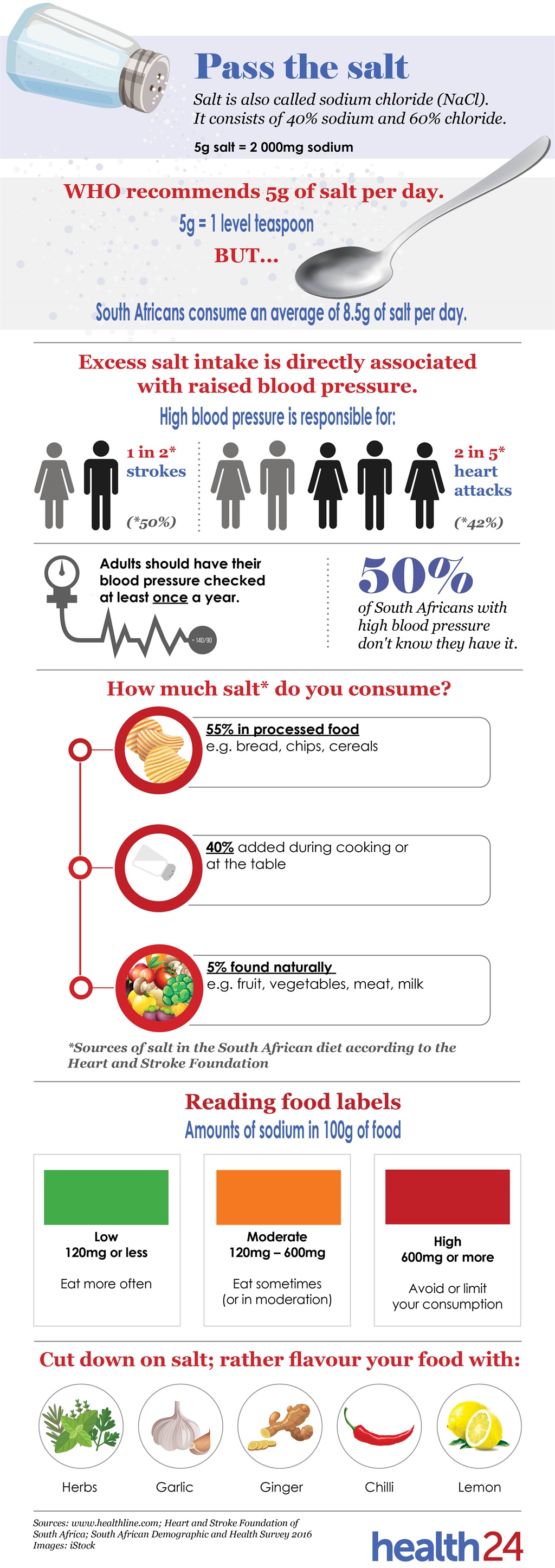
Salt is often used to add flavour to food but we actually only need a small amount to stay healthy. It helps conduct nerve impulses, contract and relax muscles, and helps maintain the correct balance of water and minerals.
However, when you consume too much salt, you put yourself at risk of high blood pressure, heart disease and stroke.
During World Salt Awareness Week (12 to 18 March), the Heart and Stroke Foundation of South Africa (HSFSA) is highlighting five simple changes you can make to reduce your salt consumption to 5g per day, and potentially preventing 1.65 million deaths worldwide from cardiovascular disease every year.
They suggest:
1. Cut down gradually.
2. Flavour your meals without salt.
3. Always check food labels to make sure you know how much salt is in a product.
4. Remove the salt shaker from the table to prevent younger family members from making it a habit to add salt to food.
5. Eat more fruit and vegetables.
Professor Pamela Naidoo, CEO of the HSFSA says, “Healthy eating habits should be reinforced at an early age, during the period that babies and young children are developing their sense of taste and food preferences. Adults who are influencing the eating habits of young children, therefore, have the responsibility to ensure low-salt meals are prepared or purchased.”

NEXT ON HEALTH24X


Surgery may not always be the answer for men with early-stage prostate cancer, a new study from Washington University in St Louis suggests.
For the study, which was recently published in The New England Journal of Medicine, researchers randomly assigned 731 men with localised prostate cancer to radical prostatectomy or observation from November 1994 to January 2002.
Read more: Eating these foods may help stop prostate cancer in its tracks?
That means half the guys underwent an operation to remove their prostate gland, while others closely monitored their symptoms under their doctor’s care, or opted for more frequent PSA testing.
Men in the observation group were only treated if their symptoms became more severe, like if they had bone pain or trouble urinating, both of which suggest the cancer might be becoming more aggressive.
During the nearly 20-year follow up, there was no significant difference in the number of deaths of men in the surgery group and those in the observation group. That means there was no significant survival benefit to going under the knife.
Read more: Get circumcised after 35 to reduce risk of prostate cancer
But the guys who did have the surgery had some other issues to contend with: Side effects from the operation.
The researchers found that 15% of the 364 men treated with surgery suffered from erectile dysfunction and 17% reported having urinary incontinence, or difficulty holding in their pee. An additional 45% developed other complications from surgery.
“About 70% of patients newly diagnosed with prostate cancer cases are in the early stages, meaning the cancer is confined to the prostate gland, and they have nonaggressive tumors,” explained study author Dr Gerald L Andriole, director of Washington University’s Division of Urologic Surgery in a press release.
“As such, these patients have an excellent prognosis without surgery. This study confirms that aggressive treatment usually is not necessary.”
Read more: How top doctors avoid cancer
That’s not to say surgery has no benefits. For healthy guys with intermediate- to high-risk prostate cancer, surgery can be lifesaving, the study authors say.
“It would be a disservice to dismiss surgery as a viable option for patients with intermediate-risk prostate cancer,” added Dr Andriole. “For these patients, and for some men with high-risk prostate cancer, surgery is often beneficial, as are other treatments, such as radiation.”
Read more: I survived testicular cancer, here’s why you should get your balls checked
Prostate cancer is the third leading cause of cancer death in American men, according to the American Cancer Society. If you experience any of the telltale symptoms of prostate cancer, like problems urinating, blood in your pee or semen, or trouble getting an erection, talk to your doctor immediately.
Even if you don’t experience any symptoms, make sure you read up on the eight steps you can take to prevent prostate cancer and everything you need to know about the PSA blood test to figure out if you should actually need one.
This article was originally published on www.menshealth.com
Image credit: iStock

The claim: Carrots can make you see better in the dark.
As a child, your mother probably told you to finish all the carrots on your plate. “It will make you see in the dark,” she may have said, while dishing you another spoonful.
But is there any truth to this, or is a just a cheap trick mothers use to get their children to eat carrots? Or do mothers themselves perhaps believe that carrots will give you excellent night vision? We examine the science behind this popular belief.
Better eyesight
Can carrots help improve your vision? It could. Under certain conditions, eating carrots will help improve eyesight, according to Scientific American.
The body uses beta-carotene (the pigment of carrots) to make vitamin A, and vitamin A is really important, says Emily Chew, deputy clinical director at the National Eye Institute in the USA.
Vitamin A helps the eye convert light into a signal that can be transmitted to the brain to allow people to see in difficult conditions. Without vitamin A, the cornea of the eye can literally disappear.
Yet, it’s important to distinguish between beta-carotene in carrots, and straight vitamin A. Research has shown that beta-carotene from carrots doesn’t convert into vitamin A very efficiently. You would probably be better off taking a vitamin A supplement than consuming bunches of carrots.
Night vision
And what about night vision? The exact amount of carrots you need to optimise your night vision is also unclear. According to research, it would be extremely difficult to eat enough carrots to significantly improve your night vision.
In fact, too much vitamin A could be toxic, and the body naturally regulates levels to prevent a dangerous buildup. High levels of vitamin A can cause symptoms such as dizziness, nausea and headaches and even lead to a coma and death. It can cause birth deformities in unborn babies when pregnant women take abnormally high amounts of vitamin A.
We now know that beta-carotene isn’t the same as straight vitamin A, and that too much beta-carotene can actually cause carotenemia, a harmless condition that turns skin yellow or orange.
An interesting study conducted in 1999 shows that poor night vision was associated with a higher intake of beta-carotene, but the researchers couldn’t determine whether the beta-carotene was the actual cause of poor night vision. The study, however, indicated that beta-carotene didn’t actually reverse poor night vision.
Although higher beta-carotene levels can’t help fix existing poor night vision, it is still true that a vitamin A deficiency can lead to night blindness, a condition where people have difficulty adjusting their vision to low levels of light.
An old myth
The origin of the myth that carrots allow you to see in the dark may be traced back to World War II when German planes were targeting Britain at night. In order to make it more difficult for these planes to identify their targets, the British government ordered blackouts and developed secret radar technology that worked well against the German fighters in the dark.
The Ministry of Information kept the new technology secret by giving all the credit to carrots, implying that their fighters had developed night vision as a result of eating carrots. This soon became a craze with the British public, with some people still believing this myth.
The verdict?
Consuming copious levels of vitamin A and beta-carotene will not reverse damaged eyesight. While there is some truth in the notion that vegetables, such as carrots, are rich in antioxidants and may protect you against cataracts in the future, there is no direct correlation between carrots and strong eyesight. According to Harvard Medical School, consuming carrots will not help prevent future vision problems, nor will it reverse existing problems.
Want to maintain your eye health? Go for an annual eye test to detect possible problems early on and to correct your vision with the help of spectacles and contact lenses.

Image credit: iStock


The plan aims to review the number of medicines taken by residents, which can be 10 or more.
Healthier fish stocks. Higher catches. Profits from fishing. Is there a way to achieve these holy grails of commercial fisheries without harming endangered species that are caught incidentally?
A new UC Santa Barbara-led study has found that may indeed be possible about half the time. According to the research group’s analysis, ending overfishing would also promote population recoveries for many endangered species ensnared accidentally as bycatch — the unwanted fish and other marine creatures caught during commercial fishing for a different species. The team’s findings appear in the journal Science.
“Many large animals, including marine mammals, turtles and birds, are threatened by bycatch,” said lead author Matt Burgess, a postdoctoral scholar in the Sustainable Fisheries Group at UCSB’s Bren School of Environmental Science & Management. “We tend to think that we can only save these species by either dramatically improving our gear or by constraining our fisheries. But this project demonstrated that wasn’t always the case. In about half the cases, overexploiting these mammals, turtles and birds occurs because we’re also overexploiting the target species.”
The study examined how much fishing pressure needs to be reduced to maximize profits in the 4,713 fisheries that produce most of the world’s catch — and to halt the population declines of 20 marine mammal, sea turtle and sea bird populations threatened as bycatch. The researchers also identified which fisheries might be causing the bycatch for each population.
To account for the many uncertainties in each of these aspects, the scientists simulated 1,000 possible scenarios. In each, they asked what fraction of the 20 threatened bycatch populations would begin to recover if all fisheries adopted efforts that would maximize their profits. For each bycatch population that would not recover under such efforts, the investigators then asked how much profit the fisheries would have to give up to enable recovery of the bycatch population. In 95 percent of the simulated scenarios, the analysis demonstrated that between seven and 13 of the bycatch populations could be saved from decline at a cost of less than 5 percent of the maximum profit.
“Maintaining productive fisheries and protecting threatened bycatch species are two of the primary goals of fisheries policy,” Burgess said. “We found that about half the time we can accomplish these goals together with the same management actions.”
For some populations like the eastern Pacific leatherback turtle, that bycatch is unsustainable but so, too, is the fishing pressure on many of the target species. “For many species, you actually get a ‘win-win,’ where building higher stocks of fish in the ocean leads to higher fishery profits and recovery of endangered species,” said co-author Christopher Costello, a Bren professor and co-principal investigator of the Sustainable Fisheries Group.
To save the other half of the bycatch populations, fisheries would either have to reduce fishing so much that they would give up a lot of their profits or substantially improve their fishing technologies to better avoid bycatch. “These bycatch populations either need total or near-total elimination of bycatch to survive, like the vaquita porpoise from the Gulf of California,” Burgess explained. “Or they are caught in fisheries that already exploit their target species relatively sustainably, as may be the case for the New Zealand sea lion.”
“Recognizing the benefits of rebuilding fisheries to endangered populations allows us to also focus attention on other key sources of endangered species mortality, like egg poaching, invasive species, pollution and habitat loss,” said co-author Rebecca Lewison of San Diego State University.
All of the data and computer code from the study is publicly available online. “We did this so that our analysis will be fully transparent and reproducible by others,” said co-lead author Grant McDermott of the University of Oregon. “This is gradually becoming the norm in science, which is great.”
Story Source:
Materials provided by University of California – Santa Barbara. Original written by Julie Cohen. Note: Content may be edited for style and length.

Malaria parasites multiply asexually in the human bloodstream, thereby causing chronic infection and all the complications associated with this devastating disease. During each round of multiplication, a small proportion of parasites develop into non-dividing gametocytes instead. Gametocytes are infectious to mosquitoes and are therefore the catalyst for transmitting malaria to other humans. Understanding how malaria parasites control the switch to gametocyte production is central to support the development of therapeutic interventions that could block malaria transmission.
How malaria parasites turn the switch
Whether a parasite continues to multiply or develops into a gametocyte is controlled by a molecular switch. A recent publication in Cell demonstrated that this switch responds to a lipid molecule present in human blood: lysophosphatidylcholine (LPC). Under high LPC concentrations, parasites multiply, consuming LPC to build new membranes. When LPC concentrations drop, as they do during acute infections, parasites convert into gametocytes to secure their transmission to the next human host.
Researchers at the Swiss Tropical and Public Health Institute (Swiss TPH) have now identified a parasite protein (GDV1) that plays a crucial role in activating the gametocyte conversion switch. “GDV1 basically ignites a process that reprograms gene expression in the parasite such that gametocyte development occurs,” said Till Voss, corresponding author of the study and Head of the Malaria Gene Regulation Unit at Swiss TPH.
The study in Science further shows that GDV1 is only produced in parasites destined to develop into gametocytes. In multiplying parasites, an inhibitory molecule prevents expression of GDV1. “We were amazed to observe that after targeted disruption of this inhibitory molecule using CRISPR-Cas9 technology, all parasites expressed the GDV1 protein,” said Michael Filarsky, first author of the study and scientist at Swiss TPH. Another important finding of this study is that GDV1 production is likewise inhibited by LPC. “This is exiting. We are onto the molecular pathway that transports an environmental stimulus into the parasite to activate gametocyte development,” concludes Voss.
“Fundamental knowledge and a new tool for future research”
Drugs and vaccines that target gametocytes are urgently needed to reach the declared aim of eliminating and eradicating malaria. “Although our study does not offer immediate solutions for novel therapies, it sheds new light on the mechanisms responsible for the production of gametocytes,” said Till Voss. “If we can block this mechanism or eliminate gametocytes altogether, we might get an important step closer to interrupting malaria transmission.”
The new knowledge also allows Swiss TPH scientists to produce high quantities of gametocytes in the laboratory. “Research on gametocytes is hampered by the fact that they usually only arise in very small numbers,” said Michael Filarsky. “We are now able to engineer genetically-modified parasites that deliver enormous quantities of gametocytes. We predict that these parasites will be useful not only for future basic research, but also for applied research in this area.”
Story Source:
Materials provided by Swiss Tropical and Public Health Institute. Note: Content may be edited for style and length.

Young, resting neural stem cells in the brains of mice store large clumps of proteins in specialized cellular trash compartments known as lysosomes, researchers at the Stanford University School of Medicine have found.
As the cells age, they become less proficient at disposing of these protein aggregates, and their ability to respond readily to “make new neurons” signals wanes. Restoring the ability of the lysosomes to function normally rejuvenates the cells’ ability to activate, the researchers found.
The discovery of the aggregates in young stem cells was unexpected, in part because similar aggregates are associated with the development of neurodegenerative diseases, such as Alzheimer’s. It also highlights the importance of maintaining precise control over the protein production and disposal process throughout the life and activation status of neural stem cells.
“We were surprised by this finding because resting, or quiescent, neural stem cells have been thought to be a really pristine cell type just waiting for activation,” said Anne Brunet, PhD, professor of genetics. “But now we’ve learned they have more protein aggregates than activated stem cells, and that these aggregates continue to accumulate as the cells age. If we remove these aggregates, we can improve the cells’ ability to activate and make new neurons. So if one were able to restore this protein-processing function, it could be very important to bringing older, more dormant neural stem cells ‘back to life.'”
A paper describing the research will be published March 15 in Science. Brunet, an associate director of Stanford’s Paul F. Glenn Center for the Biology of Aging, is the senior author. Postdoctoral scholar Dena Leeman, PhD, is the lead author.
Resting versus active neural stem cells
The researchers began their studies by looking to see what difference there might be, if any, between the gene expression profiles of resting neural stem cells and those that had been activated in response to an outside signal to launch the process to make new neurons. They also compared how the cells changed as they aged.
Leeman isolated several populations of cells for study from the brains of both young and old mice, including resting neural stem cells, activated neural stem cells and the neural cell progenitors that arise from activated stem cells. She found that resting stem cells expressed many lysosome-associated genes, while activated stem cells expressed genes associated with a protein complex involved in protein destruction called a proteasome. Strict control of production and disposal allows cells to maintain the necessary protein inventory to carry out needed cellular functions.
When Leeman stained young resting and activated neural stem cells with a dye that binds to protein aggregates, she was surprised to find the resting stem cells stained more brightly, despite the fact that resting cells have a lower rate of protein production. Leeman also found that the young resting neural stem cells accumulated these protein aggregates in their large lysosomes relatively slowly compared with their activated counterparts.
“We were really struck by the differences between resting and activated stem cells in the expression of genes involved in protein quality control,” said Brunet. “The fact that these young, pristine resting stem cells accumulate protein aggregates makes us wonder whether they actually serve an important function, perhaps by serving as a source of nutrients or energy upon degradation.”
Old resting stem cells, Leeman found, express fewer lysosome-associated genes and begin to accumulate even higher levels of protein aggregates.
“It’s almost as if these older cells lose the ability to store, or park, these aggregates,” said Brunet. “We found that artificially clearing them by either activating lysosomes in older cells or subjecting them to starvation conditions to limit their protein production actually restored the ability of these older resting stem cells to activate.”
The researchers plan to continue their studies to learn what types of proteins might be contributing to the aggregates, to better understand why activated neural stem cells appear to favor proteasomes over lysosomes and to determine how the regulation of protein aggregation becomes disrupted during aging.
‘Are they good or bad?’
“We’d like to know whether the aggregated proteins are the same in the young and old cells,” said Brunet. “What do they do? Are they good or bad? Are they storing factors important for activation? If so, can we help elderly resting stem cells activate more quickly by harnessing these factors? Their existence in young cells suggests they may be serving an important function.”
Story Source:
Materials provided by Stanford Medicine. Original written by Krista Conger. Note: Content may be edited for style and length.

GPs prescribed nearly 24 million potentially addictive painkillers, equivalent to 2,700 an hour.
The weird semi-aquatic creature’s milk could lead to the creation of a new type of antibiotic.
