The number of children being admitted to hospital with constipation is at a 10-year high.


The number of children being admitted to hospital with constipation is at a 10-year high.
What makes a healthy first meal of the day, and when to have it
An NHS trust meeting hears staff criticised bereaved families involved in a major maternity review.
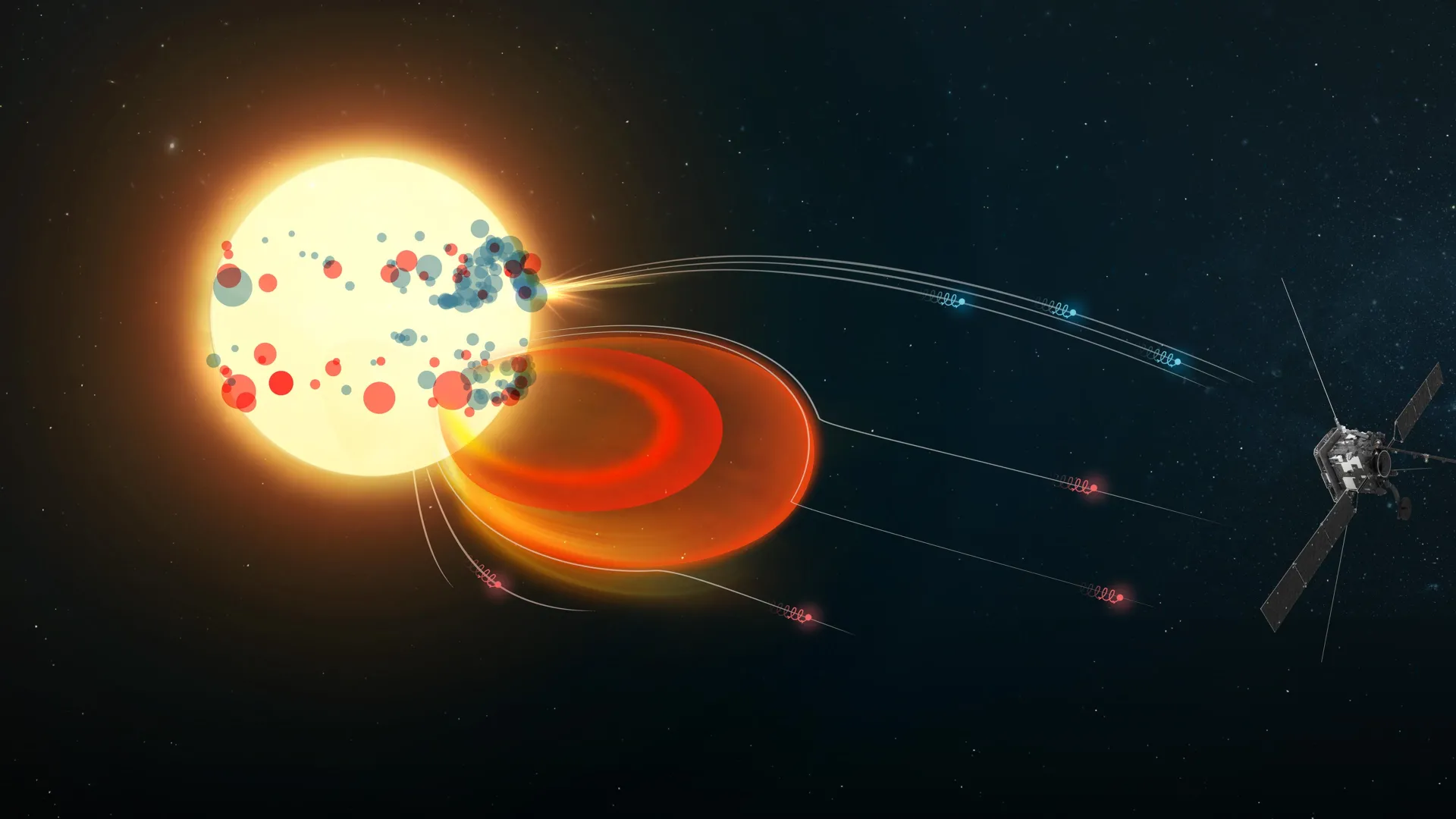
The European Space Agency-led Solar Orbiter mission has split the flood of energetic particles flung out into space from the Sun into two groups, tracing each back to a different kind of outburst from our star.
The Sun is the most energetic particle accelerator in the Solar System. It whips up electrons to nearly the speed of light and flings them out into space, flooding the Solar System with so-called ‘Solar Energetic Electrons’ (SEEs).
Researchers have now used Solar Orbiter to pinpoint the source of these energetic electrons and trace what we see out in space back to what’s actually happening on the Sun. In a paper to be published in Astronomy & Astrophysics on September 1, they explain that they found two kinds of SEE with clearly distinct stories: one connected to intense solar flares (explosions from smaller patches of the Sun’s surface), and one to larger eruptions of hot gas from the Sun’s atmosphere (known as ‘coronal mass ejections’, or CMEs).
“We see a clear split between ‘impulsive’ particle events, where these energetic electrons speed off the Sun’s surface in bursts via solar flares, and ‘gradual’ ones associated with more extended CMEs, which release a broader swell of particles over longer periods of time,” says lead author Alexander Warmuth of the Leibniz Institute for Astrophysics Potsdam (AIP), Germany.
A clearer connection
While scientists were aware that two types of SEE event existed, Solar Orbiter was able to measure a large number of events, and look far closer to the Sun than other missions had, to reveal how they form and leave the surface of our star.
“We were only able to identify and understand these two groups by observing hundreds of events at different distances from the Sun with multiple instruments – something that only Solar Orbiter can do,” adds Alexander. “By going so close to our star, we could measure the particles in a ‘pristine’ early state and thus accurately determine the time and place they started at the Sun.”
Flight delays
The researchers detected the SEE events at different distances from the Sun. This let them study how the electrons behave as they travel through the Solar System, answering a lingering question about these energetic particles.
When we spot a flare or a CME, there’s often an apparent lag between what we see taking place at the Sun, and the release of energetic electrons into space. In extreme cases, the particles seem to take hours to escape. Why?
“It turns out that this is at least partly related to how the electrons travel through space – it could be a lag in release, but also a lag in detection,” says co-author and ESA Research Fellow Laura Rodríguez-García. “The electrons encounter turbulence, get scattered in different directions, and so on, so we don’t spot them immediately. These effects build up as you move further from the Sun.”
The space between the Sun and the planets of the Solar System isn’t empty. A wind of charged particles streams out from the Sun constantly, dragging the Sun’s magnetic field with it. It fills space and influences how the energetic electrons travel; rather than being able to go where they like, they are confined, scattered, and disturbed by this wind and its magnetism.
The study fulfils an important goal of Solar Orbiter: to continuously monitor our star and its surroundings to trace ejected particles back to their sources at the Sun.
“Thanks to Solar Orbiter, we’re getting to know our star better than ever,” says Daniel Müller, ESA Project Scientist for Solar Orbiter. “During its first five years in space, Solar Orbiter has observed a wealth of Solar Energetic Electron events. As a result, we’ve been able to perform detailed analyses and assemble a unique database for the worldwide community to explore.”
Keeping Earth safe
Crucially, the finding is important for our understanding of space weather, where accurate forecasting is essential to keep our spacecraft operational and safe. One of the two kinds of SEE events is more important for space weather: that connected to CMEs, which tend to hold more high-energy particles and so threaten far more damage. Because of this, being able to distinguish between the two types of energetic electrons is hugely relevant for our forecasting.
“Knowledge such as this from Solar Orbiter will help protect other spacecraft in the future, by letting us better understand the energetic particles from the Sun that threaten our astronauts and satellites,” adds Daniel. “The research is a really great example of the power of collaboration – it was only possible due to the combined expertise and teamwork of European scientists, instrument teams from across ESA Member States, and colleagues from the US.”
Looking ahead, ESA’s Vigil mission will pioneer a revolutionary approach, operationally observing the ‘side’ of the Sun for the first time, unlocking continuous insights into solar activity. To be launched in 2031, Vigil will detect potentially hazardous solar events before they come into view as seen from Earth, giving us advance knowledge of their speed, direction and chance of impact.
Our understanding of how our planet responds to solar storms will also be investigated further with the launch of ESA’s Smile mission next year. Smile will study how Earth endures the relentless ‘wind’, and sporadic bursts, of fierce particles thrown our way from the Sun, exploring how the particles interact with our planet’s protective magnetic field.
Solar Orbiter is a space mission of international collaboration between ESA and NASA, operated by ESA.
The Earth supports the only known life in the universe, all of it depending heavily on the presence of liquid water to facilitate chemical reactions. While single-celled life has existed almost as long as the Earth itself, it took roughly three billion years for multicellular life to form. Human life has existed for less than one 10 thousandth of the age of the Earth.
All of this suggests that life might be common on planets that support liquid water, but it might be uncommon to find life that studies the universe and seeks to travel through space, like we do. To find extraterrestrial life, it might be necessary for us to travel to it.
However, the vastness of space, coupled with the impossibility of traveling or communicating faster than the speed of light, places practical limits on how far we can roam. Only the closest stars to the sun could possibly be visited in a human lifetime, even by a space probe. In addition, only stars similar in size and temperature to the sun are long-lived enough, and have stable enough atmospheres, for multicellular life to have time to form. For this reason, the most valuable stars to study are the 60 or so sun-like stars that are closer to us than approximately 30 light-years. The most promising planets orbiting these stars would have sizes and temperatures similar to the Earth, so solid ground and liquid water can exist.
A needle in the haystack
Observing an Earth-like exoplanet separately from the star it is orbiting around is a major challenge. Even in the best possible scenario, the star is a million times brighter than the planet; if the two objects are blurred together, there is no hope of detecting the planet. Optics theory says that the best resolution one can get in telescope images depends on the size of the telescope and the wavelength of the observed light. Planets with liquid water give off the most light at wavelengths around 10 microns (the width of a thin human hair and 20 times the typical wavelength of visible light). At this wavelength, a telescope needs to collect light over a distance of at least 20 meters to have enough resolution to separate the Earth from the sun at a distance of 30 light-years. Additionally, the telescope must be in space, because looking through the Earth’s atmosphere would blur the image too much. However, our largest space telescope – the James Webb Space Telescope (JWST) – is only 6.5 meters in diameter, and that telescope was extremely difficult to launch.
Because deploying a 20-meter space telescope seems out-of-reach with current technology, scientists have explored several alternative approaches. One involves launching multiple, smaller telescopes that maintain extremely accurate distances between them, so that the whole set acts as one telescope with a large diameter. But, maintaining the required spacecraft position accuracy (which must be precisely calibrated to the size of a typical molecule) is also currently infeasible.
Other proposals use shorter wavelength light, so that a smaller telescope can be used. However, in visible light a sun-like star is more than 10 billion times brighter than the Earth. It is beyond our current capability to block out enough starlight to be able to see the planet in this case, even if in principle the image has high enough resolution.
One idea for blocking the starlight involves flying a spacecraft called a ‘starshade’ that is tens of meters across, at a distance of tens of thousands of miles in front of the space telescope, so that it exactly blocks the light from the star while the light from a companion planet is not blocked. However, this plan requires that two spacecraft be launched (a telescope and a starshade). Furthermore, pointing the telescope at different stars would entail moving the starshade thousands of miles, using up prohibitively large quantities of fuel.
A rectangular perspective
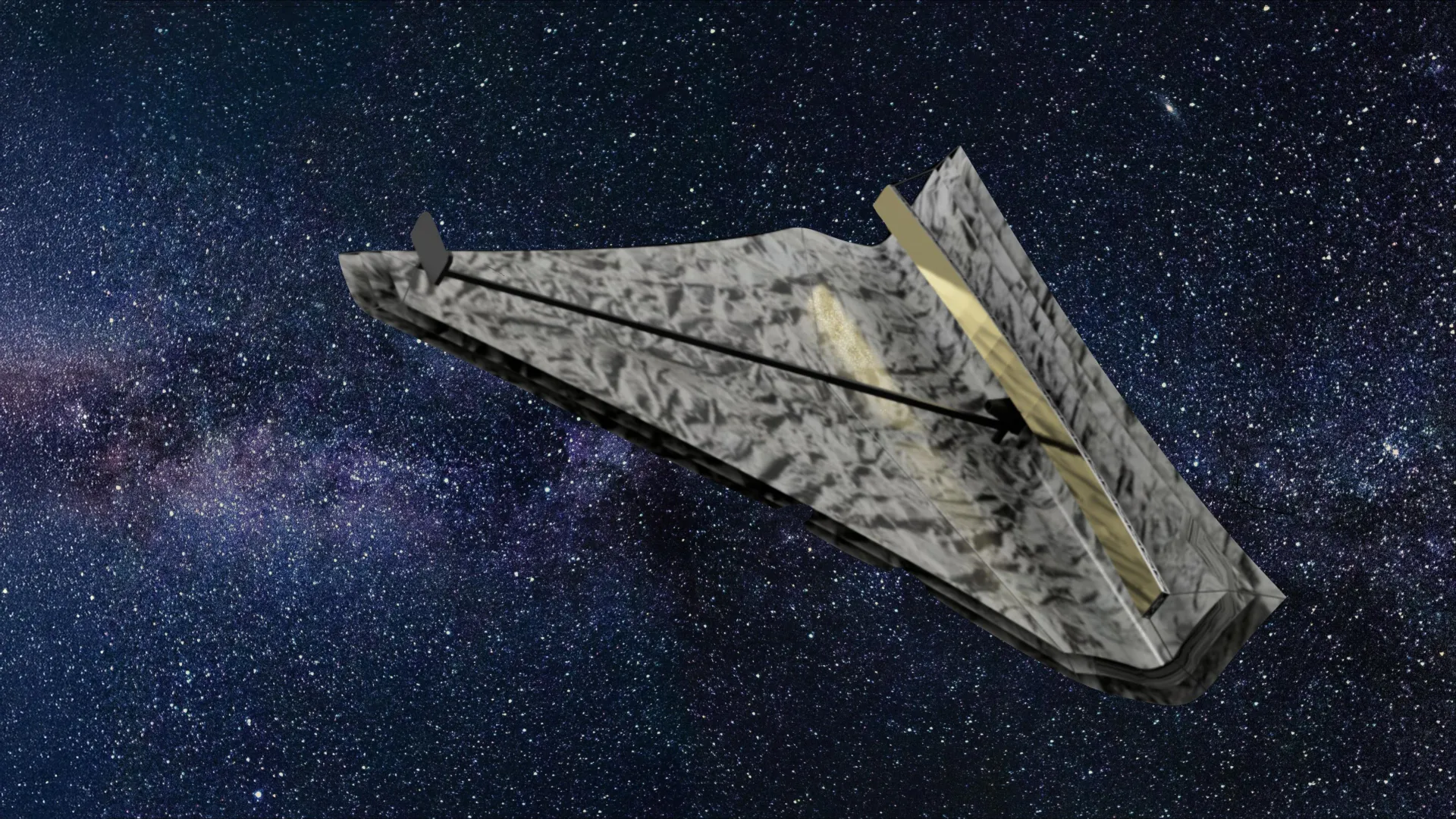
In our paper, we propose a more feasible alternative. We show that it is possible to find nearby, Earth-like planets orbiting sun-like stars with a telescope that is about the same size as JWST, operating at roughly the same infrared (10 micron) wavelength as JWST, with a mirror that is a one by 20 meter rectangle instead of a circle 6.5 meters in diameter.
With a mirror of this shape and size, we can separate a star from an exoplanet in the direction that the telescope mirror is 20 meters long. To find exoplanets at any position around a star, the mirror can be rotated so its long axis will sometimes align with the star and planet. We show that this design can in principle find half of all existing Earth-like planets orbiting sun-like stars within 30 light-years in less than three years. While our design will need further engineering and optimization before its capabilities are assured, there are no obvious requirements that need intense technological development, as is the case for other leading ideas.
If there is about one Earth-like planet orbiting the average sun-like star, then we would find around 30 promising planets. Follow-up study of these planets could identify those with atmospheres that suggest the presence of life, for example oxygen that was formed through photosynthesis. For the most promising candidate, we could dispatch a probe that would eventually beam back images of the planet’s surface. The rectangular telescope could provide a straightforward path towards identifying our sister planet: Earth 2.0.

The widely used diabetes drug metformin changes blood metal levels in humans. The Kobe University study is an important step in understanding the drug’s many actions and designing better ones in the future.
Metformin is the most widely prescribed diabetes drug in the world. Apart from lowering blood sugar levels, it is also known to have a broad range of beneficial side effects such as against tumors, inflammations and atherosclerosis. However, although it has been used for more than 60 years now, its mechanism of action is still not clear, hampering the development of even better drugs against these conditions.
Kobe University endocrinologist Wataru Ogawa says: “It is known that diabetes patients experience changes in the blood levels of metals such as copper, iron and zinc. In addition, chemical studies found that metformin has the ability to bind certain metals, such as copper, and recent studies showed that it is this binding ability that might be responsible for some of the drug’s beneficial effects. So, we wanted to know whether metformin actually affects blood metal levels in humans, which had not been clarified.” To do so, Ogawa and his team enlisted about 200 diabetes patients at Kobe University Hospital, half of which took metformin and half of which did not, in a study to analyze their blood serum levels for those metals and various metal deficiency indicators.
In the journal BMJ Open Diabetes Research & Care, the Kobe University team now published the first clinical evidence of altered blood metal levels in patients taking metformin. They showed that drug-taking patients have significantly lower copper and iron levels and heightened zinc levels. Ogawa says: “It is significant that we could show this in humans. Furthermore, since decreases in copper and iron concentrations and an increase in zinc concentration are all considered to be associated with improved glucose tolerance and prevention of complications, these changes may indeed be related to metformin’s action.”
Recently, Japan has approved the use of imeglimin, a new diabetes drug that is a derivative of metformin but that should not be able to bind metals the same way as its parent. “Imeglimin is thought to have a different method of action, and we are already conducting studies to compare the effects the two drugs have,” says Ogawa.
It is not just about understanding the current drugs, however. Ogawa explains the bigger picture, saying: “We need both clinical trials and animal experiments to pinpoint the causal relationship between the drug’s action and its effects. If such studies progress further, they may lead to the development of new drugs for diabetes and its complications by properly adjusting the metal concentrations in the body.”
This research was funded by the Japan Society for the Promotion of Science (grant 24H00638) and the Manpei Suzuki Diabetes Foundation. It was conducted in collaboration with a researcher from the Kagayaki Diabetes and Endocrinology Clinic Sannomiya.
The EU has new rules regarding gel nail polish and its ingredients
Health and Social Care Secretary Wes Streeting said he was acting on concerns for children’s health.

One of the first parts of the brain affected by Alzheimer’s disease is the entorhinal cortex — a region that plays a big role in memory, spatial navigation, and the brain’s internal mapping system.
With support from the Commonwealth of Virginia’s Alzheimer’s and Related Diseases Research Award Fund (ARDRAF), Fralin Biomedical Research Institute at VTC scientists Sharon Swanger and Shannon Farris are working to understand why this area is especially vulnerable.
Swanger studies how brain cells communicate across synapses in disease-susceptible brain circuits, while Farris focuses on how different circuits in the brain’s memory center function at the molecular level. Their overlapping expertise made the collaboration a natural fit.
“We’ve both been studying how circuits differ at the molecular level for a while,” said Swanger, an assistant professor at the research institute. “This new collaborative project brings together my work on synapses and Shannon’s on mitochondria in a way that addresses a big gap in the Alzheimer’s disease field.”
“This kind of state-level support is critical,” Farris said. “It gives researchers in Virginia the chance to ask questions that may eventually make a difference for people living with Alzheimer’s. It’s meaningful to be part of research that could help people facing that journey.”
A key focus of their research is mitochondria — tiny structures inside brain cells that provide the energy needed for a variety of cellular functions in neurons including synaptic transmission. In Alzheimer’s disease, mitochondria stop working properly in the course of the disease.
Farris and Swanger are investigating whether mitochondria in a vulnerable memory-related circuit may become overloaded with calcium, a key signaling chemical for multiple neuronal and synaptic processes. That overload could contribute to the early breakdown of memory circuits.
“The connection between these cells is one of the first to fail in Alzheimer’s,” Farris said. “We found that this synapse has unusually strong calcium signals in nearby mitochondria — so strong we can see them clearly under a light microscope. Those kinds of signals are hard to ignore. It gives us a model where we can really watch what’s happening as things start to go wrong.”
To test their hypothesis, the researchers will study brain tissue from healthy mice and mice with certain aspects of Alzheimer’s pathology. By comparing how mitochondria function and how brain cells communicate across synapses in each group, they hope to find early signs of stress or failure in the entorhinal cortex-hippocampus circuit.
Swanger and Farris are members of the Fralin Biomedical Research Institute’s Center for Neurobiology Research and also faculty in the Department of Biomedical Sciences and Pathobiology of the Virginia-Maryland College of Veterinary Medicine.
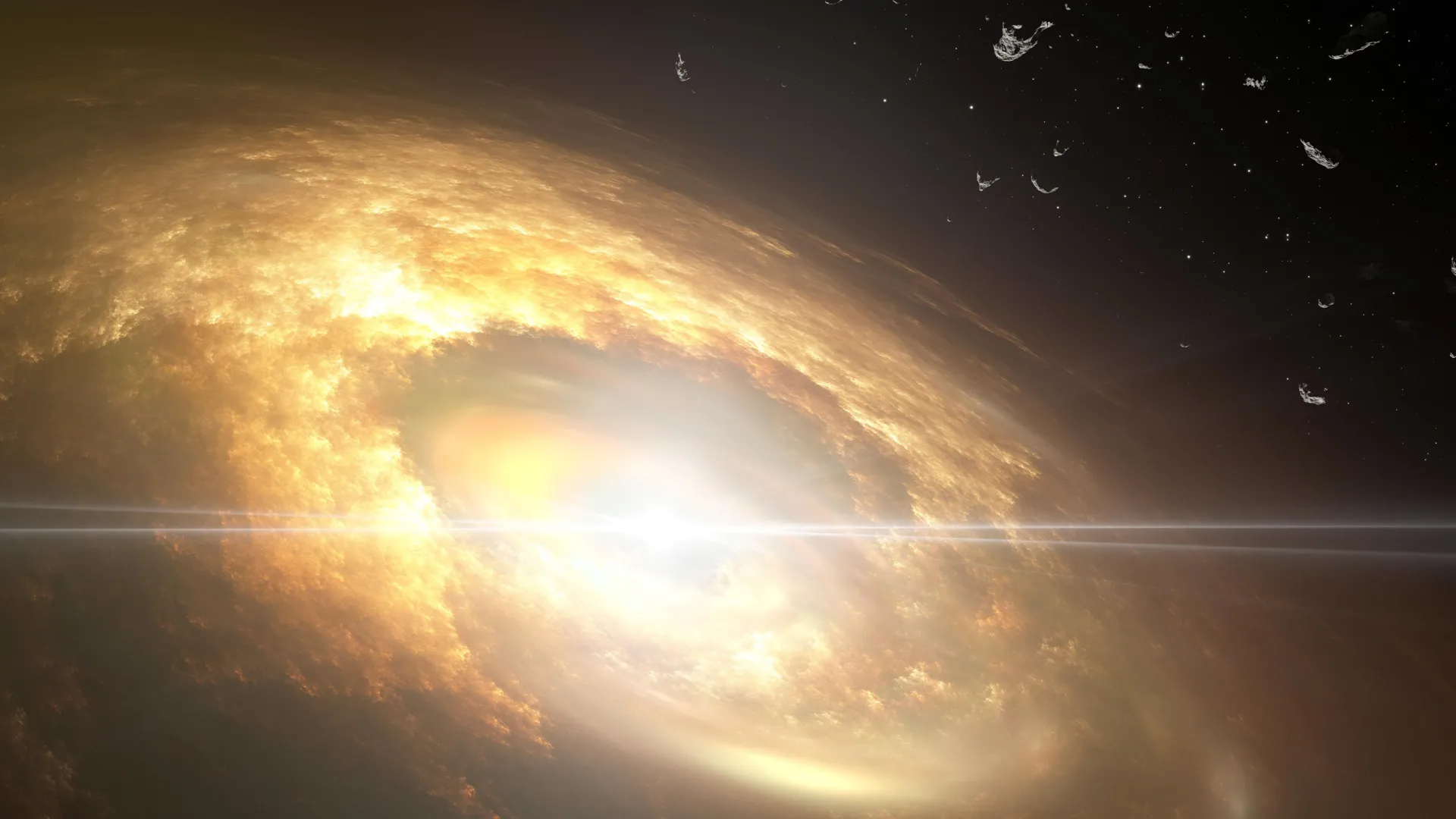
The textbook picture of how planets form – serene, flat discs of cosmic dust – has just received a significant cosmic twist. New research, published in the Astrophysical Journal Letters, is set to reshape this long-held view. An international team of scientists, wielding the formidable power of the Atacama Large Millimeter/submillimeter Array (ALMA), has found compelling evidence that many protoplanetary discs, the very birthplaces of planets, are in fact subtly warped.
These slight bends and twists in the disc plane, often just a few degrees, bear a striking resemblance to the subtle tilts observed among the planets in our own Solar System. This discovery suggests the initial conditions for planetary systems might be far less orderly than previously thought, with profound implications for how planets grow and settle into their final orbits.
Dr Andrew Winter, the lead author of the study from Queen Mary University of London where he is Royal Society University Research Fellow in astronomy, said: “Our results suggest that protoplanetary discs are slightly warped. This would be quite a change in how we understand these objects and has many consequences for how planets form. Particularly interesting is that the couple of degree warping is similar to the differences in inclination between our own Solar System planets.”
Dr Myriam Benisty, director of the Planet and Star Formation Department at the Max Planck Institute for Astronomy said,”exoALMA has revealed large scale structures in the planet forming discs that were completely unexpected. The warp-like structures challenge the idea of orderly planet formation and pose a fascinating challenge for the future.
To uncover these subtle twists, the team meticulously analysed Doppler shifts – tiny changes in the radio waves emitted by carbon monoxide (CO) molecules swirling within the discs. These shifts act like a cosmic speedometer, revealing the gas’s exact motion. As part of a major ALMA program called exoALMA, researchers used this flagship observatory to map the gas’s velocity across each disc in unprecedented detail. By carefully modelling these intricate patterns, they were able to detect when different regions of a disc were slightly tilted, thus revealing the warps.
“These modest misalignments may be a common outcome of star and planet formation,” Dr Winter added, noting the intriguing parallel with our own Solar System. The research not only provides a fresh perspective on the mechanics of planet formation but also raises new questions about why these discs are warped – a mystery the team is eager to unravel.
Is it the gravitational pull of unseen companion stars, or perhaps the chaotic dance of gas and dust that twists these stellar cradles? The findings show that these subtle disc warps, often tilting by as little as half a degree to two degrees, can naturally explain many of the prominent large-scale patterns observed in the gas’s motion across the discs. They even suggest these warps could be responsible for creating intriguing spiral patterns and slight temperature variations within these cosmic nurseries.
If these warps are a key driver of how gas moves within the disc, it profoundly changes our understanding of critical processes like turbulence and how material is exchanged – ultimately dictating how planets form and settle into their final orbits. Intriguingly, the nature of these warps appears to be connected to how much material the young star is actively drawing in towards its center. This hints at a dynamic link between the disc’s innermost regions, where the star is fed, and its outer, planet-forming areas.
This discovery offers a thrilling glimpse into the complex and often surprising realities of planet formation, fundamentally changing our cosmic blueprint and opening new avenues for understanding the diverse worlds beyond our Sun.
This research was conducted by the ‘exoALMA’ collaboration that is an international collaboration of institutions including the Max-Planck Institute for Astronomy (MPIA), University of Florida, Leiden Observatory (Leiden University), European Southern Observatory, Università degli Studi di Milano, Massachusetts Institute of Technology, Center for Astrophysics | Harvard & Smithsonian, Univ. Grenoble Alpes, Universidad de Chile, University of St. Andrews, Université Côte d’Azur, The University of Georgia, Monash University, University of Leeds, National Astronomical Observatory of Japan, University of Cambridge, Ibaraki University, Academia Sinica Institute of Astronomy & Astrophysics, The Graduate University for Advanced Studies (SOKENDAI), Wesleyan University, and The Pennsylvania State University.
