French researchers studied effects of highly-processed foods, such as cakes, bread and chicken nuggets.


French researchers studied effects of highly-processed foods, such as cakes, bread and chicken nuggets.
[unable to retrieve full-text content]

[unable to retrieve full-text content]

[unable to retrieve full-text content]

The Girls star reveals the pain of endometriosis led her to have surgery to remove her womb.
When you look at top model Brad Kroenig’s body, “lean” and “ripped” are probably the first words that come to mind.
For most guys looking to get that kind of physique, there are usually two questions that follow: What does he eat? And how often does he work out?
Read more: The ultimate six-pack diet
Kroenig – who has worked with Chanel, Versace, Tommy Hilfiger and more during his two-decade streak in modelling – hit his peak weight at 82kg.
After he noticed a dip in his energy levels, he decided to take his diet into a different direction, the New York Post reports.
“In June 2016, he embarked upon a diet that was radical, at least for members of the fashion tribe. No, his weight-loss plan didn’t involve periodic fasting or extreme juicing. Rather, Kroenig started eating carbs – cups and cups of them each day,” the New York Post notes.
Read more: 10 easy ways to lose weight without starving
“I’m almost 40 and in the best physical and mental shape of my life,” he says.
The thing is, eating carbs shouldn’t be radical for anyone. Kroenig downs about six cups of rice a day, but when you look at the grand scheme of his 10 042 kilojoule diet, it’s not exactly as unhealthy as it sounds.
That’s because “carbohydrates are the only nutrients that exist solely to fuel the body,” Donald Layman, PhD, a professor of human nutrition at the University of Illinois told Men’s Health in 2016. Your body relies on that glucose to power you through a long day or tough workout.
Read more: Eat your way to a sixpack
In fact, 45 to 65% of your daily kilojoules should come from carbs, according to the US Dietary Guidelines. So, say Kroenig was relying solely on six cups of white rice for his daily carb intake. At roughly 556kJ per cup, that would make up about 42% of his daily kilojoules, not counting fruit or other forms of carbs he chooses to eat that day. That puts him right in the recommended range.
But keep in mind that the quality of your carbs matter. Complex carbs found in starchy vegetables and whole grains will always outweigh the refined carbs you’ll find in junk food and processed snacks.
Read more: 8 carb-heavy foods that will help you lose your gut
Obviously, rice isn’t the only thing Kroenig eats. Grilled meats and steamed vegetables paired with rice are a go-to for lunch and dinner, while his breakfast consists of hard boiled eggs and black coffee, sometimes with a piece of fruit on the side.
If he gets sick of basmati rice, he’ll opt for sweet potatoes instead. Based off that, Kroenig sticks to an extremely disciplined plan and balances his carb intake with hefty doses of protein, too.
Plus, “cheat days” aren’t really a thing for him: “Maybe some pizza or cake for my kid’s birthday, but really that’s all,” he tells the New York Post.
Read more: Try this breakfast pizza recipe
It’s also important to note that a big part of the reason Kroenig rocks visible abs has more to do with how much he’s eating rather than what he’s eating. He’s taking in 10 042kJ a day, which is slightly under the USDA’s recommended amount of 10 878kJ for a moderately active man his age, and quite a bit below 12 552kJ, the recommended amount for an active guy.
Combine that with his workout plan – he completes a 40-minute strength workout three times a week, supplemented with walking or hiking with his kids throughout the rest of the week, according to the New York Post – and that may explain how he stays so lean.
Read more: The workout that will fast track your fat loss
While Kroenig admits that his diet can be hard to stick with, the results have been worth it for him – but that doesn’t necessarily mean what works for him will work for you. In the end, the best diet will always be the one you can actually follow, whether that is the ketogenic diet, intermittent fasting, or loading up on healthy carbs.
Finding a plan that your body personally responds to that you can consistently follow is key – male model or not.
This article was originally published on www.menshealth.com
Image credit: iStock

There were 16,263 babies conceived in the week of Valentine’s Day in 2015, NHS figures estimate.
Everyone reacts differently to stress. For some people it means struggling to fall asleep (or stay asleep) at night, while for others it leads to unhealthy eating choices.
According to a previous Health24 article, anything that poses a threat to your wellbeing has the potential to trigger stress. A certain amount of stress is actually good for you as it gets you going and can be a form of motivation.
It is however when stress levels become too high – or stay high over long periods of time – that it can have a negative effect on your waistline.
A matter of energy
During times of stress, your body releases adrenaline and cortisol that help prepare you for “flight or fight”.
Initially, adrenaline suppresses your hunger – blood flows away from your organs towards your muscles so you are ready to either run away or stay and fight.
But, as the adrenaline wears off, your adrenal gland releases large amounts of cortisol, which helps control the buildup of fat when we experience stress. It takes the fat from your blood and other storage places and moves it to your belly.
Cortisol also tells your body that you need to replenish the energy supply you lost. Of course this wasn’t a problem for our ancestors – they used up a lot of energy during moments of fight or flight, which meant their bodies needed to store that fat.
Today, however, we’re not in the wild running for our lives or catching dinner – we’re sitting at our desks, in the car or on the couch. So when we feel stressed, we’re not burning off that excess energy even though our body tells us we are.
And the result? An expanding waistline.
Is it stress or are you hungry?
It’s not always easy to determine whether you’re hungry or stressed. According to an article on HelpGuide, a website that collaborates with Harvard Health Publication, you can ask yourself these four questions to determine whether you are actually hungry or in fact stress eating.
1. Do you suddenly feel hungry?
Physical hunger usually comes on gradually – sudden hunger often means it’s emotional.
2. Are you craving a specific food?
If you are hungry, any food will sound good. Emotional hunger makes you crave unhealthy food.
3. Are you able to satisfy your hunger?
If you cannot stop eating, you are emotionally hungry; physical hunger can be satisfied before you feel stuffed.
4. Is your stomach grumbling?
Usually a growling tummy indicates physical hunger. If you are emotionally hungry, you won’t be able to get the thought of food out of your head.
How to avoid gaining weight
If you are struggling to keep your appetite under control when feeling stressed, try to make healthier choices when it comes to what you eat. Instead of reaching for a packet of chips or a doughnut, here are eight superfoods to grab instead:
1. Almonds
2. Avocados
3. Blueberries
4. Cashew nuts
5. Oatmeal
6. Spinach
7. Sweet potato
8. Walnuts
Image credit: iStock

NEXT ON HEALTH24X

Dr. Jeffrey M. Farber, University of Guelph
The largest Listeria food-borne outbreak ever recorded in human history is now taking place in South Africa.
According to the latest figures, 852 cases have been confirmed — 42 per cent of them in babies less than one month old — and 107 people have died.
Listeria is a scary bacterium because it can be found in your fridge. The most famous listeriosis outbreak in Canada occurred in 2008, when contaminated deli meat caused 57 illnesses and led to the deaths of 24 people.
The full name of the bacterium is Listeria monocytogenes and it causes foodborne illness and death mainly in at-risk individuals. These usually include pregnant women, individuals over 65 years of age, people like cancer patients who take medication to suppress their immune systems and those who are HIV-positive.
As director of the Canadian Research Institute for Food Safety, I am exploring the potential of microbiome research to combat Listeria outbreaks like the one occurring in South Africa right now.
There are also lessons that both individual consumers and the food industry in Canada can learn from previous outbreaks to prevent them from occurring in the future.
There are a number of things that make Listeria monocytogenes unique and differentiate it from other foodborne pathogens.
First, this bacterium can actually grow at refrigeration temperatures, so refrigerating foods cannot be used as a strategy to combat this organism.
Second, it’s a very hardy organism and can resist chemicals such as salt much better than other food-borne pathogenic bacteria.
As a result of its hardiness, it can survive for months and even years in an environment such as a meat-processing plant. It can then go on to contaminate meat as it’s moving through the various steps in the manufacturing facility.
Third, it’s very widespread in the environment and can be found in many different places.
Finally, it can be a very deadly bacterium.
In fact, among all the food-borne pathogens, Listeria monocytogenes has the highest number of deaths that occur during a particular period of time, such as in an outbreak. The deli-meat outbreak in Canada had a fatality rate among confirmed cases of 42 per cent.
Foods commonly identified as sources of Listeria infection include cheeses (particularly soft-ripened varieties, such as traditional Mexican cheeses, Brie/Camembert and ricotta), ice cream, raw fruits and vegetables such as cantaloupe, packaged lettuce, bean sprouts, peaches and caramel apples, pâtés, and cooked, ready-to-eat sliced deli meats.
Species of Listeria can also be found in water, soil, infected animals, human and animal feces, raw and treated sewage, leafy vegetables, effluent from poultry and meat processing facilities, and raw (unpasteurized) milk.
According to some studies, one to 10 per cent of humans may be intestinal carriers of Listeria in their stools.
When a listeriosis outbreak occurs, it can be tough for epidemiologists to identify the food source. This is because the period between exposure to the Listeria bacteria and the appearance of the first symptoms (better known as the incubation period) ranges from about one to 70 days.
Many of us can recall what we ate in the last two or three days, but to go back two or three weeks or as far back as over two months can be a daunting task.
Listeria monocytogenes can be very hard to eradicate from processing plants. But there may be novel ways for us to tackle this bacterium.
Take the body of research referred to as “microbiome research.” The microbiome of a food, for example, refers to all the microorganisms that are present in that food at a particular point in time.
My lab is trying to isolate different bacteria from the microbiome of unique and/or exotic foods, to see if any of them will have the ability to stop Listeria in its tracks.
In addition, my colleague Dr. Gisèle LaPointe and I will soon purchase a special instrument that will enable us to simulate the human gastrointestinal tract, including the large intestine.
This machine will allow us to study in great detail how pathogenic bacteria such as Listeria monocytogenes interact with the microbiome that is present in human intestines. Studying the interaction between the bacteria naturally present in the large intestine and Listeria may help us to develop new ways of fighting this dangerous food-borne pathogen.
Since Listeria is so hardy, and it’s so difficult to eliminate it from the environment of processing plants, adding good bacteria to foods to kill off the dangerous ones may be an ideal solution.
Foods that are contaminated with the Listeria bacteria will look, smell and taste normal. To avoid contracting listeriosis, here are some tips:
Pay attention to the best-before date on a ready-to-eat food. Remember that once you open, for example, a package of deli meats, the best-before date no longer applies and you should consume the food within two or three days.
Remember to periodically check to make sure that your refrigerator is kept at 4°C or lower. This is because as the temperature increases above four degrees, Listeria is able to grow more quickly.
People who are at-risk for listeriosis should avoid the following foods: Deli meats (unless they are dried and salted or heated until steaming hot), pâté and meat spreads (unless they are frozen, canned or shelf-stable), hot dogs (unless they are heated until steaming hot), raw or unpasteurized dairy products, including soft and semi-soft cheeses such Brie and Camembert and refrigerated smoked salmon. Avoidance of pasteurized soft and semi-soft cheeses is also recommended as these can be as contaminated as raw milk cheeses.
The food industry has made tremendous advances in controlling Listeria monocytogenes in ready-to-eat foods. However, outbreaks still occur.
Special attention needs to be paid to cleaning and sanitizing in food processing areas, especially of conveyor belts and equipment.
Continuous sampling of food plant environments for Listeria is also necessary — to give facilities an early warning that there may be a problem.
 Retail deli areas have also been pinpointed as a source of the organism. Much of the food contamination with Listeria monocytogenes occurs after a particular food has been heat processed.
Dr. Jeffrey M. Farber, Professor of Food Safety, University of Guelph
This article was originally published on The Conversation. Read the original article.

NEXT ON HEALTH24X

Could you imagine cleaning yourself properly without using any water? I am guessing probably not, and neither could I.
I recently found a product created by a young South African named Ludwick Marishane. Marishane created body wash called DryBath. After growing up in rural Limpopo where most people only had the option of a bucket bath, he hoped that his product would bring some relief to his community. See his TED talk here.
Initial concerns
Initially I was concerned that the consistency would be sticky, there would be a residue left on my skin and that I would still feel dirty afterwards. Also, there are few things as bad as the combination of body odour and deodorant trying to mask it. My hope was that DryBath would leave me feeling and smelling fresh.
I tried the product over a weekend to avoid any possible embarrassment if the product didn’t work, and after two days trialling DryBath, I can gladly say there was none.
Waterless washing
The DryBath gel comes in a 250ml bottle with fifteen wipes, as well as a box of seven 15ml gel sachets with seven wipes.
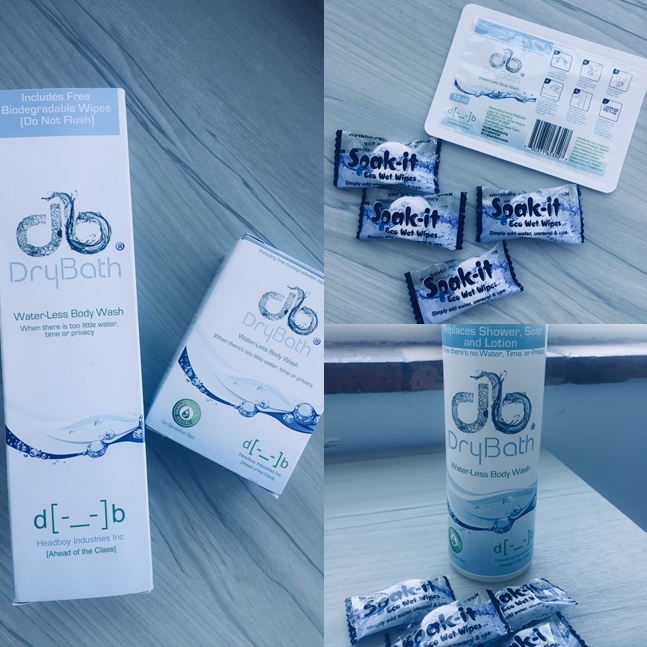
DryBath has a fresh herbal aroma with a hint of tea tree oil that it is not overbearing. This was a good indication for me because, as Health24 explains, tea tree oil is known for being antibacterial, antiviral and antifungal. The gel includes naturally derived Potash Alum (Dode), also known as Tawas, and is an odour-removing rock commonly used in India. There is no alcohol in DryBath.
The gel spreads across a very wide surface area, therefore 15ml could possibly clean an entire adult as DryBath claims. I however would suggest that it is more suitable for a small adult. The gel also moisturises well, and I didn’t feel dry or sticky after using it.
The wipe that accompanies the gel only needs four tablespoons (60ml) of water to open and become sufficiently damp. The non-flushable wipes are 100% cotton and biodegradable, so they can be binned or composted.
The wipe is useful and I used it in conjunction with the gel each time I “washed”, especially to reach those harder to clean bits. (DryBath has also been dermatologically tested for use on sensitive skin, so it can be used on genitals.) I found that any residue dried quickly enough, and once dry my skin felt clean and moisturised.
My waterless cleaning ritual for the two days was a good experience; however there is nothing like a real water shower – but in the light of needing to save water, using DryBath on the odd occasion is not a bad alternative.
Note that DryBath body wash cleaned my body but I used water to wash my hair and face.
The 250ml bottle of DryBath gel is currently retailing for R349,79 and the box of DryBath gel sachets are sold for R321,24.
For more information visit the DryBath website.
Image credits: iStock and Tarryn Temmers

