Nearly half the 655 head teachers quizzed by a charity flagged this as an issue.


Nearly half the 655 head teachers quizzed by a charity flagged this as an issue.
People are waiting 15 days on average to receive treatment after leaving hospital, a survey finds.
[unable to retrieve full-text content]

[unable to retrieve full-text content]

[unable to retrieve full-text content]

Richard Handley had 10kg of faeces removed from his digestive system shortly before he died.
“Rent-a-drip” IV lounges are popping up in big cities across the world, promising speedy recovery for hangover sufferers, jet lag victims and others seeking an intravenous solution to modern dilemmas.
But experts say these lounges are at best a waste of money and at worst potentially dangerous.
Generally unregulated
“The whole thing is really nonsense,” said Dr Stanley Goldfarb, a professor of medicine with the University of Pennsylvania Perelman School of Medicine. “It’s just catering to people’s sense that they’re taking their health into their own hands.”
The IV lounge craze has been spurred on by reports of use by the likes of Rihanna, Cindy Crawford and Simon Cowell. B-list celebrity Lisa Rinna embraced IV treatment on her reality show, “The Real Housewives of Beverly Hills”, with both her and her daughters receiving an intravenous drip in her own living room.
People who go to an IV lounge are offered a variety of different intravenous fluids containing a blend of saline, vitamins and medicines targeted to their needs. For example, a hangover IV bag also typically contains anti-nausea medications.
Treatment costs range from roughly $80 to $875 (±R970 to R10 551). The practice is generally unregulated, raising concern among the medical community that fast-buck operators could hurt people through unsafe practices, Dr Goldfarb said.
What is IV drip treatment?
An earlier article published on Health24 explained the theory behind IV drip treatments.
The IV lounges that are trending today are based on the idea that you need to adapt the formula inside the IV drip to suit the needs of the patient, but when IV drips were first administered for vitamin and nutrient therapy, it was a formula based on the findings of the late Dr John Myers, a physician from Maryland who injected nutrients into his patients to treat various conditions.
According to research published in the Alternative Medicine Review, the exact doses of nutrients in the Myers cocktail was not known, but it has been recorded that a combination of magnesium chloride, calcium, gluconate, thiamine, vitamins B6 and B12, calcium pantothenate, vitamin C and diluted hydrochloric acid was used.
Just a placebo effect?
IV drips are being used as a cure for hangovers andpeople might feel better after receiving the treatment, but it’s probably due to the placebo effect, Dr Goldfarb said.
Timing also might play a part in convincing people the IV treatment has worked, Dr Goldfarb said.
“If you’ve had a hangover, you know after a couple of hours you start to feel better anyway,” Dr Goldfarb said. “By the time they get themselves down to the lounge, sign in, start the IV fluids and complete the process, you’re probably talking three or four hours after they got up.”
As a registered nurse, Wozniak takes a medical history and performs a brief physical on everybody she hooks up to an IV drip. She stays away from hydrating seniors and others who might face risks from receiving intravenous fluids.
But not all centres are run by operators this conscientious, Dr Goldfarb and Dr Glatter said. People going to fly-by-night centres could be exposing themselves to serious illness.
More regulation needed
Dr Glatter would like to see increased regulation of the lounges, to make sure they are properly administering safe blends of intravenous fluids. Possible dangers include:
“The public needs to be aware of this,” Dr Glatter said. “The industry needs to be policed.”
Image credit: iStock

An ambulance service said there were 445 handover delays, but the hospital said there were 36.
Don’t ignore signs of hearing loss as it can have a profound effect on your quality of life at any age. Hearing loss can hamper development in children and cause serious problems at home and in the workplace for adults.
Fortunately hearing tests are non-invasive and fairly simple procedures. We found out what happens during a hearing test.
Regular checkups
According to the Association of Independent Hearing Healthcare Professionals, you should have your hearing tested regularly. They recommend:
When to go for a hearing checkup
People usually assume that hearing loss only affects the elderly but it can affect anyone at any age.
Do you find it hard to follow conversations in noisy environments or constantly ask people to repeat themselves? Does your family complain that the TV or radio is too loud?
If you answered yes to any of those questions, it might be time to book a hearing test.
What happens during a hearing test?
Always discuss any concerns you may have with your audiologist.
1. Initial examination
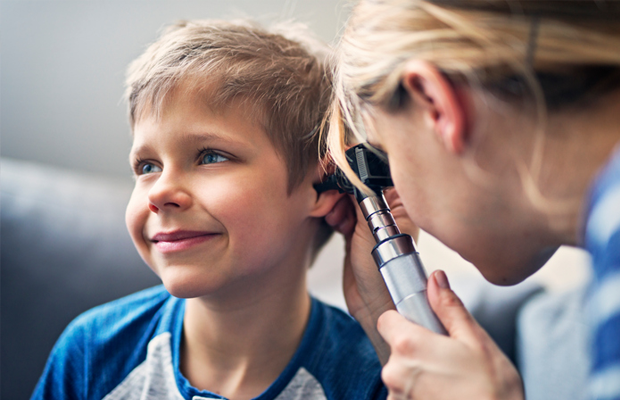
Your ears are examined with an otoscope to check for any visual problems in your ear canal or ear drum. If you need a hearing test, it is performed in a quiet, soundproof room with no background noise.
2. Pure tone test
This checks your ability to hear different pure tones, which indicates the degree of hearing loss. You’ll wear headphones and hold a button in your hand – and when you hear a tone, you press the button. Each ear is tested individually and afterwards the results are illustrated as an audiogram, which shows the softest sounds you can hear at different frequencies.

3. Bone conduction test
Sometimes you’ll have a bone conduction test to measure your ability to hear pure tones using a small bone conductor that is placed behind your ear. It checks for any problems in the middle ear cavity.
4. Speech test
This test checks to see whether there are problems with your auditory nerve, which sends signals from your ear to brain, helping translate the sounds you hear into words you can understand as speech.
5. Tympanometry
This test checks the condition of your middle ear and mobility of the eardrum.
6. Set aside some time
A hearing test can take between 60 and 90 minutes.

Image credits: iStock


There has been an increase in cases of diarrhoea among children under the age of five in Cape Town, a city health official said amid fears that good hygiene might be taking a back seat to water saving efforts to avoid Day Zero.
“On 28 January 2018, these were the statistics for the diarrhoea surge season in children under five: 9 019 cases recorded compared to 8 287 last year and 10 614 the year before,” said Doctor Virginia De Azevedo, a manager in the city’s department of public health on Tuesday in response to a request for information.
The city regards the period between November and May as “surge season” for diarrhoea and pneumonia due to the prevalence of certain contagious diseases when temperatures rise.
At the #DayZero media briefing on Monday JP Smith, member of the mayoral committee for safety and security, said the city did not want to lose the gains it had made in protecting children under five from diarrhoea.
On Monday the city’s health officials urged residents and visitors to treat water as precious but to keep washing their hands regularly and bathing themselves with clean drinking water, even though there is a restriction of 50l per person per day in force.
People are currently being encouraged to save as much drinking water as possible, and to reuse the “grey” water collected from washing and bathing where possible to bring the city’s overall water consumption down to 450 million litres a day, from 547 million litres.
Use of clean water encouraged
The city is also reducing water pressure in some areas. There may be disruptions to water supply during the installation of the equipment needed to do this.
Taps at many public and private facilities such as schools and shopping centres have been switched off, with only hand sanitiser available, or one tap with a thin stream of water.
However, the health department stressed that in spite of the water shortage, it is important to use clean drinking water supplied by the city to wash hands, bathe, cook, clean surfaces and for food preparation.
Grey water that has been saved from other household activities such as laundry, cleaning and washing dishes should never be reused for hand washing, bathing, food preparation, cooking and surface cleaning.
Grey water for flushing toilets should not be kept for longer than 24 hours because of the risk of bacteria and contaminants.
Food should not be kept in the open for long periods, and if there is no fridge available for storage, only cook what you need for one meal.
Listeriosis, typhoid
The city said on Tuesday that the number of cases per month of listeriosis had also increased from 11 in December 2017 to 12 in January 2018. The total for 2017 for the city was 38 cases.
For February only one case of listeriosis has been reported so far. Listeria bacteria can be found in soil, water and vegetation in nature, and the disease is treatable. The national Department of Health raised the alarm last year when it said the “usual” average of between 60 to 80 cases nationally had increased to 557 for 2017 (until 9 November).
Most of those cases, 345, were in Gauteng and 71 in the Western Cape.
In 2016 there were 32 cases of typhoid in the city, which dropped to 26 in 2017. In January there were three cases compared with one in January 2017, and six in January 2016. Figures for cholera and pneumonia were not yet available.
Officials warned that water from boreholes and springs and rainwater is also not suitable for drinking, cooking or bathing.
The city’s health department works with the Western Cape health department and has to notify the National Institute of Communicable Diseases of water- and food-borne diseases such as listeria, cholera and food poisoning involving more than four people at once.